




~1 min
Average Reply Time
~1 hour
To Be Matched With A Tutor
30 Min Trial
75% Find Their Tutor On The 1st Trial
$20-35+/hr
Premium Yet Affordable Learning
Your Express routes are broken, your Angular components won’t bind, and your Node server crashes on every POST request. Six weeks to your project deadline.
MEAN Stack Tutor Online
MEAN Stack is a JavaScript-based full-stack development framework combining MongoDB, Express.js, Angular, and Node.js. It equips developers to build end-to-end web applications using a single programming language across database, server, and client layers.
Finding a MEAN Stack tutor near me used to mean settling for a generalist who knew JavaScript but had never debugged a real Express middleware chain. MEB offers 1:1 online MEAN Stack tutoring and project help across 2,800+ advanced subjects — matched to your exact stack version, your course syllabus, or your personal project. If you need a working application by a deadline, that’s where the sessions start. As part of MEB’s broader software engineering tutoring coverage, MEAN Stack is one of the most requested full-stack tracks.
- 1:1 online sessions tailored to your course or project requirements
- Expert-verified tutors with real full-stack development backgrounds
- Flexible time zones — US, UK, Canada, Australia, Gulf
- Structured learning plan built after a diagnostic session
- Guided project support — we explain the architecture, you write the code
52,000+ students across the US, UK, Canada, Australia, and the Gulf have used MEB since 2008 — including students in Software Engineering subjects like MEAN Stack, MERN Stack tutoring, and full-stack development help.
Source: My Engineering Buddy, 2008–2025.
How Much Does a MEAN Stack Tutor Cost?
Most MEAN Stack tutoring sessions run $20–$40/hr. Graduate-level or project-intensive work with specialist tutors goes up to $100/hr. Not sure if it’s worth it? Start with the $1 trial — 30 minutes of live tutoring, no registration needed.
| Level / Need | Typical Rate | What’s Included |
|---|---|---|
| Standard (most levels) | $20–$35/hr | 1:1 sessions, project guidance |
| Advanced / Specialist | $35–$70/hr | Expert tutor, architecture depth |
| $1 Trial | $1 flat | 30 min live session or 1 project question |
Tutor availability tightens around end-of-semester project deadlines — particularly in May and December. Book early if you have a fixed submission date.
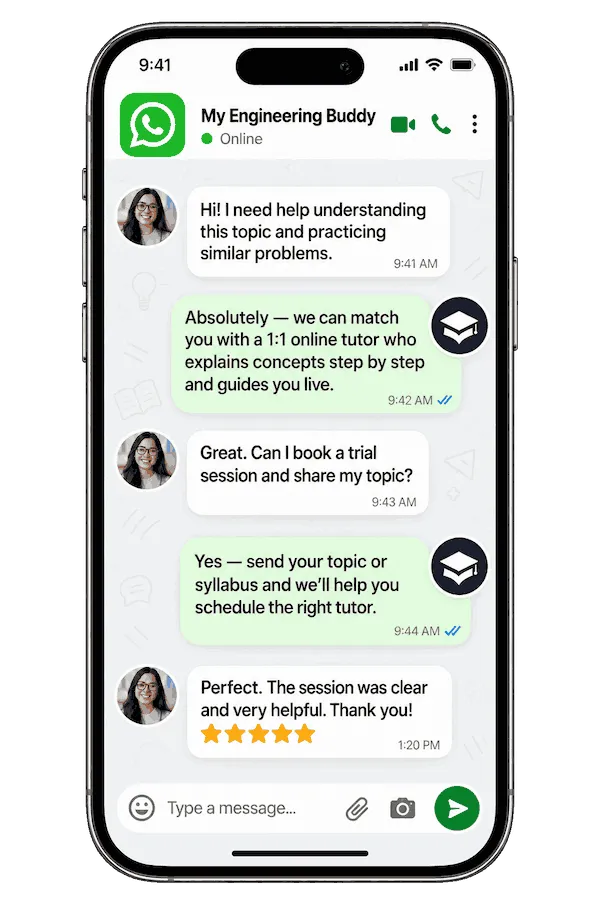
WhatsApp MEB for a quick quote — average response time under 1 minute.
Who This MEAN Stack Tutoring Is For
Most students who come to MEB for MEAN Stack help are not beginners who’ve never opened a terminal. They know some JavaScript. The problem is usually that the pieces don’t connect — the Angular front end doesn’t talk to the Express API, or MongoDB schema design falls apart at scale.
- Undergraduate and graduate students with a full-stack web development project or coursework due
- Students who passed the theory module but are stuck the moment they open VS Code
- Students with a submission deadline 2–4 weeks away and significant gaps still to close
- Developers moving from a single-layer background (just front end, just databases) into full-stack roles
- Students whose course uses a specific Angular or Node version the tutor must match exactly
- Parents supporting a computer science student whose project confidence has dropped alongside their marks
MEB has supported students at institutions including MIT, Stanford, Georgia Tech, University of Toronto, Imperial College London, TU Delft, and the University of Melbourne — as well as bootcamp graduates entering the job market.
1:1 Tutoring vs Self-Study vs AI vs YouTube vs Online Courses
Self-study works if you can debug your own thinking — most people can’t. AI tools like ChatGPT generate plausible-looking code that silently breaks under real conditions. YouTube covers setup and basic CRUD; it stops when your JWT middleware fails at 2 a.m. Online courses are structured but fixed-pace, with no one to ask why your aggregation pipeline returns an empty array. 1:1 MEAN Stack tutoring with MEB is live, calibrated to your exact project or syllabus, and corrects errors at the moment they happen — not after you’ve spent three hours in the wrong direction.
Outcomes: What You’ll Be Able To Do in MEAN Stack
After working through sessions with an MEB tutor, you’ll be able to build and deploy a functioning MEAN Stack application from scratch — not just follow a tutorial. Specifically: design a MongoDB schema that handles real query loads without requiring full collection scans; write Express.js RESTful APIs with proper middleware chains and error handling; structure Angular components, services, and routing so the application scales beyond a single view; connect the Node.js backend to MongoDB using Mongoose with validation and indexing; and explain your architectural decisions clearly in a viva or project report.
Based on feedback from 40,000+ sessions collected by MEB from 2022 to 2025, 58% of students improved by one full grade after approximately 20 hours of 1:1 tutoring in subjects like MEAN Stack. A further 23% achieved at least a half-grade improvement.
Source: MEB session feedback data, 2022–2025.

Try your first session for $1 — 30 minutes of live 1:1 tutoring or one project question explained in full. No registration. No commitment. WhatsApp MEB now and get matched within the hour.
What We Cover in MEAN Stack (Syllabus / Topics)
MongoDB & Database Layer
- Document model design: collections, documents, embedded vs referenced schemas
- Mongoose ODM: schema definition, validation, pre/post hooks
- Indexing strategies and query optimisation for large datasets
- Aggregation pipelines: $match, $group, $lookup, $project
- Atlas setup, cloud deployment, and connection string configuration
- Data seeding, migrations, and handling schema changes in production
Key references: MongoDB: The Definitive Guide (Chodorow), Mongoose documentation (official), Designing Data-Intensive Applications (Kleppmann — relevant chapters).
Express.js & Node.js Backend
- Express routing: route handlers, route parameters, query strings
- Middleware: built-in, third-party (Morgan, Helmet, CORS), custom error handlers
- RESTful API design: HTTP methods, status codes, response shaping
- JWT authentication and session management
- Node.js event loop, asynchronous patterns (callbacks, Promises, async/await)
- Environment variables, dotenv, and configuration management
- Connecting to MongoDB via Mongoose from a Node.js server
Key references: Node.js Design Patterns (Casciaro & Mammino), Express in Action (Hahn), Stanford University Computer Science open materials on web services.
Angular Front End
- Component architecture: modules, components, templates, data binding
- Services and dependency injection
- Routing and navigation: RouterModule, lazy loading, route guards
- HTTP client: consuming Express REST APIs, handling observables with RxJS
- Forms: template-driven vs reactive forms, validation
- State management basics and structuring a scalable Angular application
- Build and deployment: Angular CLI, environment configs, production builds
Key references: Angular — The Complete Guide (Schwarzmüller), ng-book: The Complete Guide to Angular (Murray et al.), Express.js project help for cross-layer integration work.
Platforms, Tools & Textbooks We Support
MEAN Stack development runs across a specific set of tools, and your tutor will already know them. MEB tutors work across VS Code, WebStorm, Postman for API testing, MongoDB Compass and Atlas, GitHub and GitLab for version control, and Node Version Manager (nvm) for environment management. Sessions run on Google Meet with a digital pen-pad for architecture diagrams and schema sketches.
- VS Code (with relevant extensions: ESLint, Prettier, Angular Language Service)
- Postman — API testing and endpoint documentation
- MongoDB Compass and MongoDB Atlas
- Git and GitHub / GitLab for version control
- Node Version Manager (nvm) and npm
- Angular CLI
- Docker for local environment containerisation (where applicable)
What a Typical MEAN Stack Session Looks Like
The tutor opens by checking the previous topic — usually wherever the student’s Express route or Angular service broke down. From there, both tutor and student work live on the same shared screen: the tutor might sketch the request-response lifecycle on a digital pen-pad while the student traces it through their own codebase. Then it’s hands-on — the student writes the Mongoose schema or the Angular HTTP call while the tutor watches and corrects in real time. Common focal points include JWT middleware not passing correctly, RxJS observable subscriptions left open, and MongoDB aggregation stages producing unexpected output. The session closes with one concrete task — fix a specific route, refactor a component, or add one validation rule — plus the topic for next time.
How MEB Tutors Help You with MEAN Stack (The Learning Loop)
Diagnose: In the first session, the tutor identifies exactly where things are breaking down — is it the database layer, the API design, the Angular data flow, or something more fundamental like asynchronous JavaScript? This shapes every session that follows.
Explain: The tutor works through the problem live, using a digital pen-pad to show how an Express middleware chain executes or how Angular’s change detection cycle fires. You see the thinking, not just the answer.
Practice: You build it. The tutor watches as you write the route handler or wire up the service, stepping in only when the logic goes off track — not before.
At MEB, we’ve found that students who write the code themselves during the session — even slowly, even with corrections — retain the pattern far better than those who copy a solution and review it later. The discomfort of building it live is the point.
Feedback: Every error gets a reason — not just “this is wrong” but why it fails, what the runtime is actually doing, and what the fix tells you about how Node or Angular works internally.
Plan: The session ends with a specific next step and a topic for next time. Progress is tracked so the diagnostic from session one has a measurable answer by session five.
Sessions run on Google Meet. The tutor uses a digital pen-pad or iPad with Apple Pencil for architecture diagrams and data-flow sketches. Before your first session, share your course outline or project brief, the specific component or endpoint that’s failing, and your submission deadline. The first session is your diagnostic — every minute after that is targeted.
Start with the $1 trial — 30 minutes of live tutoring that also serves as your first diagnostic.
Students consistently tell us that the biggest shift isn’t learning a new tool — it’s finally understanding how the four layers of MEAN Stack actually talk to each other. Once that clicks, the project stops feeling like four separate problems.
Source: My Engineering Buddy, compiled from session feedback, 2022–2025.
Tutor Match Criteria (How We Pick Your Tutor)
Not every JavaScript developer is a MEAN Stack specialist. MEB matches on four criteria:
Subject depth: The tutor has hands-on experience with all four layers — MongoDB schema design, Express API structure, Angular architecture, Node.js async patterns — not just one or two.
Tools: Every tutor uses Google Meet with a digital pen-pad or iPad and Apple Pencil. Architecture diagrams happen in real time, not on a whiteboard you can’t see.
Time zone: Matched to your region — US, UK, Gulf, Canada, or Australia. No scheduling across a 12-hour gap.
Goals: Whether you need a project debugged, conceptual gaps closed, or ongoing weekly support through a full-stack module, the match reflects your specific objective.
Unlike platforms where you fill out a form and wait, MEB responds in under a minute, 24/7. Tutor match takes under an hour. The $1 trial means you test the fit before you commit. Everything runs over WhatsApp — no logins, no intake forms.
Students consistently tell us that the first thing they notice is how quickly the tutor locates the real problem. It’s rarely where the student thinks it is. That redirect — from symptom to cause — is usually what changes the project trajectory.
Pricing Guide
MEAN Stack tutoring starts at $20/hr for standard undergraduate coursework. Advanced project work, graduate-level system design, or sessions targeting deployment and DevOps integration run $35–$70/hr. Highly specialised work — production-grade architecture, performance optimisation at scale — is available up to $100/hr.
Rate factors: Angular version complexity, MongoDB query depth, Node.js concurrency requirements, timeline urgency, and tutor seniority.
Availability tightens significantly around semester-end project deadlines in May and December. If you have a fixed submission date, book sooner rather than later.
For students targeting roles at competitive tech companies or building portfolio projects for graduate admissions, tutors with professional full-stack development backgrounds are available at higher rates — share your specific goal and MEB will match the tier to your ambition.
Start with the $1 trial — 30 minutes, no registration, no commitment. WhatsApp MEB for a quick quote.
FAQ
Is MEAN Stack hard to learn?
It’s not one technology — it’s four, all interacting. Most students find MongoDB and Node manageable individually. The difficulty is wiring them together: getting Angular to consume an Express API that queries MongoDB through a Node server, without breaking any layer. A tutor reduces that friction significantly.
How many sessions will I need?
Students closing a specific project gap typically need 4–8 sessions. Those working through a full-stack module from start to finish usually need 12–20 sessions across a semester. The diagnostic after your first session will give you a clearer number for your specific situation.
Can you help with projects and portfolio work?
Yes. MEB tutoring is guided learning — the tutor explains the architecture, debugging approach, and code logic; you write and submit the work yourself. This applies to coursework projects, portfolio builds, and capstone assignments. See our Academic Integrity policy and Why MEB page for full details on what we help with and what we don’t.
Will the tutor match my exact syllabus or exam board?
Yes. Share your course outline, Angular version, and any specific framework constraints before the first session. The tutor matches to your exact requirements — not a generic MEAN Stack curriculum. This matters particularly when your course specifies Angular 15+ vs older versions.
What happens in the first session?
The tutor runs a diagnostic — reviews your current code or course outline, identifies where gaps are, and maps a session plan. Bring your project brief or the specific endpoint or component that’s failing. The first 30 minutes establish everything that follows.
Is online tutoring as effective as in-person for MEAN Stack?
For code-based subjects, online is often more effective. Both tutor and student see the same screen, the tutor can annotate architecture diagrams live, and sessions are recorded for review. There’s no whiteboard you can’t read from across a room.
Can I get MEAN Stack help at midnight?
Yes. MEB operates 24/7 across time zones. WhatsApp the team at any hour and you’ll get a response within minutes. Tutors cover US, UK, Gulf, Australian, and European time zones — so midnight for you is business hours for someone on the roster.
What if I don’t like my assigned tutor?
Tell us over WhatsApp and we rematch you. No forms, no delay. Most rematch requests are resolved within the same day. The $1 trial exists precisely so you can test the fit before committing to a longer session block.
Should I learn MEAN Stack or MERN Stack — and can MEB help me decide?
MEAN uses Angular; MERN uses React. Both use MongoDB, Express, and Node. Angular suits structured enterprise applications with TypeScript; React suits flexible, component-driven UIs. Your tutor can walk through the trade-offs against your specific project or career goal in the first session.
How do I structure a MEAN Stack project for a university submission?
MEB tutors help with project folder structure, separation of concerns (routes, controllers, models, services), and documentation. The tutor won’t write your report, but will explain the architecture decisions you’ll need to justify in a viva or written submission. This is one of the most common requests on this subject.
My Node server keeps crashing — can a tutor diagnose it remotely?
Yes. Share your error logs and codebase before the session. Tutors diagnose common failures — unhandled Promise rejections, port conflicts, Mongoose connection drops, and middleware ordering errors — live on screen. Most crash patterns in a standard MEAN Stack setup are identifiable within the first 15 minutes.
How do I get started?
Three steps: WhatsApp MEB with your subject and deadline, get matched to a tutor within the hour, then start the $1 trial — 30 minutes of live tutoring or one project question explained in full. No registration required, no commitment beyond the first dollar.
Trust & Quality at My Engineering Buddy
Every MEB tutor goes through subject-specific screening — not just a general coding test. For MEAN Stack, that means a live demo session covering MongoDB aggregation, Express middleware design, Angular component architecture, and Node.js async patterns. Tutors are assessed on explanation quality, not just whether they get the right answer. Rated 4.8/5 across 40,000+ verified reviews on Google, MEB has been running since 2008 — long enough that most of the tutors have seen every failure pattern your project is likely to hit.
MEB tutoring is guided learning — you understand the work, then submit it yourself. For full details on what we help with and what we don’t, read our Academic Integrity policy and Why MEB.
MEB serves students across the US, UK, Canada, Australia, Gulf, and Europe in 2,800+ subjects. Within Software Engineering, MEAN Stack is one of the most-requested tracks — alongside students seeking Node.js tutoring, MongoDB tutoring, and back-end development help. The platform has been matching students with verified subject specialists since 2008.
A common pattern our tutors observe is that students who’ve been Googling their errors for hours arrive with five different partial fixes applied on top of each other. The tutor’s first job is often to strip that back to a clean state — then build the right solution once.
Our experience across thousands of sessions shows that MEAN Stack students learn fastest when the tutor explains the full data flow — from MongoDB document to Express response to Angular template — in a single worked example before touching the student’s own project code.
Source: My Engineering Buddy, compiled from tutor session notes, 2022–2025.
Explore Related Subjects
Students studying MEAN Stack often also need support in:
Next Steps
Before your first session, have ready: your course outline or project brief, the specific route, component, or error you’re stuck on, and your submission or exam deadline. The tutor handles the rest.
- Share your stack version, hardest component, and current timeline over WhatsApp
- Share your availability and time zone
- MEB matches you with a verified MEAN Stack tutor — usually within the hour
The first session starts with a diagnostic so every minute after it is used well. Visit www.myengineeringbuddy.com for more on how MEB works.
WhatsApp to get started or email [email protected].
Reviewed by Subject Expert
This page has been carefully reviewed and validated by our subject expert to ensure accuracy and relevance.




