Hire Verified & Experienced
Mechanical Measurements (Metrology) Tutors
4.8/5 40K+ session ratings collected on the MEB platform



Hire The Best Mechanical Measurements (Metrology) Tutor
Top Tutors, Top Grades. Without The Stress!
52,000+ Happy Students From Various Universities





How Much For Private 1:1 Tutoring & Hw Help?
Private 1:1 Tutoring and HW help Cost $20 – 35 per hour* on average.
Calibration errors costing you marks? Most students lose points in Metrology not from guessing — but from misreading measurement chains and error propagation.
Mechanical Measurements (Metrology) Tutor Online
Mechanical Measurements (Metrology) is the engineering science of measurement — covering instruments, calibration, error analysis, tolerances, and surface metrology — equipping students to specify, verify, and control dimensional and physical quantities in mechanical systems.
If you’re searching for a Mechanical Measurements (Metrology) tutor near me, MEB connects you with a verified specialist, live online, for 1:1 sessions matched exactly to your course. We cover undergraduate and graduate Mechanical Engineering programmes across the US, UK, Canada, Australia, and the Gulf. Tutors work through your actual syllabus — not a generic overview — and every session is built around where you’re stuck right now. One session in the right area can shift weeks of confusion.
- 1:1 online sessions tailored to your exact course and syllabus
- Expert-verified tutors with subject-specific Metrology knowledge
- Flexible time zones — US, UK, Canada, Australia, Gulf
- Structured learning plan built after a diagnostic session
- Ethical homework and assignment guidance — you understand the work before you submit
52,000+ students across the US, UK, Canada, Australia, and the Gulf have used MEB since 2008 — including students in Mechanical Engineering subjects like Mechanical Measurements (Metrology), Mechanics of Materials tutoring, and Manufacturing Processes help.
Source: My Engineering Buddy, 2008–2025.
How Much Does a Mechanical Measurements (Metrology) Tutor Cost?
Most Mechanical Measurements (Metrology) tutoring sessions run $20–$40/hr. Advanced graduate-level or highly specialist metrology content can reach up to $100/hr. The $1 trial gives you 30 minutes of live 1:1 tutoring or one full homework question explained — no registration required.
| Level / Need | Typical Rate | What’s Included |
|---|---|---|
| Standard (most undergrad levels) | $20–$35/hr | 1:1 sessions, homework guidance |
| Advanced / Graduate Specialist | $35–$100/hr | Expert tutor, niche metrology depth |
| $1 Trial | $1 flat | 30 min live session or 1 homework question |
Tutor availability tightens significantly during end-of-semester exam periods and submission weeks. Book early if your deadline is within six weeks.
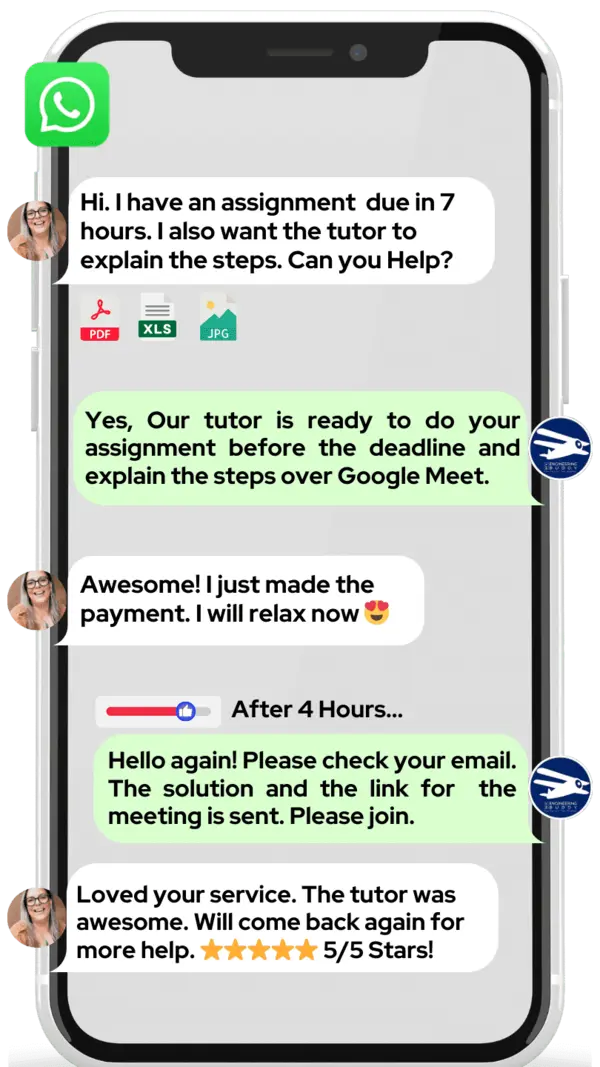
WhatsApp MEB for a quick quote — average response time under 1 minute.
Who This Mechanical Measurements (Metrology) Tutoring Is For
This is for engineering students who can follow a lecture but then open a problem set and go blank. That gap — between hearing something explained and actually solving it — is exactly what 1:1 tutoring closes.
- Undergraduate Mechanical Engineering students covering dimensional metrology, GD&T, and calibration
- Graduate students working with surface roughness analysis, CMM operation, or uncertainty budgets
- Students retaking after a failed first attempt in a measurements or instrumentation course
- Students with a university conditional offer depending on this grade
- Parents watching a student’s confidence drop alongside their quiz scores
- Students at universities including MIT, Georgia Tech, University of Michigan, TU Delft, Imperial College London, RMIT, and the University of Toronto
Start with the $1 trial to find out exactly where your understanding breaks down.
1:1 Tutoring vs Self-Study vs AI vs YouTube vs Online Courses
Self-study works if you’re disciplined, but there’s no one to catch a systematic error in your uncertainty calculations. AI tools give fast definitions — they can’t watch you set up a measurement chain and tell you where your reasoning went wrong. YouTube is good for seeing a vernier caliper read — useless when you’re stuck on a combined error propagation problem. Online courses move at a fixed pace regardless of whether you’ve understood tolerance stack-ups. 1:1 tutoring with MEB is live, calibrated to your exact module, and corrects your errors in the moment — which matters enormously in a subject where one wrong assumption compounds through every subsequent calculation.
Outcomes: What You’ll Be Able To Do in Mechanical Measurements (Metrology)
After focused sessions with an online Mechanical Measurements (Metrology) tutor, you’ll be able to apply systematic error analysis to real instrument readings, solve tolerance stack-up problems using worst-case and statistical methods, analyse surface roughness parameters like Ra and Rz from profilometer data, explain calibration procedures and traceability chains for micrometers and CMMs, and present uncertainty budgets that meet ISO/GUM reporting standards. These are the specific skills examiners test — and employers expect.
Based on feedback from 40,000+ sessions collected by MEB from 2022 to 2025, 58% of students improved by one full grade after approximately 20 hours of 1:1 tutoring in subjects like Mechanical Measurements (Metrology). A further 23% achieved at least a half-grade improvement.
Source: MEB session feedback data, 2022–2025.

What We Cover in Mechanical Measurements (Metrology) (Syllabus / Topics)
Track 1: Measurement Fundamentals and Error Analysis
- Standards of measurement — SI units, traceability, and calibration hierarchies
- Types of errors: systematic, random, and gross errors
- Error propagation and combined uncertainty calculations
- GUM (Guide to the Expression of Uncertainty in Measurement) framework
- Least-count, precision, accuracy, and resolution distinctions
- Statistical methods: mean, standard deviation, and confidence intervals in measurement
- Repeatability and reproducibility (R&R) studies
Core texts for this track include Beckwith, Marangoni & Lienhard’s Mechanical Measurements and Figliola & Beasley’s Theory and Design for Mechanical Measurements.
Track 2: Dimensional Metrology and Instruments
- Linear measurement: vernier calipers, micrometers, height gauges, slip gauges
- Angular measurement: sine bars, autocollimators, clinometers
- Coordinate Measuring Machines (CMM) — operation, probing strategy, and data output
- Geometric Dimensioning and Tolerancing (GD&T) — ASME Y14.5 and ISO standards
- Form measurement: flatness, roundness (circularity), cylindricity
- Surface texture: Ra, Rz, Rq parameters and profilometer use
- Optical methods: interferometry, laser trackers, vision systems
Standard references: Groover’s Fundamentals of Modern Manufacturing and Whitehouse’s Handbook of Surface and Nanometrology.
Track 3: Engineering Instrumentation and Signal Analysis
- Transducers and sensors: strain gauges, LVDTs, thermocouples, pressure transducers
- Signal conditioning: amplification, filtering, and analog-to-digital conversion
- Wheatstone bridge circuits and their role in load and stress measurement
- Data acquisition systems (DAQ): sampling rate, aliasing, and Nyquist criterion
- Dynamic measurements: frequency response, rise time, and damping effects
- Temperature and pressure measurement systems
Key references: Doebelin’s Measurement Systems: Application and Design and Bentley’s Principles of Measurement Systems.
At MEB, we’ve found that most students lose marks in Metrology not because they don’t understand the instruments — but because they can’t correctly identify which error type applies to a given scenario. One session focused on this distinction usually unlocks the rest of the topic.
What a Typical Mechanical Measurements (Metrology) Session Looks Like
The tutor opens by checking your last topic — say, uncertainty propagation for a multi-instrument measurement chain. If that wasn’t resolved cleanly, it gets finished first. Then you move into the day’s focus: working through surface roughness analysis or a CMM inspection problem on a shared screen. The tutor uses a digital pen-pad to annotate diagrams and write out error budgets step by step. You replicate the process or explain your reasoning back, which surfaces exactly where your logic slips. The session closes with a specific practice task — three uncertainty budget problems at increasing complexity — and the next topic is noted. Nothing is left vague.
How MEB Tutors Help You with Mechanical Measurements (Metrology) (The Learning Loop)
Diagnose: In the first session, the tutor identifies whether your gaps are in fundamentals (error types, SI traceability) or applied skills (GD&T interpretation, CMM data analysis). This shapes every session that follows.
Explain: The tutor works through problems live — tolerance stack-ups, signal conditioning circuits, surface parameter calculations — using a digital pen-pad so you see every step as it happens, not after the fact.
Practice: You attempt problems with the tutor present. Not after the session. Not as homework you check alone. Right there, where errors get caught before they become habits.
Feedback: The tutor identifies exactly where your answer went wrong — whether it’s a sign error in combined uncertainty, a misread GD&T symbol, or an incorrect Nyquist application — and explains why that step costs marks.
Plan: After each session, the tutor maps the next topic in sequence and flags any prerequisite gaps to revisit. Progress is tracked, not assumed.
Sessions run over Google Meet with a digital pen-pad or iPad and Apple Pencil. Before your first session, have your course outline, a recent homework or past paper attempt, and your exam date ready. The first session functions as a diagnostic and a teaching session simultaneously. Start with the $1 trial — 30 minutes of live tutoring that also serves as your first diagnostic.
Students consistently tell us that Metrology finally clicked when they stopped memorising formulas and started working through real instrument problems with someone who could stop them mid-calculation. That real-time correction is what changes the outcome.
Tutor Match Criteria (How We Pick Your Tutor)
Every Mechanical Measurements (Metrology) tutor on MEB is matched to you on four criteria.
Subject depth: The tutor holds a relevant engineering degree and has demonstrable experience with your specific syllabus — whether that’s GD&T under ASME Y14.5, GUM-based uncertainty analysis, or CMM-based inspection workflows for manufacturing process quality control.
Tools: All tutors use Google Meet with a digital pen-pad or iPad and Apple Pencil — no whiteboard screenshots, no static PDFs.
Time zone: Matched to your region — US, UK, Gulf, Canada, Australia — so sessions happen when you’re actually alert.
Goals: Whether you need to pass an end-of-semester exam, complete a lab report, or build depth for a graduate research project, the tutor is briefed on your specific target before session one.
Unlike platforms where you fill out a form and wait, MEB responds in under a minute, 24/7. Tutor match takes under an hour. The $1 trial means you test before you commit. Everything runs over WhatsApp — no logins, no intake forms.
Study Plans (Pick One That Matches Your Goal)
After the diagnostic, your tutor builds a specific session sequence. The three most common plans: a one-to-three week catch-up for students behind on error analysis or dimensional metrology before a test; a four-to-eight week exam prep block covering all syllabus tracks with past-paper practice built in; or ongoing weekly support aligned to your semester schedule and lab submission deadlines. The tutor maps the exact sequence — you don’t have to decide what to cover next.
Pricing Guide
Mechanical Measurements (Metrology) tutoring starts at $20/hr for standard undergraduate content. Graduate-level uncertainty analysis, advanced CMM programming, or specialist surface metrology can reach $100/hr depending on tutor depth and timeline. Rate factors include your level, topic complexity, how quickly you need support, and tutor availability.
For students targeting positions at precision engineering firms, aerospace manufacturers, or graduate research programmes at institutions like Georgia Tech, TU Delft, or Imperial College London, tutors with professional metrologist or quality engineering backgrounds are available at higher rates — share your specific goal and MEB will match the tier to your need.
Availability tightens sharply in the four weeks before final exams. Start with the $1 trial — 30 minutes, no registration, no commitment. WhatsApp MEB for a quick quote.
FAQ
Is Mechanical Measurements (Metrology) hard?
It’s not conceptually abstract, but it demands precision in reasoning. Students struggle most with error propagation and GD&T interpretation — not because the ideas are complex, but because small misunderstandings compound across every calculation. Targeted 1:1 sessions fix this quickly.
How many sessions are needed?
Most students see a clear improvement in two to four sessions on a specific weak area. A full syllabus revision for end-of-semester exams typically takes eight to twelve sessions, depending on starting level and how many tracks need coverage.
Can you help with homework and assignments?
MEB tutoring is guided learning — you understand the work, then submit it yourself. The tutor walks through the method and logic; you apply it. See our Academic Integrity policy and Why MEB page for full details on what we help with and what we don’t.
Will the tutor match my exact syllabus or exam board?
Yes. Before session one, you share your course outline or module descriptor. The tutor is briefed on your specific content — whether that’s Figliola and Beasley’s framework, a CMM-heavy industrial metrology unit, or a GUM-compliant uncertainty analysis module.
What happens in the first session?
The tutor runs a short diagnostic — identifying your strongest and weakest areas across measurement fundamentals, dimensional instruments, and signal analysis. Then the session moves directly into teaching on the highest-priority gap. No time is wasted.
Is online tutoring as effective as in-person?
For Metrology, yes. The digital pen-pad replicates whiteboard working exactly. Students share screens to show instrument diagrams or lab data. The real-time feedback loop is identical to in-person — and you can record sessions for review, which in-person rarely allows.
Can I get Mechanical Measurements (Metrology) help at midnight?
MEB operates 24/7. WhatsApp MEB at any hour — response time averages under a minute. Tutors across multiple time zones means a session can often be arranged within a few hours, even late at night before a deadline.
What if I don’t understand GD&T symbols and my exam is in two weeks?
Two weeks is workable. GD&T under ASME Y14.5 has a learnable core — flatness, circularity, true position, and datum references — that covers most exam questions. A focused three-to-four session block on interpretation and application typically closes this gap.
Do you cover uncertainty budgets and GUM compliance?
Yes. Tutors work through GUM-based uncertainty analysis step by step — Type A and Type B evaluation, combined standard uncertainty, expanded uncertainty, and coverage factors. This is one of the most frequently tested and most frequently misunderstood areas in the subject.
What’s the difference between accuracy, precision, and resolution in measurements?
These three terms are routinely confused and frequently tested. Accuracy describes how close a reading is to the true value; precision describes repeatability; resolution is the smallest detectable change an instrument can register. A tutor can demonstrate the distinctions with real instrument examples in a single session.
How do I get started?
WhatsApp MEB, share your syllabus and exam date, and you’ll be matched with a verified Metrology tutor — usually within an hour. The first session is the $1 trial: 30 minutes live or one question explained in full. Three steps: WhatsApp, match, start.
Can MEB help with CMM programming and inspection reports?
Yes. Tutors experienced with CMM workflows — probing strategy, datum alignment, GD&T callout interpretation, and inspection report generation — are available. Share the specific machine or software context when you WhatsApp and MEB will match accordingly.
Trust & Quality at My Engineering Buddy
Every MEB tutor goes through subject-specific screening — a live demo evaluation, a review of their academic and professional background, and ongoing session feedback assessment. Tutors covering Mechanical Measurements (Metrology) hold engineering degrees with hands-on metrology or quality engineering experience. Rated 4.8/5 across 40,000+ verified reviews on Google.
MEB tutoring is guided learning — you understand the work, then submit it yourself. For full details on what we help with and what we don’t, read our Academic Integrity policy and Why MEB.
MEB has served 52,000+ students since 2008 across 2,800+ subjects in the US, UK, Canada, Australia, the Gulf, and Europe. Within Mechanical Engineering, we cover Mechanical Measurements (Metrology) alongside subjects including Mechanical Vibrations tutoring, Engineering Thermodynamics help, and Finite Element Analysis (FEA) tutoring. See our tutoring methodology for how sessions are structured.
Our experience across thousands of sessions shows that Metrology students who struggle in exams almost always share the same root issue — they were never shown how to set up a measurement uncertainty budget from scratch. That’s where our tutors start.
Explore Related Subjects
Students studying Mechanical Measurements (Metrology) often also need support in:
- Engineering Mechanics
- Solid Mechanics
- Fluid Mechanics
- Heat Transfer
- Dynamics of Machine
- Design of Machine Elements
- Engineering Statics
- Thermodynamics
Next Steps
When you WhatsApp MEB, share your exam board or course name, the topic or component you’re most behind on, and your exam or submission date. Add your time zone and availability. MEB matches you with a verified Metrology tutor — usually within 24 hours.
Before your first session, have ready:
- Your syllabus or course outline (or the module descriptor from your university)
- A recent homework problem or past paper question you couldn’t finish
- Your exam date or deadline
The tutor handles the rest. First session starts with a diagnostic so every minute is used on what actually matters.
Visit www.myengineeringbuddy.com for more on how MEB works.
Try your first session for $1 — 30 minutes of live 1:1 tutoring or one homework question explained in full. No registration. No commitment. WhatsApp MEB now and get matched within the hour.
WhatsApp to get started or email meb@myengineeringbuddy.com.
Reviewed by Subject Expert
This page has been carefully reviewed and validated by our subject expert to ensure accuracy and relevance.