~1 min
Average Reply Time
~1 hour
To Be Matched With A Tutor
30 Min Trial
75% Find Their Tutor On The 1st Trial
$20-35+/hr
Premium Yet Affordable Learning
Your Nagios checks are returning CRITICAL errors and you have no idea why. Most students hit this wall in week two.
Nagios Tutor Online
Nagios is an open-source IT infrastructure monitoring platform used to track hosts, services, and network components. It alerts administrators to failures in real time, enabling proactive fault detection across servers, applications, and network devices.
Finding a Nagios tutor near me who actually knows the stack — NRPE, check plugins, notification escalations — is harder than it sounds. MEB connects you with verified infrastructure and IT tutors who have configured Nagios in real environments, not just read the docs. Part of MEB’s broader software engineering tutoring network covering 2,800+ applied subjects since 2008, every session is 1:1 and built around your exact setup. One session often clears what three hours of forum-diving didn’t.
- 1:1 online sessions tailored to your course, lab environment, or project stack
- Expert verified tutors with hands-on Nagios configuration experience
- Flexible time zones — US, UK, Canada, Australia, Gulf
- Structured learning plan built after a diagnostic of your current setup
- Guided project support — we explain the logic, you build and submit
52,000+ students across the US, UK, Canada, Australia, and the Gulf have used MEB since 2008 — including students working on infrastructure and monitoring tools like Nagios, Zabbix, and Prometheus.
Source: My Engineering Buddy, 2008–2025.
How Much Does a Nagios Tutor Cost?
Rates start at $20–$40/hr for most levels. Specialist DevOps and enterprise monitoring topics run higher — up to $100/hr for senior-level support. The $1 trial gets you 30 minutes of live 1:1 tutoring or one project problem walked through in full.
| Level / Need | Typical Rate | What’s Included |
|---|---|---|
| Standard (most course levels) | $20–$35/hr | 1:1 sessions, config walkthroughs, project guidance |
| Advanced / Enterprise Monitoring | $35–$100/hr | Expert tutor, NRPE/NSClient++, distributed setups |
| $1 Trial | $1 flat | 30 min live session or one project question explained |
Tutor availability tightens at semester end and during DevOps certification pushes — book early if you have a deadline.
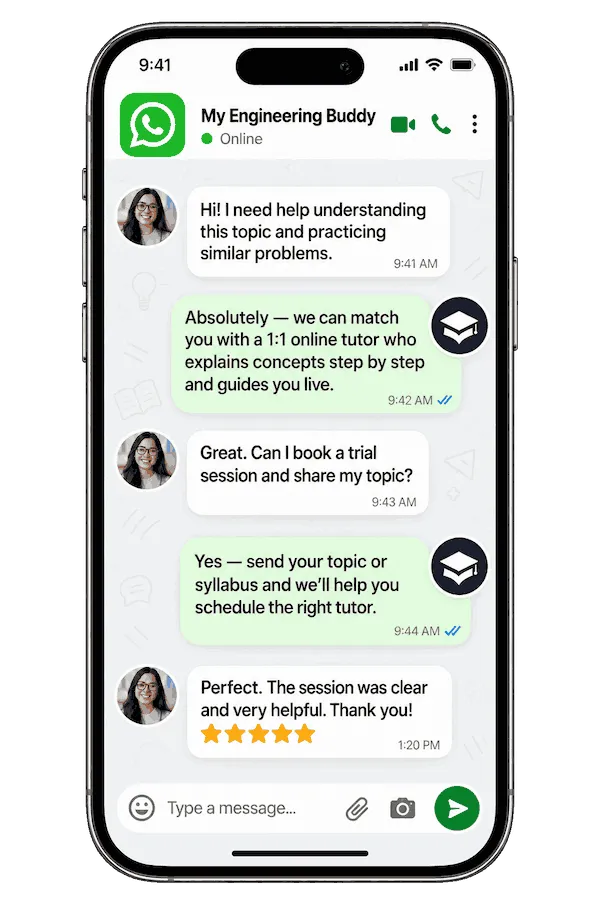
WhatsApp MEB for a quick quote — average response time under 1 minute.
Who This Nagios Tutoring Is For
Nagios trips up students and professionals at very specific points — usually the moment a plugin returns an unexpected state or a notification chain refuses to fire. If you’re past the installation step but stuck on configuration logic, this is for you.
- University students in systems administration, DevOps, or network engineering modules who need Nagios as part of lab or coursework submissions
- Students working toward a certification deadline with gaps in their monitoring knowledge still to close
- Professionals learning Nagios on the job who need structured guidance rather than trial and error
- Students retaking after a failed first attempt at a systems monitoring or infrastructure module
- Parents supporting an undergraduate whose grade in a systems administration course depends on completing a working Nagios deployment
- Students building a DevOps portfolio who need their monitoring setup to actually work before a submission date
Students have come to MEB from programmes at institutions including Georgia Tech, University of Edinburgh, TU Delft, University of Toronto, RMIT, and NYU — often in their second or third year when infrastructure modules get serious. The $1 trial means there’s no risk in finding out whether MEB is the right fit.
1:1 Tutoring vs Self-Study vs AI vs YouTube vs Online Courses
Self-study works if you can read error logs patiently — but no feedback means bad habits compound. AI tools generate config snippets fast, but they can’t watch you make the same NRPE port mistake three times and diagnose why. YouTube covers Nagios installation well; it stops when your specific plugin fails silently. Online courses walk through standard setups at a fixed pace — your non-standard environment isn’t their problem. 1:1 tutoring with MEB means a tutor who has debugged Nagios in production sits with you live, reads your actual config, and fixes the real issue — not a hypothetical one.
Outcomes: What You’ll Be Able To Do in Nagios
After working with an online Nagios tutor through MEB, you’ll be able to configure host and service checks from scratch using the define host{} and define service{} syntax without relying on templates you don’t understand. You’ll apply NRPE correctly to monitor remote Linux hosts and troubleshoot the specific plugin state transitions — OK, WARNING, CRITICAL, UNKNOWN — that most students misread. You’ll solve notification escalation failures by tracing contact groups and timeperiod definitions. You’ll analyze passive vs active check logic and choose the right model for your infrastructure. And you’ll present a working Nagios deployment — from daemon startup to alert delivery — that holds up under review.
Based on feedback from 40,000+ sessions collected by MEB from 2022 to 2025, students working 1:1 on infrastructure monitoring tools like Nagios consistently report faster resolution of configuration errors, clearer understanding of check logic and plugin states, and stronger confidence deploying monitoring in real or lab environments than they achieved through self-directed troubleshooting alone. Progress varies by starting level and project complexity.
Source: MEB session feedback data, 2022–2025.
At MEB, we’ve found that Nagios students waste the most time on two things: misreading plugin exit codes and misconfiguring contact group inheritance. A tutor who has seen both patterns catches them in minutes — not after another hour of forum searching.
What We Cover in Nagios (Syllabus / Topics)

Core Nagios Architecture and Configuration
- Nagios daemon structure: nagios.cfg, objects directory, and CGI configuration
- Defining hosts, host groups, services, and service groups using object definitions
- Check command syntax: command_name, command_line, and plugin paths
- Timeperiod definitions and their use in scheduling checks and notifications
- Contact and contactgroup definitions — notification commands and escalation chains
- Understanding check intervals, retry intervals, and max_check_attempts logic
- Enabling and interpreting the Nagios web interface (CGIs and status.dat)
Recommended references: Learning Nagios 4 by Wojciech Kocjan; official Nagios Core documentation at IEEE Computer Society for broader systems context.
NRPE, Plugins, and Remote Monitoring
- Installing and configuring NRPE on remote Linux hosts
- Writing and deploying custom check plugins using Bash and Python
- Standard Nagios plugins: check_ping, check_http, check_disk, check_load, check_procs
- NSClient++ configuration for monitoring Windows hosts via Nagios
- Passive checks and the NSCA (Nagios Service Check Acceptor) workflow
- Troubleshooting plugin return codes: exit status 0/1/2/3 and what they mean
- Securing NRPE connections: allowed_hosts, SSL, and port 5666 configuration
Recommended references: Nagios: System and Network Monitoring by Wolfgang Barth; plugin development guides from the Nagios Exchange community.
Nagios in DevOps and Infrastructure Contexts
- Integrating Nagios with Ansible for automated deployment of monitoring configs
- Using Nagios alongside Docker to monitor containerised services and health endpoints
- Event handlers: triggering automated responses to service state changes
- Nagios vs modern alternatives: where it fits in a stack alongside Datadog or Grafana
- Distributed Nagios setups with remote pollers for multi-site infrastructure
- Nagios log parsing and integration with Elasticsearch or syslog pipelines
Recommended references: The Practice of System and Network Administration by Limoncelli, Hogan, and Chalup; Nagios Enterprise documentation for distributed monitoring architecture.
Platforms, Tools & Textbooks We Support
Nagios runs across a range of Linux distributions and infrastructure environments. MEB tutors are comfortable working across the following platforms and tools that students typically encounter in coursework and professional deployments:
- Nagios Core 4.x on Ubuntu, CentOS, and Red Hat Linux
- NRPE 4.x and NSClient++ for remote host monitoring
- Nagios XI (commercial edition) alongside Core
- VirtualBox and VMware lab environments used in university infrastructure courses
- Terraform and Ansible for infrastructure-as-code setups that feed Nagios configs
- PagerDuty and Slack integrations for notification routing from Nagios alerts
What a Typical Nagios Session Looks Like
The tutor starts by asking where you left off — usually the check command that returned an unexpected state last time, or the notification that never fired. You share your nagios.cfg or objects directory over screen share on Google Meet, and the tutor reads through it live. Specific problems get worked through line by line: a mismatched contact group name, a wrong plugin path, a timeperiod that excludes the hours you’re testing. The tutor uses a digital pen-pad to annotate the config logic on screen — you see exactly which field caused the issue and why. You make the change, reload the daemon, and watch the status update together. By the end, the tutor sets one concrete task: reconfigure a specific service check or write a basic custom plugin before next session, and the next topic is noted.
Students consistently tell us that seeing a working Nagios config side-by-side with their broken one — not just reading about it — is what finally makes the object definition model click. That’s what a live session does that documentation can’t.
How MEB Tutors Help You with Nagios (The Learning Loop)
Diagnose: In the first session, the tutor reviews your current Nagios setup or project brief. They identify whether the issue is structural (object definition errors), environmental (daemon not running, wrong paths), or conceptual (misunderstanding active vs passive checks). This takes 10–15 minutes and shapes every session that follows.
Explain: The tutor works through the problem live — showing a corrected config, annotating the logic with a digital pen-pad, and explaining why each directive exists. Not just what to write — why Nagios requires it in that order.
Practice: You attempt the next configuration step yourself while the tutor watches. This is where most sessions surface the second layer of confusion — the thing you didn’t know you didn’t know.
Feedback: The tutor catches errors the moment they happen. They show you exactly which line failed, what the daemon log says, and what the corrected logic looks like. No guessing.
Plan: Every session ends with a specific next task — a plugin to write, a host group to configure, a notification chain to test. The tutor notes where you’ll pick up next time so no session starts from scratch.
Sessions run over Google Meet with screen sharing. The tutor uses an iPad with Apple Pencil or a digital pen-pad to annotate configs directly. Before your first session, have your nagios.cfg or course brief ready, know which Linux distribution you’re running, and note the specific error or behaviour you can’t resolve. The first session covers a full diagnostic of your setup and tackles the most urgent blocker. Start with the $1 trial — 30 minutes of live tutoring that also serves as your first diagnostic.
A common pattern our tutors observe is that Nagios students who struggle most have never seen a fully working config from scratch — they’ve only inherited broken ones. Starting clean in a session changes that quickly.
Source: MEB tutor observations, 2008–2025.
Tutor Match Criteria (How We Pick Your Tutor)
Not every systems tutor knows Nagios at the level your course or project requires. MEB matches on four criteria:
Subject depth: Tutors are matched on the specific Nagios context you need — university lab, professional certification prep, DevOps pipeline integration, or enterprise deployment. A tutor who has only configured Nagios Core on a single server won’t be matched to someone building a distributed monitoring setup.
Tools: Every tutor works over Google Meet with a digital pen-pad or iPad and Apple Pencil — so live config annotation is standard, not optional.
Time zone: Matched to your region. US, UK, Gulf, Canada, and Australia all have available slots — including late evenings and weekends.
Goals: Whether you need a working Nagios deployment for a coursework grade, a portfolio piece, or a job-ready skill, the tutor is briefed on that goal before session one.
Unlike platforms where you fill out a form and wait, MEB responds in under a minute, 24/7. Tutor match takes under an hour. The $1 trial means you test before you commit. Everything runs over WhatsApp — no logins, no intake forms.
Pricing Guide
Standard Nagios tutoring runs $20–$40/hr. Graduate-level infrastructure design, distributed Nagios architecture, or enterprise-grade monitoring integration can reach $100/hr depending on tutor specialisation and timeline urgency.
Rate factors include the complexity of your setup, how quickly you need sessions, and whether you need a tutor with professional SRE or NOC experience versus academic familiarity. Availability tightens around semester end and certification windows — lock in your tutor before the crunch.
For students targeting SRE roles or enterprise infrastructure positions, tutors with production monitoring backgrounds are available at higher rates — share your specific goal and MEB will match the tier to your ambition.
Start with the $1 trial — 30 minutes, no registration, no commitment. WhatsApp MEB for a quick quote.
Try your first session for $1 — 30 minutes of live 1:1 tutoring or one homework question explained in full. No registration. No commitment.
WhatsApp MEB now
and get matched within the hour.
FAQ
Is Nagios hard to learn?
Nagios has a steep configuration curve. The object definition model — hosts, services, contacts, timeperiods — is logical once you see it working, but the documentation alone rarely gets students there. A tutor shortens that curve significantly by showing a live working config.
How many sessions will I need?
Most students with a specific lab or project goal see real progress in 3–5 sessions. Students learning Nagios from scratch for a semester module typically benefit from 8–12 sessions spread across the term.
Can you help with my Nagios project and portfolio work?
Yes. MEB provides guided project support — the tutor explains the logic, walks through the configuration approach, and helps you understand each component. You build and submit the work yourself. See our Academic Integrity policy and Why MEB page for full details on what we help with and what we don’t.
Will the tutor match my exact syllabus or exam board?
Yes. Before your first session, share your course outline, module guide, or project brief. The tutor is briefed on your specific requirements — whether that’s a university lab spec, a Nagios Core certification objective, or an employer’s infrastructure setup.
What happens in the first session?
The first session is a diagnostic. The tutor reviews your current setup, identifies the gaps, and builds a session plan around your most urgent blocker. You leave with a working next step — not just a list of things to read.
Is online Nagios tutoring as effective as in-person?
For a tool-based subject like Nagios, online is often better. You share your actual terminal, your real config files, and your live daemon output. The tutor sees exactly what you see. There’s nothing lost in translation that you’d gain from sitting in the same room.
Can I get Nagios help late at night or on weekends?
Yes. MEB tutors cover US, UK, Gulf, and Australia time zones, with slots available evenings and weekends. WhatsApp MEB at any hour — average response time is under a minute.
What if I don’t get along with my assigned tutor?
Tell MEB via WhatsApp. You’ll be matched with a different tutor — no questions asked, no additional fee. The $1 trial exists precisely so you can test the fit before committing to paid sessions.
What’s the difference between Nagios Core and Nagios XI, and do tutors cover both?
Nagios Core is the free, open-source version used in most academic courses and many professional environments. Nagios XI is the commercial edition with a GUI-based configuration interface and additional reporting. MEB tutors cover both — specify which version you’re working with when you message.
How do I set up NRPE correctly? Can a tutor walk me through it?
NRPE configuration — installing the daemon on the remote host, setting allowed_hosts, and writing check commands on the Nagios server — is one of the most common sticking points. Yes, tutors walk through this live, step by step, on your actual servers or lab environment.
Do you offer group Nagios sessions?
No. All MEB sessions are 1:1. Group formats don’t allow the tutor to read your specific config or debug your exact environment — which is where Nagios help actually happens.
How do I get started?
Start with the $1 trial — 30 minutes of live 1:1 tutoring or one project problem explained in full. Three steps: WhatsApp MEB, get matched with a verified Nagios tutor within the hour, then start your trial session.
Trust & Quality at My Engineering Buddy
Every MEB tutor goes through subject-specific screening before taking sessions. For Nagios, that means demonstrating hands-on configuration experience — not just theoretical familiarity. Tutors complete a live demo evaluation, and ongoing session feedback from students is reviewed regularly. Rated 4.8/5 across 40,000+ verified reviews on Google. Tutors hold degrees in computer science, systems engineering, or related fields, and many have professional experience in NOC, SRE, or DevOps roles where Nagios is a daily tool.
MEB provides guided learning support. All project work is produced and submitted by the student. See our Policies page for details. Read our tutoring methodology to understand how the diagnostic-led session structure works in practice.
MEB has served 52,000+ students across the US, UK, Canada, Australia, the Gulf, and Europe since 2008 — covering 2,800+ subjects in software engineering, systems administration, and related technical fields. Students working on Kubernetes tutoring, Jenkins project help, and related infrastructure tools regularly come to MEB alongside their Nagios work.
Explore Related Subjects
Students studying Nagios often also need support in:
Next Steps
Getting started takes three minutes. Share your exam board, course outline, or project brief — whichever applies. Tell MEB your time zone and weekly availability. A verified Nagios tutor is matched within 24 hours, often the same day.
Before your first session, have ready:
- Your course outline, lab specification, or project brief
- Your current nagios.cfg or the error output you’re stuck on
- Your Linux distribution and Nagios version
The tutor handles the rest. First session starts with a full diagnostic so every minute is used on what actually matters.
Visit www.myengineeringbuddy.com for more on how MEB works.
WhatsApp to get started or email [email protected].
Our experience across thousands of sessions shows that the students who make the fastest progress in Nagios are the ones who come with a specific broken config — not a vague question. Bring the actual problem. The tutor brings the fix.
Reviewed by Subject Expert
This page has been carefully reviewed and validated by our subject expert to ensure accuracy and relevance.