~1 min
Average Reply Time
~1 hour
To Be Matched With A Tutor
30 Min Trial
75% Find Their Tutor On The 1st Trial
$20-35+/hr
Premium Yet Affordable Learning
Hire The Best Organometallic Chemistry Tutor


Organometallic metal–ligand bonding failed you in the exam? You’re not alone — it trips up most students the first time.
Organometallic Chemistry Tutor Online
Organometallic chemistry studies compounds containing metal–carbon bonds, including transition metal complexes and main-group organometallics. It equips students to understand catalysis mechanisms, reaction pathways, and spectroscopic characterisation at undergraduate and graduate levels.
If you’re searching for an organometallic chemistry tutor near me, MEB connects you with verified specialist tutors for chemistry and its advanced branches — including organometallic chemistry — through 1:1 online sessions. Tutors work through your exact course content: d-block electron counting, oxidative addition, cross-coupling catalysis. One session changes the trajectory for most students who arrive confused about the 18-electron rule or why Wilkinson’s catalyst behaves the way it does.
- 1:1 online sessions tailored to your university syllabus or graduate course
- Expert verified tutors with organometallic chemistry research or teaching backgrounds
- Flexible time zones — US, UK, Canada, Australia, Gulf
- Structured learning plan built after a diagnostic session
- Ethical homework and assignment guidance — you understand the work, then submit it yourself
52,000+ students across the US, UK, Canada, Australia, and the Gulf have used MEB since 2008 — including students in Chemistry subjects like Organometallic Chemistry, inorganic chemistry tutoring, and transition metal coordination chemistry help.
Source: My Engineering Buddy, 2008–2025.
How Much Does an Organometallic Chemistry Tutor Cost?
Most organometallic chemistry sessions run $20–$40/hr. Graduate-level and specialist research support reaches up to $100/hr. The $1 trial gets you 30 minutes of live tutoring or a full explanation of one assignment question — no registration needed.
| Level / Need | Typical Rate | What’s Included |
|---|---|---|
| Undergraduate (2nd–4th year) | $20–$40/hr | 1:1 sessions, homework guidance |
| Masters / PhD research support | $40–$100/hr | Expert tutor, literature depth, reaction design |
| $1 Trial | $1 flat | 30 min live session or 1 homework question |
Tutor availability tightens at the end of semester and during final exam periods. Book early if your deadline is within four weeks.
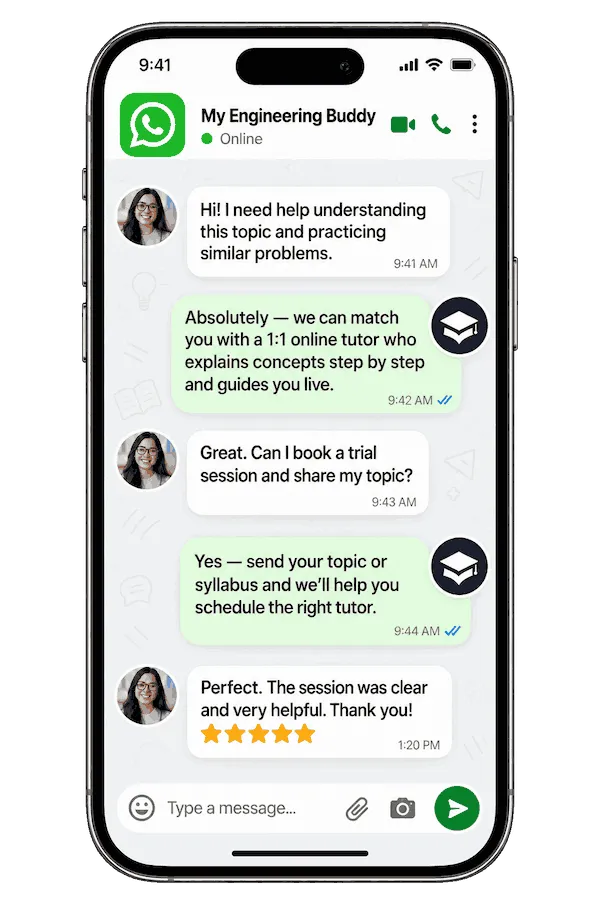
WhatsApp MEB for a quick quote — average response time under 1 minute.
Who This Organometallic Chemistry Tutoring Is For
Organometallic chemistry sits at a difficult intersection of inorganic mechanisms, organic reaction logic, and quantum-mechanical orbital theory. Students who hit a wall here usually hit it hard and fast.
- Second and third-year undergraduates encountering d-block chemistry for the first time
- Graduate students whose research involves transition metal catalysis or synthesis
- Students with a conditional university offer depending on their final chemistry grade
- Students 4–6 weeks from an exam with significant gaps still to close in ligand field theory or reaction mechanisms
- Parents watching a student’s confidence drop as the complexity of metal complex chemistry escalates
- Researchers at institutions including MIT, ETH Zürich, Imperial College London, University of Toronto, and ANU who need conceptual clarity on a specific mechanism or spectroscopic method
Try the $1 trial session — it doubles as your first diagnostic.
1:1 Tutoring vs Self-Study vs AI vs YouTube vs Online Courses
Self-study works if you’re disciplined, but organometallic chemistry has too many interrelated concepts for gaps to stay small for long. AI tools explain mechanisms quickly but can’t diagnose why you specifically keep misassigning oxidation states. YouTube covers the basics of the 18-electron rule clearly enough — then stops exactly where your exam question starts. Online courses are structured but fixed-pace with no live correction. With a 1:1 online organometallic chemistry tutor from MEB, you work through your actual problem sets and past papers in real time, with errors corrected the moment they appear.
Outcomes: What You’ll Be Able To Do in Organometallic Chemistry
After working with an MEB tutor, students can solve electron-counting problems across a range of metal centres without reverting to guesswork. They can analyze oxidative addition and reductive elimination steps in catalytic cycles for reactions like the Heck or Suzuki coupling. They can model the thermodynamic and kinetic factors that determine whether a given ligand set stabilises a complex. They can explain spectroscopic data — NMR, IR, and mass spectrometry — in the context of characterising novel organometallic compounds. They can apply crystal field and molecular orbital theory to predict and rationalise the properties of d-block complexes.
Based on feedback from 40,000+ sessions collected by MEB from 2022 to 2025, 58% of students improved by one full grade after approximately 20 hours of 1:1 tutoring in subjects like Organometallic Chemistry. A further 23% achieved at least a half-grade improvement.
Source: MEB session feedback data, 2022–2025.
At MEB, we’ve found that organometallic chemistry is one of those subjects where students know they’re lost but can’t pinpoint exactly where the understanding broke down. The tutor’s first job is always to find that exact point — not to start from the beginning of the textbook.
What We Cover in Organometallic Chemistry (Syllabus / Topics)

Bonding, Electron Counting, and Ligand Theory
- The 18-electron rule: applications and exceptions
- Hapticity and denticity of ligands (η and κ notation)
- Formal oxidation state assignment in metal complexes
- σ-donor, π-donor, and π-acceptor ligand classification
- Crystal field theory and molecular orbital theory for d-block complexes
- Metal–carbon bond types: σ-bond, π-bond, carbene, carbyne
- Agostic interactions and their structural significance
Core references: Miessler, Fischer & Tarr Inorganic Chemistry (5th ed.); Crabtree The Organometallic Chemistry of the Transition Metals (6th ed.).
Reaction Mechanisms and Catalytic Cycles
- Oxidative addition and reductive elimination mechanisms
- Migratory insertion and β-hydride elimination
- Nucleophilic and electrophilic attack on coordinated ligands
- Heck, Suzuki, Negishi, and Stille cross-coupling catalytic cycles
- Olefin metathesis: Chauvin mechanism, Grubbs catalysts
- Ziegler–Natta and metallocene-catalysed polymerisation
- Homogeneous vs heterogeneous catalysis: key distinctions
Core references: Hartwig Organotransition Metal Chemistry; Spessard & Miessler Organometallic Chemistry (2nd ed.).
Spectroscopic Characterisation and Main-Group Organometallics
- IR spectroscopy: CO stretching frequencies as diagnostic tools
- NMR spectroscopy: ¹H, ¹³C, and metal-nucleus NMR of organometallic compounds
- Mass spectrometry: fragmentation patterns in metal–organic species
- X-ray crystallography: reading and interpreting crystal structures
- Grignard reagents, organolithium compounds, and organotin chemistry
- Main-group organometallics in synthesis: scope and limitations
Core references: Housecroft & Sharpe Inorganic Chemistry (5th ed.); Kühlborn & Nozaki — review literature on organolithium and organotin methods.
Students consistently tell us that the catalytic cycle section is where everything either clicks or completely falls apart. Working through one full Heck mechanism on the digital pen-pad — step by step, every intermediate drawn out — is worth more than re-reading the chapter three times.
What a Typical Organometallic Chemistry Session Looks Like
The tutor starts by checking what happened with the previous topic — usually something like oxidative addition mechanisms or electron counting for a specific complex the student got wrong. The session moves into the current problem: often a catalytic cycle question from a past paper or a homework set involving ligand substitution kinetics. The student works through the mechanism on screen while the tutor annotates in real time using a digital pen-pad, pointing out exactly where the electron bookkeeping goes wrong or why the proposed intermediate isn’t stable. The student then replicates the reasoning independently on a fresh example. The session closes with a specific practice task — two or three electron-counting problems or a mechanism to work through before the next session — and the next topic is noted. Get catalysis tutoring bundled into sessions where catalytic cycle questions are the focus.
How MEB Tutors Help You with Organometallic Chemistry (The Learning Loop)
Diagnose: In the first session, the tutor asks you to work through a representative problem — an 18-electron count, an oxidation state assignment, or a catalytic cycle step. This immediately shows whether the issue is with orbital theory foundations, ligand classification, or mechanism logic. The gap is almost never where the student thinks it is.
Explain: The tutor works through live examples using a digital pen-pad — drawing d-orbital diagrams, constructing MO schemes for specific complexes, or mapping every elementary step in a Suzuki cycle. You see the reasoning constructed in real time, not just the answer.
Practice: You attempt the next problem while the tutor watches. No moving on until you can reproduce the logic, not just copy it. This is where most students discover the second layer of confusion they didn’t know was there.
Feedback: The tutor corrects errors step by step — explaining not just what went wrong but why the examiner deducts marks for that specific error. Knowing the difference between an incorrect mechanism and an insufficiently justified one is exam-critical.
Plan: Each session ends with a clear next topic and a short practice set. The tutor tracks which mechanism types and complex families still need work and sequences the plan accordingly.
Sessions run on Google Meet with a digital pen-pad or iPad + Apple Pencil. Before your first session, have your course syllabus or module guide, a recent problem set or past paper attempt, and your exam or assessment date ready. The first session covers the diagnostic and begins work on your highest-priority gap. Start with the $1 trial — 30 minutes of live tutoring that also serves as your first diagnostic.
MEB has been running 1:1 sessions in advanced chemistry subjects — including physical chemistry help, computational chemistry tutoring, and organometallic chemistry — since 2008, across 52,000+ students in the US, UK, Canada, Australia, and the Gulf.
Source: My Engineering Buddy, 2008–2025.
Tutor Match Criteria (How We Pick Your Tutor)
Not every chemistry tutor can teach organometallic chemistry. MEB’s matching process filters specifically for this.
Subject depth: Tutors must have postgraduate-level training or research experience in organometallic or inorganic chemistry — not just a general chemistry background. They are vetted on specific mechanism families before being assigned to organometallic sessions.
Tools: Every tutor works on Google Meet with a digital pen-pad or iPad + Apple Pencil. Drawing mechanisms live is non-negotiable for this subject.
Time zone: Matched to your region — US, UK, Gulf, Canada, or Australia — so sessions happen at reasonable hours without scheduling gymnastics.
Goals: Whether you need exam score improvement, deeper conceptual understanding of reaction mechanisms, or homework support for a specific module, the tutor is matched to that goal, not to a generic chemistry profile.
Unlike platforms where you fill out a form and wait, MEB responds in under a minute, 24/7. Tutor match takes under an hour. The $1 trial means you test before you commit. Everything runs over WhatsApp — no logins, no intake forms.
Study Plans (Pick One That Matches Your Goal)
The tutor builds your exact session sequence after the diagnostic, but most students fall into one of three patterns. Catch-up (1–3 weeks): you’re behind and need to close specific gaps before an assessment. Exam prep (4–8 weeks): structured revision across the full organometallic syllabus with past paper practice. Weekly support: ongoing sessions aligned to your lecture schedule, keeping pace with the course rather than catching up after it. The tutor maps the plan to whichever fits your timeline.
Pricing Guide
Undergraduate organometallic chemistry sessions: $20–$40/hr. Graduate-level and research-focused support — including reaction design, literature review, and spectroscopic interpretation — runs up to $100/hr depending on tutor specialisation and session complexity. Rate factors include course level, topic difficulty, timeline pressure, and tutor availability.
Tutor slots fill quickly during finals periods at US, UK, and Australian universities. If your exam is within six weeks, book sooner rather than waiting.
For students targeting competitive PhD programmes, industry research roles, or academic positions at institutions with active organometallic research groups, tutors with professional research backgrounds in transition metal catalysis are available at higher rates — share your specific goal and MEB will match the tier to your ambition.
Start with the $1 trial — 30 minutes, no registration, no commitment. WhatsApp MEB for a quick quote.
FAQ
Is organometallic chemistry hard?
Yes — it demands simultaneous fluency in inorganic bonding theory, organic reaction logic, and spectroscopic interpretation. Most students find the 18-electron rule and catalytic cycle mechanisms the steepest hurdles. A good tutor locates your specific gap within the first session and works from there, rather than reviewing everything from scratch.
How many sessions are needed?
Students closing a single conceptual gap — electron counting, one mechanism type — often need 3–5 sessions. Full exam preparation across an organometallic module typically takes 10–20 hours of 1:1 tutoring. The diagnostic session in your $1 trial gives a realistic estimate based on your actual starting point.
Can you help with homework and assignments?
MEB tutoring is guided learning — you understand the work, then submit it yourself. Tutors explain the reasoning behind mechanism questions and problem sets so you can complete them independently. See our Academic Integrity policy and Why MEB page for full details on what we help with and what we don’t.
Will the tutor match my exact syllabus or exam board?
Yes. Share your course outline, university, and module name before the first session. Tutors are matched to your specific content — whether that’s a UK undergraduate module, a North American graduate course, or a specific topic like cross-coupling mechanisms or spectroscopic characterisation of metal complexes.
What happens in the first session?
The tutor asks you to work through a representative problem from your course — usually a mechanism or electron-counting question. This diagnostic identifies exactly where the understanding breaks down. The rest of the session addresses the highest-priority gap, and the tutor sets a short practice task before the next session.
Is online tutoring as effective as in-person?
For organometallic chemistry, the digital pen-pad format is genuinely effective — tutors draw orbital diagrams, reaction arrows, and catalytic cycles live on screen. Most students who switch from in-person tuition report no loss of quality. The flexibility of online sessions also means more consistent scheduling, which matters more than format for most students.
What’s the difference between organometallic and coordination chemistry, and do MEB tutors cover both?
Coordination chemistry covers metal complexes with ligands coordinated via lone pairs (amines, halides, water). Organometallic chemistry specifically involves metal–carbon bonds. The boundary overlaps — many tutors cover both. If your course spans both, say so when you contact MEB and the tutor will be matched accordingly. Get transition metal coordination chemistry help if your course covers both areas.
Can I get help with specific name reactions — Heck, Suzuki, Negishi — for my exam?
Yes. These cross-coupling mechanisms appear on exams at undergraduate and graduate level across most universities. Tutors work through the full catalytic cycle for each reaction — oxidative addition, transmetalation, reductive elimination — and practise exam-style mechanism questions drawn from past papers or your course’s problem sets. Students needing broader context also benefit from organic chemistry tutoring.
Can I get help at midnight or on weekends?
Yes. MEB operates 24/7 across all major time zones. WhatsApp MEB at any hour — average response time is under a minute. Tutors are available in the US, UK, Gulf, Canada, and Australia, so a midnight session in one region is a normal working hour for a tutor in another.
Do you offer group organometallic chemistry sessions?
MEB specialises in 1:1 tutoring. Group sessions are not offered. The individual format is deliberate — organometallic chemistry requires the tutor to diagnose and address each student’s specific gap, which isn’t possible in a group setting where the pace is set by the average, not by you.
How do I get started?
Start with the $1 trial: WhatsApp MEB, get matched to a verified organometallic chemistry tutor within the hour, then run a 30-minute live session or get one homework question explained in full. Three steps: WhatsApp → matched → start trial. No forms, no waiting.
Trust & Quality at My Engineering Buddy
MEB tutors for organometallic chemistry hold postgraduate degrees — most at PhD level — with verifiable research or teaching experience in transition metal chemistry, catalysis, or related fields. Every tutor completes a subject-specific live demo evaluation before being placed with students. Session feedback is reviewed continuously; tutors who don’t perform against their matched subject are removed. Rated 4.8/5 across 40,000+ verified reviews on Google. Get analytical chemistry tutoring or quantum chemistry help from the same verified tutor pool if your course spans multiple disciplines.
MEB tutoring is guided learning — you understand the work, then submit it yourself. For full details on what we help with and what we don’t, read our Academic Integrity policy and Why MEB.
MEB has served 52,000+ students in Chemistry and related disciplines — including medicinal chemistry tutoring and green chemistry help — since 2008, across the US, UK, Canada, Australia, the Gulf, and Europe. The platform covers 2,800+ advanced subjects. Tutors are matched to subject, level, exam board, and time zone — not assigned from a generic pool.
Our experience across thousands of sessions shows that students who bring a specific past paper question or homework problem to their first organometallic chemistry session make faster progress than those who arrive asking to “go over everything.” Having one concrete problem ready transforms the diagnostic into a working session immediately.
Explore Related Subjects
Students studying organometallic chemistry often also need support in:
- Stereochemistry
- Chemical Kinetics
- NMR Spectroscopy
- Photochemistry
- Supramolecular Chemistry
- Lanthanide Chemistry
- Polymer Chemistry
Next Steps
Before your first session, have ready: your exam board and syllabus or course outline, a recent past paper attempt or homework problem you struggled with, and your exam or deadline date. The tutor handles the rest.
- Share your exam board or module name, hardest topic, and current timeline
- Share your availability and time zone
- MEB matches you with a verified organometallic chemistry tutor — usually within the hour
- First session starts with a diagnostic so every minute is used well
Visit www.myengineeringbuddy.com for more on how MEB works.
WhatsApp to get started or email [email protected].
Reviewed by Subject Expert
This page has been carefully reviewed and validated by our subject expert to ensure accuracy and relevance.