





~1 min
Average Reply Time
~1 hour
To Be Matched With A Tutor
1 Trial
75% Find Their Tutor On The 1st Trial
$1
Your First 30 Minutes
Hire The Best Public Economics Tutor
Top Tutors, Top Grades. Without The Stress!
Related Subjects
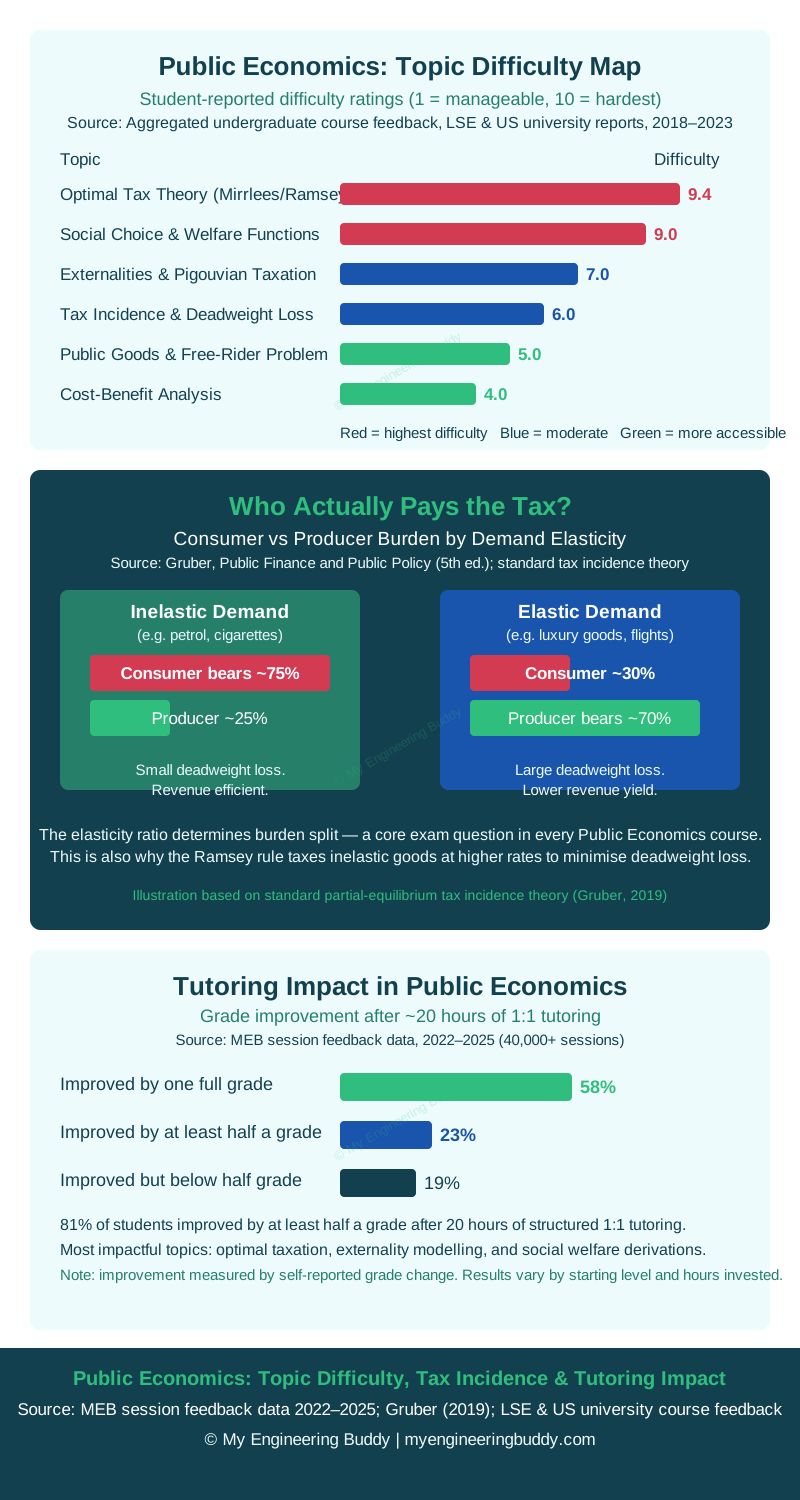
Most students hit a wall somewhere between tax incidence and social welfare functions — and no amount of re-reading the textbook moves them forward.
Public Economics Tutor Online
Public Economics is the study of government’s role in the economy, covering taxation, public expenditure, market failures, public goods, and social welfare — equipping students to analyze fiscal policy and resource allocation decisions at national and local levels.
If you’re searching for a Public Economics tutor near me, MEB connects you with a verified expert for 1:1 online sessions across every major university syllabus — from introductory undergraduate modules through to PhD-level fiscal theory. Our Economics tutoring covers the full discipline, and Public Economics tutors are matched by level, exam board, and specific topic gaps. One targeted session on externalities or the Ramsey rule can shift your understanding faster than ten lectures.
- 1:1 online sessions tailored to your exact course and syllabus
- Expert verified tutors with subject-specific knowledge in public finance and fiscal policy
- Flexible time zones — US, UK, Canada, Australia, Gulf
- Structured learning plan built after a diagnostic session
- Ethical homework and assignment guidance — you understand before you submit
52,000+ students across the US, UK, Canada, Australia, and the Gulf have used MEB since 2008 — including students in Economics subjects like Public Economics, Welfare Economics, and Health Economics.
Source: My Engineering Buddy, 2008–2025.
How Much Does a Public Economics Tutor Cost?
Most Public Economics sessions run $20–$40 per hour. Graduate-level and research-focused work can reach $70–$100/hr depending on topic complexity and tutor experience. The $1 trial gets you 30 minutes of live tutoring or a full explanation of one homework question — no registration required.
| Level / Need | Typical Rate | What’s Included |
|---|---|---|
| Undergraduate (introductory/mid) | $20–$35/hr | 1:1 sessions, assignment guidance |
| Advanced / Graduate | $35–$70/hr | Expert tutor, fiscal theory depth |
| $1 Trial | $1 flat | 30 min live session or 1 homework question |
Availability tightens significantly around semester finals and dissertation deadlines — book early if you have a fixed exam date.
WhatsApp MEB for a quick quote — average response time under 1 minute.
Who This Public Economics Tutoring Is For
Public Economics sits at the intersection of economic theory and political reality. Students often struggle not because the concepts are inaccessible, but because courses move fast and the math — optimal tax theory, general equilibrium effects — arrives before the intuition is solid.
- Undergraduate economics students covering public goods, externalities, and fiscal federalism
- Graduate and Masters students working through optimal taxation, social choice theory, or cost-benefit analysis
- Students retaking after a failed first attempt at a core public finance module
- PhD students needing structured support on dissertation chapters involving public sector data or welfare analysis
- Students with a university conditional offer depending on this grade
- Parents watching a student’s confidence drop as public finance problem sets pile up
Students from institutions including Harvard, LSE, University of Toronto, University of Sydney, Sciences Po, and NYU have used MEB for Public Economics support at various levels.
1:1 Tutoring vs Self-Study vs AI vs YouTube vs Online Courses
Self-study works if you’re disciplined — but Public Economics problem sets on Pigouvian taxes or Lindahl equilibria rarely have a clear answer in the back of the book. AI tools give fast definitions, but they can’t diagnose why your social welfare derivation keeps going wrong. YouTube covers the intuition well; it stops the moment you need to work through your specific problem set. Online courses move at a fixed pace with no adjustment for where you actually are. A 1:1 Public Economics tutor from MEB works through your exact assignment, your exam board’s question style, and your specific sticking point — live, in real time, correcting errors as they happen.
Outcomes: What You’ll Be Able To Do in Public Economics
After consistent 1:1 sessions, you’ll be able to solve optimal tax problems using the Ramsey and Diamond-Mirrlees frameworks, analyze the efficiency and equity trade-offs in real government budget decisions, model externalities and design corrective policy using Pigouvian logic, explain the conditions under which public provision of goods is welfare-improving over private markets, and apply social choice criteria — Pareto, Kaldor-Hicks, Rawlsian — to evaluate policy outcomes. These aren’t abstract skills. They show up directly in exam essays, policy memos, and dissertation literature reviews.
Supporting a student through Public Economics? MEB works directly with parents to set up sessions, track progress, and keep coursework on schedule. WhatsApp MEB — average response time is under a minute, 24/7.
Based on feedback from 40,000+ sessions collected by MEB from 2022 to 2025, 58% of students improved by one full grade after approximately 20 hours of 1:1 tutoring in subjects like Public Economics. A further 23% achieved at least a half-grade improvement.
Source: MEB session feedback data, 2022–2025.
What We Cover in Public Economics (Syllabus / Topics)
Public Goods, Externalities, and Market Failure
- Non-rivalry and non-excludability: defining pure public goods
- Free-rider problem and voluntary provision models
- Pigouvian taxes and subsidies for negative and positive externalities
- Coase theorem and its limitations in policy contexts
- Common pool resources and tragedy of the commons
- Government intervention criteria: when markets fail and when they don’t
Core texts include Stiglitz & Rosengard’s Economics of the Public Sector and Hindriks & Myles’ Intermediate Public Economics — both are standard on most undergraduate reading lists.
Taxation: Theory and Policy
- Tax incidence: who really bears the burden of a tax
- Deadweight loss and efficiency costs of taxation
- Optimal income taxation: Mirrlees model and extensions
- Ramsey rule for optimal commodity taxation
- Capital gains, corporate tax, and international tax competition
- Value-added tax design and distributional effects
- Behavioural responses to taxation: labour supply elasticity
Atkinson & Stiglitz’s foundational papers remain essential alongside Salanié’s The Economics of Taxation for graduate-level treatment.
Public Expenditure, Fiscal Policy, and Social Insurance
- Cost-benefit analysis: discount rates, shadow prices, distributional weights
- Social insurance: unemployment, health, and pension system design
- Fiscal federalism: assignment of taxing and spending across government tiers
- Public debt sustainability and intergenerational equity
- Political economy of public spending: median voter theorem, rent-seeking
- Welfare state reform and means-testing vs universalism
Gruber’s Public Finance and Public Policy is widely used at undergraduate level; Myles’ Public Economics suits more advanced courses.
What a Typical Public Economics Session Looks Like
The tutor opens by checking where the previous session ended — usually a specific problem, such as a tax incidence derivation or a social welfare maximisation exercise. From there, the session works through your current assignment or exam question on screen. The tutor uses a digital pen-pad to work through diagrams — budget constraints, Laffer curves, deadweight triangles — while you follow and then replicate the reasoning in your own words. If you’re stuck on why the Ramsey rule gives different results for elastic versus inelastic goods, the tutor explains the intuition, then runs a second example until it’s clear. Sessions close with a specific practice task — typically one exam-style question on the next topic — and a note of where the next session picks up. You get applied economics help built into the structure whenever a topic bridges theory and real-world policy.
How MEB Tutors Help You with Public Economics (The Learning Loop)
Diagnose: In the first session, the tutor identifies exactly which concepts are shaky — whether that’s the maths behind optimal tax theory, the logic of Lindahl equilibrium, or how to structure a cost-benefit analysis answer under exam conditions. No guessing, no generic review.
Explain: The tutor works through live problems using a digital pen-pad on Google Meet. You see the reasoning built step-by-step — not a finished answer, but the process. This is where microeconomics tutoring skills feed directly into public economics problem-solving.
Practice: You attempt the next problem while the tutor watches. This is not optional. Silent watching builds nothing. Active attempted reasoning — even wrong reasoning — is where the learning happens.
Feedback: The tutor identifies exactly where marks were lost and why. “Your deadweight loss triangle is correct, but you’ve misapplied the incidence split to the elastic side” — that level of precision, not “good try.”
Plan: After each session, you know exactly what topic comes next and what to attempt before the next session. Progress on economic policy concepts is tracked across sessions, not reinvented each time.
Sessions run over Google Meet. Tutors use a digital pen-pad or iPad with Apple Pencil for live diagram work. Before your first session, share your course outline, the specific topic you’re stuck on, and any past exam or problem set you’ve attempted. Start with the $1 trial — 30 minutes of live tutoring that also serves as your first diagnostic.
At MEB, we’ve found that Public Economics students who bring a specific failed problem to the first session — not a vague topic — make faster progress in the first two hours than students who start with “I need to review everything.” Narrow the problem first. The tutor will find the rest.
Tutor Match Criteria (How We Pick Your Tutor)
Not every economist can teach Public Economics well. These are the criteria MEB applies when matching you.
Subject depth: Tutors are matched by level — undergraduate core, advanced undergraduate, Masters, or PhD — and by specific sub-field: taxation theory, public expenditure, social insurance, or fiscal federalism.
Tools: Every tutor works over Google Meet with a digital pen-pad or iPad and Apple Pencil. No static slides. Live, writable problem-solving only.
Time zone: Matched to your region — US Eastern or Pacific, UK, Gulf Standard Time, Canadian, or Australian time zones.
Goals: Whether you need to pass a single exam, deepen your grasp of optimal tax theory for a dissertation, or work through weekly problem sets in macroeconomics alongside your Public Economics course — the tutor is matched to that specific goal.
Unlike platforms where you fill out a form and wait, MEB responds in under a minute, 24/7. Tutor match takes under an hour. The $1 trial means you test before you commit. Everything runs over WhatsApp — no logins, no intake forms.
Study Plans (Pick One That Matches Your Goal)
Your tutor builds the session sequence after the first diagnostic — but here’s how the plans typically take shape. A catch-up plan (1–3 weeks) targets the two or three topics causing the most damage to your grade right now: usually tax incidence, externalities, or social welfare functions. Exam prep (4–8 weeks) works systematically through past papers by topic, then by timed conditions. Weekly ongoing support keeps you current with lectures and problem sets through the semester, so nothing accumulates into a crisis. Students working on dissertations or research papers involving public finance data use a research-support structure instead — session by session, chapter by chapter.
Pricing Guide
Public Economics tutoring starts at $20/hr for standard undergraduate modules and scales to $70–$100/hr for advanced graduate work, dissertation support, or highly specialist topics like mechanism design in public goods provision. Rate factors include level, topic complexity, how close your exam or deadline is, and tutor availability in your time zone.
For students targeting graduate programmes at LSE, Princeton, Sciences Po, or Columbia — institutions where Public Economics is a core field — tutors with research and policy backgrounds are available at higher rates. Share your specific goal and MEB matches the right tier.
Start with the $1 trial — 30 minutes, no registration, no commitment. WhatsApp MEB for a quick quote.
Students consistently tell us that the first session they almost skipped — the one booked as a one-off the week before an exam — ended up being the session that changed how they approached every Public Economics question after it. One session. One concept clicked. Everything else follows.
FAQ
Is Public Economics hard?
It’s conceptually demanding because it combines microeconomic theory, political constraints, and real policy trade-offs. The maths — particularly optimal tax derivations and social welfare maximisation — catches most students off guard. With structured 1:1 support, the core models become manageable faster than students expect.
How many sessions are needed?
Students closing a single topic gap typically need 2–4 sessions. Full exam preparation across a semester’s content usually runs 10–20 hours over 4–8 weeks. The tutor maps a specific plan after the first diagnostic — nothing is assumed in advance.
Can you help with homework and assignments?
Yes. MEB tutoring is guided learning — you understand the work, then submit it yourself. The tutor explains the approach, works through the logic with you, and checks your reasoning. See our Academic Integrity policy and Why MEB page for full details on what we help with and what we don’t.
Will the tutor match my exact syllabus or exam board?
Yes. Share your course outline and institution when you make contact. Tutors are matched by syllabus — whether that’s a US university public finance module, a UK undergraduate programme, or a Masters-level fiscal theory course. Broad “public economics” matching is a starting point, not the end point.
What happens in the first session?
The tutor runs a short diagnostic: what topics have been covered, where the gaps are, and what the immediate deadline is. From there, the session moves directly into live problem-solving. You won’t spend 45 minutes on introductions — the tutor gets to work fast.
Is online tutoring as effective as in-person?
For Public Economics — which is primarily analytical and diagram-based — online delivery with a digital pen-pad is genuinely equivalent to in-person. Most MEB students report no meaningful difference in quality. The flexibility to book late-evening or early-morning sessions is an advantage many students wouldn’t have with local tutors.
Can I get Public Economics help at midnight?
Yes. MEB operates 24/7. Tutors are available across time zones, so late-night sessions for students in the US, Gulf, or Australia are standard. WhatsApp MEB at any hour — median response time is under a minute regardless of when you message.
What’s the difference between Public Economics and Public Finance?
Public Finance is largely a subset — focused on government revenue, expenditure, and budgeting. Public Economics is broader: it includes market failure theory, externalities, public goods, social choice, and political economy alongside the finance elements. Some courses use the terms interchangeably; check your syllabus to be sure.
What if I don’t like my assigned tutor?
Request a replacement via WhatsApp. MEB rematches without penalty. The $1 trial is specifically designed so you test the fit before committing to a full package — if the match isn’t right, you haven’t lost anything substantial.
Do Public Economics tutors help with dissertation chapters?
Yes — particularly for chapters involving optimal tax frameworks, welfare analysis, cost-benefit methodology, or fiscal federalism literature. The tutor helps you structure the argument, work through the relevant models, and check the economic logic. You write and submit your own work.
How do I find a Public Economics tutor in my city?
You don’t need one locally. All sessions run over Google Meet, and tutors are matched by syllabus level and time zone — not geography. Students in London, Dubai, Toronto, and Sydney all access the same pool of verified tutors through WhatsApp, any time of day.
How do I get started?
WhatsApp MEB, share your course or exam details, and you’ll be matched with a verified Public Economics tutor within the hour. The first session starts at $1 — 30 minutes of live tutoring or one homework question explained in full. Three steps: WhatsApp → matched → start trial.
Trust & Quality at My Engineering Buddy
Every MEB tutor goes through subject-specific screening: a live demo session evaluated by a senior tutor, degree verification, and ongoing review based on student feedback after each session. Tutors covering Public Economics hold postgraduate qualifications in economics or related fields — many have policy research or government advisory backgrounds. Rated 4.8/5 across 40,000+ verified reviews on Google.
MEB tutoring is guided learning — you understand the work, then submit it yourself. For full details on what we help with and what we don’t, read our Academic Integrity policy and Why MEB.
MEB has served 52,000+ students across the US, UK, Canada, Australia, the Gulf, and Europe since 2008 — across 2,800+ subjects. Within Economics, subjects like Political Economy tutoring, Development Economics help, and Labour Economics tutoring are covered alongside Public Economics by the same verified tutor pool. The MEB tutoring methodology — diagnostic first, then structured progression — applies consistently across every subject.
A common pattern our tutors observe is that Public Economics students arrive having memorised the diagrams but not understood the logic behind them. Reproducing a deadweight loss triangle is not the same as knowing when the Pigouvian fix works and when it doesn’t. That distinction is what the sessions build.
Explore Related Subjects
Students studying Public Economics often also need support in:
- Environmental Economics
- Behavioral Economics
- Econometrics
- International Economics
- Monetary Economics
- Socioeconomics
- Institutional Economics
Next Steps
When you contact MEB, share three things: your exam board or course outline, the topic or problem set causing the most trouble right now, and your exam or deadline date. Add your time zone and availability. MEB matches you with a verified Public Economics tutor — usually within 24 hours, often faster.
Before your first session, have ready:
- Your syllabus or course outline
- A recent past paper attempt or problem set you struggled with
- Your exam or submission deadline date
The tutor handles the rest.
Visit www.myengineeringbuddy.com for more on how MEB works.
WhatsApp to get started or email [email protected].
The American Economic Association publishes research on public finance, taxation, and welfare policy that underpins much of what is studied in advanced Public Economics courses.
Source: American Economic Association
Try your first session for $1 — 30 minutes of live 1:1 tutoring or one homework question explained in full. No registration. No commitment. WhatsApp MEB now and get matched within the hour.
Our experience across thousands of sessions shows that the students who improve fastest in Public Economics are not the ones who study more hours — they’re the ones who get corrective feedback on exactly the wrong step in a derivation, early enough to fix the habit before the exam.
Source: My Engineering Buddy, internal session observation, 2008–2025.
52,000+ Happy Students From Various Universities






Reviewed by Subject Expert
This page has been carefully reviewed and validated by our subject expert to ensure accuracy and relevance.
