

Hire Verified & Experienced
Statistical Mechanics Tutors
Email: [email protected]
4.8/5 40K+ session ratings collected on the MEB platform



Hire The Best Statistical Mechanics Tutor
Top Tutors, Top Grades. Without The Stress!
Partition functions, entropy derivations, phase transitions — Statistical Mechanics breaks more students than almost any other graduate physics course.
Statistical Mechanics Tutor Online
Statistical Mechanics is the branch of physics that connects the microscopic behaviour of particles to macroscopic thermodynamic properties using probability, entropy, and ensemble theory, equipping students to model systems from ideal gases to quantum condensates.
MEB offers 1:1 online tutoring and homework help in 2800+ advanced subjects, including Statistical Mechanics. If you’ve searched for a Statistical Mechanics tutor near me and found mostly generic platforms, MEB is different — your tutor is matched to your specific course, syllabus, and level within hours. Our Physics tutoring network covers everything from undergraduate thermal physics to graduate-level quantum statistical mechanics. Sessions are live, structured, and built around where you’re actually stuck.
- 1:1 online sessions tailored to your exact course and syllabus
- Expert-verified tutors with graduate-level subject knowledge in Statistical Mechanics
- Flexible time zones — US, UK, Canada, Australia, Gulf
- Structured learning plan built after a first diagnostic session
- Ethical homework and assignment guidance — you understand the work before you submit
52,000+ students across the US, UK, Canada, Australia, and the Gulf have used MEB since 2008 — including students in Physics subjects like Statistical Mechanics, Quantum Mechanics, and Thermal Physics.
Source: My Engineering Buddy, 2008–2025.
How Much Does a Statistical Mechanics Tutor Cost?
Most Statistical Mechanics tutoring sessions run $20–$40/hr depending on level — undergraduate versus graduate, and topic complexity. Start with the $1 trial: 30 minutes of live 1:1 tutoring or one homework question explained in full, no registration required.
| Level / Need | Typical Rate | What’s Included |
|---|---|---|
| Undergraduate (Year 2–3) | $20–$35/hr | 1:1 sessions, homework guidance |
| Graduate / Research Level | $40–$100/hr | Expert tutor, advanced topic depth |
| $1 Trial | $1 flat | 30 min live session or 1 homework question |
Tutor availability tightens in the weeks before finals and qualifying exams. Book early.
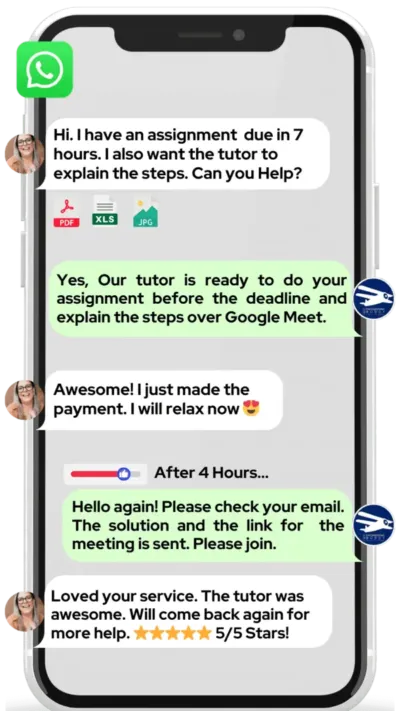
WhatsApp MEB for a quick quote — average response time under 1 minute.
Who This Statistical Mechanics Tutoring Is For
Statistical Mechanics sits at the intersection of probability theory, thermodynamics, and quantum physics. It’s technically demanding, and most students hit a wall somewhere between Boltzmann distributions and grand canonical ensembles. This tutoring is for anyone who’s hit that wall.
- Second and third-year physics or chemistry undergraduates struggling with partition functions or entropy derivations
- Graduate students preparing for qualifying exams where Statistical Mechanics is a core tested area
- Students retaking after a failed first attempt — especially those who passed thermodynamics but lost marks on the statistical framework
- Masters and PhD students needing support with research-level topics like non-equilibrium systems or renormalisation group methods
- Students with a coursework or problem-set submission deadline approaching and specific gaps still to close
- Parents watching a student’s confidence drop as Statistical Mechanics problem sets get returned with failing marks
Students we’ve worked with have come from programmes at MIT, Caltech, University of Cambridge, ETH Zurich, Imperial College London, University of Toronto, and Australian National University, among many others.
1:1 Tutoring vs Self-Study vs AI vs YouTube vs Online Courses
Self-study works if you’re disciplined, but Statistical Mechanics problem sets expose gaps fast and self-correction is slow. AI tools give quick derivations but can’t tell where your reasoning actually breaks down. YouTube is useful for conceptual overviews of the Boltzmann factor or phase diagrams, but stops short the moment your specific problem diverges from the example. Online courses move at a fixed pace — unhelpful when you need one concept resolved before you can move forward. 1:1 tutoring with MEB is live and calibrated to your exact course: your tutor works through your actual problem set, corrects the specific step where marks are lost, and moves at your pace.
Outcomes: What You’ll Be Able To Do in Statistical Mechanics
After a structured programme of 1:1 Statistical Mechanics tutoring, students work more confidently through problems they previously avoided. You’ll be able to derive partition functions for canonical and grand canonical ensembles without prompting. You’ll apply the Boltzmann distribution to real systems — from ideal gases to two-state spin systems. You’ll analyse phase transitions using mean-field theory and identify the physical meaning behind critical exponents. You’ll model entropy changes across thermodynamic processes with mathematical precision. You’ll explain the connection between microscopic states and macroscopic observables in ways that hold up under exam or qualifying-exam questioning.
Based on feedback from 40,000+ sessions collected by MEB from 2022 to 2025, 58% of students improved by one full grade after approximately 20 hours of 1:1 tutoring in subjects like Statistical Mechanics. A further 23% achieved at least a half-grade improvement.
Source: MEB session feedback data, 2022–2025.
Try your first session for $1 — 30 minutes of live 1:1 tutoring or one homework question explained in full. No registration. No commitment. WhatsApp MEB now and get matched within the hour.
What We Cover in Statistical Mechanics (Syllabus / Topics)

Track 1: Foundations — Probability, Entropy, and Classical Ensembles
- Microstates, macrostates, and the fundamental postulate of statistical mechanics
- Boltzmann entropy: S = k ln W and its physical interpretation
- Canonical ensemble, partition function Z, and free energy
- Grand canonical ensemble and chemical potential
- Maxwell–Boltzmann distribution for ideal gases
- Equipartition theorem and heat capacities
- Gibbs paradox and the role of indistinguishability
Core texts: Kittel & Kroemer Thermal Physics, Reif Fundamentals of Statistical and Thermal Physics, Mandl Statistical Physics.
Track 2: Quantum Statistical Mechanics
- Fermi–Dirac and Bose–Einstein statistics — derivation and physical meaning
- Fermi energy, Fermi surface, and electron gas in metals
- Bose–Einstein condensation and its conditions
- Planck distribution and blackbody radiation via statistical mechanics
- Debye and Einstein models of heat capacity in solids
- Chemical potential in quantum systems
Core texts: Pathria & Beale Statistical Mechanics, Huang Statistical Mechanics, Sakurai Modern Quantum Mechanics (for background).
Track 3: Phase Transitions, Critical Phenomena, and Advanced Topics
- First- and second-order phase transitions — definitions and examples
- Mean-field theory and the Ising model
- Critical exponents and universality classes
- Landau theory of phase transitions
- Introduction to renormalisation group methods
- Fluctuations, correlation functions, and the fluctuation-dissipation theorem
- Non-equilibrium statistical mechanics and the Boltzmann transport equation
Core texts: Goldenfeld Lectures on Phase Transitions and the Renormalization Group, Callen Thermodynamics and an Introduction to Thermostatistics, Kardar Statistical Physics of Particles.
At MEB, we’ve found that students who struggle with Statistical Mechanics usually aren’t weak in physics generally — they’ve hit a specific conceptual gap between thermodynamics and probability theory that nobody has explicitly bridged for them. One session on that bridge changes everything.
What a Typical Statistical Mechanics Session Looks Like
The tutor opens by checking the previous topic — usually wherever the last problem set exposed a gap, such as computing the partition function for a harmonic oscillator or applying the grand canonical ensemble to an open system. From there, student and tutor work through two or three live problems on screen: deriving the Fermi–Dirac distribution from scratch, stepping through a phase transition calculation, or dissecting a mean-field Ising model problem. The tutor uses a digital pen-pad to write derivations in real time. The student then replicates the key steps or explains the physical reasoning — not just copying, but demonstrating understanding. By the end of the session, one concrete practice problem is set and the next topic is named so there’s no ambiguity about what to prepare.
How MEB Tutors Help You with Statistical Mechanics (The Learning Loop)
Diagnose: In the first session, the tutor identifies exactly where your understanding breaks down — whether it’s the mathematical formalism of partition functions, the physical interpretation of entropy, or the leap from classical to quantum statistics. This takes 15–20 minutes and shapes everything that follows.
Explain: The tutor works through problems live using a digital pen-pad, showing every step of a derivation — not just the answer. Canonical ensemble, Fermi level calculations, Landau free energy expansions — each is unpacked at the pace you need.
Practice: You attempt problems with the tutor present. No waiting for a marked script to come back a week later. You work, the tutor watches and intervenes at the precise moment the reasoning slips.
Feedback: Step-by-step correction in real time. The tutor explains not just what went wrong but why — which physical assumption was violated, which mathematical step was skipped, why that loses marks in an exam context.
Plan: Each session ends with a clear next topic, a specific practice task, and a timeline. Whether you’re working toward a final exam, a qualifying exam, or a coursework deadline, the tutor tracks your progress and adjusts the sequence each week.
Sessions run on Google Meet with a digital pen-pad or iPad and Apple Pencil. Before your first session, have your course syllabus or problem set ready, along with any past work where you lost marks. The first session covers your diagnostic and your first core topic.
Start with the $1 trial — 30 minutes of live tutoring that also serves as your first diagnostic.
Statistical Mechanics qualifying exams test depth, not breadth. Students who improve fastest are those who stop re-reading notes and start working problems under tutor supervision — every session at MEB is built around that shift.
Source: My Engineering Buddy, tutoring methodology and session design principles.
Students consistently tell us that Statistical Mechanics felt abstract until they worked through derivations by hand with someone who could stop them mid-step and ask: “What does this quantity physically mean?” That one question — repeated — is what makes the subject click.
Tutor Match Criteria (How We Pick Your Tutor)
Not every physics tutor can teach Statistical Mechanics at graduate level. Here’s how MEB matches you.
Subject depth: Tutors are vetted specifically for Statistical Mechanics — their degree level, the courses they’ve taught or TA’d, and their familiarity with the textbooks and syllabus structures common at your institution. A tutor covering undergraduate canonical ensembles is different from one handling graduate renormalisation group problems.
Tools: All tutors work via Google Meet with a digital pen-pad or iPad and Apple Pencil — essential for live derivation work in Statistical Mechanics.
Time zone: Matched to your region — US, UK, Gulf, Canada, Australia — so sessions happen at hours that actually work.
Goals: Whether you need to pass a final exam, clear a qualifying exam, complete a problem set, or build conceptual depth for research, the tutor selection reflects that specific goal.
Unlike platforms where you fill out a form and wait, MEB responds in under a minute, 24/7. Tutor match takes under an hour. The $1 trial means you test before you commit. Everything runs over WhatsApp — no logins, no intake forms.
Study Plans (Pick One That Matches Your Goal)
Catch-up (1–3 weeks): for students behind on a course or facing a problem set with serious gaps — tutor focuses on the highest-impact topics first. Exam prep (4–8 weeks): structured revision for a final or qualifying exam, working through past papers and problem sets systematically. Weekly support: ongoing sessions aligned to your course schedule, keeping pace with lectures and coursework deadlines. After the first diagnostic, the tutor builds the specific sequence — nothing is generic.
Pricing Guide
Statistical Mechanics tutoring runs $20–$40/hr for most undergraduate levels. Graduate-level and research-support sessions — covering topics like non-equilibrium mechanics, renormalisation group, or quantum field-theoretic methods — go up to $100/hr. Rate factors include topic complexity, course level, tutor background, and how quickly you need sessions to start.
For students targeting top PhD programmes or preparing for qualifying exams at institutions like Princeton, Oxford, or ETH Zurich, tutors with active research backgrounds in condensed matter or theoretical physics are available at higher rates — share your specific goal and MEB will match the tier to your ambition.
Availability tightens sharply in the weeks before finals and qualifying exam windows. Book early to secure your preferred tutor.
Start with the $1 trial — 30 minutes, no registration, no commitment. WhatsApp MEB for a quick quote.
FAQ
Is Statistical Mechanics hard?
Yes — consistently rated among the most difficult undergraduate and graduate physics courses. The challenge is bridging rigorous probability theory with physical intuition. Students who struggle usually have a specific gap — partition functions, entropy interpretation, or quantum statistics — not a general physics weakness.
How many sessions are needed?
Students with a single-topic gap typically see a clear improvement in 3–5 sessions. Students preparing for qualifying exams or covering the full course usually work over 10–20 sessions. The tutor gives a realistic estimate after the first diagnostic.
Can you help with homework and assignments?
Yes. MEB tutoring is guided learning — you understand the work, then submit it yourself. The tutor explains the method, not just the answer. See our Academic Integrity policy and Why MEB page for full details on what we help with and what we don’t.
Will the tutor match my exact syllabus or exam board?
Yes. Statistical Mechanics syllabi vary significantly — Pathria-based graduate courses differ from undergraduate Kittel-based courses. Share your course outline, textbook, and institution, and MEB matches a tutor familiar with that specific structure.
What happens in the first session?
The first 15–20 minutes are diagnostic: the tutor identifies where your understanding breaks down. The remainder of the session covers your most urgent topic. You leave with a clear plan and a practice task.
Is online tutoring as effective as in-person?
For Statistical Mechanics, yes — derivation work on a shared digital pen-pad is as clear as a whiteboard, often clearer because the work is saved and reviewable. MEB tutors have refined this format across thousands of physics sessions since 2008.
Do you cover Statistical Mechanics for physics qualifying exams?
Yes. Qualifying exams at US PhD programmes almost always include Statistical Mechanics as a core section — covering canonical and grand canonical ensembles, Fermi–Dirac and Bose–Einstein statistics, and phase transitions. MEB tutors with qualifying exam experience are available specifically for this preparation.
What’s the difference between Statistical Mechanics and Thermodynamics tutoring?
Thermodynamics deals with macroscopic laws — energy, entropy, temperature — without explaining their microscopic origin. Statistical Mechanics derives those laws from particle-level probability theory. Students sometimes need both; MEB can cover either or both in a single matched programme. Our thermal physics tutoring is available alongside Statistical Mechanics sessions.
Can I get Statistical Mechanics help at midnight?
Yes. MEB operates 24/7 across time zones. WhatsApp MEB at any hour — response time is typically under one minute. Tutors are available across US, UK, Gulf, and Australian time zones, so a midnight session in one region is normal working hours for a tutor elsewhere.
What if I don’t like my assigned tutor?
Request a change. No friction, no forms — just WhatsApp MEB and a new match is arranged, usually within an hour. The $1 trial exists precisely so you test the fit before committing to a longer programme.
How do I get started?
Three steps: WhatsApp MEB, get matched with a verified Statistical Mechanics tutor — usually within 24 hours — then start your $1 trial. Thirty minutes of live tutoring or one full homework question explained. No registration. No commitment.
Trust & Quality at My Engineering Buddy
Every MEB tutor goes through subject-specific screening: degree verification, a live demo session evaluation, and ongoing review based on student feedback. For Statistical Mechanics, tutors are assessed on their ability to work through graduate-level derivations, explain quantum statistics clearly, and adapt to different textbook frameworks. Rated 4.8/5 across 40,000+ verified reviews on Google. MEB has been running since 2008 — 18 years of session data, tutor feedback, and outcome tracking across 2,800+ subjects.
MEB tutoring is guided learning — you understand the work, then submit it yourself. For full details on what we help with and what we don’t, read our Academic Integrity policy and Why MEB.
MEB serves students across the US, UK, Canada, Australia, Gulf, and Europe in Physics and related subjects including Quantum Mechanics tutoring, Condensed Matter Physics help, and Classical Mechanics tutoring. The platform connects students with tutors who have genuine subject depth — not generalist science tutors assigned to whatever comes in.
A common pattern our tutors observe is that Statistical Mechanics students have often studied thermodynamics well and quantum mechanics adequately — but nobody ever explicitly showed them how probability theory ties both together. That connection is what MEB tutors build first.
Explore Related Subjects
Students studying Statistical Mechanics often also need support in:
- Quantum Field Theory (QFT)
- Solid State Physics
- Modern Physics
- Computational Physics
- Complex Systems
- Superconductivity
- Particle Physics
Next Steps
To get matched with a verified online Statistical Mechanics tutor:
- Share your exam board or course outline, the topics you’re struggling with most, and your exam or deadline date
- Share your availability and time zone
- MEB matches you with a verified tutor — usually within 24 hours
- Your first session starts with a diagnostic so every minute counts
Before your first session, have ready: your syllabus or course outline (or the textbook your course uses), a recent problem set or assignment where you lost marks, and your exam or deadline date. The tutor handles the rest.
Visit www.myengineeringbuddy.com for more on how MEB works.
WhatsApp to get started or email [email protected].
52,000+ Happy Students From Various Universities





How Much For Private 1:1 Tutoring & Hw Help?
Private 1:1 Tutoring and HW help Cost $20 – 35 per hour* on average.
Reviewed by Subject Expert
This page has been carefully reviewed and validated by our subject expert to ensure accuracy and relevance.
