




~1 min
Average Reply Time
~1 hour
To Be Matched With A Tutor
30 Min Trial
75% Find Their Tutor On The 1st Trial
$20-35+/hr
Premium Yet Affordable Learning
Most students don’t fail complex systems because the math is too hard. They fail because nobody showed them how emergence, feedback loops, and nonlinear dynamics connect — and standard lectures rarely slow down long enough to do that.
Complex Systems Tutor Online
Complex systems is the interdisciplinary study of systems whose collective behaviour arises from interactions among many components — covering nonlinear dynamics, emergence, self-organisation, chaos theory, and network science across physics, biology, economics, and engineering.
Finding a complex systems tutor near me who actually knows the territory — from agent-based models to bifurcation theory — is harder than it sounds. MEB connects you with verified 1:1 physics and complex systems tutors who have worked at graduate and research level. Sessions run online, match your syllabus, and start from $20/hr. One outcome you can reasonably expect: clarity on the concepts that currently feel like a wall.
- 1:1 online sessions tailored to your course, syllabus, or research framework
- Expert-verified tutors with subject-specific graduate or research backgrounds
- Flexible time zones — US, UK, Canada, Australia, Gulf
- Structured learning plan built after a diagnostic session
- Ethical academic guidance — you understand the work, then submit it yourself
52,000+ students across the US, UK, Canada, Australia, and the Gulf have used MEB since 2008 — including students in Physics subjects like complex systems, statistical mechanics tutoring, and computational physics help.
Source: My Engineering Buddy, 2008–2025.
How Much Does a Complex Systems Tutor Cost?
Most complex systems sessions run $20–$40/hr. Graduate-level or research-focused sessions — covering topics like renormalisation group methods or stochastic differential equations — can reach $70–$100/hr. The $1 trial gets you 30 minutes of live 1:1 tutoring or a full explanation of one homework question.
| Level / Need | Typical Rate | What’s Included |
|---|---|---|
| Undergraduate / taught MSc | $20–$40/hr | 1:1 sessions, homework guidance |
| Advanced / research-level | $40–$100/hr | Expert tutor, niche depth, research support |
| $1 Trial | $1 flat | 30 min live session or 1 homework question explained |
Tutor availability tightens around semester end and dissertation submission windows — early booking helps. WhatsApp MEB for a quick quote — average response time under 1 minute.
Who This Complex Systems Tutoring Is For
Complex systems draws students from physics, mathematics, biology, economics, computer science, and engineering. What they share: courses that move fast, concepts that resist memorisation, and assessment that rewards genuine understanding over rote answers.
- Undergraduates hitting their first encounter with chaos theory or network models and finding lectures insufficient
- MSc students whose background is in one discipline and who need to bridge into another (e.g. a biologist navigating dynamical systems equations)
- PhD students needing a structured sounding board for agent-based modelling or stochastic processes
- Students retaking after a failed first attempt — especially those who need to reframe the conceptual foundations before retrying the exam
- Students with a university conditional offer depending on their final module grade in complex systems or a closely related unit
- Parents watching a child’s confidence drop alongside their grades in a demanding interdisciplinary programme at universities such as MIT, Oxford, ETH Zurich, University of Toronto, University of Melbourne, or TU Delft
MEB also works with students in adjacent courses — those taking classical mechanics tutoring, quantum mechanics help, or thermal physics tutoring who find complex systems sitting at the edge of their programme. If the overlap is real, the tutor covers it.
1:1 Tutoring vs Self-Study vs AI vs YouTube vs Online Courses
Self-study works if you’re disciplined — but complex systems has no standard path, and going in circles alone is easy. AI tools give fast definitions but can’t diagnose why your bifurcation diagram is wrong. YouTube covers Lorenz attractors at a surface level and stops when the problem gets specific. Online courses are structured but fixed-pace, with no one to catch your reasoning errors. 1:1 tutoring with MEB is live, calibrated to your exact course or research question, and corrects mistakes in real time — which matters in a subject where one misconception about feedback loops can corrupt an entire analysis.
Outcomes: What You’ll Be Able To Do in Complex Systems
After working with an MEB complex systems tutor, students can analyze nonlinear dynamical systems and identify fixed points, limit cycles, and bifurcations with confidence. They can model emergent behaviour using agent-based frameworks, apply network centrality measures to real graphs, and explain the connection between entropy production and self-organisation. Students also learn to write up simulation results and interpret phase-space portraits — skills directly tested in coursework and dissertation chapters at programmes in universities like the University of Warwick, Arizona State University, and the University of Amsterdam.
Based on feedback from 40,000+ sessions collected by MEB from 2022 to 2025, 58% of students improved by one full grade after approximately 20 hours of 1:1 tutoring in subjects like complex systems. A further 23% achieved at least a half-grade improvement.
Source: MEB session feedback data, 2022–2025.
Supporting a student through complex systems? MEB works directly with parents to set up sessions, track progress, and keep coursework on schedule. WhatsApp MEB — average response time is under a minute, 24/7.
What We Cover in Complex Systems (Syllabus / Topics)

Nonlinear Dynamics and Chaos
- Fixed points, stability analysis, and phase portraits
- Bifurcations: saddle-node, pitchfork, Hopf, and period-doubling
- The Lorenz system and sensitive dependence on initial conditions
- Lyapunov exponents and routes to chaos
- Fractal dimension and strange attractors
- Poincaré maps and return maps
Core texts for this track include Strogatz’s Nonlinear Dynamics and Chaos and Guckenheimer & Holmes’s Nonlinear Oscillations, Dynamical Systems, and Bifurcations of Vector Fields.
Emergence, Self-Organisation, and Network Science
- Emergence and downward causation — definitions and examples
- Self-organised criticality: sandpile models, power laws, and 1/f noise
- Network topology: degree distribution, clustering, small-world and scale-free graphs
- Percolation theory and phase transitions in networks
- Agent-based modelling: design, calibration, and interpretation
- Synchronisation in coupled oscillators (Kuramoto model)
- Resilience, tipping points, and early-warning signals
Key references include Barabási’s Network Science (freely available online) and Holland’s Emergence: From Chaos to Order. MIT OpenCourseWare also hosts relevant civil and environmental engineering materials that address network resilience in applied contexts.
Statistical Physics and Stochastic Processes
- Probability distributions in complex systems — fat tails, Pareto, log-normal
- Brownian motion and the Langevin equation
- Master equations and Fokker-Planck formalism
- Monte Carlo methods and equilibrium sampling
- Information theory: entropy, mutual information, transfer entropy
- Maximum entropy models and their applications
Students in this track often use van Kampen’s Stochastic Processes in Physics and Chemistry and Cover & Thomas’s Elements of Information Theory. Students who need additional grounding in statistical mechanics will find the tutor covers both in sequence.
At MEB, we’ve found that students in complex systems most often get stuck not on the equations themselves — but on the conceptual leap between a model and what it actually claims about the real world. That translation is where the tutor earns their time.
What a Typical Complex Systems Session Looks Like
The tutor opens by checking the previous topic — say, whether the student can reproduce the fixed-point stability analysis from last session without prompting. From there, the session moves into the current difficulty: often a phase portrait the student drew incorrectly, a percolation threshold calculation that’s giving the wrong critical probability, or an agent-based model whose output doesn’t match expected emergent behaviour. The tutor works through the problem on a digital pen-pad so the student can see every step in real time — then the student replicates the reasoning independently. The session closes with a concrete task: re-run the bifurcation diagram for a different parameter range, or write up the network centrality results using the correct metric. Next topic is named before the call ends.
How MEB Tutors Help You with Complex Systems (The Learning Loop)
Diagnose: In the first session, the tutor identifies exactly where understanding breaks down — whether that’s phase-space intuition, the mathematical formalism of stochastic processes, or an inability to connect agent-based simulation output to theoretical predictions.
Explain: The tutor works through a live example — a Hopf bifurcation, a Kuramoto synchronisation threshold, or a Fokker-Planck derivation — using a digital pen-pad so the working is visible step by step. No slides, no pre-recorded video.
Practice: The student attempts a parallel problem with the tutor present. Not after the session. During it. Errors surface immediately rather than days later when the student is alone.
Feedback: The tutor explains exactly where reasoning went wrong and why it would cost marks in an assignment or exam context. The correction is specific — not “check your sign” but “you’ve applied the Jacobian to the wrong equilibrium point.”
Plan: Each session ends with a clear next topic and a realistic timeline. If the exam is in five weeks and three major tracks remain, the tutor says so and maps the sequence accordingly.
Sessions run on Google Meet. The tutor uses a digital pen-pad or iPad with Apple Pencil for all written working. Before your first session, share your course outline or reading list, a piece of work you’ve struggled with, and your assessment or submission date. The first session serves as a diagnostic and establishes the session sequence. Start with the $1 trial — 30 minutes of live tutoring that also serves as your first diagnostic.
Students consistently tell us that complex systems tutoring feels different from other subjects — the tutor isn’t just correcting answers, they’re rebuilding how the student thinks about systems. That shift takes a few sessions, but it tends to stick.
Tutor Match Criteria (How We Pick Your Tutor)
Not every physicist is equipped to teach complex systems. MEB matches based on four criteria.
Subject depth: The tutor must have demonstrable experience at or above the student’s level — a taught MSc student gets a tutor with doctoral or postdoctoral background in dynamical systems, network science, or a closely related discipline. Experience in computational physics or quantum field theory counts when the student’s syllabus overlaps.
Tools: All tutors use Google Meet plus a digital pen-pad or iPad with Apple Pencil. No exceptions — the written working must be visible.
Time zone: Matched to the student’s region — US, UK, Gulf, Canada, or Australia — so scheduling doesn’t require anyone to meet at an unreasonable hour.
Goals: Whether the student needs exam-score recovery, conceptual depth for a dissertation, homework completion, or research-level discussion shapes which tutor profile fits best.
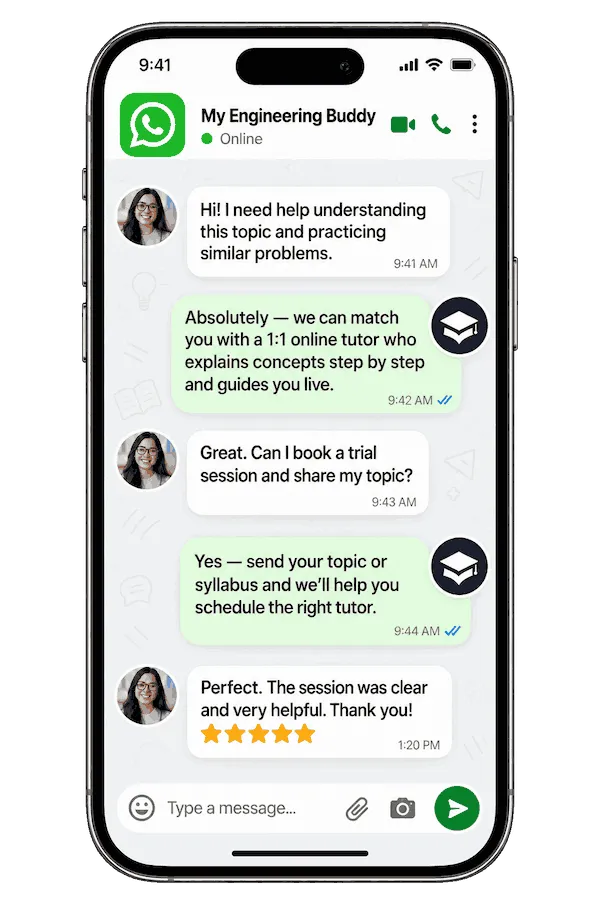
Unlike platforms where you fill out a form and wait, MEB responds in under a minute, 24/7. Tutor match takes under an hour. The $1 trial means you test before you commit. Everything runs over WhatsApp — no logins, no intake forms.
Study Plans (Pick One That Matches Your Goal)
The tutor builds a specific sequence after the diagnostic, but most students fall into one of three patterns. Catch-up (1–3 weeks): for students behind on a module with an imminent deadline — the tutor prioritises the highest-weight topics first. Exam prep (4–8 weeks): structured revision across all assessed tracks, past paper work included. Weekly support: ongoing sessions aligned to lecture schedule and assignment deadlines, useful for students who want to stay ahead rather than catch up. The tutor adjusts as priorities shift.
Pricing Guide
Standard complex systems tutoring runs $20–$40/hr for undergraduate and taught postgraduate level. Research-level support — covering topics like renormalisation, information-theoretic measures, or stochastic simulation — is available from specialist tutors at $70–$100/hr. Rate depends on topic complexity, the student’s level, the tutor’s background, and timeline urgency.
Availability narrows during semester-end and dissertation submission periods — this is not a sales line, it’s a scheduling reality that affects every popular subject.
For students targeting programmes at leading research universities — Oxford, MIT, ETH Zurich, Caltech, or equivalent — tutors with active research backgrounds in complex systems and related condensed matter physics or plasma physics are available at higher rates. Share your specific goal and MEB will match the tier to your ambition.
Start with the $1 trial — 30 minutes, no registration, no commitment. WhatsApp MEB for a quick quote.
MEB has been running since 2008 — 18 years across 2,800+ subjects, 52,000+ students, and a 4.8/5 rating on Google. That history means the tutor-matching process is refined, not guesswork.
Source: My Engineering Buddy, 2008–2025.
Try your first session for $1 — 30 minutes of live 1:1 tutoring or one homework question explained in full. No registration. No commitment. WhatsApp MEB now and get matched within the hour.
FAQ
Is complex systems hard?
Yes — it sits at the intersection of mathematics, physics, biology, and computer science, and most courses assume fluency in dynamical systems and probability before the first lecture. The difficulty is real, but it’s addressable with the right tutor.
How many sessions are needed?
Most students see clear progress in 6–10 sessions. Students starting from a significant conceptual gap — or targeting distinction-level work — typically need 15–25 sessions spread over a full term or semester.
Can you help with practice exercises?
MEB tutoring is guided learning — you understand the work, then submit it yourself. See our Academic Integrity policy and Why MEB page for full details on what we help with and what we don’t. The tutor explains; you produce and submit.
Will the tutor match my exact syllabus or exam board?
Yes. Before the first session, share your course outline, reading list, or past exam papers. The tutor maps sessions to your actual assessment structure — not a generic complex systems curriculum that may differ from yours.
What happens in the first session?
The first session is a diagnostic. The tutor identifies exactly where your understanding breaks down, sets a session sequence, and may work through one or two key concepts to give you an immediate win. It also functions as the $1 trial session.
Is online tutoring as effective as in-person?
For complex systems, yes — the subject relies on written derivations and visualisations, both of which work well on a shared digital pen-pad over Google Meet. Most MEB students never request a switch to in-person.
Can I get complex systems help at midnight or on weekends?
MEB operates 24/7 across time zones. WhatsApp response time is under a minute. Tutors are available outside standard business hours — useful for students in the Gulf or Australia whose overlap with US-based support services is limited.
What if I don’t like my assigned tutor after the first session?
Tell MEB via WhatsApp. A replacement tutor is matched within hours. The $1 trial is designed partly for this — test the fit before committing to a longer plan.
What’s the difference between complex systems and chaos theory?
Chaos theory is one branch of complex systems — it focuses on sensitive dependence on initial conditions in deterministic systems. Complex systems also covers emergence, self-organisation, network dynamics, and stochastic processes, making it a broader and more interdisciplinary field.
Do you cover agent-based modelling software like NetLogo or Mesa?
Yes. MEB tutors familiar with NetLogo, Mesa (Python), and MATLAB-based ABM frameworks are available. Share your specific modelling environment when you contact MEB so the tutor match accounts for software experience.
Can MEB help if my complex systems course is part of a PhD programme?
Yes. Research-level tutoring is available for PhD students working on dynamical systems, network science, or interdisciplinary complex systems problems. These sessions are more discussion-based — closer to peer consultation than taught instruction — and priced accordingly.
How do I get started?
Three steps: WhatsApp MEB, get matched with a verified tutor (usually within an hour), then start your $1 trial — 30 minutes of live tutoring or one question explained in full. No forms, no waiting, no commitment beyond $1.
Trust & Quality at My Engineering Buddy
Every MEB tutor goes through a structured screening process — subject-knowledge test, live demo session, and an ongoing review based on student feedback after each session. For complex systems, this means the tutor must demonstrate working knowledge of dynamical systems, network science, and the statistical physics underpinning the subject — not just familiarity with the name. Rated 4.8/5 across 40,000+ verified reviews on Google.
MEB tutoring is guided learning — you understand the work, then submit it yourself. For full details on what we help with and what we don’t, read our Academic Integrity policy and Why MEB.
MEB has served 52,000+ students across the US, UK, Canada, Australia, the Gulf, and Europe since 2008, across 2,800+ subjects. Physics and its adjacent disciplines — including complex systems, quantum mechanics, and statistical mechanics — are among the most requested. The platform connects students to tutors who have been in the same courses and passed the same exams. Read more about the methodology at MEB’s tutoring methodology page.
Explore Related Subjects
Students studying complex systems often also need support in:
- Nonlinear dynamics — covered under our classical mechanics track
- Modern physics
- Particle physics
- Biophysics
- Superconductivity
- Oscillations
- Thermal physics
- Spintronics
Next Steps
When you contact MEB, have three things ready: your exam board or course outline, the topic or assessment you’re most stuck on, and your exam date or submission deadline. That’s enough for the tutor to start building a plan.
- Share your syllabus, hardest component, and current timeline
- Share your availability and time zone
- MEB matches you with a verified complex systems tutor — usually within 24 hours
Before your first session, also have ready: a recent past paper attempt or piece of homework you struggled with. The tutor handles the rest — the first session is a diagnostic, so no preparation beyond that is needed.
Visit www.myengineeringbuddy.com for more on how MEB works.
WhatsApp to get started or email [email protected].
Reviewed by Subject Expert
This page has been carefully reviewed and validated by our subject expert to ensure accuracy and relevance.




