




~1 min
Average Reply Time
~1 hour
To Be Matched With A Tutor
30 Min Trial
75% Find Their Tutor On The 1st Trial
$20-35+/hr
Premium Yet Affordable Learning
Most athletes and students plateau not because they lack effort — but because nobody has ever corrected their programming logic or explained periodisation in a way that actually sticks.
Strength and Conditioning Tutor Online
Strength and conditioning is the applied science of developing athletic performance through resistance training, energy system work, movement mechanics, and periodisation planning, equipping students and practitioners to design evidence-based programmes for sport and health.
MEB provides 1:1 online lessons and coaching in 2800+ advanced subjects — including strength and conditioning — with tutors who have applied sport science backgrounds, not just textbook knowledge. Whether you’re searching for a Strength and Conditioning tutor near me or need someone to walk you through a periodisation model at 11pm, MEB matches you within the hour. Sessions are built around your course, your gaps, and your timeline — not a generic syllabus someone else designed. Explore our broader Physical Education tutoring if you need support across related areas too.
- 1:1 online sessions tailored to your specific course, module, or certification syllabus
- Expert-verified tutors with sport science and practical coaching backgrounds
- Flexible time zones — US, UK, Canada, Australia, Gulf
- Structured learning plan built after a diagnostic session
- Structured practice plans and progress tracking between sessions
52,000+ students across the US, UK, Canada, Australia, and the Gulf have used MEB since 2008 — including students in Physical Education subjects like Strength and Conditioning, Exercise Physiology, and Sports and Exercise Science.
Source: My Engineering Buddy, 2008–2025.
How Much Does a Strength and Conditioning Tutor Cost?
Sessions run $20–$40/hr for most undergraduate and postgraduate modules. Specialist tutors with professional coaching or elite sport backgrounds go up to $100/hr. Not sure if it’s worth it? Start with the $1 trial — 30 minutes of live 1:1 coaching or a full explanation of one concept, no registration required.
| Level / Need | Typical Rate | What’s Included |
|---|---|---|
| Undergraduate modules | $20–$35/hr | 1:1 sessions, concept explanation, programme design guidance |
| Postgraduate / Specialist | $35–$70/hr | Advanced periodisation, research methods, evidence-based practice |
| Professional Certification Prep | $40–$100/hr | CSCS, NSCA, UKSCA exam-specific coaching |
| $1 Trial | $1 flat | 30 min live session or one concept fully explained |
Tutor availability tightens significantly around exam and competition prep periods — peak demand hits fast. Book early if you have a fixed deadline.
WhatsApp MEB for a quick quote — average response time under 1 minute.
Who This Strength and Conditioning Tutoring Is For
This isn’t a service for people who just want lecture notes summarised. It’s for students and practitioners who need to understand why a programme works, not just follow one.
- Undergraduate sport science students struggling with periodisation theory or needs analysis assignments
- Students retaking a failed strength and conditioning module with a resit deadline looming
- Students with a university conditional offer that depends on passing this unit
- Postgraduate students working through advanced programme design, biomechanics, or evidence-based practice modules
- Practitioners preparing for the NSCA-CSCS, UKSCA, or similar certification exams
- Parents watching a student’s confidence drop as their coursework marks slip below what they need
Students from programmes at institutions including Loughborough University, the University of Queensland, Ohio State University, the University of Toronto, and Edith Cowan University have all used MEB for sports and exercise science help and related strength and conditioning support.
1:1 Tutoring vs Self-Study vs AI vs YouTube vs Online Courses
Self-study works if you’re disciplined — but strength and conditioning has enough applied nuance that self-study alone rarely builds the programme design judgement you need. AI tools give fast definitions of terms like RFD or RPE but can’t look at your training plan and tell you what’s actually wrong with the loading progression. YouTube is excellent for watching a squat cue demonstrated — it stops there when you need to explain the neuromuscular rationale for an exam. Online courses move at a fixed pace with no feedback on your specific errors. 1:1 tutoring with MEB is calibrated to your exact module or certification, corrects your reasoning live, and builds the kind of applied understanding that holds up under exam or client-facing pressure — which matters in strength and conditioning more than in most fields.
Outcomes: What You’ll Be Able To Do in Strength and Conditioning
After working with an online Strength and Conditioning tutor through MEB, you’ll be able to apply the NSCA’s needs analysis framework to any sport, design block and undulating periodisation models with clear rationale, explain the physiological basis of acute programme variables like intensity, volume, and rest periods, analyse movement patterns to identify technique faults and their downstream injury risk, and present evidence-based justifications for training decisions — the exact skill most examiners and certification assessors are testing.
Based on feedback from 40,000+ sessions collected by MEB from 2022 to 2025, students working 1:1 on Strength and Conditioning consistently report noticeably stronger programme design reasoning, clearer understanding of periodisation logic, and faster progress than self-directed study alone. Progress varies by starting level and practice frequency.
Source: MEB session feedback data, 2022–2025.
Try your first session for $1 — 30 minutes of live 1:1 tutoring or one homework question explained in full. No registration. No commitment. WhatsApp MEB now and get matched within the hour.
What We Cover in Strength and Conditioning (Syllabus / Topics)

Programme Design and Periodisation
- Needs analysis — sport demands, athlete profiling, movement screening
- Acute programme variables: intensity, volume, frequency, rest, tempo
- Linear, block, and undulating periodisation models
- Training phase sequencing: hypertrophy, strength, power, peaking
- Tapering strategies and competition preparation
- Long-term athlete development (LTAD) frameworks
- Monitoring load: RPE, session RPE, GPS, HRV applications
Core texts include Essentials of Strength Training and Conditioning (Haff & Triplett, NSCA), Science and Practice of Strength Training (Zatsiorsky & Kraemer), and Periodization (Bompa & Buzzichelli).
Exercise Science Foundations
- Muscle physiology: fibre types, motor unit recruitment, force-velocity relationships
- Energy systems: ATP-PCr, glycolytic, oxidative pathways and their sport relevance
- Neuromuscular adaptations to resistance training
- Biomechanics of the squat, deadlift, Olympic lifts, and sprint mechanics
- Rate of force development (RFD) and its role in power training
- Endocrine responses to training: testosterone, cortisol, GH interactions
Key references include Exercise Physiology (McArdle, Katch & Katch) and Biomechanics of Sport and Exercise (McGinnis). Get dedicated exercise physiology tutoring if this track is your primary gap.
Testing, Monitoring, and Special Populations
- Fitness testing protocols: 1RM, Yo-Yo, CMJ, sprint testing
- Statistical analysis of performance data: reliability, validity, ICC
- Strength and conditioning for youth athletes — growth and maturation considerations
- Returning athletes post-injury: load management and return-to-play criteria
- Female athlete considerations: hormonal cycle, relative energy deficiency (RED-S)
- Evidence-based practice: reading and applying sport science research
Recommended reading includes Strength and Conditioning for Sports Performance (Jeffreys & Moody) and research from the Journal of Strength and Conditioning Research.
At MEB, we’ve found that strength and conditioning students who struggle most aren’t confused about what exercises to prescribe — they’re unclear on how to justify their choices with physiological evidence. That’s almost always what the tutor addresses first.
What a Typical Strength and Conditioning Session Looks Like
The tutor opens by checking where you left off — usually a periodisation model you were building or a needs analysis framework you were applying. If you attempted a practice exam question on energy system contribution to a specific sport, the tutor pulls it up and goes through it line by line on screen. From there, you work through new material together — maybe the biomechanical rationale for an Olympic lifting progression, or the statistical interpretation of CMJ data. The tutor uses a digital pen-pad to draw force-velocity curves or annotate your training plan in real time. You explain your reasoning back; the tutor identifies exactly where the logic breaks down. The session closes with a specific task — redesign one mesocycle block, or answer one past exam question on monitoring load — and the next topic is flagged so you come in prepared. Nothing is left vague.
How MEB Tutors Help You with Strength and Conditioning (The Learning Loop)
Diagnose: In the first session, the tutor identifies whether your gaps are conceptual (you don’t understand periodisation theory), applied (you understand it but can’t build a coherent programme), or communicative (you know the answer but can’t write it for an examiner). These require different fixes.
Explain: The tutor works through live examples — a block periodisation model for a rugby player, an energy system breakdown for a 400m sprinter — using a digital pen-pad so you can see the reasoning built out step by step, not just stated.
Practice: You attempt the next problem with the tutor present. Not after the session. The point is catching errors before they become habits.
Feedback: Every error gets a specific explanation — not “that’s wrong” but “here’s why a linear model won’t work for a multi-sport athlete at this stage of the season, and here’s the NSCA framework that explains it.” That’s how understanding gets built.
Plan: Each session ends with a clear next step — a topic to read, a past question to attempt, a programme design task to bring back. Progress is tracked; nothing is left to chance.
Sessions run on Google Meet with a digital pen-pad or iPad and Apple Pencil. Before your first session, share your course outline or certification syllabus, any past work you’ve already attempted, and your exam or submission date. The tutor handles the session structure from there. Whether you need a quick catch-up before an assessment, structured revision over four to eight weeks, or ongoing weekly support through a full semester, the plan gets mapped after the first diagnostic. Start with the $1 trial — 30 minutes of live coaching that doubles as your first diagnostic session.
MEB has been running 1:1 tutoring sessions since 2008 — across sports medicine tutoring, sports nutrition help, and strength and conditioning. The learning loop is the same: diagnose the gap, explain with worked examples, practise with feedback, then plan the next step.
Source: My Engineering Buddy, 2008–2025.
Tutor Match Criteria (How We Pick Your Tutor)
Not every sport science tutor is the right fit for strength and conditioning at postgraduate level or CSCS certification level. Here’s what MEB checks.
Subject depth: Tutors are matched to your specific level — undergraduate module, masters dissertation, or certification exam — and to your exact curriculum or certification framework (NSCA, UKSCA, ASCA).
Tools: Every tutor uses Google Meet with a digital pen-pad or iPad and Apple Pencil. No static slideshows; everything is worked through live.
Time zone: Matched to your region — US, UK, Gulf states, Canada, Australia. Sessions happen when you’re available, not when a tutor in a different time zone happens to be free.
Goals: Whether you need to pass a resit, hit a distinction, or clear the CSCS exam on a second attempt, the tutor is selected against that specific target — not assigned randomly.
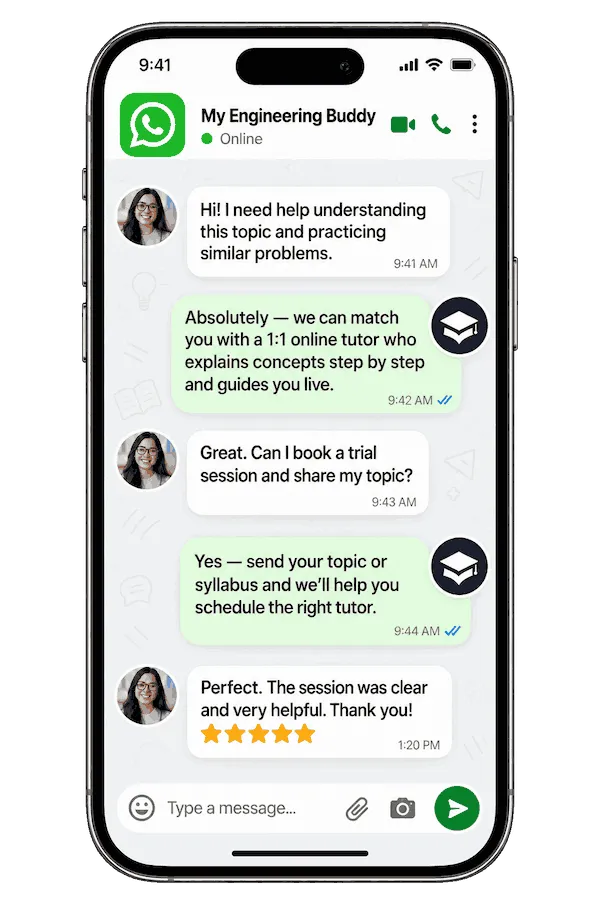
Unlike platforms where you fill out a form and wait, MEB responds in under a minute, 24/7. Tutor match takes under an hour. The $1 trial means you test before you commit. Everything runs over WhatsApp — no logins, no intake forms.
Pricing Guide
Most undergraduate and postgraduate strength and conditioning modules: $20–$40/hr. CSCS, UKSCA, and other professional certification prep: $40–$100/hr depending on tutor background and exam proximity.
Rate factors include level, topic complexity, your timeline, and tutor availability. Demand rises sharply around spring exam periods and certification exam windows — availability gets tight fast.
For students targeting elite sport academy roles, professional club positions, or strength and conditioning certifications with strict cut-off scores, tutors with professional applied coaching backgrounds are available at higher rates — share your specific goal and MEB will match the tier to your ambition.
Start with the $1 trial — 30 minutes, no registration, no commitment. WhatsApp MEB for a quick quote.
Students consistently tell us that the $1 trial session is where everything clicks — not because the tutor is impressive, but because seeing your specific programme design error corrected in real time is completely different from reading about it.
FAQ
Is Strength and Conditioning hard?
It’s genuinely demanding. The combination of exercise science theory, applied programme design, and evidence-based justification trips up students who expected it to be mostly practical. The jump from knowing what to prescribe to explaining why — in writing, for an examiner — catches most people off guard.
How many sessions are needed?
Most students see a clear shift in understanding after four to six sessions. Students preparing for CSCS or UKSCA certification, or working through a full semester module, typically book eight to twelve sessions. The diagnostic in session one shapes the plan.
How do you structure practice between sessions?
The tutor sets a specific task at the end of every session — design one mesocycle block, apply a needs analysis to a named sport, or answer a past exam question. These tasks are reviewed at the start of the next session. Progress is tracked explicitly, not left to chance.
Will the tutor match my current level and goals?
Yes. Tutors are matched to your exact level — first-year undergraduate, masters module, or professional certification — and to your specific goal. A student targeting a distinction in a university module needs a different approach than one preparing for the CSCS on a four-week timeline.
What happens in the first session?
The tutor runs a short diagnostic — asking you to walk through a concept or review something you’ve attempted. From that, the session plan gets built. Most of the first session is working through your biggest current gap, not orientation or admin.
Are online lessons as effective as in-person?
For concept work, programme design review, and exam preparation — yes, fully. The digital pen-pad replicates whiteboard explanation well. The one limitation is hands-on movement coaching, which requires in-person contact. MEB sessions focus on the knowledge and reasoning components, where online delivery works cleanly.
What’s the difference between NSCA-CSCS and UKSCA accreditation — and can MEB help with both?
The NSCA-CSCS is US-based and uses a two-section exam covering scientific foundations and practical application. UKSCA accreditation involves a portfolio and practical assessment process. Both require deep programme design knowledge. MEB tutors familiar with each framework are available — specify your certification when you message.
Can MEB help me understand how to apply periodisation to team sports, not just individual athletes?
Yes. Team sport periodisation — managing congested fixture schedules, positional demands, and collective versus individual load — is a common module topic and a real applied challenge. Tutors cover block versus in-season programming for team contexts specifically, not just textbook individual athlete models.
What if I don’t like my assigned tutor?
Tell MEB via WhatsApp and a replacement is arranged. There’s no process to navigate. Most re-matches happen the same day. The $1 trial exists partly for this reason — you test the fit before committing to anything further.
Can I get Strength and Conditioning help at midnight?
Yes. MEB operates across time zones, and WhatsApp response time is under a minute at most hours. Tutors in matching time zones are available for late-night sessions across the US, UK, Gulf, and Australia — submit your availability when you first message.
How do I get started?
WhatsApp MEB, share your course, certification, or exam details, and MEB matches you with a verified tutor — usually within the hour. Your first session is the $1 trial: 30 minutes of live 1:1 coaching. Three steps: WhatsApp, match, start.
Trust & Quality at My Engineering Buddy
Every MEB tutor goes through subject-specific screening before their first session — not a generic interview, but a live demonstration that they can explain the concepts your course actually tests. Tutors are evaluated on applied knowledge, ability to diagnose student errors, and clarity of explanation. Ongoing session feedback means poor performers don’t stay on the platform. Rated 4.8/5 across 40,000+ verified reviews on Google.
MEB tutoring is guided learning — you understand the work, then submit it yourself. For full details on what we help with and what we don’t, read our Academic Integrity policy and Why MEB.
MEB has served 52,000+ students across the US, UK, Canada, Australia, the Gulf, and Europe in 2,800+ subjects since 2008. Within Physical Education and sport science, that includes sports management help, health education tutoring, and strength and conditioning — at undergraduate, postgraduate, and professional certification levels. See our tutoring methodology for how the learning loop is built and applied across subjects.
18 years. 52,000+ students. A 4.8/5 Google rating built on 40,000+ reviews. MEB’s track record in sport science and sports and exercise science coaching reflects the same standard applied to every subject on the platform.
Source: My Engineering Buddy, 2008–2025.
Explore Related Subjects
Students studying Strength and Conditioning often also need support in:
Next Steps
Here’s what to do right now:
- Share your course, module, or certification name — and the specific topics or exam components you’re struggling with
- Share your availability and time zone
- MEB matches you with a verified strength and conditioning tutor — usually within 24 hours, often within the hour
Before your first session, have ready: your course outline or certification syllabus, a past exam question or piece of work you’ve struggled with, and your exam or deadline date. The tutor handles everything else from there.
Visit www.myengineeringbuddy.com for more on how MEB works.
WhatsApp to get started or email [email protected].
Reviewed by Subject Expert
This page has been carefully reviewed and validated by our subject expert to ensure accuracy and relevance.




