

Contact MEB Today To Get The Best
Sports and Exercise Science Tutoring Online
Email: [email protected]



~1 min
Average Reply Time
~1 hour
To Be Matched With A Tutor
30 Min Trial
75% Find Their Tutor On The 1st Trial
$20-35+/hr
Premium Yet Affordable Learning
Most students don’t fail Sports and Exercise Science because the subject is impossible. They fail because nobody ever showed them how to connect the physiology to the performance data — and then an exam arrived.
Sports and Exercise Science Tutor Online
Sports and Exercise Science is an interdisciplinary academic field covering human anatomy, exercise physiology, biomechanics, and sport psychology, equipping students to analyse athletic performance, understand health outcomes, and apply scientific principles to physical activity.
If you’re searching for a Sports and Exercise Science tutor near me, MEB gives you 1:1 online access to verified subject specialists — tutors who know the difference between VO₂ max calculations and lactate threshold interpretation, and who can walk you through the exact content your syllabus demands. Our physical education tutoring covers a wide range of applied health and performance subjects, and Sports and Exercise Science sits at the heart of that. One focused session can shift the way you read a study or structure an exam answer.
- 1:1 online sessions tailored to your exact course and exam board
- Expert-verified tutors with degrees and practical experience in exercise science
- Flexible time zones — US, UK, Canada, Australia, Gulf
- Structured learning plan built after a diagnostic session
- Ethical academic guidance — you understand before you submit
52,000+ students across the US, UK, Canada, Australia, and the Gulf have used MEB since 2008 — including students in Physical Education subjects like Sports and Exercise Science, Exercise Physiology, and Sports Medicine.
Source: My Engineering Buddy, 2008–2025.
How Much Does a Sports and Exercise Science Tutor Cost?
Most Sports and Exercise Science tutoring with MEB runs $20–$40/hr. Advanced or dissertation-level support can reach $100/hr depending on tutor experience and topic depth. Not sure yet? Start with the $1 trial first.
| Level / Need | Typical Rate | What’s Included |
|---|---|---|
| Standard (A Level, undergrad) | $20–$35/hr | 1:1 sessions, homework guidance |
| Advanced / Specialist (Masters, research) | $35–$100/hr | Expert tutor, niche depth |
| $1 Trial | $1 flat | 30 min live session or 1 homework question explained |
Tutor availability tightens sharply around end-of-semester coursework deadlines and summer exam windows. Book early if your deadline is within four weeks.
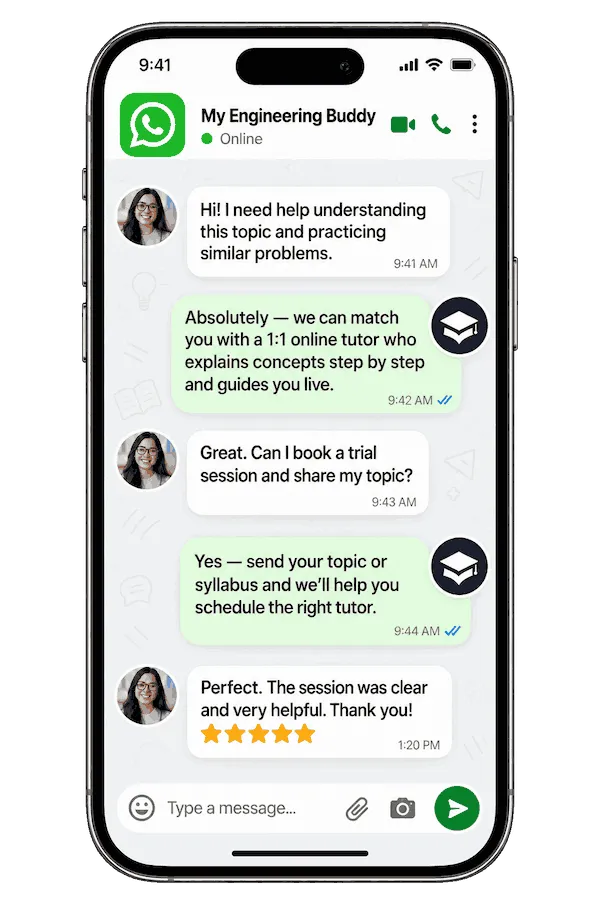
WhatsApp MEB for a quick quote — average response time under 1 minute.
Who This Sports and Exercise Science Tutoring Is For
Sports and Exercise Science attracts students from A Level and AP pathways right through to postgraduate research. The content range is wide — and so is the type of student who gets stuck. Here’s who we work with most often.
- A Level and IB students struggling to connect theory (energy systems, muscle fibre types) to applied exam questions
- Undergraduate students at universities across the US, UK, Canada, and Australia hitting a wall with statistics, biomechanics calculations, or physiology lab reports
- Students with a university conditional offer depending on this grade — where the margin between pass and failure is one exam component
- Masters students working through research methodology, data analysis, or literature review chapters
- Students 4–6 weeks from an exam with significant gaps in exercise physiology or sport psychology still to close
- Parents watching a child’s confidence drop alongside their grades in a subject they chose because they love sport
Students have come to MEB from degree programmes at institutions including Loughborough University, the University of Queensland, Penn State, the University of Toronto, and Brunel University. We don’t name-drop — we just want you to know we know the syllabuses.
At MEB, we’ve found that Sports and Exercise Science students often know the content better than they think — the real gap is usually in applying terminology precisely under exam conditions. Closing that gap in 3–4 focused sessions is entirely realistic.
1:1 Tutoring vs Self-Study vs AI vs YouTube vs Online Courses
Self-study works if you’re disciplined — but Sports and Exercise Science has too many interconnected systems for most students to sequence alone. AI tools give fast explanations but can’t identify that you’re misreading cardiac output data every time. YouTube is great for visualising muscle anatomy, then goes silent when you’re stuck on a specific OBLA question. Online courses follow a fixed pace regardless of where your gaps actually are. 1:1 tutoring with MEB is live, calibrated to your exact syllabus and exam board, and corrects your reasoning in the moment — not after you’ve submitted the wrong answer.
Outcomes: What You’ll Be Able To Do in Sports and Exercise Science
After working with an online Sports and Exercise Science tutor through MEB, students consistently report being able to analyse energy system demands across different sport types with precision, apply VO₂ max and lactate threshold data to training programme design, explain biomechanical principles like ground reaction forces and torque in exam-ready language, evaluate research methodology in peer-reviewed exercise science studies, and present sport psychology concepts — including motivation theories and arousal models — within structured essay frameworks.
Supporting a student through Sports and Exercise Science? MEB works directly with parents to set up sessions, track progress, and keep coursework on schedule. WhatsApp MEB — average response time is under a minute, 24/7.
Based on feedback from 40,000+ sessions collected by MEB from 2022 to 2025, 58% of students improved by one full grade after approximately 20 hours of 1:1 tutoring in subjects like Sports and Exercise Science. A further 23% achieved at least a half-grade improvement.
Source: MEB session feedback data, 2022–2025.
Try your first session for $1 — 30 minutes of live 1:1 tutoring or one homework question explained in full. No registration. No commitment. WhatsApp MEB now and get matched within the hour.
What We Cover in Sports and Exercise Science (Syllabus / Topics)

Exercise Physiology and Anatomy
- Energy systems: ATP-PC, glycolytic, and aerobic pathways and their application to sport
- Cardiovascular and respiratory responses to acute and chronic exercise
- Muscle fibre types (Type I, IIa, IIx) and their recruitment patterns
- VO₂ max, lactate threshold, and onset of blood lactate accumulation (OBLA)
- Thermoregulation and hydration during exercise
- Adaptations to endurance and resistance training over time
Core texts include McArdle, Katch & Katch’s Exercise Physiology and Wilmore & Costill’s Physiology of Sport and Exercise.
Biomechanics and Movement Analysis
- Newton’s laws applied to human movement and sport performance
- Linear and angular motion, velocity, acceleration, and momentum
- Ground reaction forces, centre of mass, and stability
- Torque, levers, and their role in strength and technique
- Projectile motion in sport contexts (throws, jumps, kicks)
- Video analysis and basic kinematic data interpretation
Recommended references include Hamill, Knutzen & Derrick’s Biomechanical Basis of Human Movement and McGinnis’s Biomechanics of Sport and Exercise.
Sport Psychology and Performance
- Arousal, anxiety, and performance: Inverted-U theory, catastrophe theory, and IZOF
- Motivation theories: achievement goal theory, self-determination theory
- Confidence, self-efficacy, and attribution in sport contexts
- Attention, concentration, and psychological skills training (PST)
- Group dynamics, cohesion, and leadership in team sport
- Stress and coping strategies for competitive athletes
Key texts include Weinberg & Gould’s Foundations of Sport and Exercise Psychology and Gill & Williams’s Psychological Dynamics of Sport and Exercise.
Research Methods and Applied Sport Science
- Quantitative and qualitative research design in exercise science
- Validity, reliability, and ethical considerations in sport science research
- Statistical analysis: descriptive stats, correlation, t-tests, and ANOVA basics
- Fitness testing protocols: VO₂ max estimation, strength, flexibility, body composition
- Training programme design principles: periodisation, overload, specificity, recovery
- Interpreting and critiquing peer-reviewed exercise science literature
Useful references include Thomas, Nelson & Silverman’s Research Methods in Physical Activity and Vincent’s Statistics in Kinesiology.
What a Typical Sports and Exercise Science Session Looks Like
The tutor opens by revisiting the previous topic — say, the cardiovascular drift during prolonged exercise — checking what stuck and what didn’t. From there, the session moves into the current focus: the student and tutor work through a biomechanics problem on screen, such as calculating torque at the knee joint during a squat, with the tutor using a digital pen-pad to annotate diagrams in real time. The student then attempts a parallel problem while explaining their reasoning aloud. If they misapply a formula or confuse angular and linear momentum, the tutor catches it immediately and shows exactly where the logic broke. The session closes with a specific practice task — two exam-style questions on energy systems — and the next topic is noted so no session starts cold.
How MEB Tutors Help You with Sports and Exercise Science (The Learning Loop)
Diagnose: In the first session, the tutor identifies exactly where understanding breaks down — whether it’s energy system sequencing, misreading a force-velocity curve, or structuring a sport psychology essay argument. Not general weakness. Specific gaps.
Explain: The tutor works through live problems using a digital pen-pad — annotating muscle diagrams, drawing training adaptation curves, or walking through a research design flaw step by step. No slides. No pre-recorded content.
Practice: The student attempts the next problem with the tutor present. This is where real learning happens — not watching someone else do it, but doing it under guided conditions.
Feedback: The tutor gives step-by-step error correction, naming exactly why a mark would be lost in an exam context. “You described the mechanism but didn’t link it to the sport — that’s worth 2 of the 4 marks.”
Plan: Each session ends with a clear next topic, a practice task, and a note of what to bring to the next session. Progress doesn’t drift — it compounds.
Sessions run over Google Meet with a digital pen-pad or iPad and Apple Pencil. Before your first session, share your syllabus or course outline, a recent past paper attempt or piece of work you found difficult, and your exam or submission date. The tutor builds the plan from there. Start with the $1 trial — 30 minutes of live tutoring that also serves as your first diagnostic.
Students consistently tell us that the Learning Loop approach — diagnose, explain, practice, feedback, plan — is what separates MEB from watching a lecture recording for the third time and still not understanding why the answer is wrong.
Source: My Engineering Buddy, 2008–2025.
Tutor Match Criteria (How We Pick Your Tutor)
Not every exercise scientist is the right tutor for every student. Here’s how MEB matches.
Subject depth: Tutors are matched to your specific level — A Level OCR/AQA, IB Sports Exercise and Health Science, undergraduate kinesiology, or Masters-level research methods. Syllabus familiarity is verified, not assumed.
Tools: Every tutor uses Google Meet with a digital pen-pad or iPad and Apple Pencil — essential for annotating diagrams, drawing force vectors, and working through calculations visually.
Time zone: Tutors are matched to your region — US, UK, Gulf, Canada, or Australia — so session times are realistic, not 2am compromises.
Goals: Whether you need exam score improvement, conceptual depth on a specific topic, ongoing academic guidance, or research methodology guidance for a dissertation, the tutor is selected accordingly.
Unlike platforms where you fill out a form and wait, MEB responds in under a minute, 24/7. Tutor match takes under an hour. The $1 trial means you test before you commit. Everything runs over WhatsApp — no logins, no intake forms.
Study Plans (Pick One That Matches Your Goal)
Three options fit most Sports and Exercise Science students. Catch-up (1–3 weeks): for students behind on specific topics with a deadline close. Exam prep (4–8 weeks): structured revision across all components — physiology, biomechanics, psychology, research methods — timed to your exam date. Weekly support: ongoing sessions aligned to your semester schedule, coursework deadlines, and module assessments. The tutor builds the specific sequence after the first diagnostic — no generic plans.
Pricing Guide
Sports and Exercise Science tutoring runs $20–$40/hr for most levels. Graduate-level support, dissertation methodology help, or highly specialist topics can reach $100/hr. Rate depends on the level, topic complexity, your timeline, and tutor availability.
For students targeting competitive postgraduate programmes or sport science careers in professional sport organisations, MEB can match tutors with relevant research or industry backgrounds — share your specific goal and MEB will identify the right tier.
Availability narrows fast during April–May exam windows and November coursework deadlines. If your submission is within four weeks, don’t wait. Start with the $1 trial — 30 minutes, no registration, no commitment. WhatsApp MEB for a quick quote.
FAQ
Is Sports and Exercise Science hard?
It’s demanding because it spans multiple disciplines — physiology, biomechanics, psychology, and research methods — each with its own vocabulary and assessment style. Students who struggle most are usually those who treat it as memorisation rather than applied reasoning. A tutor reframes that early.
How many sessions are needed?
Most students see a clear shift in 4–6 sessions. Exam prep typically runs 8–12 sessions over 4–6 weeks. A single session is enough to resolve a specific calculation or essay structure problem. The $1 trial shows you exactly what one session can do.
Can you help with homework and assignments?
Yes. MEB tutoring is guided learning — you understand the work, then submit it yourself. If you’re stuck on a physiology lab report or a biomechanics problem set, the tutor explains the method until you can apply it independently. See our Academic Integrity policy and Why MEB page for full details on what we help with and what we don’t.
Will the tutor match my exact syllabus or exam board?
Yes. Whether you’re on AQA, OCR, Pearson, CSEC, or a university module with a specific textbook, the tutor is matched to your syllabus. Share your course outline or exam board on WhatsApp and MEB handles the rest.
What happens in the first session?
The tutor runs a short diagnostic — asking you to work through a problem or explain a concept — to locate exactly where the gaps are. From there, the session moves directly into the highest-priority content. No generic introductions. No wasted time.
Is online tutoring as effective as in-person?
For Sports and Exercise Science, yes — and often better. Digital pen-pads let tutors annotate diagrams, draw energy system graphs, and mark up biomechanics problems in real time. Students in our sessions report clearer understanding than from classroom teaching, where there’s rarely time for individual questions.
What’s the difference between Sports and Exercise Science and Physical Education at university level?
Sports and Exercise Science is science-focused — physiology, biomechanics, research methods, data analysis. Physical Education at university typically emphasises pedagogy, coaching, and curriculum delivery. Many degree programmes overlap. MEB tutors cover both, and can clarify which content applies to your specific module.
Can MEB help with the research methods and statistics component?
Yes. Research methods is one of the most commonly requested areas — particularly ANOVA, correlation analysis, validity and reliability concepts, and writing up a methods section. Tutors with postgraduate research backgrounds are available specifically for this component.
Do you offer group Sports and Exercise Science sessions?
MEB specialises in 1:1 sessions. Group sessions aren’t offered as a standard format. The 1:1 model exists because Sports and Exercise Science gaps are specific to each student — energy systems for one, biomechanics calculations for another — and group sessions can’t address both in the same hour.
How do I find a Sports and Exercise Science tutor in my city?
MEB is fully online, so location doesn’t matter. Students in London, Toronto, Dubai, Sydney, and Houston all access the same tutor pool. Time zone is matched to your region. There’s no local availability problem to solve.
Can you help with coursework and NEA components specific to Sports and Exercise Science?
Yes. NEA and coursework components — particularly data collection write-ups, analysis sections, and evaluation of testing protocols — are areas where tutors provide structured guidance. You plan, collect, write, and submit. The tutor helps you understand what’s expected at each stage and where your current draft falls short.
How do I get started?
Three steps. WhatsApp MEB, share your subject level, exam board, and hardest topic. MEB matches you with a verified tutor — usually within the hour. Your first session is the $1 trial — 30 minutes of live 1:1 tutoring or one assignment question explained fully. No registration required.
Trust & Quality at My Engineering Buddy
Every MEB tutor goes through subject-specific screening — degree verification, a live demo session reviewed by the MEB team, and ongoing feedback monitoring from student ratings. Tutors covering Sports and Exercise Science hold relevant degrees in kinesiology, sport science, exercise physiology, or closely related fields, and many have practical experience in performance coaching, lab research, or clinical exercise settings. Rated 4.8/5 across 40,000+ verified reviews on Google.
MEB tutoring is guided learning — you understand the work, then submit it yourself. For full details on what we help with and what we don’t, read our Academic Integrity policy and Why MEB.
MEB has served 52,000+ students across the US, UK, Canada, Australia, the Gulf, and Europe in 2,800+ subjects since 2008. Within Physical Education and applied health sciences, tutors cover Sports and Exercise Science alongside exercise physiology tutoring and sports medicine help — drawing on a tutor pool with genuine depth across the full discipline. The MEB tutoring methodology is built around the diagnostic-first model that underpins every session.
A common pattern our tutors observe is that students arrive having memorised energy system facts but unable to apply them to a novel sport scenario in an exam — that transfer gap is exactly what 1:1 tutoring closes faster than any other format.
Source: My Engineering Buddy, 2008–2025.
Explore Related Subjects
Students studying Sports and Exercise Science often also need support in:
Next Steps
Getting started takes under two minutes. Share your exam board or course outline, your hardest topic right now, and your exam or submission date. Add your time zone and preferred session times. MEB matches you with a verified Sports and Exercise Science tutor — usually within 24 hours, often faster.
Before your first session, have ready:
- Your exam board and syllabus or course module outline
- A recent past paper attempt or piece of work you found difficult
- Your exam date or coursework deadline
The tutor handles the rest. First session starts with a diagnostic so every minute is used well.
Visit www.myengineeringbuddy.com for more on how MEB works.
WhatsApp to get started or email [email protected].
Reviewed by Subject Expert
This page has been carefully reviewed and validated by our subject expert to ensure accuracy and relevance.




