~1 min
Average Reply Time
~1 hour
To Be Matched With A Tutor
30 Min Trial
75% Find Their Tutor On The 1st Trial
$20-35+/hr
Premium Yet Affordable Learning
Most students who struggle with Sports Medicine don’t lack effort — they’re working through musculoskeletal anatomy, injury assessment protocols, and rehabilitation principles without anyone to catch where their reasoning goes wrong.
Sports Medicine Tutor Online
Sports Medicine is an interdisciplinary health science covering injury prevention, diagnosis, and rehabilitation in athletic and physically active populations. It integrates anatomy, physiology, biomechanics, and clinical assessment to prepare students for careers in sports healthcare.
MEB offers 1:1 online Sports Medicine tutor sessions for undergraduate, graduate, and professional certification students across the US, UK, Canada, Australia, and the Gulf. Whether you’re working through injury assessment frameworks, rehabilitation protocols, or exercise physiology principles, a Sports Medicine tutor near me — now available online — gives you live, subject-specific guidance that no textbook chapter can replicate. MEB’s Physical Education tutoring network connects you with tutors who know your exact course structure and where students typically lose marks.
- 1:1 online sessions tailored to your course outline and syllabus
- Expert-verified tutors with subject-specific clinical and academic backgrounds
- Flexible time zones — US, UK, Canada, Australia, Gulf
- Structured learning plan built after a diagnostic session
- Ethical homework and assignment guidance — you understand before you submit
52,000+ students across the US, UK, Canada, Australia, and the Gulf have used MEB since 2008 — including students in Physical Education subjects like Sports Medicine, Exercise Physiology, and Sports and Exercise Science.
Source: My Engineering Buddy, 2008–2025.
How Much Does a Sports Medicine Tutor Cost?
Most Sports Medicine tutoring sessions run $20–$40/hr. Advanced topics — clinical biomechanics, sports pharmacology, graduate-level rehabilitation science — may reach up to $100/hr depending on tutor depth and session complexity. The $1 trial gets you 30 minutes of live 1:1 tutoring or one full homework question explained — no registration required.
| Level / Need | Typical Rate | What’s Included |
|---|---|---|
| Standard (most undergrad levels) | $20–$35/hr | 1:1 sessions, homework guidance |
| Advanced / Graduate / Clinical | $35–$100/hr | Expert tutor, specialist depth |
| $1 Trial | $1 flat | 30 min live session or 1 homework question |
Tutor availability tightens around end-of-semester assessment periods and clinical placement preparation weeks. Book early if your deadline is within four weeks.
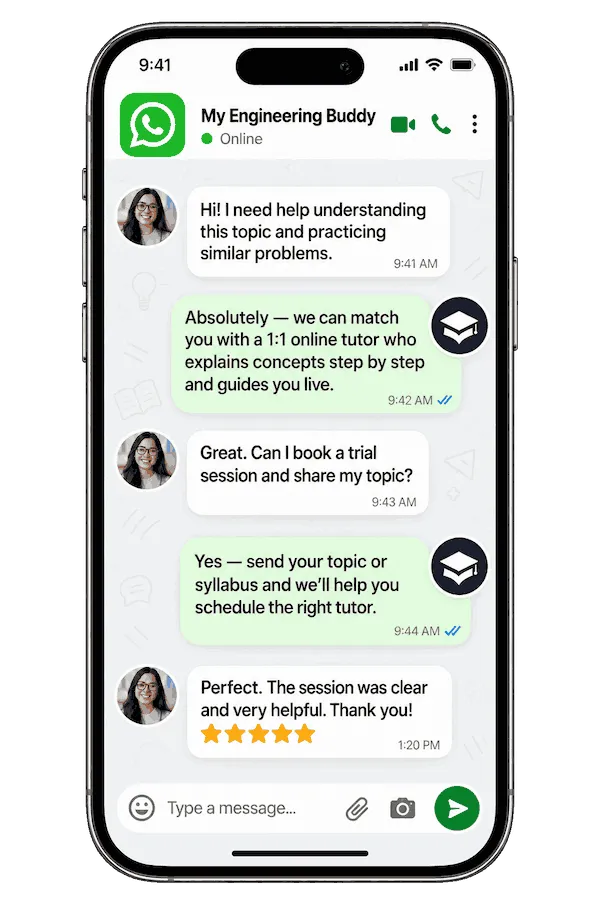
WhatsApp MEB for a quick quote — average response time under 1 minute.
Who This Sports Medicine Tutoring Is For
Sports Medicine draws students from kinesiology, athletic training, physical therapy pre-professional programs, and health sciences. The content is clinically rigorous, and gaps in anatomy or biomechanics foundations compound fast.
- Undergraduate students struggling with musculoskeletal anatomy or orthopedic assessment techniques
- Graduate students working through advanced rehabilitation science, sports pharmacology, or research methodology
- Athletic training certification candidates preparing for the BOC exam
- Students retaking after a failed first attempt in a clinical practicum or written assessment
- Students with a university conditional offer depending on passing this course
- Parents watching a student’s confidence drop alongside their practical marks
MEB has worked with students from programs at institutions including the University of Michigan, Penn State, the University of Toronto, Loughborough University, the University of Queensland, and Ohio State. The $1 trial is the fastest way to find out whether the fit is right.
1:1 Tutoring vs Self-Study vs AI vs YouTube vs Online Courses
Self-study works if you’re disciplined, but Sports Medicine requires clinical reasoning — and no textbook corrects your logic in real time. AI tools give fast definitions of RICE protocol or muscle origins, but can’t diagnose why your injury assessment reasoning keeps breaking down on case studies. YouTube covers the basics of taping techniques and anatomical landmarks well — it stops when your lecturer’s case study format doesn’t match the video. Online courses follow a fixed pace that ignores where you specifically got stuck. 1:1 tutoring with MEB is live, calibrated to your exact course, and corrects errors the moment they form — before they cost you marks on a practical or written exam.
Outcomes: What You’ll Be Able To Do in Sports Medicine
After focused 1:1 sessions, students consistently report moving from passive memorisation to genuine clinical reasoning. You’ll be able to apply injury assessment frameworks like HOPS and SOAP notes accurately under exam conditions, analyse biomechanical factors contributing to common athletic injuries such as ACL tears and rotator cuff pathologies, explain the physiological basis of rehabilitation progressions, present differential diagnosis reasoning for musculoskeletal complaints, and write evidence-based treatment plans that meet the standards expected at your program level.
Based on feedback from 40,000+ sessions collected by MEB from 2022 to 2025, 58% of students improved by one full grade after approximately 20 hours of 1:1 tutoring in subjects like Sports Medicine. A further 23% achieved at least a half-grade improvement.
Source: MEB session feedback data, 2022–2025.
Supporting a student through Sports Medicine? MEB works directly with parents to set up sessions, track progress, and keep coursework on schedule. WhatsApp MEB — average response time is under a minute, 24/7.
What We Cover in Sports Medicine (Syllabus / Topics)

Musculoskeletal Anatomy & Injury Assessment
- Skeletal anatomy: bones, joints, and articular structures of the upper and lower extremity
- Muscle origins, insertions, actions, and common injury sites
- Ligament and tendon anatomy relevant to athletic injury patterns
- HOPS assessment framework: History, Observation, Palpation, Special Tests
- SOAP note writing for clinical documentation
- Orthopaedic special tests: Lachman, McMurray, Hawkins-Kennedy, and equivalents
- Differential diagnosis for common sports injuries: sprains, strains, fractures, dislocations
Textbooks used in this track include Starkey & Brown’s Examination of Orthopedic and Athletic Injuries and Prentice’s Principles of Athletic Training.
Rehabilitation Science & Therapeutic Modalities
- Phases of tissue healing: inflammatory, proliferative, remodelling
- Rehabilitation progression principles: range of motion, strength, proprioception, functional return
- Therapeutic modalities: ultrasound, electrical stimulation, cryotherapy, thermotherapy
- Taping and bracing techniques: McConnell, kinesiology tape, prophylactic bracing
- Return-to-sport criteria and functional testing protocols
- Evidence-based rehabilitation for ACL, rotator cuff, ankle sprain, and hamstring injuries
Core references include Prentice’s Therapeutic Modalities for Sports Medicine and Athletic Training and Andrews, Harrelson & Wilk’s Physical Rehabilitation of the Injured Athlete.
Exercise Physiology & Sports Performance
- Energy systems: ATP-PCr, glycolytic, and oxidative pathways in sport contexts
- Cardiovascular and respiratory adaptations to training
- Thermoregulation and heat illness prevention in athletic settings
- Overtraining syndrome, fatigue, and recovery science
- Performance nutrition principles as they relate to injury risk and recovery
- Doping, banned substances, and WADA guidelines for student-athlete contexts
Recommended texts include McArdle, Katch & Katch’s Exercise Physiology and the Australian Curriculum, Assessment and Reporting Authority frameworks for health science subjects at secondary and tertiary levels.
Students consistently tell us that Sports Medicine feels manageable in lecture — it’s the case study application where things fall apart. The gap between knowing a special test exists and correctly interpreting it under exam pressure is where 1:1 sessions make the most difference.
What a Typical Sports Medicine Session Looks Like
The tutor opens by checking the previous session’s topic — often a specific orthopedic special test or a rehabilitation phase the student was applying incorrectly. From there, the student and tutor work through a clinical case study on screen: the tutor presents a scenario, the student works through the HOPS assessment or SOAP note, and the tutor uses a digital pen-pad to annotate anatomical landmarks or mark errors in the clinical reasoning chain. When the student gets stuck on the difference between a Grade II and Grade III ligament sprain and what that means for rehabilitation staging, the tutor works through it live. By the end, a specific practice task is set — usually a timed case study response or a set of special test identification questions — and the next session topic is agreed.
How MEB Tutors Help You with Sports Medicine (The Learning Loop)
Diagnose: In the first session, the tutor identifies exactly where clinical reasoning breaks down — whether that’s anatomy gaps, misapplication of assessment frameworks, or weak evidence-based justification in written answers.
Explain: The tutor works through live problems using a digital pen-pad, drawing anatomical structures, annotating injury mechanisms, and walking through case study logic step by step — not just the answer, but why.
Practice: The student attempts a case study, writes a SOAP note, or answers a differential diagnosis question with the tutor present — building the clinical reasoning habit under low-stakes conditions before the exam.
Feedback: The tutor gives step-by-step correction: where marks were lost, which assessment criterion wasn’t met, and how to restructure the answer. Sports Medicine marking rubrics are unforgiving, and students rarely know exactly what went wrong.
Plan: Each session closes with a specific progression — the next topic, a timed practice task, and a check on the overall timeline to the exam or submission deadline.
Sessions run on Google Meet with a digital pen-pad or iPad and Apple Pencil. Before the first session, share your course outline or syllabus, a recent case study or homework you struggled with, and your exam or submission date. The first session doubles as a diagnostic. Start with the $1 trial — 30 minutes of live tutoring that also serves as your first diagnostic.
At MEB, we’ve found that Sports Medicine students often know the terminology but can’t yet sequence it into clinical reasoning. The shift happens when they’re pushed to justify every step out loud — that’s when the knowledge stops being passive.
The most common pattern MEB tutors see in Sports Medicine: a student who can name every special test but cannot explain when to use one over another, or why a negative result still warrants further investigation.
Source: My Engineering Buddy tutor observations, 2008–2025.
Tutor Match Criteria (How We Pick Your Tutor)
Not every Sports Medicine tutor is right for every student. MEB matches on four criteria.
Subject depth: The tutor must have covered your specific course level — undergraduate athletic training, graduate rehabilitation science, or BOC certification prep — not just general anatomy knowledge.
Tools: All tutors use Google Meet with a digital pen-pad or iPad and Apple Pencil. Clinical diagrams and case study annotations require proper visual tools — not a shared Google Doc.
Time zone: Matched to your region — US, UK, Canada, Australia, or the Gulf. No scheduling across inconvenient time gaps.
Goals: Whether you need exam score improvement, conceptual depth in rehabilitation science, or homework completion support, the tutor is matched to that specific goal.
Unlike platforms where you fill out a form and wait, MEB responds in under a minute, 24/7. Tutor match takes under an hour. The $1 trial means you test before you commit. Everything runs over WhatsApp — no logins, no intake forms.
Study Plans (Pick One That Matches Your Goal)
The tutor builds the specific sequence after the diagnostic, but most Sports Medicine students fall into one of three plans: Catch-up (1–3 weeks) for students behind on anatomy or assessment frameworks with an exam close; Exam prep (4–8 weeks) for structured progression through every assessable topic with timed case study practice built in; or Weekly support aligned to your semester schedule, covering each clinical module as it appears. Students targeting Strength and Conditioning tutoring alongside Sports Medicine can have both streams coordinated under one tutor match.
Pricing Guide
Sports Medicine tutoring starts at $20/hr for standard undergraduate content. Graduate-level rehabilitation science, sports pharmacology, and clinical practicum preparation run higher — typically $50–$100/hr depending on tutor background and session complexity.
Rate factors include your current level, the complexity of the specific topics, your timeline, and tutor availability in your time zone. Availability shrinks significantly during end-of-semester and clinical placement preparation periods.
For students targeting admission to competitive sports medicine graduate programs or BOC certification, tutors with professional clinical or research backgrounds are available at higher rates — share your specific goal and MEB will match the tier to your ambition.
Start with the $1 trial — 30 minutes, no registration, no commitment. WhatsApp MEB for a quick quote.
FAQ
Is Sports Medicine hard?
It’s clinically demanding. The anatomy load is high, case study reasoning takes practice to develop, and assessment frameworks like HOPS and SOAP require consistent application under pressure. Most students find the concepts logical — the difficulty is applying them precisely.
How many sessions are needed to improve in Sports Medicine?
Most students see meaningful progress in 6–10 focused sessions. Students with significant anatomy gaps or complex rehabilitation science content typically benefit from 15–20 hours before an exam. The diagnostic session maps the exact plan.
Can you help with Sports Medicine homework and assignments?
MEB tutoring is guided learning — you understand the work, then submit it yourself. Tutors work through case study reasoning, SOAP note structure, and evidence-based justification with you. See our Academic Integrity policy and Why MEB page for full details on what we help with and what we don’t.
Will the tutor match my exact syllabus or exam board?
Yes. MEB tutors are matched to your specific course — whether that’s an undergraduate athletic training program, a graduate sports medicine module, or BOC certification content. Share your syllabus or course outline before the first session.
What happens in the first session?
The tutor runs a diagnostic: identifying your strongest and weakest areas, reviewing a recent assignment or case study you found difficult, and building a session plan from there. No time is wasted on content you already know well.
Is online Sports Medicine tutoring as effective as in-person?
For theory, case study reasoning, and assessment preparation — yes. Google Meet with a digital pen-pad handles anatomical annotation and case study walkthroughs well. Hands-on clinical skills requiring physical practice are outside the scope of online sessions.
What’s the difference between Sports Medicine and Exercise Physiology, and can MEB help with both?
Sports Medicine focuses on injury assessment, diagnosis, and rehabilitation; Exercise Physiology tutoring covers physiological responses to training and performance. Many programs require both. MEB tutors can cover either or coordinate content across both subjects.
Do MEB tutors cover BOC athletic training certification preparation?
Yes. MEB has tutors familiar with the Board of Certification (BOC) exam content domains, including injury and illness prevention, examination and diagnosis, immediate and emergency care, and therapeutic interventions. Share your target exam date and current content gaps when you make contact.
Can I get Sports Medicine tutoring help late at night or on weekends?
Yes. MEB operates 24/7 across time zones. Students in the US, UK, Gulf, Canada, and Australia regularly book evening and weekend sessions. WhatsApp response time is typically under one minute regardless of the hour.
What if I don’t like my assigned Sports Medicine tutor?
Request a switch over WhatsApp. MEB will match you with a different tutor — usually within the hour. The $1 trial exists precisely so you can test the fit before any commitment.
How do I get started with Sports Medicine tutoring?
Three steps: WhatsApp MEB, get matched with a verified Sports Medicine tutor within 24 hours, then start the $1 trial — 30 minutes of live 1:1 tutoring or one homework question explained in full. No registration required.
Can sports nutrition and sports medicine topics be covered in the same sessions?
Where they overlap — recovery nutrition, supplement safety, WADA guidelines, and energy availability — yes. For dedicated Sports Nutrition tutoring covering macronutrient periodisation and dietary assessment, a subject-specific tutor match is recommended.
Trust & Quality at My Engineering Buddy
Every MEB tutor goes through subject-specific screening: degree verification, a live demo session evaluation, and ongoing review based on student feedback. Tutors covering Sports Medicine hold relevant degrees in athletic training, kinesiology, sports science, or physiotherapy — many with clinical or research experience. Rated 4.8/5 across 40,000+ verified reviews on Google, MEB has served 52,000+ students since 2008 across the US, UK, Canada, Australia, the Gulf, and Europe.
MEB tutoring is guided learning — you understand the work, then submit it yourself. For full details on what we help with and what we don’t, read our Academic Integrity policy and Why MEB.
MEB covers 2,800+ subjects, with particular depth in health sciences including Physical Education, Sports Medicine, Sports and Exercise Science tutoring, and Health Education tutoring. Whether you need help with a single assessment or ongoing support through a full semester, the platform is built to match you fast and get the first session started without delay. Read more about how sessions are structured at MEB’s tutoring methodology page.
Try your first session for $1 — 30 minutes of live 1:1 tutoring or one homework question explained in full. No registration. No commitment. WhatsApp MEB now and get matched within the hour.
MEB tutors working in Sports Medicine and adjacent health science subjects bring a mix of academic and clinical backgrounds — including athletic trainers, physiotherapists, and sports scientists — matched to each student’s specific course level.
Source: My Engineering Buddy, 2008–2025.
Explore Related Subjects
Students studying Sports Medicine often also need support in:
- Sports Management
- Sports Nutrition
- Strength and Conditioning
- Sports and Exercise Science
- Health Education
Next Steps
When you contact MEB, share your exam board or course outline, the component you’re finding hardest, and your current timeline to the exam or submission deadline. Include your available time slots and time zone — MEB will match you with a verified Sports Medicine tutor, usually within 24 hours.
Before your first session, have ready: your syllabus or course outline, a recent case study attempt or homework question you struggled with, and your exam or deadline date. The tutor handles the rest.
- Share your exam board, hardest component, and current timeline
- Share your availability and time zone
- MEB matches you with a verified tutor — usually within 24 hours
The first session starts with a diagnostic so every minute is used well. Visit www.myengineeringbuddy.com for more on how MEB works.
WhatsApp to get started or email [email protected].
Reviewed by Subject Expert
This page has been carefully reviewed and validated by our subject expert to ensure accuracy and relevance.