




~1 min
Average Reply Time
~1 hour
To Be Matched With A Tutor
30 Min Trial
75% Find Their Tutor On The 1st Trial
$20-35+/hr
Premium Yet Affordable Learning
Pods refusing to schedule. Services unreachable. Your cluster is broken and the deadline is in 48 hours.
Kubernetes Tutor Online
Kubernetes is an open-source container orchestration platform that automates deploying, scaling, and managing containerised applications across clusters of nodes, equipping engineers to run production-grade distributed systems reliably.
Finding a Kubernetes tutor near me who actually understands cluster networking, RBAC, and Helm releases — not just the theory — is harder than it sounds. MEB connects you with verified software engineering and DevOps specialists who work through your exact setup, live, on screen. Whether you are stuck on a CKA exam topic, debugging a broken deployment pipeline, or building your first multi-node cluster for a portfolio project, the right tutor makes the difference between hours of dead ends and actual progress.
- 1:1 online sessions built around your environment, your version, your problem
- Expert-verified tutors with hands-on Kubernetes production and certification experience
- Flexible time zones — US, UK, Canada, Australia, Gulf covered
- Structured plan built after a short diagnostic of your current setup and goals
- Guided project support — we explain the concepts and architecture; you build and deploy
52,000+ students across the US, UK, Canada, Australia, and the Gulf have used MEB since 2008 — including students working on software engineering subjects like Docker, Terraform, and Ansible.
Source: My Engineering Buddy, 2008–2025.
How Much Does a Kubernetes Tutor Cost?
Most Kubernetes tutoring sessions run $20–$40/hr. For CKA/CKAD exam prep, advanced cluster architecture, or production-level troubleshooting with an industry-experienced engineer, rates go up to $100/hr. Start with the $1 trial — 30 minutes live or one project question explained in full.
| Level / Need | Typical Rate | What’s Included |
|---|---|---|
| Standard (coursework, intro projects) | $20–$35/hr | 1:1 live sessions, project guidance |
| Advanced / CKA / CKAD exam prep | $35–$70/hr | Expert tutor, exam simulation, deep debug |
| Production / cloud architecture | Up to $100/hr | Industry engineer, real cluster review |
| $1 Trial | $1 flat | 30 min live session or 1 project question |
Tutor availability tightens significantly in the weeks before CKA exam windows. If you have a fixed target date, book early.
WhatsApp MEB for a quick quote — average response time under 1 minute.
Who This Kubernetes Tutoring Is For
Kubernetes is genuinely hard. The gap between reading the documentation and getting a real cluster to behave is wide — and most people hit it fast. This tutoring is for people who have hit that gap and need someone who has been there before.
- Computer science and engineering students building containerised applications for coursework or final-year projects
- Developers preparing for the DevOps or cloud engineering path who need to close Kubernetes gaps fast
- Students retaking a failed first attempt at the CKA or CKAD certification exam
- Professionals setting up their first production cluster and stuck on networking, storage, or RBAC configuration
- Graduate students building distributed systems research infrastructure who need technical guidance, not documentation links
- Students who built their entire portfolio around microservices and now cannot get the orchestration layer working before a job interview.
Students who have worked with MEB on Kubernetes also come from programmes at institutions including MIT, Carnegie Mellon, Georgia Tech, Imperial College London, ETH Zurich, the University of Toronto, and the Australian National University.
1:1 Tutoring vs Self-Study vs AI vs YouTube vs Online Courses
Self-study: works if you are disciplined and have a working cluster to experiment on — but no feedback loop when something breaks silently. AI tools: fast for syntax questions, but cannot see your actual YAML files, your cluster state, or why your pod is in CrashLoopBackOff. YouTube: good for concept overviews; ends the moment your specific error is not the one in the video. Online courses: structured, but move at a fixed pace and skip the messy real-world edge cases Kubernetes is famous for. 1:1 tutoring with MEB: live, looking at your exact cluster output, correcting your specific misconfiguration in the moment — not a generic walkthrough.
Outcomes: What You’ll Be Able To Do in Kubernetes
After working with a Kubernetes tutor through MEB, you will be able to deploy and manage multi-container applications using Deployments, StatefulSets, and DaemonSets without second-guessing the resource manifest. You will apply RBAC policies correctly, configure Persistent Volumes and Claims, and explain the difference between a ClusterIP, NodePort, and LoadBalancer service to a technical interviewer. You will troubleshoot failing pods — reading logs, describing resources, and tracing network policies — rather than restarting blindly. You will present a working CI/CD pipeline integrated with a Kubernetes cluster as a portfolio piece that holds up to scrutiny.
Based on feedback from 40,000+ sessions collected by MEB from 2022 to 2025, students working 1:1 on Kubernetes consistently report faster debugging confidence, clearer understanding of cluster architecture, and progress that self-directed study alone had not produced. Progress varies by starting level and practice frequency.
Source: MEB session feedback data, 2022–2025.
Try your first session for $1 — 30 minutes of live 1:1 tutoring or one project question explained in full. No registration. No commitment. WhatsApp MEB now and get matched within the hour.
What We Cover in Kubernetes (Syllabus / Topics)

Core Architecture and Workloads
- Cluster components: API server, etcd, scheduler, controller manager, kubelet, kube-proxy
- Pods, ReplicaSets, Deployments, StatefulSets, DaemonSets, Jobs, CronJobs
- Namespaces, labels, selectors, and annotations
- ConfigMaps and Secrets — creation, mounting, and best practices
- Resource requests, limits, and quality-of-service classes
- Health checks: liveness, readiness, and startup probes
- Docker and OCI container integration with Kubernetes runtimes
Recommended references: Kubernetes in Action by Marko Lukša; The Kubernetes Book by Nigel Poulton; official Kubernetes documentation at kubernetes.io.
Networking, Storage, and Security
- Services: ClusterIP, NodePort, LoadBalancer, ExternalName
- Ingress controllers and Ingress resources — NGINX, Traefik configuration
- Network policies — allow/deny rules, namespace isolation
- Persistent Volumes, Persistent Volume Claims, and StorageClasses
- RBAC: Roles, ClusterRoles, RoleBindings, ClusterRoleBindings, ServiceAccounts
- Pod Security Admission, SecurityContexts, and image pull secrets
- Envoy Proxy and service mesh concepts (Istio overview)
Recommended references: Kubernetes Networking by James Strong and Vallery Lancey; CNCF networking documentation; Cilium and Calico official guides.
DevOps Integration, Helm, and CKA/CKAD Exam Prep
- Helm charts — writing, templating, values overrides, and chart repositories
- CI/CD pipeline integration: Jenkins, GitLab CI/CD, and Azure DevOps with Kubernetes
- Horizontal Pod Autoscaler and Vertical Pod Autoscaler
- Rolling updates, rollbacks, and blue-green deployment strategies
- Monitoring with Prometheus and visualisation with Grafana
- CKA and CKAD exam format: time-pressured kubectl tasks, imperative vs declarative approaches, exam environment setup
- Minikube and kind for local cluster development and exam practice
Recommended references: Certified Kubernetes Administrator (CKA) Study Guide by Benjamin Muschko; Linux Foundation CKA curriculum documentation; killer.sh exam simulator.
Platforms, Tools & Textbooks We Support
Kubernetes tutoring at MEB is hands-on. Sessions work directly inside your environment — not slides. Tutors are comfortable across the full Kubernetes toolchain, including: kubectl, Minikube, kind, k3s, Helm, Kustomize, Terraform with Kubernetes provider, Amazon Web Services (AWS) EKS, Google Cloud Platform (GCP) GKE, Microsoft Azure AKS, Datadog, Prometheus, Grafana, Lens IDE, and the killer.sh CKA/CKAD simulator.
What a Typical Kubernetes Session Looks Like
The tutor opens by checking where the previous session left off — usually a specific kubectl command output or a half-written Helm chart. You share your terminal or cluster dashboard on screen. From there, the session moves through your actual problem: maybe it is a pod stuck in Pending because no node satisfies the resource request, or an Ingress that is routing to the wrong service. The tutor writes annotations and diagrams with a digital pen-pad, walks through the fix step by step, and then has you reproduce it independently. The session closes with a concrete next task — a specific YAML file to write, a network policy to test, or a set of kubectl commands to run — and the next topic is noted before you disconnect.
How MEB Tutors Help You with Kubernetes (The Learning Loop)
Diagnose: In the first session, the tutor asks you to run a few commands and share the output. Within 15 minutes, they know whether your gaps are in core architecture, networking, security, or exam technique — and they adjust the plan accordingly.
Explain: The tutor works through live examples using your actual manifests or a shared cluster. Concepts like etcd consensus, pod scheduling decisions, or CNI plugin behaviour are explained with diagrams drawn in real time on a digital pen-pad — not copied from a slide deck.
Practice: You write the YAML. You run the commands. The tutor watches, says nothing until you are stuck, and then asks a question rather than handing you the answer. This is how CKA muscle memory actually forms.
Feedback: Every error is traced to its root cause. A CrashLoopBackOff is not just fixed — the tutor explains which probe configuration caused it, what the scheduler log would show, and why the same mistake trips people in the exam.
Plan: At the end of each session, the tutor sets a specific task — a topic to read, a manifest to write from scratch, a cluster scenario to replicate. The next session begins by reviewing exactly that. Nothing drifts.
Sessions run over Google Meet. The tutor uses a digital pen-pad or iPad with Apple Pencil for live diagrams. Before your first session, share your Kubernetes version, your cloud provider or local setup, and the specific error or topic you are stuck on. The first session covers a diagnostic, one full worked concept, and a short plan for the next two to three sessions. Whether you need a quick fix before a project deadline, structured CKA prep over six weeks, or ongoing weekly support through a cloud engineering course, the tutor maps the sequence after the diagnostic.
Start with the $1 trial — 30 minutes of live tutoring that also serves as your first diagnostic.
At MEB, we’ve found that Kubernetes students who struggle most are not the ones with weak fundamentals — they are the ones who learned by copying manifests without understanding the scheduler’s decision logic. One session on how the control plane actually works tends to unlock three or four problems at once.
Tutor Match Criteria (How We Pick Your Tutor)
Not every engineer who knows Kubernetes can explain why a pod is evicted under memory pressure to someone who has never read the scheduling documentation. MEB’s matching goes beyond subject name.
Subject depth: Tutors are matched to your specific context — CKA/CKAD exam prep, university coursework, production cluster work, or portfolio project. A tutor who only knows managed Kubernetes on EKS is not matched to someone building bare-metal clusters with kubeadm.
Tools: All sessions run over Google Meet with a digital pen-pad or iPad and Apple Pencil. Tutors share their screen when walking through kubectl output; you share yours when you are driving.
Time zone: Matched to your region — US, UK, Gulf, Canada, Australia. No early-morning sessions at inconvenient hours unless you request them.
Goals: Whether you are chasing a pass on the CKA, trying to get a microservices architecture running for a final-year project, or building cloud infrastructure skills for a career move, the tutor is selected with that specific goal in mind.
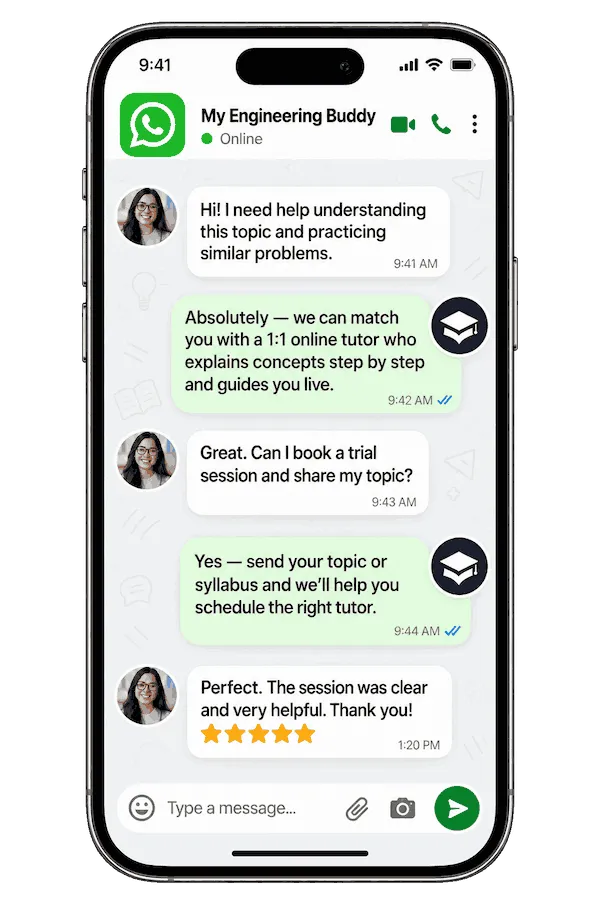
Unlike platforms where you fill out a form and wait, MEB responds in under a minute, 24/7. Tutor match takes under an hour. The $1 trial means you test before you commit. Everything runs over WhatsApp — no logins, no intake forms.
Most Kubernetes students come to MEB after three things: a failed first attempt at a CKA exam, a broken cluster deployment the night before a demo, or a job interview that exposed gaps they did not know existed. The $1 trial is built for exactly that moment.
Source: My Engineering Buddy, 2008–2025.
Pricing Guide
Standard Kubernetes tutoring runs $20–$40/hr. Graduate-level cloud architecture sessions, production cluster reviews, and CKA/CKAD exam simulation with an industry engineer run up to $100/hr. Rate factors include your experience level, the complexity of your cluster setup, your timeline, and tutor availability.
Demand spikes before Linux Foundation exam windows. Slots fill fast in the two weeks prior. Book before that window if you have a fixed exam date.
For students targeting roles at cloud-native companies, fintech firms, or SRE teams at large tech organisations, tutors with professional production Kubernetes backgrounds are available at higher rates — share your specific goal and MEB matches the tier to your target.
Start with the $1 trial — 30 minutes, no registration, no commitment. WhatsApp MEB for a quick quote.
Students consistently tell us that the biggest mistake in Kubernetes prep is spending too long reading and not enough time running a real cluster. Even a Minikube setup on a laptop is enough to make the concepts stick — the tutor helps you build that habit from session one.
FAQ
Is Kubernetes hard to learn?
Kubernetes has a steep initial curve — the control plane architecture, networking model, and YAML-heavy configuration all land at once. Most students find it manageable once the core scheduling and networking concepts click. That usually takes two to four focused sessions with a tutor.
How many sessions will I need?
For CKA exam prep starting from a Docker/Linux baseline, most students need 10–15 sessions over six to eight weeks. For a specific project fix or coursework gap, two to four sessions often covers it. The diagnostic session gives you a clearer estimate.
Can you help with projects and portfolio work?
Yes. MEB provides guided project support — the tutor explains the architecture, walks through the configuration logic, and helps you understand why each component is set up the way it is. All project work is produced and submitted by you. See our Policies page for full details on what we help with and what we don’t.
Will the tutor match my exact syllabus or exam board?
Yes. If you are preparing for the CKA or CKAD, the tutor works specifically within the Linux Foundation curriculum and exam environment. For university coursework, they align to your course outline. Share the syllabus or course brief before the first session.
What happens in the first session?
The first session is a diagnostic. The tutor asks you to walk through your current setup or attempt a short task while they observe. Within the session, you also cover one substantive topic or fix one concrete problem. You leave with a short plan for the next two to three sessions.
Is online tutoring as effective as in-person for Kubernetes?
For a terminal-based subject like Kubernetes, online is arguably better. Screen sharing means the tutor sees your exact output — not a description of it. Digital pen-pad diagrams, shared kubectl sessions, and real-time YAML review work smoothly over Google Meet.
What is the difference between CKA and CKAD, and which should I take first?
The CKA (Certified Kubernetes Administrator) focuses on cluster setup, maintenance, and troubleshooting. The CKAD (Certified Kubernetes Application Developer) focuses on deploying and managing applications. Most developers start with CKAD; operations-focused engineers go for CKA. MEB tutors cover both — share your role and the tutor advises which path fits.
Can you help me debug a specific cluster error I am stuck on right now?
Yes. The $1 trial is designed for exactly this. Share your kubectl output or error logs over WhatsApp, get matched to a tutor within the hour, and spend 30 minutes live diagnosing the specific issue. No need to frame it as a course — bring the problem directly.
Can I get Kubernetes help late at night or at the weekend?
Yes. MEB operates 24/7 across time zones. Students in the US, Gulf, and Australia regularly book weekend and late-evening sessions. Availability varies by tutor, but the matching team responds in under a minute at any hour.
What if I do not get on with my assigned tutor?
Tell MEB over WhatsApp. A replacement is arranged without any additional charge. The $1 trial exists partly for this reason — you test the match before committing to a full session block.
How do I get started?
Three steps: WhatsApp MEB with your Kubernetes topic or error, get matched to a verified tutor within the hour, then start the $1 trial — 30 minutes of live tutoring or one project question explained in full. No registration required.
Do you offer group Kubernetes sessions?
MEB specialises in 1:1 tutoring only. Group sessions are not offered. The individual format is what makes the diagnostic and live debugging approach work — group formats cannot replicate that for a hands-on tool like Kubernetes.
Trust & Quality at My Engineering Buddy
Every MEB tutor goes through subject-specific screening before their first session. For Kubernetes, that means demonstrating working knowledge of cluster architecture, networking, RBAC, and at least one cloud provider’s managed Kubernetes offering. Tutors complete a live demo evaluation reviewed by MEB’s technical team, and ongoing session feedback keeps quality in check. Rated 4.8/5 across 40,000+ verified reviews on Google.
MEB provides guided learning support. All project work is produced and submitted by the student. See our Policies page for details.
MEB has served 52,000+ students across the US, UK, Canada, Australia, the Gulf, and Europe in 2,800+ subjects since 2008. Within infrastructure and cloud subjects specifically, the platform covers Kubernetes alongside closely related areas including Ansible tutoring and cloud architecture help. For a full picture of how MEB structures sessions and vets tutors, see our tutoring methodology.
Explore Related Subjects
Students studying Kubernetes often also need support in:
- Apache Kafka
- Site Reliability Engineering (SRE)
- Infrastructure as Code
- Elasticsearch
- Puppet
- CircleCI
- System Design
Next Steps
Getting started takes about two minutes.
- Share your Kubernetes version, cloud provider or local setup, and your specific problem or goal
- Share your availability and time zone
- MEB matches you with a verified tutor — usually within an hour
- Your first session opens with a diagnostic so every minute is used on what actually matters
Before your first session, have ready: your course outline or CKA/CKAD curriculum, a recent kubectl output or error you have been stuck on, and your exam date or project deadline. The tutor handles the rest.
Visit www.myengineeringbuddy.com for more on how MEB works.
A common pattern our tutors observe is that students who do not know what to fix first make the most progress by session three — not because the material became easier, but because the diagnostic gave them a clear sequence to work through instead of studying everything at once.
WhatsApp to get started or email [email protected].
Reviewed by Subject Expert
This page has been carefully reviewed and validated by our subject expert to ensure accuracy and relevance.




