Contact MEB Today To Get The Best
A/AS Level Marine Science (9693) Tutoring Online
Email: [email protected]



~1 min
Average Reply Time
~1 hour
To Be Matched With A Tutor
30 Min Trial
75% Find Their Tutor On The 1st Trial
$20-35+/hr
Premium Yet Affordable Learning
Marine Science 9693 has a Paper 4 independent investigation — most students underestimate it until six weeks out.
A/AS Level Marine Science (9693) Tutor Online
A/AS Level Marine Science (9693) is a Cambridge International qualification covering ocean systems, marine ecology, coastal processes, and human impacts on marine environments. It equips students to apply scientific reasoning and quantitative skills to real-world marine and environmental challenges.
If you’re searching for an A/AS Level Marine Science (9693) tutor near me, MEB offers 1:1 online tutoring and academic guidance matched to your exact Cambridge syllabus. Our tutors know Paper 4 investigations, Paper 2 data-handling questions, and every topic in between. No guarantees — but students who put in the sessions see the gaps close.
- 1:1 online sessions tailored to Cambridge International syllabus 9693
- Expert verified tutors with subject-specific marine science knowledge
- Flexible time zones — US, UK, Canada, Australia, Gulf
- Structured learning plan built after a diagnostic session
- Ethical academic guidance — you understand before you submit
52,000+ students across the US, UK, Canada, Australia, and the Gulf have used MEB since 2008 — across 2,800+ subjects, from AP Calculus to A Level Music Technology to Data Science.
Source: My Engineering Buddy, 2008–2025.
How Much Does a A/AS Level Marine Science (9693) Tutor Cost?
Most A/AS Level Marine Science (9693) tutoring sessions run $20–$40/hr. The $1 trial gets you 30 minutes of live 1:1 tutoring or one homework question explained in full — no registration required.
Availability tightens significantly in the six weeks before Cambridge exam windows. Book early if your sitting is approaching.
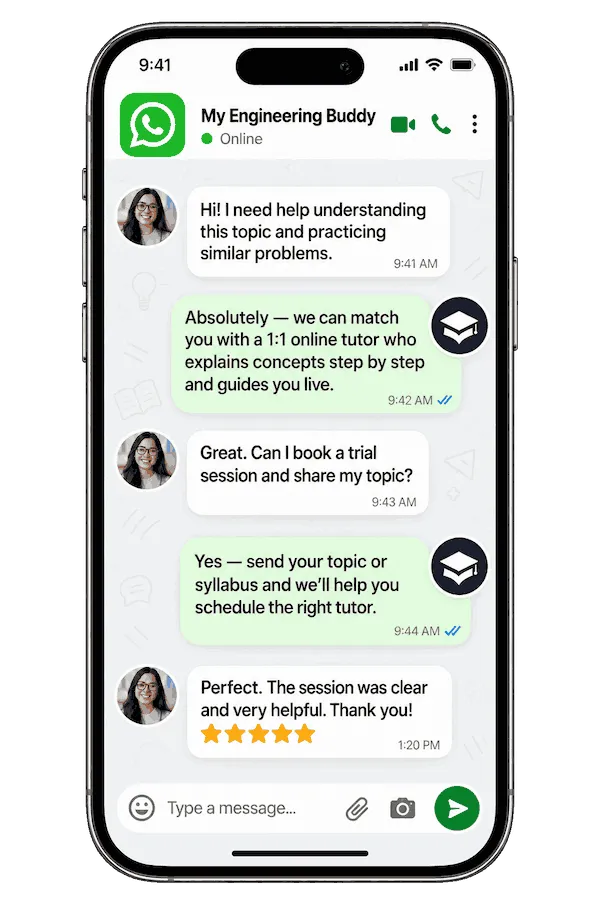
WhatsApp MEB for a quick quote — average response time under 1 minute.
Who This A/AS Level Marine Science (9693) Tutoring Is For
Marine Science 9693 covers ground that sits between biology, chemistry, geography, and earth science. Students who struggle often do so because no single textbook ties those threads together the way the Cambridge syllabus does.
- AS Level students working through oceanography and marine ecology for the first time
- A Level students preparing for Paper 4 independent investigations and data analysis questions
- Students with a university conditional offer depending on their Marine Science grade — and a narrow margin for error
- Students who need homework guidance on data-handling questions or structured written responses
- Home-educated and international school students following the Cambridge 9693 curriculum
- Students aiming for degrees in marine biology, environmental science, or oceanography at universities such as Southampton, Plymouth, Exeter, Queensland, or Dalhousie
1:1 Tutoring vs Self-Study vs AI Tools
Self-study works for motivated students — but without feedback, it’s easy to practise the wrong method on Paper 2 data questions and not realise it until the mark scheme says otherwise. AI tools are fast for explaining terms like thermohaline circulation or eutrophication, but they cannot diagnose whether your investigation write-up for Paper 4 actually meets Cambridge’s assessment criteria, adapt to your specific fieldwork data, or annotate your working in real time. In Marine Science 9693, where marks depend on how you structure quantitative arguments, live human instruction catches errors that no chatbot will flag. MEB combines online flexibility with a structured feedback loop calibrated to the exact Cambridge syllabus — nothing generic about it.
Outcomes: What You’ll Be Able To Do in A/AS Level Marine Science (9693)
After working through sessions with an MEB tutor, students can analyze oceanographic data sets and explain circulation patterns like the ENSO cycle with the precision Cambridge mark schemes reward. They can apply ecological concepts — trophic cascades, keystone species, coral bleaching thresholds — to unseen case studies in Paper 1. Students can model the impact of human pressures such as overfishing or coastal development using the quantitative tools the syllabus demands. They can write structured investigation reports for Paper 4 that meet Cambridge’s planning, data collection, and evaluation criteria. And they can present arguments about marine conservation policy with the evidence-based reasoning that distinguishes a B from an A.
Supporting a student through A/AS Level Marine Science (9693)? MEB works directly with parents to set up sessions, track progress, and keep coursework on schedule. WhatsApp MEB — average response time is under a minute, 24/7.
Based on feedback from 40,000+ sessions collected by MEB from 2022 to 2025, 58% of students improved by one full grade after approximately 20 hours of 1:1 tutoring in a single subject. A further 23% achieved at least a half-grade improvement.
Source: MEB session feedback data, 2022–2025.
At MEB, we’ve found that Marine Science students often arrive having memorised definitions but without knowing how to apply them to a novel data set under timed conditions. That gap — between knowing and doing — is exactly what a diagnostic session surfaces in the first thirty minutes.
What We Cover in A/AS Level Marine Science (9693) (Syllabus / Topics)
| Assessment Component | Description | Typical Weighting |
|---|---|---|
| Paper 1 — Multiple Choice | Core knowledge across all topic areas | Varies by board specification |
| Paper 2 — Structured Questions | Data handling, analysis, and extended written responses | Varies by board specification |
| Paper 3 — A Level Extended Essay | Evaluative essay on marine science issues (A Level only) | Varies by board specification |
| Paper 4 — Independent Investigation | Fieldwork-based investigation: planning, data collection, evaluation | Varies by board specification |
Ocean Systems and Physical Oceanography
- Ocean basin formation and seafloor topography
- Thermohaline circulation and deep-water formation
- Tidal systems, wave dynamics, and coastal processes
- ENSO, upwelling systems, and climate linkages
- Sediment transport and deposition in coastal zones
- Ocean temperature, salinity, and density relationships
Core texts: Oceanography: An Invitation to Marine Science (Garrison), Introduction to Ocean Sciences (Segar). The Cambridge 9693 syllabus guide is the definitive reference for assessment scope.
Marine Ecology and Biodiversity
- Phytoplankton, zooplankton, and primary productivity
- Coral reef ecology — bleaching, symbiosis, succession
- Rocky shore zonation and intertidal communities
- Deep-sea ecosystems and hydrothermal vent biology
- Food webs, trophic cascades, and keystone species
- Marine mammal biology and migration patterns
- Biodiversity indices and sampling methods used in fieldwork
Core texts: Marine Biology: Function, Biodiversity, Ecology (Levinton), An Introduction to Marine Ecology (Barnes & Hughes). Supplement with Cambridge-specific past papers for data-handling practice.
Human Impacts and Marine Conservation
- Overfishing, bycatch, and fisheries management models
- Coastal development, habitat loss, and sea-level rise
- Plastic pollution — sources, transport pathways, biological effects
- Ocean acidification: chemistry, causes, and ecological consequences
- Marine protected areas — design, effectiveness, and policy frameworks
- Oil spill dynamics and remediation strategies
Core texts: Marine Conservation Biology (Norse & Crowder), Cambridge 9693 past paper mark schemes. Reference the PubMed Central database for primary research on ocean acidification and fisheries science used in extended essay preparation.

What a Typical A/AS Level Marine Science (9693) Session Looks Like
The tutor opens by checking the previous topic — say, thermohaline circulation and its role in climate regulation — then asks one diagnostic question to see what held. From there, you move into the session focus: perhaps ocean acidification chemistry or Paper 2 data-handling on a phytoplankton productivity data set. The tutor annotates graphs and works through mark-scheme logic on a digital pen-pad while you follow, then you attempt the next question yourself and talk through your reasoning. If the reasoning breaks down — say, confusing buffering capacity with pH directly — the tutor catches it immediately and walks back to the point of error. The session closes with two or three practice questions set as preparation, and the next topic logged.
How MEB Tutors Help You with A/AS Level Marine Science (9693) (The Learning Loop)
Diagnose: In the first session, the tutor reviews a past paper attempt or recent homework, maps which topic areas are weak — biodiversity sampling calculations, essay structure on conservation policy, Paper 4 methodology — and sets the sequence from there.
Explain: The tutor works through problems live using a digital pen-pad, annotating graphs, building food web diagrams, or stepping through the chemistry of carbonate dissolution. You see the reasoning as it happens, not just a finished answer.
Practice: You attempt the next problem with the tutor present. No waiting. No guessing at home and getting it wrong five times before checking. The feedback is immediate.
Feedback: The tutor explains exactly where marks were lost and why — whether it’s imprecise scientific language, missing a unit in a calculation, or failing to link trophic cascade evidence back to the question command word.
Plan: After each session, the next topic is agreed. If Paper 4 is six weeks out, the tutor builds a sequence that covers methodology, data handling, and evaluation criteria in time.
Sessions run on Google Meet. The tutor uses a digital pen-pad or iPad with Apple Pencil to annotate diagrams and work through calculations in real time. Before your first session, share your syllabus, a recent past paper or homework attempt, and your exam date. Start with the $1 trial — 30 minutes of live tutoring that also serves as your first diagnostic. Whether you need a quick catch-up before an exam, structured revision over 4–8 weeks, or ongoing weekly support through the semester, the tutor maps the session plan after the first diagnostic.
Students consistently tell us that the moment things click in Marine Science is when they stop treating Paper 2 data questions as reading comprehension and start treating them as calculation problems with a biological context. That shift usually happens in one session — if someone is there to name it.
Tutor Match Criteria (How We Pick Your Tutor)
Not every science tutor knows the Cambridge 9693 syllabus. Here is how MEB matches you specifically.
Subject depth: Tutors are vetted for knowledge of the Cambridge International Marine Science syllabus — its specific paper structure, assessment objectives, and mark-scheme logic. A general biology background alone is not sufficient.
Tools: All sessions run on Google Meet with a digital pen-pad or iPad and Apple Pencil — essential for annotating oceanographic diagrams and working through data-handling problems visually.
Time zone: MEB covers New York, Los Angeles, Chicago, London, Dubai, Toronto, Sydney, Melbourne, and all major European time zones — including evenings and weekends.
Learning style: Calibrated from the first session. Some students need slow, step-by-step worked examples; others need to be pushed toward exam-speed practice quickly.
Communication: Clear English, adapted to the student’s level — whether that’s an AS Level student encountering phytoplankton for the first time or an A Level student refining Paper 4 evaluation language.
Goals: Exam grade targets, specific paper preparation, Paper 4 investigation support, or general conceptual depth — the match reflects the actual goal.
Unlike platforms where you fill out a form and wait, MEB responds in under a minute, 24/7. Tutor match takes under an hour. The $1 trial means you test before you commit. Everything runs over WhatsApp — no logins, no intake forms.
Study Plans (Pick One That Matches Your Goal)
If you have one to three weeks before the exam, the focus is triage — Paper 2 data handling and the highest-yield topic areas from past paper frequency. With four to eight weeks, the tutor builds a structured sequence across all three tracks, with Paper 4 investigation support running in parallel if needed. Ongoing weekly support aligns to your school’s teaching sequence and assignment deadlines. The tutor finalises the specific plan after the first diagnostic — not before, because the gaps are different for every student.
Pricing Guide
A/AS Level Marine Science (9693) tutoring runs $20–$40/hr for most students. Niche specialist topics or graduate-level marine science support can reach up to $100/hr depending on tutor background and timeline.
Rate factors include your current level, the specific papers you need help with, how soon your exam is, and tutor availability. Availability in the six weeks before Cambridge exam windows is limited — book ahead.
For students targeting degrees at research-intensive marine science programmes, tutors with professional oceanography or environmental research backgrounds are available at higher rates — share your specific goal and MEB will match the tier to your ambition.
Start with the $1 trial — 30 minutes, no registration, no commitment. WhatsApp MEB for a quick quote.
MEB has been matching students to verified subject tutors since 2008 — across 52,000+ students and 2,800+ subjects. The process is fast because it has to be: most students contact us when time is already short.
Source: My Engineering Buddy, 2008–2025.
FAQ
Is A/AS Level Marine Science (9693) hard?
It is genuinely cross-disciplinary — chemistry, biology, geography, and quantitative data skills all appear in the papers. Students who struggle most are those who treat it as purely descriptive. Paper 2 and Paper 4 both reward analytical precision, which takes practice with feedback to develop.
How many sessions are needed?
Most students see measurable progress after 6–10 sessions on a focused topic area. Closing wider gaps across the full syllabus typically takes 15–25 sessions. The tutor gives a more specific estimate after the first diagnostic.
Can you help with practice exercises?
Yes — tutors explain the underlying concepts and guide you through the method. You produce and submit your own work. MEB tutoring is guided learning — you understand the work, then submit it yourself. For full details on what we help with and what we don’t, read our Academic Integrity policy and Why MEB.
Will the tutor match my exact syllabus or exam board?
Yes. MEB tutors for Cambridge International 9693 specifically — not a generic marine biology course. Your tutor will know the paper structure, assessment objectives, and mark-scheme conventions for your exact qualification.
What happens in the first session?
The tutor reviews a past paper attempt or recent homework, identifies the weakest topic areas and the source of errors, then sets the session sequence. By the end of 30 minutes, you have a clear picture of what to work on and in what order.
Is online tutoring as effective as in-person?
For a subject like Marine Science 9693, yes — annotated diagrams, data graph walkthroughs, and mark-scheme analysis all translate well to a shared screen with a digital pen-pad. Many students cover more ground online because the session starts immediately with no travel time.
Can I get A/AS Level Marine Science (9693) help at midnight?
WhatsApp MEB any time — responses average under a minute around the clock. Session scheduling depends on tutor availability, but evening and weekend slots across US, UK, Gulf, and Australian time zones are typically available, including late-night options.
What if I don’t like my assigned tutor?
Tell MEB via WhatsApp and a replacement is arranged without friction. The $1 trial is specifically designed so you experience the tutor before committing to a package. Tutor fit matters — MEB does not lock you in.
Do you offer group A/AS Level Marine Science (9693) sessions?
MEB specialises in 1:1 sessions only. Group sessions are not offered. The 1:1 model exists because gap identification and feedback are specific to each student’s errors — a group session cannot replicate that.
How do I get started?
Three steps: WhatsApp MEB with your exam board, target paper, and available times. MEB matches you to a verified tutor — usually within the hour. Your first session is the $1 trial — 30 minutes of live 1:1 tutoring or one homework question fully explained.
Try your first session for $1 — 30 minutes of live 1:1 tutoring or one homework question explained in full. No registration. No commitment. WhatsApp MEB now and get matched within the hour.
Trust & Quality at My Engineering Buddy
Every MEB tutor goes through subject-specific screening before working with students — that includes a live demo evaluation, degree and qualification verification, and ongoing review based on student feedback. Tutors covering Cambridge 9693 hold degrees in marine science, oceanography, environmental science, or closely related disciplines, and are vetted for familiarity with the specific paper structure and mark-scheme language. Rated 4.8/5 across 40,000+ verified reviews on Google. MEB has served 52,000+ students across the US, UK, Canada, Australia, the Gulf, and Europe since 2008.
MEB tutoring is guided learning — we explain, you submit your own work. Academic Integrity policy is published and linked in every relevant session. See also our tutoring methodology for how sessions are structured from diagnostic through to exam readiness.
MEB covers 2,800+ subjects at every level. Students working on Marine Science 9693 often also need support in A/AS Level Biology (9700) tutoring, A/AS Level Chemistry (9701) academic guidance, or A/AS Level Geography (9696) tutoring. MEB covers all three under one platform, with the same matching and trial process.
MEB tutors are screened for subject depth, not just general science knowledge. For Marine Science 9693, that means knowing the difference between what Paper 2 rewards and what Paper 4 assesses — and teaching to both, specifically.
Source: My Engineering Buddy, 2008–2025.
A common pattern our tutors observe is that students who fall behind in Marine Science often do so on Paper 4 methodology — not because they lack scientific ability, but because no one has shown them how Cambridge defines a valid investigation design. One structured session on that alone changes the trajectory.
Explore Related Subjects
Students studying A/AS Level Marine Science (9693) often also need support in:
- A/AS Level Environmental Science
- AS Level Environmental Management
- A/AS Level Physics
- A/AS Level Mathematics
- A/AS Level Thinking Skills
- A/AS Level Global Perspectives & Research
Next Steps
Getting started takes under five minutes.
- Share your exam board, the paper you’re struggling with most, and how many weeks until your exam
- Share your time zone and available slots — evenings and weekends included
- MEB matches you to a verified Marine Science tutor, usually within 24 hours
Before your first session, have ready: your Cambridge 9693 syllabus or course outline, a recent past paper attempt or homework question you found difficult, and your exam or coursework deadline date. The tutor handles the rest.
Visit www.myengineeringbuddy.com to read more about the MEB process, methodology, and how sessions are structured from first diagnostic to final exam.
WhatsApp to get started or email [email protected].
Reviewed by Subject Expert
This page has been carefully reviewed and validated by our subject expert to ensure accuracy and relevance.