




~1 min
Average Reply Time
~1 hour
To Be Matched With A Tutor
30 Min Trial
75% Find Their Tutor On The 1st Trial
$20-35+/hr
Premium Yet Affordable Learning
Hire The Best SUMO Traffic Simulator Tutor




Traffic simulation models breaking down mid-assignment? SUMO Traffic Simulator has tripped up even strong civil engineering students — here’s how to fix that fast.
SUMO Traffic Simulator Tutor Online
SUMO (Simulation of Urban MObility) is an open-source microscopic traffic simulation platform used in transportation engineering to model vehicle flow, signal timing, route assignment, and multimodal network behaviour at the individual vehicle level.
Finding a SUMO Traffic Simulator tutor near me is easier than most students expect. MEB connects you with verified civil engineering specialists who know SUMO’s Python scripting interface, TraCI API calls, network import workflows, and simulation output analysis — the exact sticking points that slow down transportation engineering projects. One session can get you unblocked.
- 1:1 online sessions tailored to your course, project brief, or research scope
- Expert verified tutors with hands-on SUMO and transportation engineering experience
- Flexible time zones — US, UK, Canada, Australia, Gulf
- Structured learning plan built after a diagnostic session
- Guided project support — we explain how it works, you build and run it
52,000+ students across the US, UK, Canada, Australia, and the Gulf have used MEB since 2008 — including students in Civil Engineering subjects like SUMO Traffic Simulator, PTV VISSIM tutoring, and transportation engineering help.
Source: My Engineering Buddy, 2008–2025.
How Much Does a SUMO Traffic Simulator Tutor Cost?
Most SUMO tutoring sessions run $20–$40/hr. Graduate-level or research-focused work — particularly custom TraCI scripting or large-scale network calibration — can reach $60–$100/hr depending on scope. Not sure what you need? Start with the $1 trial first.
| Level / Need | Typical Rate | What’s Included |
|---|---|---|
| Undergraduate / standard | $20–$40/hr | 1:1 sessions, network setup, project guidance |
| Graduate / research | $40–$100/hr | TraCI scripting, calibration, simulation analysis |
| $1 Trial | $1 flat | 30 min live session or one project question explained |
Tutor availability tightens around semester project submission windows. Book early if your deadline is within three weeks.
WhatsApp MEB for a quick quote — average response time under 1 minute.
Who This SUMO Traffic Simulator Tutoring Is For
SUMO looks straightforward until you’re knee-deep in a network that won’t import, signals that won’t cycle, or a TraCI script throwing errors you can’t decode. Most students hit a wall within the first few hours. That’s exactly where MEB steps in.
- Undergraduate and graduate civil or transportation engineering students using SUMO for coursework or capstone projects
- PhD and research students building simulation models for peer-reviewed work
- Students whose project grade depends on a working, calibrated simulation
- Students 4–6 weeks from a project submission with significant modelling gaps still to close
- Professionals in transportation planning or traffic operations learning SUMO for applied use
- Students at universities such as MIT, TU Delft, University of Toronto, Imperial College London, UNSW, and ETH Zurich where traffic simulation is a required component of transportation engineering modules
If you’re getting a working simulation across the line for a course at any of those institutions — or anywhere else — an online SUMO Traffic Simulator tutor from MEB can cut days off your timeline.
1:1 Tutoring vs Self-Study vs AI vs YouTube vs Online Courses
Self-study works if you’re disciplined — but SUMO’s documentation is dense and assumes prior familiarity with traffic theory. AI tools explain concepts quickly but can’t debug your specific .net.xml file or tell you why your detector outputs are zeroing out. YouTube covers installation and basic setups; it stops when your scenario gets specific. Online courses exist for traffic simulation broadly, but few go deep on SUMO’s current release. With 1:1 SUMO tutoring through MEB, you get a live session calibrated to your exact network, your project brief, and your deadline — errors get caught and corrected before they compound.
Outcomes: What You’ll Be Able To Do in SUMO Traffic Simulator
After working with an online SUMO Traffic Simulator tutor, students consistently move from stuck to functional fast. You’ll be able to build and import road networks from OpenStreetMap or custom geometry, configure vehicle type distributions and traffic demand using OD matrices, apply signal control logic including fixed-time and adaptive plans, and analyse simulation outputs such as travel time, queue length, and throughput. Apply TraCI to control simulations programmatically — adjusting signal phases or rerouting vehicles mid-run. Present calibrated results with statistical confidence intervals, not just raw visualisation exports.
At MEB, we’ve found that SUMO students consistently underestimate how much the network import step matters. Getting the geometry right before touching demand or signal logic saves hours. Tutors address this in session one — every time.
Based on feedback from 40,000+ sessions collected by MEB from 2022 to 2025, 58% of students improved by one full grade after approximately 20 hours of 1:1 tutoring in subjects like SUMO Traffic Simulator. A further 23% achieved at least a half-grade improvement.
Source: MEB session feedback data, 2022–2025.
What We Cover in SUMO Traffic Simulator (Syllabus / Topics)

Network Modelling and Demand Setup
- Importing networks from OpenStreetMap using NETCONVERT
- Manual network construction with NETEDIT — edges, junctions, lanes
- Defining vehicle types, routes, and flows using DUAROUTER
- OD matrix conversion and demand scaling with OD2TRIPS
- Multimodal networks — buses, cyclists, pedestrians alongside vehicles
- Calibrating demand to match observed turning counts or AADT data
Recommended references: Traffic Flow Theory and Control (Drew); Introduction to Traffic Engineering (Roess, Prassas & McShane); SUMO official documentation (sumo.dlr.de).
Signal Control and Intersection Logic
- Fixed-time signal plans — cycle length, green splits, offset coordination
- Actuated and adaptive signal control using SUMO’s built-in controllers
- Junction priority rules — right-of-way, yield, stop logic
- Roundabout modelling and gap acceptance parameters
- Pedestrian crossing phases and shared-space junctions
- Signal timing optimisation for minimising delay and stops
Recommended references: Traffic Engineering (Mannering & Washburn); Highway Capacity Manual (HCM); highway design tutoring resources for context on geometric constraints.
TraCI Scripting, Output Analysis, and Research Applications
- TraCI API setup — connecting Python to a running SUMO instance
- Real-time vehicle control: speed changes, lane changes, rerouting mid-run
- Detector configuration — inductive loops, E2 detectors, multi-entry/exit
- Extracting and parsing XML output files — tripinfo, summary, edgedata
- Statistical validation of simulation results — multiple runs, seed variation
- Integrating SUMO with external tools for urban transportation planning workflows
- Emissions modelling using SUMO’s HBEFA-based output
Recommended references: Simulation of Urban Mobility (Behrisch et al.); Traffic Simulation with SUMO course materials (DLR); Python TraCI documentation.
Platforms, Tools & Textbooks We Support
SUMO tutoring at MEB covers the full simulation stack. Tutors work with you across the tools that a typical SUMO workflow actually requires — not just the simulator itself.
- SUMO (current release) — GUI and command-line modes
- NETEDIT — graphical network editor
- NETCONVERT — network import and conversion
- DUAROUTER and OD2TRIPS — demand generation tools
- TraCI — Python-based real-time simulation control API
- OpenStreetMap — source data for realistic network import
- Python (pandas, matplotlib) — for output parsing and visualisation
- QGIS — for spatial data preparation before network import
What a Typical SUMO Traffic Simulator Session Looks Like
The tutor opens by checking where you left off — usually whether the network imported cleanly or whether a specific demand file is producing unrealistic flows. From there, you and the tutor work through the problem on screen: the tutor uses a digital pen-pad to annotate junction geometry or signal phase diagrams while you edit the config files live. You might work through why a detector is returning zero counts, or step through a TraCI script line by line to find where vehicle control logic is breaking. The tutor doesn’t just fix it — they walk you through the reasoning so you can replicate it independently. Session closes with a specific task: re-run with adjusted headway parameters, validate against observed counts, or extend the script to log additional vehicle attributes. Next topic is noted before you log off.
How MEB Tutors Help You with SUMO Traffic Simulator (The Learning Loop)
Diagnose: In the first session, the tutor reviews your network file, demand setup, or script to identify exactly where the model is failing — whether that’s a geometry error, a misconfigured route, or a TraCI connection issue that’s been quietly crashing the simulation.
Explain: The tutor works a corrected example on the digital pen-pad — drawing out signal phase logic, annotating an OD matrix, or stepping through a Python function — so you understand what the tool is actually doing, not just what button to click.
Practice: You attempt the next step with the tutor present. Run the corrected simulation. Adjust a parameter. Write the next TraCI function. The tutor watches and prompts rather than takes over.
Feedback: Every error gets an explanation. If your travel time output looks wrong, the tutor traces it back — is it the route distribution, the headway setting, or the detector placement? You learn to diagnose, not just fix.
Plan: Each session ends with a clear next step — what to attempt before the following session, which SUMO module to tackle next, and how close the model is to being submission-ready.
Sessions run over Google Meet. Tutors use a digital pen-pad or iPad with Apple Pencil for annotation. Before your first session, share your project brief, the network or script file you’re working with, and your submission date. The first session doubles as your diagnostic. Start with the $1 trial — 30 minutes of live tutoring that also serves as your first diagnostic and gets the model moving.
Students consistently tell us that the biggest SUMO breakthrough comes when they stop treating it as a black box. Once you understand the file structure — how net, route, and config files connect — the whole workflow becomes readable. That’s what the first two sessions target.
Tutor Match Criteria (How We Pick Your Tutor)
Not every transportation engineer knows SUMO. MEB matches on specifics.
Subject depth: Tutors must have direct SUMO experience — not just general traffic engineering knowledge. That means working simulations, TraCI scripting, and output analysis at the level your project demands.
Tools: Every tutor uses Google Meet plus a digital pen-pad or iPad with Apple Pencil — the session is visual, not just verbal.
Time zone: Matched to your region — US, UK, Gulf, Canada, or Australia — so sessions happen when you’re actually awake.
Goals: Whether you need a working model for a course submission, deeper conceptual understanding of traffic flow theory, or research-grade calibration for a dissertation, the tutor is matched to that specific aim.
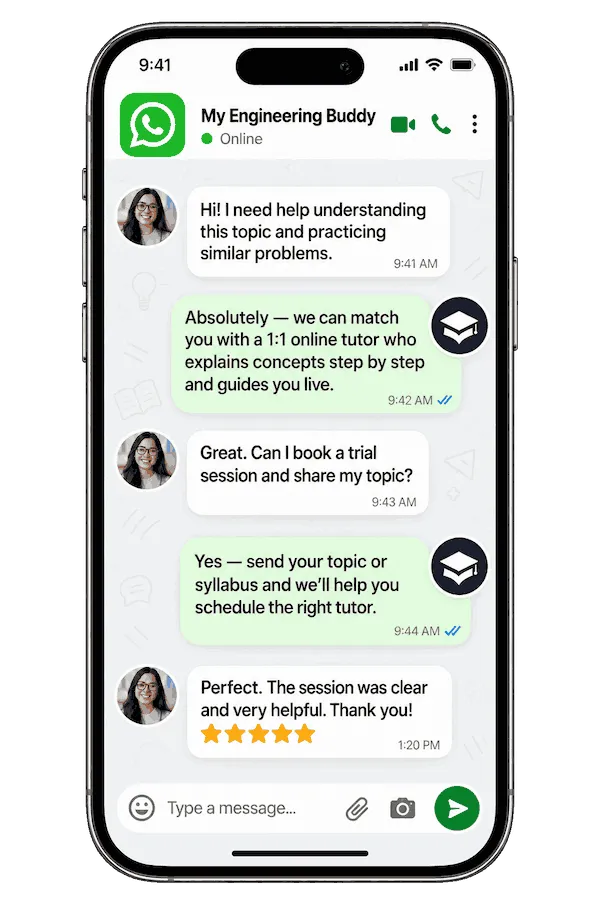
Unlike platforms where you fill out a form and wait, MEB responds in under a minute, 24/7. Tutor match takes under an hour. The $1 trial means you test before you commit. Everything runs over WhatsApp — no logins, no intake forms.
MEB tutors are matched by subject depth, tools proficiency, and time zone — not by whoever is available. For SUMO, that means a tutor who has built and run simulations, not just one who teaches traffic theory.
Source: My Engineering Buddy, 2008–2025.
A common pattern our tutors observe is that students come in with a SUMO file that technically runs but produces nonsense outputs. The simulation isn’t broken — the demand setup is. Distinguishing between the two is a skill the tutor builds quickly.
Study Plans (Pick One That Matches Your Goal)
Catch-up (1–3 weeks): for students who’ve lost ground on network setup or scripting and need to close gaps before a submission deadline. Exam prep (4–8 weeks): structured progression through network modelling, signal control, and output analysis aligned to a specific project milestone. Weekly support: ongoing sessions tied to semester coursework, with the tutor tracking your model’s development from initial import to final validation. The tutor builds a specific session sequence after reviewing your brief and current progress in the first diagnostic.
Pricing Guide
Standard SUMO tutoring runs $20–$40/hr for undergraduate and taught-masters projects. Research-level work — custom TraCI development, large-scale network calibration, or emissions modelling for a dissertation — sits in the $60–$100/hr range depending on tutor depth and session frequency.
Rate factors: your study level, the complexity of the simulation scenario, how close your deadline is, and tutor availability. Demand peaks around semester project submission periods — rates and availability both tighten.
For students targeting graduate research positions, transport consultancy roles, or submissions to transportation engineering journals, tutors with professional traffic modelling or research backgrounds are available at higher rates — share your goal and MEB matches the tier to your ambition.
Start with the $1 trial — 30 minutes, no registration, no commitment. WhatsApp MEB for a quick quote.
FAQ
Is SUMO Traffic Simulator hard to learn?
SUMO has a steep initial curve. The file-based workflow — separate network, route, and config files — confuses most beginners. Once the structure clicks, progress accelerates. Most students get a basic simulation running within two or three focused sessions.
How many sessions do I typically need?
A working single-intersection model: two to three sessions. A calibrated multi-corridor network with signal coordination and output analysis: six to ten sessions. Research-grade work with TraCI scripting runs longer. The diagnostic session maps this out specifically for your project.
Can you help with projects and portfolio work?
MEB tutoring is guided learning — the tutor explains the method, you build and run the simulation yourself. See our Academic Integrity policy and Why MEB page for full details on what we help with and what we don’t.
Will the tutor match my exact syllabus or exam board?
Yes. Share your course outline, project brief, or module specification before the first session. The tutor aligns entirely to what your university or programme requires — not a generic SUMO curriculum.
What happens in the first session?
The tutor reviews your current files or starting point, identifies the most critical gap, and works through the first concrete fix with you on screen. You leave with a working next step and a clear plan for subsequent sessions.
Is online tutoring as effective as in-person for a simulation tool like SUMO?
Yes — often more so. Screen sharing lets the tutor see your exact files and terminal output in real time. The digital pen-pad annotates diagrams live. There’s nothing an in-person session offers here that an online SUMO tutor can’t match.
Can I get SUMO help at midnight or over a weekend?
Yes. MEB operates 24/7 across time zones. WhatsApp MEB at any hour — average response time is under a minute. Tutors are available across US, UK, Gulf, Canada, and Australia time zones, including weekends and the night before a deadline.
What if I don’t get along with my assigned tutor?
Say so over WhatsApp and MEB will match you with a different tutor — no forms, no delay. The $1 trial exists partly for this reason: you test the match before committing to a full session package.
Do you offer group SUMO Traffic Simulator sessions?
MEB specialises in 1:1 sessions. Group project teams sometimes book separately and compare notes, but each student gets individual tutor time. This keeps the session calibrated to your specific role in the project.
How do I get started?
Three steps: WhatsApp MEB, get matched with a verified SUMO tutor (usually within the hour), then start the $1 trial — 30 minutes of live tutoring or one project question explained in full. No registration required.
What is the difference between SUMO and PTV VISSIM — and which should I use?
SUMO is open-source, Python-extensible, and widely used in academic research. VISSIM is commercial, widely used in professional consultancy. If your university course specifies one, use that. If you have a choice, ask your supervisor — both are worth knowing. MEB tutors cover both.
Can SUMO model public transport, cyclists, and pedestrians — or just cars?
SUMO supports full multimodal modelling: buses with timetables, bicycles, pedestrians, and mixed flows at shared-space junctions. Setting this up correctly — especially bus stop logic and pedestrian crossing phases — is one of the most common areas where students need tutor support.
Trust & Quality at My Engineering Buddy
Every MEB tutor goes through subject-specific vetting — not a general interview. For SUMO tutoring, that means demonstrating hands-on simulation experience, live demo evaluation, and ongoing session feedback review. Tutors hold relevant degrees in civil, transportation, or systems engineering, and many have professional traffic modelling backgrounds. Rated 4.8/5 across 40,000+ verified reviews on Google.
MEB provides guided learning support. All project work is produced and submitted by the student. See our Policies page for details.
MEB has served 52,000+ students across the US, UK, Canada, Australia, Gulf, and Europe in 2,800+ subjects since 2008. Within Civil Engineering, that includes airport engineering and planning help, structural engineering tutoring, and geotechnical engineering tutoring — alongside traffic simulation and transportation engineering. The MEB tutoring methodology is built around diagnostic-first sessions, not generic lesson plans.
Since 2008, MEB has matched students to subject-specific tutors — not the nearest available generalist. For SUMO, that means a tutor who has actually debugged a broken TraCI connection or rebuilt a misconfigured signal plan under deadline pressure.
Source: My Engineering Buddy, 2008–2025.
Try your first session for $1 — 30 minutes of live 1:1 tutoring or one homework question explained in full. No registration. No commitment. WhatsApp MEB now and get matched within the hour.
Explore Related Subjects
Students studying SUMO Traffic Simulator often also need support in:
- Air Pollution Control
- Autodesk InfraWorks
- Environmental Engineering
- Railway Engineering
- Sustainable Design and Development
- Wind Engineering
- Energy Management
Next Steps
Before your first session, have ready: your course outline or project brief, the SUMO files or scripts you’ve been working with (even broken ones are useful), and your submission or exam date. The tutor handles the rest.
- Share your project scope, the specific SUMO component you’re stuck on, and your timeline
- Share your time zone and preferred session hours
- MEB matches you with a verified SUMO tutor — usually within an hour
First session starts with a diagnostic so every minute is used on the right problem.
Visit www.myengineeringbuddy.com for more on how MEB works.
WhatsApp to get started or email [email protected].
Reviewed by Subject Expert
This page has been carefully reviewed and validated by our subject expert to ensure accuracy and relevance.




