~1 min
Average Reply Time
~1 hour
To Be Matched With A Tutor
30 Min Trial
75% Find Their Tutor On The 1st Trial
$20-35+/hr
Premium Yet Affordable Learning
Hire The Best Air Pollution Control Tutor

Most students don’t fail Air Pollution Control because it’s impossible — they fail because dispersion modelling, scrubber design, and regulatory frameworks hit at the same time with no one explaining the connections.
Air Pollution Control Tutor Online
Air Pollution Control is an engineering discipline covering the sources, transport, and removal of atmospheric pollutants. It equips students to design control systems, apply dispersion models, and meet regulatory emission standards across industrial and environmental contexts.
My Engineering Buddy (MEB) connects you with a 1:1 online Air Pollution Control tutor who knows your exact course — whether that’s an undergraduate environmental engineering module at a US state university, a graduate-level course at institutions like Georgia Tech or Imperial College London, or a professional certification track. If you’ve been searching for an Air Pollution Control tutor near me, online 1:1 tutoring delivers the same depth without geography getting in the way. Our tutors cover everything from Gaussian dispersion to fabric filter selection, working at your pace, on your syllabus. Part of MEB’s broader civil engineering tutoring offering across 2,800+ subjects.
- 1:1 online sessions tailored to your university course or syllabus
- Expert-verified tutors with graduate-level subject knowledge in environmental and civil engineering
- Flexible time zones — US, UK, Canada, Australia, Gulf
- Structured learning plan built after a diagnostic session
- Ethical homework and assignment guidance — you understand the work before you submit it
52,000+ students across the US, UK, Canada, Australia, and the Gulf have used MEB since 2008 — including students in Civil Engineering subjects like Air Pollution Control, Environmental Engineering, and Water and Wastewater Treatment.
Source: My Engineering Buddy, 2008–2025.
How Much Does an Air Pollution Control Tutor Cost?
Rates run $20–$40/hr for most undergraduate and graduate-level Air Pollution Control courses. Specialist topics — CFD-based dispersion modelling, advanced combustion systems, or thesis-level research support — can reach $100/hr. The $1 trial gives you 30 minutes of live tutoring or one full homework question explained before you commit to a rate.
| Level / Need | Typical Rate | What’s Included |
|---|---|---|
| Undergraduate (most levels) | $20–$35/hr | 1:1 sessions, homework guidance |
| Graduate / Specialist | $35–$100/hr | Expert tutor, advanced topic depth |
| $1 Trial | $1 flat | 30 min live session or 1 homework question |
Tutor availability tightens near end-of-semester deadlines. Book early if you have a specific submission date in mind.
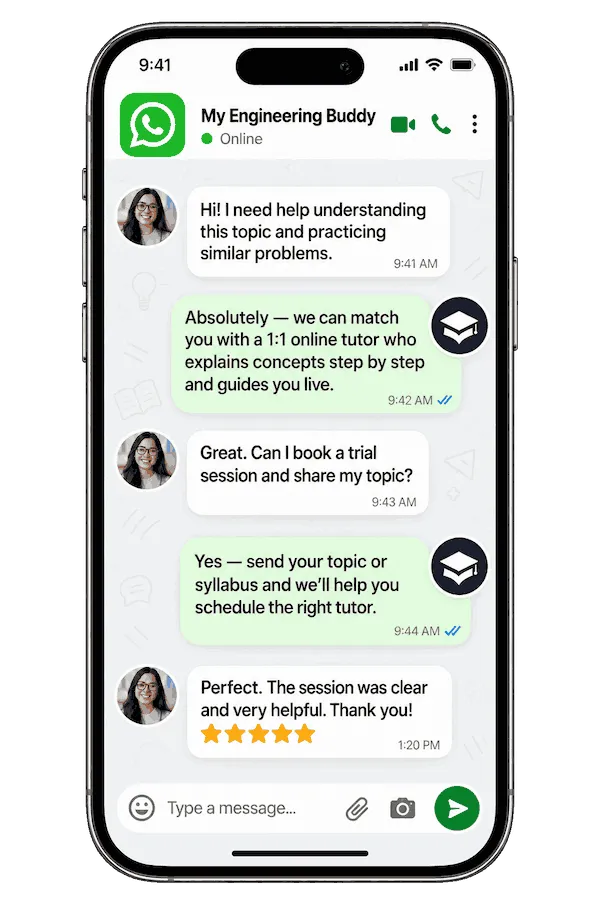
WhatsApp MEB for a quick quote — average response time under 1 minute.
Who This Air Pollution Control Tutoring Is For
Air Pollution Control attracts students from civil, environmental, chemical, and mechanical engineering programmes. The material demands both quantitative precision and regulatory literacy — a difficult combination to self-study when you’re already managing a full course load.
- Undergraduate students struggling with Gaussian plume equations or pollutant mass balance
- Graduate students working through stack design, scrubber efficiency calculations, or dispersion software outputs
- Students with a failing mid-semester grade who need to recover before finals
- Students retaking after a failed first attempt — particularly those who stalled on atmospheric stability classes or EPA regulatory frameworks
- Engineers pursuing professional development in emission compliance or environmental impact assessment
- Parents supporting a student whose confidence has dropped alongside their grades in an environmental engineering programme
Students from universities including the University of Michigan, University of Toronto, ETH Zurich, University of New South Wales, and Delft University of Technology have used MEB for Air Pollution Control support.
1:1 Tutoring vs Self-Study vs AI vs YouTube vs Online Courses
Self-study works if you’re disciplined — but Air Pollution Control involves interlocking systems (meteorology, chemistry, fluid mechanics, regulation) that are hard to sequence alone. AI tools answer questions fast but can’t run through a dispersion problem with you live or identify where your model assumptions broke down. YouTube covers the basics of stack emissions or the Clean Air Act adequately, but stops short when you’re debugging a specific AERMOD output. Online courses give structure but no personalisation — your professor’s syllabus may differ significantly. 1:1 tutoring with MEB means a tutor who has worked in or studied Air Pollution Control specifically, calibrated to your exact assignments and exam format, correcting errors in real time.
Outcomes: What You’ll Be Able To Do in Air Pollution Control
After consistent 1:1 sessions, students can apply Gaussian dispersion equations to real stack configurations, analyse the efficiency of electrostatic precipitators and fabric filters under varying particle loads, model pollutant concentrations using standard EPA methodologies, explain the regulatory chain from emission source to ambient air quality standard, and write technically sound environmental impact sections for engineering reports. You won’t just follow a formula — you’ll know why each control technology is chosen for a given pollutant and industry context.
Based on feedback from 40,000+ sessions collected by MEB from 2022 to 2025, 58% of students improved by one full grade after approximately 20 hours of 1:1 tutoring in subjects like Air Pollution Control. A further 23% achieved at least a half-grade improvement.
Source: MEB session feedback data, 2022–2025.
At MEB, we’ve found that Air Pollution Control students who struggle with dispersion modelling almost always have a gap in atmospheric stability concepts — not mathematics. Fixing the conceptual root takes one session. Patching the symptoms takes ten.
What We Cover in Air Pollution Control (Syllabus / Topics)

Track 1: Atmospheric Dispersion and Meteorology
- Gaussian plume and puff models — derivation and application
- Pasquill-Gifford atmospheric stability classes
- Stack height design and effective stack height calculations
- AERMOD and CALPUFF dispersion modelling frameworks
- Wind rose interpretation and site-specific meteorological data
- Fumigation, looping, and lofting plume behaviours
Core texts: Cooper & Alley, Air Pollution Control: A Design Approach (4th ed.); Wark, Warner & Davis, Air Pollution: Its Origin and Control.
Track 2: Control Technologies and Equipment Design
- Electrostatic precipitators — Deutsch-Anderson equation, collection efficiency
- Fabric filters and baghouses — pressure drop, air-to-cloth ratio
- Wet scrubbers — absorption, stripping, and venturi scrubber design
- Cyclones — cut diameter, fractional efficiency curves
- Combustion-based control: thermal and catalytic oxidisers
- NOx and SOx control — SCR, SNCR, wet limestone FGD systems
- VOC recovery and vapour control systems
Core texts: Cooper & Alley (above); de Nevers, Air Pollution Control Engineering (3rd ed.).
Track 3: Regulatory Frameworks and Air Quality Standards
- US EPA National Ambient Air Quality Standards (NAAQS) — criteria pollutants
- Clean Air Act structure — Title I, Title III, New Source Review
- EU Air Quality Directive and Industrial Emissions Directive
- Emission inventories and emission factor methodology (AP-42)
- Permitting: Prevention of Significant Deterioration (PSD) and Best Available Control Technology (BACT)
- Health-based risk assessment for toxic air pollutants
Core texts: Heinsohn & Kabel, Sources and Control of Air Pollution; US EPA AP-42 Emission Factors compendium. For context on global air quality data, see the World Health Organization Global Health Observatory.
Students consistently tell us that the regulatory track in Air Pollution Control feels abstract until they work through a real PSD permit application step by step. One structured session on that process changes how every earlier topic connects.
What a Typical Air Pollution Control Session Looks Like
The tutor opens by reviewing the previous session’s practice problem — usually a stack emission calculation or a control technology sizing exercise. From there, the session moves into the current topic: the student and tutor work side by side on screen, often through a Gaussian plume derivation or a baghouse pressure-drop calculation. The tutor uses a digital pen-pad to annotate diagrams, walk through unit conversions, and mark where assumptions change the answer. The student replicates the method or explains the reasoning back. By the end, a specific practice task is set — typically one exam-style problem — and the next topic is flagged. Sessions run on Google Meet. Need help with related topics? Many students also work with MEB on solid waste management tutoring and energy management help alongside their Air Pollution Control coursework.
How MEB Tutors Help You with Air Pollution Control (The Learning Loop)
Diagnose: In the first session, the tutor identifies exactly where understanding breaks down — whether that’s the atmospheric stability classification system, the Deutsch-Anderson derivation, or the gap between what the EPA standard says and how it applies to a specific source category.
Explain: The tutor works through live problems on screen using a digital pen-pad. Dispersion calculations, control technology sizing, and mass balance problems are shown step by step — not just the answer, but the logic at each decision point.
Practice: The student attempts the next problem with the tutor present. This is where most platforms fail — the gap between watching and doing. The tutor adjusts pace based on where the student hesitates.
Feedback: Errors are corrected with explanation — not just “that’s wrong” but why the assumption broke down and what it would cost in marks on a real exam.
Plan: Each session closes with a clear next step: one specific topic to review, one problem set to attempt, one concept to test in the next session. Progress is tracked across the arc of your course.
Sessions run on Google Meet with a digital pen-pad or iPad and Apple Pencil. Before your first session, share your course syllabus or module outline and any problem sets you’ve struggled with. The first session is partly diagnostic — the tutor uses it to map your gaps before committing to a sequence. Start with the $1 trial — 30 minutes of live tutoring that also serves as your first diagnostic.
At MEB, the Learning Loop isn’t a sales term — it’s the actual session structure. Diagnose, explain, practice, correct, plan. Every Air Pollution Control session follows it. Every tutor is trained on it.
Source: My Engineering Buddy tutoring methodology, 2008–2025.
Try your first session for $1 — 30 minutes of live 1:1 tutoring or one homework question explained in full. No registration. No commitment. WhatsApp MEB now and get matched within the hour.
Tutor Match Criteria (How We Pick Your Tutor)
Not every environmental engineering tutor is right for Air Pollution Control. Here’s what MEB checks.
Subject depth: Tutors hold graduate degrees or professional experience specifically covering atmospheric dispersion, emission control technology, or environmental regulatory compliance — not just general environmental engineering.
Tools: Every tutor works on Google Meet with a digital pen-pad or iPad and Apple Pencil. No shared PDFs in a chat window.
Time zone: Matched to your region — US, UK, Gulf, Canada, or Australia — so sessions don’t require 2am sacrifices.
Goals: Whether you need exam score recovery, conceptual depth on a specific topic, or research-level support for a graduate thesis on emission modelling, the tutor is matched to that outcome.
Unlike platforms where you fill out a form and wait, MEB responds in under a minute, 24/7. Tutor match takes under an hour. The $1 trial means you test before you commit. Everything runs over WhatsApp — no logins, no intake forms.
Study Plans (Pick One That Matches Your Goal)
The tutor builds a specific sequence after the first diagnostic session, but here are the three most common structures. Catch-up (1–3 weeks): for students with significant gaps to close before a final exam or project submission — high-frequency sessions, triage approach. Exam prep (4–8 weeks): structured revision covering atmospheric dispersion, control technology design, and regulatory frameworks in the order they appear on your exam. Weekly support: ongoing, aligned to your semester’s lecture and assignment schedule so you never fall behind on a new topic.
Pricing Guide
Air Pollution Control tutoring runs $20–$40/hr for most undergraduate and taught postgraduate courses. Graduate-level thesis support, advanced CFD dispersion modelling, or professional regulatory compliance preparation can reach $100/hr. Rate factors include topic complexity, your timeline, and tutor availability.
Availability tightens near end-of-semester submission deadlines — particularly in April/May and November/December. Book earlier than you think you need to.
For students targeting positions at environmental consultancies, regulatory agencies, or graduate programmes at research-intensive universities, tutors with professional industry backgrounds in emission control or environmental compliance are available at higher rates — share your specific goal and MEB will match the tier to your ambition.
Start with the $1 trial — 30 minutes, no registration, no commitment. WhatsApp MEB for a quick quote.
FAQ
Is Air Pollution Control hard?
Yes, for most students. It combines fluid mechanics, chemistry, meteorology, and regulatory law in one course. The dispersion modelling section alone draws on calculus and atmospheric science simultaneously. Most students hit a wall at Gaussian plume derivations or scrubber design calculations — both are manageable with the right 1:1 Air Pollution Control tutoring support.
How many sessions are needed?
Students with specific gaps — one topic blocking understanding — often need 3–5 focused sessions. Students seeking full-semester support typically run 1–2 sessions per week across 8–12 weeks. The tutor sets a realistic estimate after the first diagnostic session based on your starting point and deadline.
Can you help with homework and assignments?
Yes. MEB tutoring is guided learning — you understand the work, then submit it yourself. The tutor explains the method, works through a comparable example, and helps you apply the logic to your own assignment. See our Academic Integrity policy and Why MEB page for full details on what we help with and what we don’t.
Will the tutor match my exact syllabus or exam board?
Yes. Before matching, MEB asks for your university, course code, and module outline. Air Pollution Control content varies between institutions — some emphasise US EPA frameworks, others use EU directives or ISO standards. The tutor is matched to your specific syllabus, not a generic textbook version of the subject.
What happens in the first session?
The first session is partly diagnostic. The tutor reviews what you’ve covered, identifies where understanding breaks down, and sets the sequence for future sessions. Bring your syllabus, a recent problem set you struggled with, and your exam or submission date. The tutor takes it from there.
Is online tutoring as effective as in-person?
For Air Pollution Control, yes — and in some ways better. Dispersion model outputs, equipment sizing spreadsheets, and regulatory documents are all screen-shareable. The digital pen-pad replicates the whiteboard. Students in the US, UK, Gulf, and Australia report no meaningful difference from in-person sessions once they’ve done two or three online.
What’s the difference between AERMOD and CALPUFF, and which one do I need to know?
AERMOD is the US EPA’s preferred near-field steady-state model for most regulatory applications. CALPUFF handles long-range transport and complex terrain. Most undergraduate courses focus on AERMOD; CALPUFF appears more in graduate-level or consultancy-oriented programmes. Your tutor will cover whichever your syllabus requires and explain when each applies in practice.
How does Air Pollution Control relate to environmental engineering more broadly?
Air Pollution Control is typically a specialised module within an environmental engineering programme. It draws on fluid mechanics, thermodynamics, and chemistry. Students who need support in Air Pollution Control often benefit from parallel help in water resources engineering or groundwater engineering, since the transport and fate principles overlap significantly.
Can I get Air Pollution Control help late at night or on weekends?
Yes. MEB tutors are available across multiple time zones, including US Eastern, Pacific, GMT, Gulf Standard Time, and AEST. WhatsApp MEB at any hour — typical response time is under a minute. Weekend and evening sessions are common, particularly in the weeks before major deadlines.
Do you offer group Air Pollution Control sessions?
No. MEB is 1:1 only. Group sessions dilute the diagnostic precision that makes Air Pollution Control tutoring effective — you can’t calibrate to one student’s gaps in atmospheric stability while another student needs help on scrubber efficiency at the same time. Every session is built around one student’s specific course, pace, and gaps.
How do I get started?
Three steps: WhatsApp MEB, get matched with a verified Air Pollution Control tutor (usually within an hour), then start your $1 trial — 30 minutes of live tutoring or one full homework question explained. No registration required, no commitment beyond the dollar.
Can MEB help with dispersion modelling software like AERMOD or CALPUFF outputs I don’t understand?
Yes. Several MEB tutors have hands-on experience with AERMOD, CALPUFF, and related EPA modelling tools. If you’re struggling to interpret model outputs, configure input parameters, or understand why your predicted concentrations don’t match expected values, a tutor can work through your specific files with you during the session.
Trust & Quality at My Engineering Buddy
Every tutor on MEB goes through subject-specific screening — not a generic platform interview. For Air Pollution Control, that means verifying graduate-level coursework or professional experience in atmospheric dispersion, emission control systems, or environmental regulatory compliance. Tutors are evaluated through live demo sessions before being accepted. Ongoing feedback from students triggers tutor review when scores drop. Rated 4.8/5 across 40,000+ verified reviews on Google.
MEB tutoring is guided learning — you understand the work, then submit it yourself. For full details on what we help with and what we don’t, read our Academic Integrity policy and Why MEB.
MEB has served 52,000+ students across the US, UK, Canada, Australia, the Gulf, and Europe since 2008 — across 2,800+ subjects. Within Civil Engineering, that includes Air Pollution Control alongside geotechnical engineering tutoring, structural engineering help, and hydrology tutoring. The platform has run on the same tutoring methodology — detailed at MEB’s tutoring methodology page — since its founding.
A common pattern our tutors observe is that students who arrive in their third week already behind are not weaker students — they hit Air Pollution Control’s terminology wall early and lost confidence. One targeted session usually restores momentum.
Explore Related Subjects
Students studying Air Pollution Control often also need support in:
- Sustainable Design and Development
- Green Building Design
- Renewable Energy
- Coastal Engineering
- Fire Fighting Safety and Protection Engineering
- Earthquake Engineering
- Wind Engineering
Next Steps
Ready to work with a verified Air Pollution Control tutor? Here’s what to do.
- Share your exam board or university, your hardest topic right now, and your deadline or exam date
- Share your time zone and availability — morning, evening, or weekend slots are all covered
- MEB matches you with a verified tutor, usually within 24 hours
- Your first session starts with a diagnostic so every minute is used on what you actually need
Before your first session, have ready: your course syllabus or module outline, a recent problem set or assignment you struggled with, and your exam or submission date. The tutor handles the rest.
Visit www.myengineeringbuddy.com for more on how MEB works.
WhatsApp to get started or email [email protected].
Reviewed by Subject Expert
This page has been carefully reviewed and validated by our subject expert to ensure accuracy and relevance.