~1 min
Average Reply Time
~1 hour
To Be Matched With A Tutor
30 Min Trial
75% Find Their Tutor On The 1st Trial
$20-35+/hr
Premium Yet Affordable Learning
Hire The Best PTV Vissim Tutor



Most students who struggle with PTV Vissim don’t have a software problem — they have a modelling logic problem that no tutorial video ever addresses directly.
PTV Vissim Tutor Online
PTV Vissim is a microscopic traffic flow simulation software used in transportation engineering to model vehicle and pedestrian behaviour, evaluate signal control strategies, and analyse network performance under varying demand scenarios.
If you’ve searched for a PTV Vissim tutor near me, you already know how thin the support options are. MEB connects you with a specialist civil engineering tutor who knows Vissim’s driving behaviour parameters, signal head logic, and COM interface — not just the interface basics. One session can cut hours of trial-and-error. No guarantees on outcomes, but the model you submit will actually make sense.
- 1:1 online sessions tailored to your course, project brief, or dissertation chapter
- Expert-verified tutors with hands-on Vissim modelling experience
- Flexible time zones — US, UK, Canada, Australia, Gulf covered
- Structured learning plan built after a diagnostic session
- Guided project support — we explain the logic, you build and run the model
52,000+ students across the US, UK, Canada, Australia, and the Gulf have used MEB since 2008 — including students in Civil Engineering subjects like transportation engineering, urban transportation planning, and highway design.
Source: My Engineering Buddy, 2008–2025.
How Much Does a PTV Vissim Tutor Cost?
Most PTV Vissim sessions run $20–$40/hr. Graduate-level or dissertation support with a specialist tutor goes up to $100/hr depending on complexity. The $1 trial gets you 30 minutes of live 1:1 tutoring or one full project question explained — no registration needed.
| Level / Need | Typical Rate | What’s Included |
|---|---|---|
| Undergraduate coursework | $20–$35/hr | 1:1 sessions, model setup, parameter guidance |
| Postgraduate / dissertation | $35–$70/hr | Expert tutor, COM scripting, calibration depth |
| $1 Trial | $1 flat | 30 min live session or 1 project question explained |
Tutor availability tightens around semester submission deadlines and transport planning exam periods. Book early if your deadline is within four weeks.
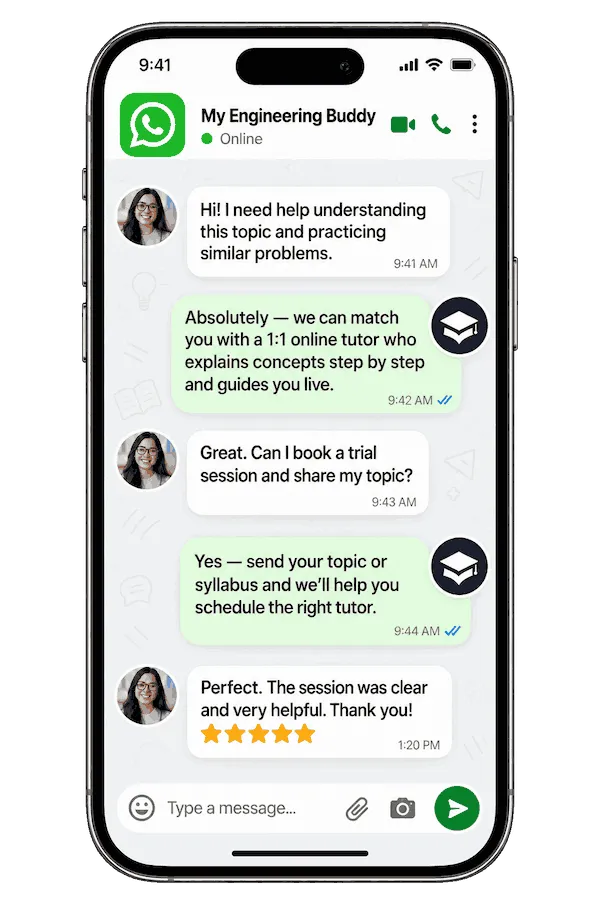
WhatsApp MEB for a quick quote — average response time under 1 minute.
Who This PTV Vissim Tutoring Is For
PTV Vissim draws students from civil engineering, transport planning, and urban design programmes at universities like MIT, TU Delft, University College London, Georgia Tech, ETH Zurich, University of Melbourne, and Delft University of Technology. If your course touches traffic modelling, signal optimisation, or pedestrian simulation, this is the right room.
- Undergraduate students building their first microsimulation network for a transport module assignment
- Masters students calibrating driving behaviour parameters for a thesis chapter and hitting unexplained model errors
- PhD researchers using Vissim’s COM interface for automated scenario testing who need a more experienced eye
- Students who submitted a model that failed peer review or examiner scrutiny and need to resubmit
- Students with a dissertation deadline four to six weeks out and significant calibration gaps still to close
- Transport planning professionals upskilling in Vissim for consultancy project work
If you’ve already spent three evenings debugging a link evaluation that still won’t run correctly — that’s exactly who this is built for. Try the $1 trial before committing to a session block.
1:1 Tutoring vs Self-Study vs AI vs YouTube vs Online Courses
Self-study works if you have time and a well-documented project — Vissim’s manual is extensive but not beginner-friendly. AI tools give fast syntax answers but can’t diagnose why your saturation flow rate is producing unrealistic queue lengths. YouTube covers basic network setup well; it stops the moment you need driving behaviour calibration for a specific road class. Online courses follow fixed workflows that don’t match your university’s project brief. With a 1:1 PTV Vissim tutor from MEB, you work through your actual model, your actual data, and your actual errors in real time — that’s the difference.
Outcomes: What You’ll Be Able To Do in PTV Vissim
After working with an online PTV Vissim tutor through MEB, you’ll be able to build a calibrated microsimulation network from scratch, apply realistic driving behaviour parameters for different vehicle classes, analyse signal timing plans using Vissim’s fixed-time and actuated control options, interpret link evaluation outputs and queue counter data, and present simulation results in a format that holds up to academic or professional scrutiny. These aren’t abstract skills — they map directly to what examiners and project supervisors actually check.
Based on feedback from 40,000+ sessions collected by MEB from 2022 to 2025, 58% of students improved by one full grade after approximately 20 hours of 1:1 tutoring in subjects like PTV Vissim. A further 23% achieved at least a half-grade improvement.
Source: MEB session feedback data, 2022–2025.
At MEB, we’ve found that most Vissim errors aren’t random — they follow patterns. Students who understand why the software behaves a certain way under specific parameter combinations fix problems in minutes instead of hours. That’s what 1:1 sessions are designed to build.
What We Cover in PTV Vissim (Syllabus / Topics)

Network Building and Vehicle Inputs
- Drawing links and connectors for arterial and motorway geometries
- Defining vehicle compositions, classes, and input volumes
- Setting speed distributions and desired speed decisions
- Configuring routing decisions and static routing
- Pedestrian areas and walking behaviour for urban scenarios
- Data collection points: travel time measurements and queue counters
Key references: Traffic Engineering by Roess, Prassas & McShane; PTV Vissim User Manual (current version).
Driving Behaviour and Model Calibration
- Wiedemann 74 and Wiedemann 99 car-following model parameters
- Lane change rules: free, necessary, and desired lane changes
- Calibrating CC0–CC9 parameters against field-observed headway data
- Priority rules and conflict areas at unsignalised intersections
- GEH statistic and RMSE as calibration validation metrics
- Sensitivity analysis for key behavioural parameters
Key references: Microsimulation for Rural Road Design (TRL); Vissim Calibration Guide — PTV Group technical documentation.
Signal Control and Network Performance
- Fixed-time signal control using ring-barrier controller logic
- Actuated and adaptive signal control with detector placement
- VISSIG and external signal state generators
- Running multiple simulation runs and interpreting averaged outputs
- COM interface basics for scripted scenario automation
- Exporting results and building evaluation reports for submission
Key references: Highway Engineering by Garber & Hoel; PTV Vissim COM Interface Manual.
What a Typical PTV Vissim Session Looks Like
The tutor opens by checking where you left the model last time — usually that means reviewing the link evaluation outputs or the parameter log from your previous calibration run. You share your screen over Google Meet. The tutor works through a specific problem with you: if your queue lengths are overestimating at a signalised junction, for example, you’d look at the CC1 and CC2 parameters together, then adjust and re-run to see the effect on the GEH score. The tutor uses a digital pen-pad to annotate the logic directly on screen. You replicate the steps and explain the reasoning back. Session ends with a concrete task: one parameter set to test independently before the next session, one section of the evaluation report to complete.
How MEB Tutors Help You with PTV Vissim (The Learning Loop)
Diagnose: In the first session, the tutor reviews your current model file or project brief. They identify the exact gap — whether that’s network geometry errors, misconfigured priority rules, or a misunderstanding of what the calibration metrics are actually measuring.
Explain: The tutor works through the problem live using your data. Every step is narrated — not just “change this value,” but why that value matters and what happens to vehicle interaction if you get it wrong.
Practice: You attempt the next configuration step while the tutor watches. This isn’t passive — errors surface immediately, which is the point.
Feedback: The tutor corrects mistakes at the parameter level, not the interface level. You learn what cost you accuracy in the last run and what to watch for in the next one.
Plan: Each session ends with a clear next step: a specific scenario to run, a section of results to interpret, or a report section to draft. Progress is tracked session to session.
Sessions run on Google Meet. The tutor uses a digital pen-pad or iPad with Apple Pencil to annotate your model diagrams and output graphs in real time. Before your first session, share your project brief, your current .inpx file if you have one, and your submission deadline. The first session covers a diagnostic of your model and sets the sequence for everything that follows. Whether you need a quick catch-up before a deadline, structured work over four to eight weeks, or ongoing support through the semester, the tutor maps the plan after that first diagnostic.
Start with the $1 trial — 30 minutes of live tutoring that also serves as your first diagnostic.
Students consistently tell us that the moment things click in Vissim isn’t when they finally get the model to run — it’s when they understand why it was wrong before. That shift is what separates a model that passes from one that actually gets cited in a report.
Tutor Match Criteria (How We Pick Your Tutor)
Not every civil engineering tutor knows Vissim. Here’s what MEB checks before the match.
Subject depth: Tutors are matched on specific Vissim experience — network type (urban arterial, motorway, pedestrian), calibration methods, and whether your project needs COM scripting or stays within the standard GUI.
Tools: Every tutor works on Google Meet with a digital pen-pad or iPad and Apple Pencil — so annotation happens on your actual model output, not a whiteboard.
Time zone: Matched to your region. US East Coast, UK, Gulf, Canada, and Australia are all covered with tutors available in those windows.
Goals: Whether you need to pass a transport modelling assignment, complete a Masters dissertation chapter, or calibrate a professional consultancy model, the tutor is matched to that specific brief — not just the subject name.
Unlike platforms where you fill out a form and wait, MEB responds in under a minute, 24/7. Tutor match takes under an hour. The $1 trial means you test before you commit. Everything runs over WhatsApp — no logins, no intake forms.
Pricing Guide
PTV Vissim tutoring runs $20–$40/hr for most undergraduate and taught-Masters coursework. Dissertation support, COM scripting guidance, or calibration at research depth runs $35–$100/hr depending on the tutor’s background and your timeline.
Rate factors: your programme level, how complex the network is, how tight the deadline is, and tutor availability at your preferred hours.
Availability tightens around April–May and November–December when transport engineering submissions cluster. If your deadline is within three weeks, book the diagnostic session first.
For students targeting roles at major transport consultancies or submitting dissertation work to academic panels, tutors with professional traffic modelling backgrounds are available at higher rates — share your specific goal and MEB will match the tier to your ambition.
Start with the $1 trial — 30 minutes, no registration, no commitment. WhatsApp MEB for a quick quote.
MEB tutors cover the full PTV Vissim workflow — from raw network geometry to calibrated output reports. If your model runs but your results don’t make sense, that’s exactly the gap a specialist session is designed to close.
Source: My Engineering Buddy, 2008–2025.
A common pattern our tutors observe is that students spend 80% of their Vissim time on network drawing and 20% on calibration — when the grade usually depends on getting calibration right. Flipping that ratio in the final two weeks makes a real difference.
FAQ
Is PTV Vissim hard to learn?
The interface is learnable in a few hours. The difficulty is in calibration — understanding which driving behaviour parameters to adjust, what the GEH statistic is actually telling you, and how to validate your model against observed data. That’s where most students get stuck.
How many sessions will I need?
Most students working on a single coursework model need three to five sessions. Dissertation-level calibration with multiple scenarios typically takes eight to twelve sessions. The first diagnostic session gives a clearer picture of your specific gap and timeline.
Can you help with project and portfolio work?
Yes — MEB tutoring is guided learning. The tutor explains the logic, walks through the methodology, and helps you understand each step. You run the model and produce the output yourself. MEB tutoring is guided learning — you understand the work, then submit it yourself. See our Academic Integrity policy and Why MEB page for full details on what we help with and what we don’t.
Will the tutor match my exact syllabus or project brief?
Yes. Before your first session, share your project brief, marking rubric, and any specific software version requirements. The tutor prepares for your exact brief — not a generic Vissim workflow. Version differences between Vissim 9, 10, and 2024 releases are accounted for.
What happens in the first session?
The tutor reviews your current model or project brief, identifies the core gaps, and sets a session sequence that fits your deadline. If you don’t have a model yet, the session starts with network setup from your data. Expect the first 10 minutes to be diagnostic, then active work begins.
Are online sessions as effective as in-person for software like Vissim?
For simulation software, online is often better. Screen sharing lets the tutor see your exact model file, parameter settings, and output graphs simultaneously. The pen-pad annotation works on your actual data — something a whiteboard in a physical room can’t replicate for software-specific problems.
Can I get PTV Vissim help at short notice — including evenings and weekends?
Yes. MEB operates 24/7 across time zones. WhatsApp MEB with your deadline and availability — tutors are matched and sessions confirmed within the hour in most cases, including late evenings and weekends for US, UK, and Gulf students.
What if I don’t understand the difference between Wiedemann 74 and Wiedemann 99?
That’s one of the most common Vissim confusions. Wiedemann 74 suits urban signalised networks; Wiedemann 99 is used for motorway and freeway modelling. Your tutor will explain which applies to your project and walk through the parameter set relevant to your network type.
Do you support PTV Vissim’s COM interface for Python or MATLAB scripting?
Yes. Tutors with COM interface experience are available for students automating scenario runs or integrating Vissim outputs with external optimisation routines. Share your scripting language and what you’re trying to automate when you message MEB — this helps with the tutor match.
Can I find a PTV Vissim tutor for a specific city’s transport network project?
Yes — the modelling principles transfer across any urban network. If your project uses real traffic count data from a specific corridor, share it before the session. The tutor works with your actual origin-destination data and network geometry, not a generic example.
How do I get started?
Start with the $1 trial — 30 minutes of live 1:1 tutoring or one project question explained in full. Three steps: WhatsApp MEB, get matched with a Vissim specialist usually within the hour, then start the trial session. No forms, no waiting.
Trust & Quality at My Engineering Buddy
Every MEB tutor goes through a structured vetting process: subject knowledge screening, a live demo session evaluated by an experienced reviewer, and ongoing performance checks based on student feedback after each session. Tutors working on PTV Vissim have direct modelling experience — not just a civil engineering degree. Rated 4.8/5 across 40,000+ verified reviews on Google.
MEB tutoring is guided learning — you understand the work, then submit it yourself. For full details on what we help with and what we don’t, read our Academic Integrity policy and Why MEB.
MEB has been running since 2008, serving 52,000+ students across the US, UK, Canada, Australia, the Gulf, and Europe in 2,800+ subjects. Civil Engineering is one of MEB’s strongest areas — including specialist support in structural engineering tutoring, geotechnical engineering help, and simulation tools like SUMO traffic simulator tutoring. If your programme sits within civil or transport engineering, MEB has covered it before.
MEB has operated across 2,800+ engineering and applied science subjects since 2008. The MEB tutoring methodology is built around diagnostics first — every session plan follows from understanding where the student actually is, not where the syllabus assumes they should be.
Source: My Engineering Buddy, 2008–2025.
Explore Related Subjects
Students studying PTV Vissim often also need support in:
- Autodesk InfraWorks
- Civil3D
- Airport Engineering & Planning
- Railway Engineering
- Environmental Engineering
- Air Pollution Control
- Feasibility Study
Next Steps
To get matched with a PTV Vissim specialist, share the following when you message MEB:
- Your programme level (undergraduate, Masters, PhD, or professional) and your institution’s project brief or marking criteria
- Your current model status — whether you have a working .inpx file or are starting from scratch
- Your submission or exam deadline and preferred session times with your time zone
Before your first session, have ready: your project brief or course outline, any traffic count or origin-destination data you’ve been given, and a note of the specific errors or outputs you don’t understand. The tutor handles the rest.
MEB matches you with a verified tutor — usually within 24 hours, often within the hour. The first session starts with a diagnostic so every minute counts from the beginning.
Visit www.myengineeringbuddy.com for more on how MEB works.
WhatsApp to get started or email [email protected].
Try your first session for $1 — 30 minutes of live 1:1 tutoring or one homework question explained in full. No registration. No commitment. WhatsApp MEB now and get matched within the hour.
Reviewed by Subject Expert
This page has been carefully reviewed and validated by our subject expert to ensure accuracy and relevance.