




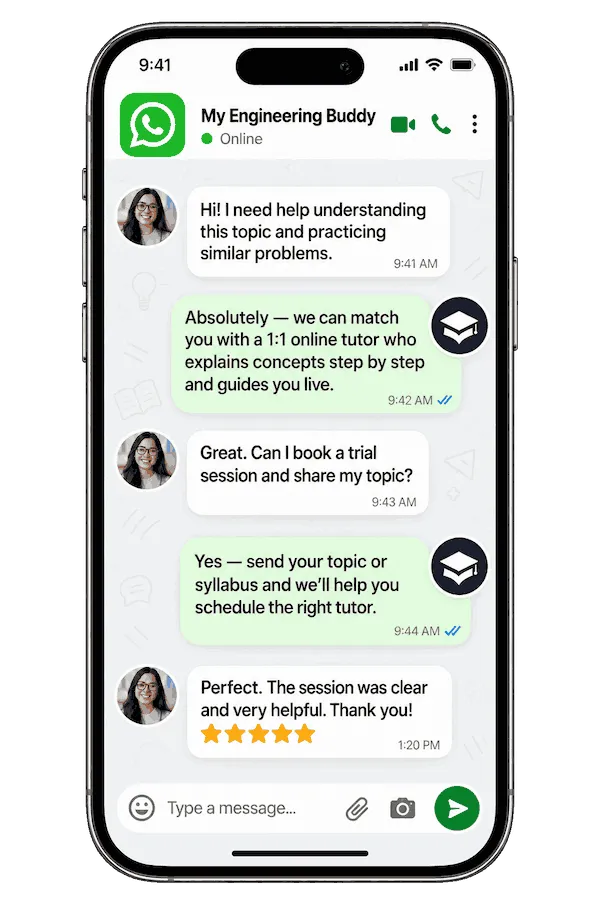
~1 min
Average Reply Time
~1 hour
To Be Matched With A Tutor
30 Min Trial
75% Find Their Tutor On The 1st Trial
$20-35+/hr
Premium Yet Affordable Learning
Most students can define Big-O. Fewer can actually prove why their recursive algorithm blows the call stack — or why their DP solution uses O(n²) memory when O(n) was possible. A Space Complexity tutor fixes that gap, fast.
Space Complexity Tutor Online
Space Complexity measures the total memory an algorithm requires relative to its input size, expressed using Big-O, Big-Theta, or Big-Omega notation. It covers stack frames, heap allocations, auxiliary space, and in-place vs out-of-place trade-offs in algorithm design.
MEB offers 1:1 online tutoring and homework help in 2,800+ advanced subjects — including Computer Science and its core analytical topics. Whether you’re searching for a Space Complexity tutor near me or need targeted help before a midterm, an MEB tutor works through your exact course material with you — not a generic syllabus. One session often shifts how a student reads and writes algorithmic analysis entirely.
- 1:1 online sessions tailored to your course, university, and syllabus
- Expert-verified tutors with CS degrees and subject-specific depth in algorithm analysis
- Flexible time zones — US, UK, Canada, Australia, Gulf
- Structured learning plan built after a diagnostic session
- Ethical homework and assignment guidance — you understand the work, then submit it yourself
52,000+ students across the US, UK, Canada, Australia, and the Gulf have used MEB since 2008 — including students in Computer Science subjects like Space Complexity, Big-O Notation, and Design and Analysis of Algorithms.
Source: My Engineering Buddy, 2008–2025.
How Much Does a Space Complexity Tutor Cost?
Rates run $20–$40/hr for most undergraduate and graduate-level sessions. Specialist tutors covering advanced topics like amortised analysis or cache-oblivious algorithms may be priced higher. The $1 trial gets you 30 minutes of live 1:1 tutoring or a full explanation of one homework question — no registration needed.
| Level / Need | Typical Rate | What’s Included |
|---|---|---|
| Standard (most levels) | $20–$35/hr | 1:1 sessions, homework guidance |
| Advanced / Specialist | $35–$70/hr | Expert tutor, niche algorithmic depth |
| $1 Trial | $1 flat | 30 min live session or 1 homework question |
Tutor availability tightens around final exam periods and assignment deadlines — particularly in November and April. Book early if your course assessment falls within those windows.
WhatsApp MEB for a quick quote — average response time under 1 minute.
Who This Space Complexity Tutoring Is For
This is for CS and engineering students who can follow lecture slides but fall apart the moment the exam asks them to derive memory usage from scratch. The gap between recognising a formula and applying it cold is where most marks are lost.
- Undergraduates in data structures, algorithms, or theory of computation courses
- Graduate students working through algorithm design coursework or research prerequisites
- Students retaking after a failed first attempt on an algorithms or CS theory module
- Students with a university conditional offer depending on their CS grade this semester
- Students 4–6 weeks from finals with specific gaps in auxiliary space and recurrence analysis still to close
- Parents watching a student’s confidence drop as algorithm assignments pile up
Students come from a wide range of universities — MIT, Stanford, Carnegie Mellon, University of Toronto, Imperial College London, University of Melbourne, ETH Zurich, and many others where algorithms and complexity courses are among the most demanding in the curriculum.
Students consistently tell us that Space Complexity is the topic where they realise they’ve been pattern-matching rather than reasoning. The moment a tutor asks “where exactly does this memory go?” and works through it on screen, things click in a way that re-reading notes never achieved.
1:1 Tutoring vs Self-Study vs AI vs YouTube vs Online Courses
Self-study works if you’re disciplined, but Space Complexity demands feedback — you can’t tell if your recurrence derivation is wrong until someone checks it. AI tools explain notation fast but can’t watch you work through a problem and catch the moment you confuse auxiliary space with total space. YouTube covers Big-O overviews well and stops there. Online courses move at a fixed pace that won’t wait for you to genuinely understand stack frame analysis. A 1:1 Space Complexity tutor from MEB works through your specific problem set, corrects errors in real time, and adjusts the session when you’re stuck on in-place sorting vs. out-of-place allocation.
Outcomes: What You’ll Be Able To Do in Space Complexity
After working with an online Space Complexity tutor, you’ll be able to analyze the memory footprint of any recursive algorithm by tracing its call stack depth precisely. You’ll apply Big-O, Big-Theta, and Big-Omega to both auxiliary and total space, distinguishing the two without hesitation. You’ll solve dynamic programming problems and correctly identify whether an O(n²) table can be compressed to O(n) — and prove it. You’ll explain in-place sorting algorithms like Heapsort against alternatives that require extra allocation. And you’ll present complete space-complexity proofs in written exams, not just arrive at an answer.
Based on feedback from 40,000+ sessions collected by MEB from 2022 to 2025, 58% of students improved by one full grade after approximately 20 hours of 1:1 tutoring in subjects like Space Complexity. A further 23% achieved at least a half-grade improvement.
Source: MEB session feedback data, 2022–2025.
Supporting a student through Space Complexity? MEB works directly with parents to set up sessions, track progress, and keep coursework on schedule. WhatsApp MEB — average response time is under a minute, 24/7.

What We Cover in Space Complexity (Syllabus / Topics)
Track 1: Foundations of Space Complexity Analysis
- Total space vs auxiliary space — definitions and distinction
- Big-O, Big-Theta, Big-Omega applied to memory usage
- Stack frame analysis for iterative and recursive functions
- In-place algorithms — criteria and verification
- Heap allocations, pointer overhead, and hidden memory costs
- Space-time trade-off framing in algorithm selection
Core texts: Introduction to Algorithms (CLRS, 4th ed.), Algorithm Design by Kleinberg & Tardos — chapters on recurrences and dynamic programming.
Track 2: Recursive Algorithms and Recurrence Relations
- Call stack depth analysis — deriving space from recursion trees
- Master Theorem applied to space (not just time)
- Tail recursion and compiler optimisation implications
- Divide-and-conquer space analysis (Merge Sort, Quick Sort)
- Memoisation vs tabulation — space cost comparison
- Space complexity of tree traversal algorithms (DFS, BFS)
Core texts: The Algorithm Design Manual by Skiena (3rd ed.), Algorithms by Dasgupta, Papadimitriou, Vazirani.
Track 3: Dynamic Programming and Advanced Topics
- DP table construction — 2D to 1D space reduction proofs
- Space-optimised DP for classic problems (Knapsack, LCS, Edit Distance)
- Cache-oblivious algorithms and memory hierarchy basics
- Space complexity in graph algorithms — adjacency matrix vs list
- Amortised space analysis concepts
- Space complexity in parallel and distributed computation contexts
Core texts: Introduction to Algorithms (CLRS) DP chapters; Competitive Programming 3 by Halim & Halim for applied problem sets.
At MEB, we’ve found that students who struggle with Space Complexity have usually skipped the step of drawing the call stack by hand. Before any notation, before any formula — draw where the memory actually goes. That single habit resolves most confusion faster than any re-explanation of theory.
What a Typical Space Complexity Session Looks Like
The tutor opens by checking the previous session’s topic — usually a specific recurrence or DP optimisation problem the student attempted independently. From there, the session moves into the student’s current problem set: often a recursive algorithm where the student has written a time complexity proof but hasn’t touched the space analysis. The tutor uses a digital pen-pad to annotate the call stack live, showing exactly where frames are pushed and when they’re freed. The student then replicates the reasoning on a new problem — same structure, different values — while the tutor watches and corrects. The session closes with one concrete practice task set for before the next meeting, and the next topic noted: often DP space reduction or graph traversal stack analysis. You’ll need your course slides or a past assignment to share at the start.
How MEB Tutors Help You with Space Complexity (The Learning Loop)
Diagnose: In the first session, the tutor asks you to work through one space complexity problem unprompted. They’re looking for where exactly your reasoning breaks — whether it’s at the notation, the stack depth counting, or the auxiliary vs total distinction. Most students have one consistent error pattern. Finding it takes about 15 minutes.
Explain: The tutor works through a carefully chosen example on the digital pen-pad — usually a recursive function you’ve seen before, so the logic is familiar and the focus stays on the memory analysis. They annotate each frame, each allocation, each return.
Practice: You attempt the next problem while the tutor watches. No hints unless you’re stuck for more than three minutes. This is where real learning happens — not when you watch, but when you do.
Feedback: The tutor goes through every step you took. Not just “this is wrong” — they show why the step was wrong, where the mark scheme would deduct points, and what the correct reasoning chain looks like.
Plan: The session ends with a clear next topic, a specific problem to attempt independently, and a note on which area to revisit first. No vague advice. A concrete sequence.
All sessions run on Google Meet. The tutor uses a digital pen-pad or iPad with Apple Pencil to write and annotate in real time. Before your first session, have your course outline or module syllabus ready, plus any past exam questions or homework you got stuck on. The first session always starts with a diagnostic — so every minute from session two onward is targeted work. Start with the $1 trial — 30 minutes of live tutoring that also serves as your first diagnostic.
A common pattern our tutors observe is that Space Complexity errors on exams are rarely about forgetting the formula — they’re about not knowing which memory to count. One session focused on that distinction is usually enough to close the gap.
Source: MEB tutor observation, Space Complexity sessions, 2022–2025.
Try your first session for $1 — 30 minutes of live 1:1 tutoring or one homework question explained in full. No registration. No commitment. WhatsApp MEB now and get matched within the hour.
Tutor Match Criteria (How We Pick Your Tutor)
Not every CS tutor understands Space Complexity at a level where they can derive and prove — not just explain. MEB’s matching accounts for that.
Subject depth: Tutors are matched to your exact level — whether that’s an introductory algorithms course, a graduate-level theory module, or a competitive programming context where space optimisation is a performance constraint.
Tools: All tutors work on Google Meet with a digital pen-pad or iPad and Apple Pencil — essential for working through stack frames and annotating code visually.
Time zone: Matched to your region — US, UK, Canada, Australia, or Gulf. Late-night availability exists for students in intensive programmes.
Goals: Whether you need to pass a final, fix a specific assignment, or build a solid foundation for a research role, the tutor match reflects that goal — not a generic slot assignment.
Unlike platforms where you fill out a form and wait, MEB responds in under a minute, 24/7. Tutor match takes under an hour. The $1 trial means you test before you commit. Everything runs over WhatsApp — no logins, no intake forms.
Study Plans (Pick One That Matches Your Goal)
After the diagnostic session, your tutor builds the sequence. Three common structures: a catch-up plan (1–3 weeks) for students with a gap to close before an upcoming exam or assignment; an exam prep plan (4–8 weeks) for students who want structured coverage of all space complexity topics before finals; and weekly support running alongside your semester, aligned to lecture pace and homework deadlines. For students in Data Structures and Algorithms or theory modules, the tutor typically sequences Foundations first, then Recursion, then DP optimisation.
Pricing Guide
Most Space Complexity sessions run $20–$40/hr. Graduate-level and research-adjacent work — amortised analysis, cache-oblivious algorithms, complexity-theoretic proofs — can reach up to $100/hr depending on tutor background.
Rate factors: your current level, the specific topics in scope, how close your deadline is, and tutor availability. Rates for specialist algorithms tutoring and adjacent theory topics follow the same structure.
Peak exam periods — November and April — see reduced tutor availability. Don’t wait until the week before.
For students targeting competitive graduate programmes at MIT, Stanford, ETH Zurich, or Carnegie Mellon where algorithmic depth is assessed in admissions or qualifying exams, tutors with research and industry backgrounds in algorithm design are available at higher rates. Share your specific goal and MEB will match the tier to your situation.
Start with the $1 trial — 30 minutes, no registration, no commitment. WhatsApp MEB for a quick quote.
FAQ
Is Space Complexity hard?
It’s not conceptually complex once the distinction between auxiliary and total space is clear — but most courses teach it fast and move on. Students who struggle usually have one specific gap: stack frame counting or recurrence-to-space translation. A single targeted session fixes that for most.
How many sessions are needed?
Most students see a clear improvement in 3–6 sessions. If you’re starting from scratch four weeks before finals, a structured 8–10 session plan covering all three tracks is more realistic. The first diagnostic session determines the right number for your situation.
Can you help with homework and assignments?
MEB tutoring is guided learning — you understand the work, then submit it yourself. The tutor explains the reasoning, works through examples, and checks your understanding. See our Academic Integrity policy and Why MEB page for full details on what we help with and what we don’t.
Will the tutor match my exact syllabus or exam board?
Yes. Before the first session, share your course outline or module descriptor. The tutor checks which topics are in scope — whether that’s an intro algorithms course at an Australian university or a CS theory module at a UK Russell Group institution — and builds the session around your exact material.
What happens in the first session?
It starts with a diagnostic: the tutor gives you a space complexity problem to work through unprompted. This identifies your exact gap — notation, stack analysis, or DP reasoning. The rest of the session addresses that gap directly. You leave with a specific practice task and a clear plan for the next session.
Is online tutoring as effective as in-person?
For Space Complexity specifically, online is often better — the tutor annotates code and call stacks live on a shared digital pen-pad, which is clearer than a whiteboard. Students in the US, UK, Canada, and Australia consistently report that the visual annotation approach clicks faster than classroom explanations.
Can I get Space Complexity help at midnight?
Yes. MEB operates 24/7 across time zones. Students in the Gulf, Australia, and North America with late-night deadlines regularly message via WhatsApp after midnight and get matched within the hour. The $1 trial has no time restriction.
What if I don’t like my assigned tutor?
Tell MEB via WhatsApp. A replacement is arranged without friction — no forms, no waiting period. Most mismatches are about teaching style rather than subject knowledge, and MEB keeps notes on your preference for the next match.
What’s the difference between Space Complexity and Time Complexity — and do tutors cover both?
Time Complexity measures operations; Space Complexity measures memory. They’re related but assessed separately. MEB tutors cover both — many students need them together, especially when optimising a DP solution requires understanding the trade-off between the two. Get Design and Analysis of Algorithms help if you need both covered systematically.
Why do students lose marks on Space Complexity exam questions even when they know Big-O?
Usually because they count total space instead of auxiliary space, or miss the implicit stack depth in a recursive call. Examiners also penalise missing justification — arriving at O(n) without showing why loses partial credit. Tutors drill both the answer and the proof structure.
Do you offer group Space Complexity sessions?
MEB sessions are 1:1 only. Group sessions aren’t available — the diagnostic and real-time correction model that makes these sessions effective requires individual attention. Study groups are fine for practice, but the tutor session itself is always one student, one tutor.
How do I get started?
Three steps: WhatsApp MEB, get matched with a Space Complexity tutor within the hour, then start your $1 trial — 30 minutes of live tutoring or one homework question explained in full. No registration, no commitment before you’ve seen the quality.
Trust & Quality at My Engineering Buddy
Every MEB tutor goes through subject-specific vetting — not a generic screening. For Space Complexity, that means demonstrating they can derive auxiliary space bounds, trace call stacks live, and explain DP optimisation without relying on memorised answers. Tutors complete a live demo evaluation before being placed with students, and ongoing session feedback is reviewed to catch quality drops early. Tutors hold CS or related degrees and many have research or industry backgrounds in algorithm design. Rated 4.8/5 across 40,000+ verified reviews on Google.
MEB tutoring is guided learning — you understand the work, then submit it yourself. For full details on what we help with and what we don’t, read our Academic Integrity policy and Why MEB.
MEB has served 52,000+ students across the US, UK, Canada, Australia, Gulf, and Europe since 2008 — covering 2,800+ subjects. In Computer Science, that includes recursion tutoring, graph algorithms help, and Theory of Computation tutoring alongside Space Complexity. The platform runs on WhatsApp — which means real humans, real response times, and no automated gatekeeping. For deeper reading on how algorithm analysis is taught at university level, MIT OpenCourseWare’s Introduction to Algorithms course materials are freely available.
Explore Related Subjects
Students studying Space Complexity often also need support in:
- Automata Theory
- Binary Search
- Binary Trees
- Sorting
- Memory Management and Allocation
- Parallel Computing
- Formal Languages
- Distributed Algorithms
Our experience across thousands of sessions shows that Space Complexity doesn’t stay isolated. Students who fix their memory analysis reasoning almost always find their time complexity proofs sharpen too — the two skills reinforce each other once the underlying logic is solid.
Source: MEB tutor observation, algorithm analysis sessions, 2019–2025.
Next Steps
Getting started takes about two minutes.
- Share your exam board or course outline, the specific topics you’re stuck on, and your deadline or exam date
- Share your time zone and available hours
- MEB matches you with a verified Space Complexity tutor — usually within an hour
Before your first session, have ready:
- Your course outline or module syllabus
- A recent past paper attempt or homework question you struggled with
- Your exam or deadline date
The tutor handles the rest. First session starts with a diagnostic so every minute of every session after that is targeted work.
Visit www.myengineeringbuddy.com for more on how MEB works.
WhatsApp to get started or email [email protected].
Reviewed by Subject Expert
This page has been carefully reviewed and validated by our subject expert to ensure accuracy and relevance.




