




~1 min
Average Reply Time
~1 hour
To Be Matched With A Tutor
30 Min Trial
75% Find Their Tutor On The 1st Trial
$20-35+/hr
Premium Yet Affordable Learning
Most students who fail their distributed algorithms exam can pinpoint the moment it fell apart: leader election made sense, then Byzantine fault tolerance arrived and nothing after it did.
Distributed Algorithms Tutor Online
Distributed algorithms are a class of algorithms designed to run across multiple networked nodes, coordinating computation without shared memory. They underpin fault-tolerant systems, consensus protocols, and large-scale distributed computing, equipping students to design and analyze correct concurrent processes.
Finding a qualified distributed algorithms tutor near me is harder than it sounds — the field sits at the intersection of Computer Science theory and systems engineering, and most generic tutoring platforms don’t cover it at the depth graduate and advanced undergraduate courses demand. MEB’s distributed systems tutoring team includes tutors who have worked through Lamport clocks, Paxos, and the FLP impossibility result — with students who are weeks from an exam and still not clear on why termination is so hard to guarantee. One clear session can unblock weeks of confusion.
- 1:1 online sessions tailored to your exact course syllabus and exam board
- Expert-verified tutors with graduate-level distributed algorithms knowledge
- Flexible time zones — US, UK, Canada, Australia, Gulf
- Structured learning plan built after a diagnostic session
- Ethical homework and assignment guidance — you understand the work, then submit it yourself
52,000+ students across the US, UK, Canada, Australia, and the Gulf have used MEB since 2008 — including students in Computer Science subjects like Distributed Algorithms, Concurrent Programming, and Theory of Computation.
Source: My Engineering Buddy, 2008–2025.
How Much Does a Distributed Algorithms Tutor Cost?
Most sessions run $20–$40/hr. Graduate-level courses covering Paxos, Raft, or formal verification push toward $60–$100/hr, depending on tutor specialisation. Not sure if it’s worth committing? Start with the $1 trial — 30 minutes live or one assignment question explained in full, no registration required.
| Level / Need | Typical Rate | What’s Included |
|---|---|---|
| Undergraduate (core modules) | $20–$40/hr | 1:1 sessions, homework guidance |
| Advanced / Graduate-level | $40–$100/hr | Expert tutor, proof-level depth |
| $1 Trial | $1 flat | 30 min live session or 1 homework question |
Tutor availability tightens significantly around semester finals and graduate qualifying exams. Book early if you’re approaching either.
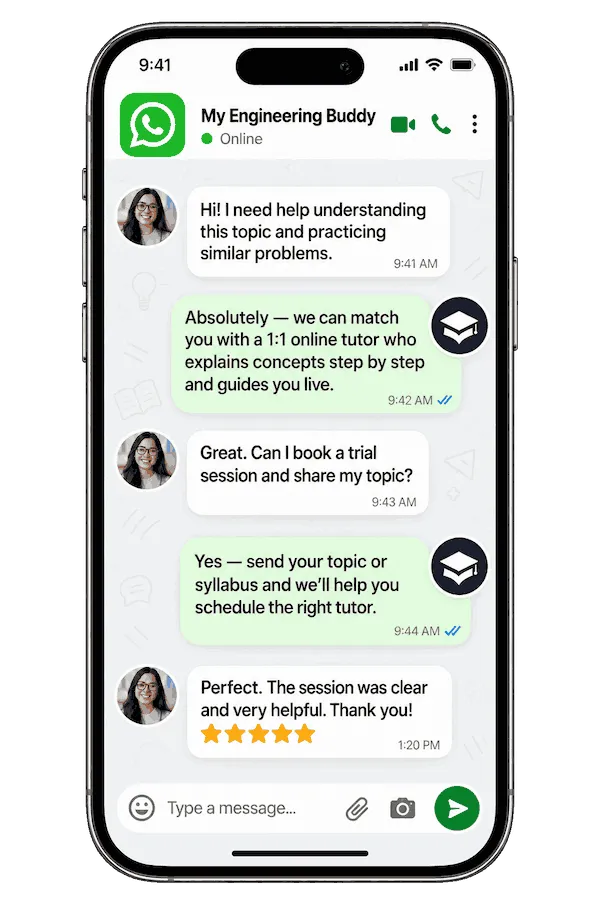
WhatsApp MEB for a quick quote — average response time under 1 minute.
Who This Distributed Algorithms Tutoring Is For
Distributed algorithms sits in the hardest tier of most CS degree programmes. It demands both mathematical rigour — proofs of safety and liveness — and systems intuition that comes only from working through real protocol designs. These students book with MEB:
- Undergraduate CS students hitting consensus protocols for the first time and losing the thread between theory and implementation
- Graduate students preparing for qualifying exams where distributed algorithms topics appear without warning
- Students retaking after a failed first attempt who need to close specific gaps — not repeat the whole course
- Students with a university conditional offer depending on this grade — one subject standing between them and their programme
- PhD students whose research touches distributed systems and who need to get sharper on the formal foundations fast
- Students at institutions like MIT, Carnegie Mellon, ETH Zurich, Imperial College London, the University of Toronto, EPFL, and ANU where distributed algorithms appears as a core or elective advanced module
- Homework and assignment guidance — you understand the work, build the reasoning, then submit it yourself
At MEB, we’ve found that students who struggle with distributed algorithms almost always have the same gap: they can follow a protocol’s steps but can’t explain why it’s correct. Once a tutor walks through a proof of safety or liveness in detail — not just the conclusion — that gap closes fast.
1:1 Tutoring vs Self-Study vs AI vs YouTube vs Online Courses
Self-study works if you’re disciplined, but distributed algorithms proofs don’t grade themselves — you won’t know your reasoning is wrong until the exam. AI tools give fast explanations but can’t catch flawed proof logic or walk you through why your model of message-passing is off. YouTube covers Lamport clocks at a surface level; it stops well short of formal verification or safety proofs. Online courses are structured but fixed-pace, with no one to ask when the FLP impossibility result stops making sense. 1:1 tutoring with MEB is live, calibrated to your exact distributed algorithms module, and corrects errors in the moment — the kind of feedback that actually moves your understanding forward.
Outcomes: What You’ll Be Able To Do in Distributed Algorithms
After working through distributed algorithms with an MEB tutor, students consistently report that they can analyze the correctness of consensus protocols like Paxos and Raft under both crash and Byzantine failure models. They can prove safety and liveness properties using formal reasoning rather than intuition. Students can model asynchronous message-passing systems and explain why the FLP impossibility result matters in practice. They can apply logical clocks — Lamport and vector clocks — to reason about event ordering in concurrent distributed processes. They can also design and evaluate leader election and mutual exclusion algorithms for real distributed environments.
Based on feedback from 40,000+ sessions collected by MEB from 2022 to 2025, 58% of students improved by one full grade after approximately 20 hours of 1:1 tutoring in subjects like Distributed Algorithms. A further 23% achieved at least a half-grade improvement.
Source: MEB session feedback data, 2022–2025.
Try your first session for $1 — 30 minutes of live 1:1 tutoring or one homework question explained in full. No registration. No commitment. WhatsApp MEB now and get matched within the hour.
What We Cover in Distributed Algorithms (Syllabus / Topics)
Track 1: Foundations and Models
- Computational models: synchronous vs asynchronous distributed systems
- Message-passing and shared-memory models
- Process and communication failures: crash, omission, Byzantine
- The FLP impossibility result and its practical implications
- Logical clocks: Lamport timestamps and vector clocks
- Causality and event ordering in distributed executions
- Safety and liveness properties — definitions and proof techniques
Core texts for this track include Lynch’s Distributed Algorithms, Attiya and Welch’s Distributed Computing, and Raynal’s Distributed Algorithms for Message-Passing Systems.
Track 2: Consensus, Leader Election, and Fault Tolerance
- The consensus problem: formulation and impossibility in asynchronous systems
- Paxos protocol: phases, roles, and correctness argument
- Raft consensus algorithm: leader election, log replication, and safety
- Byzantine fault tolerance: PBFT and its assumptions
- Leader election algorithms: ring-based (LCR), general graphs
- Mutual exclusion in distributed systems: token-based and message-based approaches
- Snapshot algorithms: Chandy-Lamport global state recording
Key references: Lamport’s original Paxos papers, Ongaro and Ousterhout’s Raft paper, and Coulouris et al.’s Distributed Systems: Concepts and Design.
Track 3: Graph Algorithms and Advanced Topics
- Distributed graph algorithms: spanning trees, shortest paths, MST
- Broadcast and convergecast in tree-structured networks
- Distributed BFS and DFS
- Self-stabilising algorithms and their convergence proofs
- Consistency models: linearisability, sequential consistency, eventual consistency
- CAP theorem: formal statement and trade-offs in real systems
Recommended texts: Peleg’s Distributed Computing: A Locality-Sensitive Approach and Herlihy and Shavit’s The Art of Multiprocessor Programming.
Students working on graph algorithms tutoring or parallel computing help alongside distributed algorithms will find significant overlap in these tracks — MEB tutors can coordinate coverage across modules.

What a Typical Distributed Algorithms Session Looks Like
The tutor opens by checking the previous topic — often the point where Raft’s leader election left off or where a Paxos phase-2 proof broke down. From there, the student and tutor work through a specific problem on screen: tracing through message rounds in a consensus protocol, identifying where a liveness argument fails under an asynchronous model, or reconstructing the Chandy-Lamport snapshot algorithm from scratch. The tutor uses a digital pen-pad to annotate system diagrams and proof steps in real time. The student then replicates the reasoning or explains it back — not just copies it. The session closes with a concrete task: prove a specific property of a named algorithm, or write out the safety argument for a simplified Raft scenario. The next topic — often Byzantine fault models or self-stabilisation — is flagged before the session ends.
How MEB Tutors Help You with Distributed Algorithms (The Learning Loop)
Diagnose: In the first session, the tutor identifies exactly where understanding breaks down — whether that’s the model of asynchronous communication, the structure of a correctness proof, or the gap between reading a protocol and being able to reconstruct its logic independently.
Explain: The tutor works through live examples using a digital pen-pad — tracing a Paxos round, drawing a vector clock execution, or stepping through an LCR leader election — so the student sees the reasoning built from scratch, not handed to them finished.
Practice: The student attempts a similar problem with the tutor present. Hesitation and wrong turns are expected and used — they’re the signal the tutor needs to adjust the explanation.
Feedback: The tutor gives step-by-step correction: where the proof logic failed, why a particular assumption doesn’t hold in asynchronous settings, which part of the answer would lose marks in an exam. Specific, not general.
Plan: Before the session ends, the tutor sets the next topic and a concrete preparation task. Progress is tracked across sessions — not reset each time.
Sessions run on Google Meet. The tutor uses a digital pen-pad or iPad with Apple Pencil for protocol diagrams and proof annotation. Before your first session, share your course syllabus or module outline, any past exam questions you’ve attempted, and your exam or assignment deadline. The first session covers a diagnostic and begins on the highest-priority topic immediately. Whether you need a two-week crash course on Paxos and Raft before a resit, structured weekly sessions through a semester, or ongoing support for graduate research — the tutor maps the plan after the diagnostic. Start with the $1 trial — 30 minutes of live tutoring that also serves as your first diagnostic.
Students who treat the $1 trial as a test of the tutor — not just the platform — consistently book follow-up sessions. The diagnostic alone is worth more than most students expect from a first hour.
Source: My Engineering Buddy, 2008–2025.
Students consistently tell us that distributed algorithms feels impossible until someone draws the execution trace in front of them and walks through what each process can and cannot know at each step. That moment of seeing it live — not reading it — is where the subject clicks.
Tutor Match Criteria (How We Pick Your Tutor)
Not every CS tutor can handle distributed algorithms at exam depth. MEB matches on four criteria.
Subject depth: The tutor must have worked with the specific course content — graduate-level consensus theory, undergraduate module structures, or specific exam boards. A tutor who covered Paxos in a distributed systems course is not automatically right for a formal algorithms course with proof requirements.
Tools: Every tutor works on Google Meet with a digital pen-pad or iPad and Apple Pencil — essential for drawing execution traces and annotating proofs in real time. Students working on algorithms tutoring or algorithm design and analysis help are matched to tutors with the same setup.
Time zone: Matched to your region — US, UK, Gulf, Canada, Australia. No scheduling across impossible time gaps.
Goals: Exam preparation, conceptual depth, assignment guidance, or research support — the match accounts for your actual objective, not a generic profile.
Unlike platforms where you fill out a form and wait, MEB responds in under a minute, 24/7. Tutor match takes under an hour. The $1 trial means you test before you commit. Everything runs over WhatsApp — no logins, no intake forms.
Study Plans (Pick One That Matches Your Goal)
After the diagnostic, the tutor builds your session sequence. Three common structures: a catch-up plan covering one to three weeks of intensive work on specific gaps — Paxos phases, Byzantine models, or proof technique — before an exam or resit; a structured exam-prep plan over four to eight weeks working through the full syllabus systematically; or ongoing weekly support aligned to your semester timetable, keeping pace with lectures and tackling data structures and algorithms homework help or distributed algorithms problem sets as they arrive. The tutor proposes the sequence after the first session.
Pricing Guide
Most distributed algorithms sessions run $20–$40/hr. Graduate-level work — formal proofs, Byzantine fault tolerance, research-adjacent topics — runs $60–$100/hr depending on tutor background and topic complexity. Rate factors include course level, proof depth required, timeline urgency, and tutor availability during peak periods.
For students targeting top research programmes or positions at companies where distributed systems design is central to technical interviews, tutors with active research or industry backgrounds in distributed computing are available at higher rates — share your specific goal and MEB matches the tier to your ambition.
Tutor slots during semester finals and qualifying exam windows fill fast. Start with the $1 trial — 30 minutes, no registration, no commitment. WhatsApp MEB for a quick quote.
FAQ
Is distributed algorithms hard?
Yes — it’s consistently rated among the hardest CS modules. The difficulty comes from combining formal proof reasoning with non-intuitive models of asynchronous communication. Most students hit a wall at consensus protocols or the FLP impossibility result. A tutor who has worked through these with dozens of students shortens that wall considerably.
How many sessions are needed?
For a student with solid CS foundations and a specific exam in six weeks, 10–15 hours covers most of the core syllabus. Graduate students doing proof-heavy courses often benefit from 20+ hours spread across a semester. The tutor gives a realistic estimate after the first diagnostic session.
Can you help with homework and assignments?
MEB tutoring is guided learning — you understand the work, then submit it yourself. The tutor explains the underlying concepts, works through similar examples, and helps you identify where your reasoning breaks down. See our Academic Integrity policy and Why MEB page for full details on what we help with and what we don’t.
Will the tutor match my exact syllabus or exam board?
Yes. Share your module outline or exam board when you message MEB on WhatsApp. Tutors are matched to your specific course — not a generic distributed algorithms curriculum. Graduate and undergraduate courses differ significantly; the match accounts for that.
What happens in the first session?
The tutor runs a short diagnostic — asking you to explain or work through one or two problems to locate exactly where understanding breaks down. From that point, the session moves directly into the highest-priority topic. No time is spent on content you already know.
Is online tutoring as effective as in-person?
For distributed algorithms specifically, it’s often better. The digital pen-pad lets the tutor annotate execution traces and proofs in real time — something a whiteboard in a physical room rarely matches. Students in the US, UK, and Australia consistently report that the live screen annotation is what makes the difference.
Can I get distributed algorithms help at midnight or over the weekend?
Yes. MEB operates 24/7 across time zones. Message on WhatsApp at any hour — average response time is under a minute. Tutors are available across US, UK, Gulf, and Australian time zones, so late-night and weekend sessions are standard, not exceptions.
What if I don’t like my assigned tutor?
Request a switch via WhatsApp. MEB will match you with a different tutor, usually within the hour. The $1 trial exists precisely so you can assess the fit before committing to a full schedule of sessions.
What’s the difference between distributed algorithms and distributed systems — and do I need both?
Distributed systems covers architecture, infrastructure, and real-world implementation. Distributed algorithms focuses on the theoretical correctness of protocols running in those systems — proofs, models, impossibility results. Many CS programmes teach both; the concepts overlap but the depth required differs. MEB covers both, and tutors can bridge the gap between them if your course does.
How do I prepare for a Paxos or Raft question in an exam?
Know the protocol phases by name, understand what each phase guarantees, and be able to argue why safety holds even when a minority of nodes crash. Exams typically ask you to trace a specific execution or identify a failure scenario. MEB tutors work through this format directly — not just the theory.
Do you offer group distributed algorithms sessions?
No — MEB sessions are 1:1 only. Group sessions dilute the diagnostic precision that makes distributed algorithms tutoring effective. Every session is calibrated to one student’s specific gaps, not averaged across a group.
How do I get started?
Message MEB on WhatsApp — three steps: WhatsApp MEB, get matched with a verified distributed algorithms tutor (usually within an hour), then start the $1 trial: 30 minutes of live 1:1 tutoring or one homework question explained in full. No registration, no forms.
Trust & Quality at My Engineering Buddy
Every MEB tutor goes through a subject-specific screening process that includes a live demo evaluation and ongoing session feedback review. For distributed algorithms, this means verifying graduate-level knowledge of consensus protocols, proof techniques, and distributed computation models — not just general CS competence. Rated 4.8/5 across 40,000+ verified reviews on Google. MEB has been operating since 2008, serving 52,000+ students across the US, UK, Canada, Australia, the Gulf, and Europe.
MEB tutoring is guided learning — you understand the work, then submit it yourself. For full details on what we help with and what we don’t, read our Academic Integrity policy and Why MEB.
MEB covers 2,800+ subjects across Computer Science and related disciplines. Students working on operating systems tutoring, computer networking help, or cryptography tutoring alongside distributed algorithms will find tutors who understand how these fields connect — and can cover both in a single session plan. Read more about MEB’s approach at our tutoring methodology.
MEB has matched students with distributed algorithms tutors across North America, the UK, Australia, and the Gulf since 2008 — across every major university calendar, time zone, and exam format the subject appears in.
Source: My Engineering Buddy, 2008–2025.
A common pattern our tutors observe is that students spend weeks re-reading lecture notes on Byzantine fault tolerance without improving. One session replacing passive reading with active proof reconstruction — working out why PBFT requires 3f+1 nodes — does more than five re-reads.
Explore Related Subjects
Students studying Distributed Algorithms often also need support in:
- Automata Theory
- Formal Languages
- High Performance Computing (HPC)
- Cloud Computing
- Quantum Computing
- Concurrent Programming
- Memory Management & Allocation
- Network Protocols
Next Steps
Before your first session, have ready: your module or course syllabus, any past exam questions or assignments you’ve struggled with, and your exam or deadline date. The tutor handles the rest.
- Share your exam board, hardest topic (Paxos? Byzantine models? Liveness proofs?), and current timeline
- Share your availability and time zone
- MEB matches you with a verified distributed algorithms tutor — usually within 24 hours
The first session starts with a diagnostic so every minute is used on what actually matters. Visit www.myengineeringbuddy.com for more on how MEB works.
WhatsApp to get started or email [email protected].
Reviewed by Subject Expert
This page has been carefully reviewed and validated by our subject expert to ensure accuracy and relevance.




