




~1 min
Average Reply Time
~1 hour
To Be Matched With A Tutor
30 Min Trial
75% Find Their Tutor On The 1st Trial
$20-35+/hr
Premium Yet Affordable Learning
Most students who struggle with GCSE Astronomy hit a wall at the same place: the inverse square law, stellar classification, or the sheer volume of terminology crammed into two written papers.
GCSE Astronomy Tutor Online
GCSE Astronomy is a standalone qualification offered by exam boards including Edexcel, covering the solar system, stellar evolution, cosmology, and observational techniques. It develops scientific reasoning and equips students to interpret astronomical data at GCSE level.
MEB provides 1:1 online tutoring and homework help in 2,800+ advanced subjects — and a dedicated GCSE Astronomy tutor online is ready to work through your exact Edexcel syllabus, paper by paper. Whether you’re searching for a GCSE Astronomy tutor near me or need someone available at midnight before a submission deadline, MEB connects you within the hour. Our GCSE tutoring covers every subject in the framework, with specialists who know the mark schemes and common examiner traps.
- 1:1 online sessions tailored to your Edexcel GCSE Astronomy syllabus
- Expert verified tutors with subject-specific knowledge in observational and theoretical astronomy
- Flexible time zones — US, UK, Canada, Australia, Gulf
- Structured learning plan built after a diagnostic session
- Ethical homework and assignment guidance — you understand before you submit
52,000+ students across the US, UK, Canada, Australia, and the Gulf have used MEB since 2008 — including students in GCSE Science subjects like GCSE Physics, GCSE Combined Science, and GCSE Geology.
Source: My Engineering Buddy, 2008–2025.
How Much Does a GCSE Astronomy Tutor Cost?
Most GCSE Astronomy sessions run $20–$40/hr. Specialist tutors with astrophysics research backgrounds sit at the higher end. You can start with the $1 trial — 30 minutes of live tutoring or one homework question explained in full, no registration required.
| Level / Need | Typical Rate | What’s Included |
|---|---|---|
| Standard GCSE | $20–$35/hr | 1:1 sessions, homework guidance |
| Advanced / Specialist | $35–$70/hr | Expert tutor, astrophysics depth |
| $1 Trial | $1 flat | 30 min live session or 1 homework question |
Tutor availability tightens significantly in April and May when Edexcel exam windows open. Book early if you’re within six weeks of your paper date.
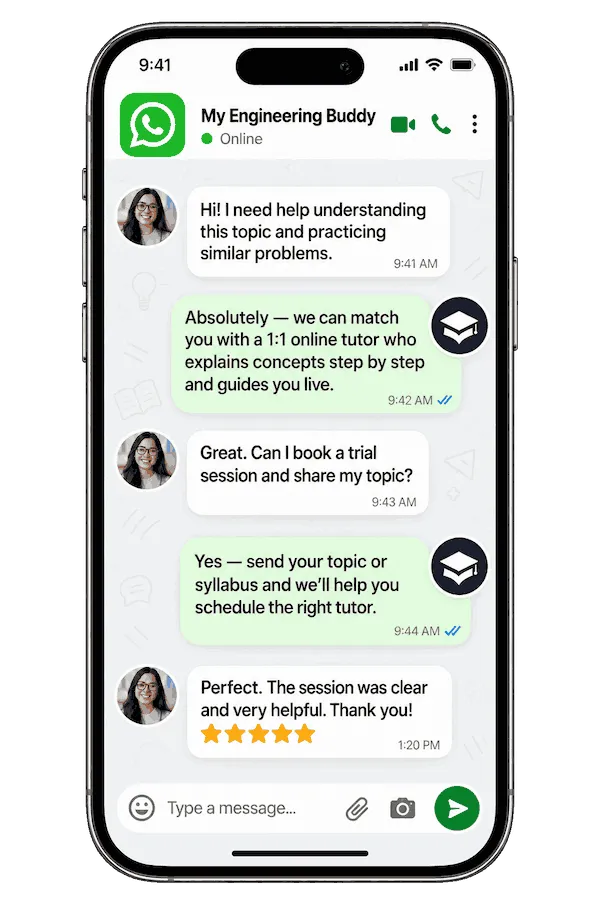
WhatsApp MEB for a quick quote — average response time under 1 minute.
Who This GCSE Astronomy Tutoring Is For
GCSE Astronomy attracts students who love space but underestimate how calculation-heavy the course gets. If the written papers — with their data interpretation questions, distance-magnitude relationships, and telescope optics — are catching you off guard, this is the right place.
- Students sitting Edexcel GCSE Astronomy for the first time and falling behind on stellar evolution or cosmology
- Students retaking after a failed first attempt who need targeted work on the specific topics that cost marks
- Students with a university conditional offer depending on this grade
- Students 4–6 weeks from their exam with significant gaps still to close
- Parents watching a child’s confidence drop alongside their grades
- Students who need homework and assignment guidance on topics like the Hertzsprung-Russell diagram or Kepler’s laws
Students who go on to study astrophysics at institutions including the University of Edinburgh, Durham University, the University of Toronto, the Australian National University, and King’s College London often point to a strong GCSE Astronomy foundation as where their interest sharpened.
1:1 Tutoring vs Self-Study vs AI vs YouTube vs Online Courses
Self-study works if you’re disciplined, but GCSE Astronomy questions are marked on specific phrasing — and no textbook tells you where you’re losing marks. AI tools give fast definitions but can’t watch you misread a magnitude scale and correct it live. YouTube is excellent for visualising stellar lifecycle or the Big Bang, but it stops the moment you need to explain why a Cepheid variable works as a distance indicator. Online courses move at a fixed pace — yours doesn’t. 1:1 tutoring with MEB is calibrated to your exact Edexcel syllabus, corrects errors in real time, and focuses the session on exactly the two or three topics that will move your grade.
Outcomes: What You’ll Be Able To Do in GCSE Astronomy
After working with a GCSE Astronomy tutor from MEB, students can solve inverse square law problems without second-guessing their rearrangement, analyse Hertzsprung-Russell diagrams to trace a star’s lifecycle from main sequence to white dwarf or supernova, apply Kepler’s third law to calculate orbital periods, explain the evidence for the Big Bang including redshift and cosmic microwave background radiation, and write extended answers that match examiner mark-scheme language rather than paraphrasing around it.
Supporting a student through GCSE Astronomy? MEB works directly with parents to set up sessions, track progress, and keep coursework on schedule. WhatsApp MEB — average response time is under a minute, 24/7.
Based on feedback from 40,000+ sessions collected by MEB from 2022 to 2025, 58% of students improved by one full grade after approximately 20 hours of 1:1 tutoring in subjects like GCSE Astronomy. A further 23% achieved at least a half-grade improvement.
Source: MEB session feedback data, 2022–2025.
What We Cover in GCSE Astronomy (Syllabus / Topics)
The Edexcel GCSE Astronomy specification is assessed through two written papers: Paper 1 (Naked Eye Astronomy) and Paper 2 (Telescopic Astronomy). Both carry equal weighting and include a mix of short-answer, data-response, and extended-writing questions. According to the Royal Society, astronomy and space science remain among the most actively growing fields in UK science education.
| Paper | Content Focus | Weighting |
|---|---|---|
| Paper 1 — Naked Eye Astronomy | Solar system, Earth-Moon system, naked-eye observations, celestial sphere | 50% |
| Paper 2 — Telescopic Astronomy | Stellar evolution, galaxies, cosmology, telescopes, electromagnetic spectrum | 50% |
Track 1: The Solar System and Earth-Moon Dynamics
- Planetary motion and Kepler’s three laws — including T² ∝ a³ calculations
- The celestial sphere, right ascension, declination, and altitude-azimuth systems
- Phases of the Moon, eclipses (solar and lunar), and tidal locking
- The Sun’s structure: photosphere, chromosphere, corona, and sunspot cycles
- Meteors, comets, and near-Earth objects
- Seasons, sidereal vs synodic periods, and apparent retrograde motion
Core texts: Edexcel GCSE Astronomy Student Book (Collins); Astronomy: A Beginner’s Guide to the Universe (Chaisson & McMillan).
Track 2: Stars, Stellar Evolution, and the Hertzsprung-Russell Diagram
- Stellar classification: spectral types O, B, A, F, G, K, M and their temperatures
- The Hertzsprung-Russell diagram — main sequence, giants, supergiants, white dwarfs
- Stellar lifecycle: nebula → protostar → main sequence → red giant → remnant
- Nuclear fusion, hydrostatic equilibrium, and energy transport in stars
- Cepheid variables as standard candles for distance measurement
- Inverse square law of light — calculations from apparent and absolute magnitude
- Supernovae, neutron stars, and black holes
Core texts: GCSE Astronomy for Edexcel (Dunn); Universe (Freedman & Kaufmann).
Track 3: Telescopes, Cosmology, and the Observable Universe
- Refracting vs reflecting telescopes — focal length, magnification, resolution
- The electromagnetic spectrum in astronomy: radio, infrared, visible, X-ray, gamma
- Redshift, Hubble’s Law, and the expanding universe
- Cosmic Microwave Background radiation as evidence for the Big Bang
- Dark matter and dark energy — observational evidence
- Galaxy types: spiral, elliptical, irregular; the Milky Way’s structure
Core texts: The Planets (Rothery et al.); GCSE Astronomy Revision Guide (CGP).

What a Typical GCSE Astronomy Session Looks Like
The tutor opens by checking the previous session’s topic — say, stellar classification and the HR diagram — and asks the student to reproduce the main sequence from memory on a shared digital whiteboard. From there the session moves into whatever is causing the most difficulty: often it’s the magnitude scale (counterintuitive because lower numbers mean brighter stars) or the inverse square law rearrangements. The tutor works through two or three past-paper questions using a digital pen-pad, annotating directly on screen. The student then attempts the next question independently while the tutor watches and corrects in real time. The session closes with a specific task — two past-paper data questions on Cepheid variables — and a note of what comes next: cosmology and redshift calculations.
At MEB, we’ve found that GCSE Astronomy students lose the most marks not from gaps in knowledge but from answers that are almost right. A tutor who knows the mark scheme can show you, in 10 minutes, exactly what the examiner wants to see written down — and that is worth more than three hours of re-reading notes.
How MEB Tutors Help You with GCSE Astronomy (The Learning Loop)
Diagnose: In the first session, the tutor works through a short diagnostic — usually a mix of past-paper questions from Paper 1 and Paper 2. This identifies whether the gaps are in calculation technique, written explanation, data interpretation, or all three.
Explain: The tutor works through the topic live, using a digital pen-pad to annotate diagrams — HR diagrams, telescope ray diagrams, redshift graphs — directly on screen. You see the working, not just the answer.
Practice: You attempt the next question yourself, with the tutor present. Not watching — present. The moment you go wrong, they catch it before it becomes a habit.
Feedback: Every error gets explained at the step level. If you lost marks on an extended writing question about stellar evolution, the tutor shows you the mark scheme and rebuilds the answer with you, phrase by phrase.
Plan: At the end of every session, the tutor sets a specific task and logs the next topic. Progress is tracked session by session, not left to memory.
Sessions run over Google Meet with a digital pen-pad or iPad and Apple Pencil. Before your first session, share your Edexcel syllabus or specification number, a recent past-paper attempt, and your exam date. The first session covers the diagnostic and at least one full topic.
Start with the $1 trial — 30 minutes of live tutoring that also serves as your first diagnostic.
Students consistently tell us that the moment things click in GCSE Astronomy is when they stop treating it as a memory subject and start treating it as a calculation subject. The terminology is dense, but the marks come from knowing when and how to apply a formula.
Tutor Match Criteria (How We Pick Your Tutor)
Every tutor goes through a subject-specific vetting process before working with students. Here’s what the match is based on.
Subject depth: The tutor must have covered the Edexcel GCSE Astronomy specification — not just general physics or general science. Exam board familiarity and mark-scheme knowledge are checked at the screening stage.
Tools: All GCSE Astronomy tutors use Google Meet with a digital pen-pad or iPad and Apple Pencil. Diagram work is done live on screen.
Time zone: You’re matched to a tutor available in your region — UK evenings, US afternoons, Gulf mornings. No 3am sessions unless that’s genuinely what you want.
Goals: If you’re chasing a grade 7 for a university offer, that’s different from needing to pass Paper 1. The tutor is matched to your specific target, not a general profile.
Unlike platforms where you fill out a form and wait, MEB responds in under a minute, 24/7. Tutor match takes under an hour. The $1 trial means you test before you commit. Everything runs over WhatsApp — no logins, no intake forms.
Study Plans (Pick One That Matches Your Goal)
After the diagnostic session, your tutor builds a specific sequence. Three common structures: a catch-up plan (1–3 weeks) for students with large gaps to close before their exam date; an exam prep plan (4–8 weeks) working through past papers, topic by topic, with timed practice built in; and weekly ongoing support aligned to your school’s teaching schedule, so homework and classwork stay on track throughout the year. The tutor adjusts the plan after every session based on what’s working.
Pricing Guide
GCSE Astronomy tutoring runs $20–$40/hr for most students. Tutors with astrophysics or planetary science research backgrounds — useful if you’re stretching for a grade 8 or 9 — are available at higher rates, typically $50–$100/hr.
Rate factors include: your current level, which topics need the most work, how close you are to the exam, and tutor availability. April and May are peak booking months for Edexcel exam preparation.
For students targeting competitive university places in physics, astrophysics, or space science at institutions like Durham, Edinburgh, or the University of Melbourne, tutors with professional research backgrounds are available at higher rates — share your specific goal and MEB will match the tier to your target.
Start with the $1 trial — 30 minutes, no registration, no commitment. WhatsApp MEB for a quick quote.
MEB has been running since 2008. That’s 18 years of tutoring across physics, sciences, and specialist subjects — long enough to know what the Edexcel GCSE Astronomy mark scheme actually rewards, and long enough for students to trust us with their conditional offers.
Source: My Engineering Buddy, 2008–2025.
FAQ
Is GCSE Astronomy hard?
It’s harder than most students expect. The course combines observational knowledge, mathematical calculation, and extended writing. The inverse square law, magnitude scale, and stellar classification trip up even students who are confident in science. Targeted tutoring with GCSE Physics tutoring background closes these gaps quickly.
How many sessions do I need?
Most students see a meaningful grade improvement after 8–12 sessions. Students with larger gaps or less than four weeks to their exam often run daily sessions for two to three weeks. The diagnostic session maps this out specifically for your situation.
Can you help with homework and assignments?
Yes. MEB tutoring is guided learning — you understand the work, then submit it yourself. The tutor explains the topic, works through similar problems, and checks your reasoning. See our Academic Integrity policy and Why MEB page for full details on what we help with and what we don’t.
Will the tutor match my exact syllabus or exam board?
GCSE Astronomy is currently offered primarily through Edexcel. Your tutor is matched to that specific specification — not a general astronomy syllabus. If your school is running a different or combined pathway, share that when you WhatsApp and MEB will confirm the fit before you start.
What happens in the first session?
The tutor runs a short diagnostic — past-paper questions covering both Paper 1 and Paper 2 topics. By the end of 30 minutes, you’ll have a clear picture of where the marks are being lost and a session plan for the next two to four weeks.
Is online tutoring as effective as in-person?
For a subject like GCSE Astronomy — which relies heavily on diagrams, graphs, and worked calculations — the digital pen-pad setup is genuinely better than a whiteboard across a table. Everything is annotated live on screen and can be saved for revision after the session.
Can I get GCSE Astronomy help at midnight?
Yes. MEB operates 24/7. WhatsApp the team at any hour and you’ll have a response within a minute. Session scheduling depends on tutor availability, but late-night slots for UK, Gulf, and Australian time zones are available most days.
What if I don’t like my assigned tutor?
Request a change. No questions, no process, no delay. MEB matches you with an alternative and you continue from where you left off. The $1 trial is also designed so you test the fit before committing to a full schedule.
Do you offer group GCSE Astronomy sessions?
No. Every MEB session is 1:1. Group classes exist elsewhere — MEB is specifically built for students who need sessions calibrated to their own syllabus gaps, pace, and exam date, not a shared timetable.
Which exam board does Edexcel GCSE Astronomy follow, and does it differ from OCR or AQA?
Edexcel is currently the main provider for GCSE Astronomy as a standalone qualification. OCR and AQA do not offer an equivalent standalone GCSE Astronomy course. If your school runs Edexcel, your tutor knows the exact specification, past papers, and mark scheme requirements.
How do I find a GCSE Astronomy tutor in my city?
You don’t need to. All MEB sessions are online — Google Meet, digital pen-pad, available from London, Dubai, Toronto, Sydney, or anywhere with internet. Local availability doesn’t limit you. WhatsApp MEB and you can start within 24 hours regardless of location.
How do I get started?
Three steps: WhatsApp MEB with your exam board and current grade, get matched to a verified tutor within the hour, then start the $1 trial — 30 minutes live or one homework question explained in full. No registration, no intake form, no commitment beyond the first session.
Trust & Quality at My Engineering Buddy
Every MEB tutor is screened before their first session. Screening includes a subject-knowledge interview, a live demo evaluation, and an ongoing review process based on student feedback after every session. Tutors are selected for their familiarity with the specific exam board and syllabus — not just their degree subject. Rated 4.8/5 across 40,000+ verified reviews on Google. MEB has served 52,000+ students since 2008 across the US, UK, Canada, Australia, and the Gulf.
MEB tutoring is guided learning — you understand the work, then submit it yourself. For full details on what we help with and what we don’t, read our Academic Integrity policy and Why MEB.
MEB covers 2,800+ subjects, with particular depth in GCSE Combined Science tutoring, GCSE Chemistry help, and GCSE Mathematics tutoring — all subjects that frequently overlap with GCSE Astronomy in terms of calculation technique and scientific reasoning. The platform has served students from the US, UK, Canada, Australia, Gulf, and Europe continuously since 2008. See our tutoring methodology for how sessions are structured.
A common pattern our tutors observe is that students who arrive having revised for weeks in isolation make faster progress in two sessions than they did in two months of self-study. The feedback loop is the difference — not the amount of time spent.
Explore Related Subjects
Students studying GCSE Astronomy often also need support in:
Next Steps
When you WhatsApp MEB, share your exam board (Edexcel), the paper or topic giving you the most difficulty, your current grade, and your exam date. Include your time zone and typical availability — morning, afternoon, evening.
MEB matches you with a verified GCSE Astronomy tutor within 24 hours. Usually faster.
Before your first session, have ready:
- Your Edexcel GCSE Astronomy specification or course outline
- A recent past-paper attempt or homework question you struggled with
- Your exam date or submission deadline
The tutor handles the rest. First session starts with a diagnostic so every minute is used well.
Visit www.myengineeringbuddy.com for more on how MEB works.
WhatsApp to get started or email [email protected].
18 years. 52,000+ students. 4.8/5 on Google. If you’re looking for a GCSE Astronomy tutor online who knows the Edexcel mark scheme and is available tonight, MEB is the answer.
Source: My Engineering Buddy, 2008–2025.
Reviewed by Subject Expert
This page has been carefully reviewed and validated by our subject expert to ensure accuracy and relevance.




