




~1 min
Average Reply Time
~1 hour
To Be Matched With A Tutor
30 Min Trial
75% Find Their Tutor On The 1st Trial
$20-35+/hr
Premium Yet Affordable Learning
Most students who struggle with GCSE Statistics aren’t bad at maths — they’ve never had someone explain the difference between a histogram and a bar chart, or why their scatter diagram lost three marks.
GCSE Statistics Tutor Online
GCSE Statistics is a standalone qualification offered by exam boards including AQA and Edexcel, covering data collection, statistical measures, probability, and data representation. It equips students to interpret, analyse, and present real-world data with confidence.
If you’re searching for a GCSE Statistics tutor near me, MEB gives you something local tutors rarely can: a subject-specialist who knows your exact exam board, available today, from $20/hr. Our 1:1 online GCSE tutoring covers every component of the Statistics specification — from data sampling to hypothesis testing — and every session is built around where you actually are, not where you should be. One tutor, one student, zero wasted time.
- 1:1 online sessions tailored to your AQA or Edexcel Statistics syllabus
- Expert-verified tutors with GCSE Statistics-specific knowledge
- Flexible time zones — US, UK, Canada, Australia, Gulf
- Structured learning plan built after a diagnostic session
- Ethical homework and assignment guidance — you understand before you submit
52,000+ students across the US, UK, Canada, Australia, and the Gulf have used MEB since 2008 — including students in GCSE subjects like GCSE Mathematics tutoring, GCSE Physics help, and GCSE Statistics.
Source: My Engineering Buddy, 2008–2025.
How Much Does a GCSE Statistics Tutor Cost?
Most GCSE Statistics sessions run $20–$40/hr, depending on the tutor’s level, your exam board, and how close you are to the exam. New students can start with the $1 trial — 30 minutes of live 1:1 tutoring or a full explanation of one homework question, before spending anything more.
Tutor availability tightens sharply in May and during the January mock window. If you’re booking for exam season, don’t leave it late.
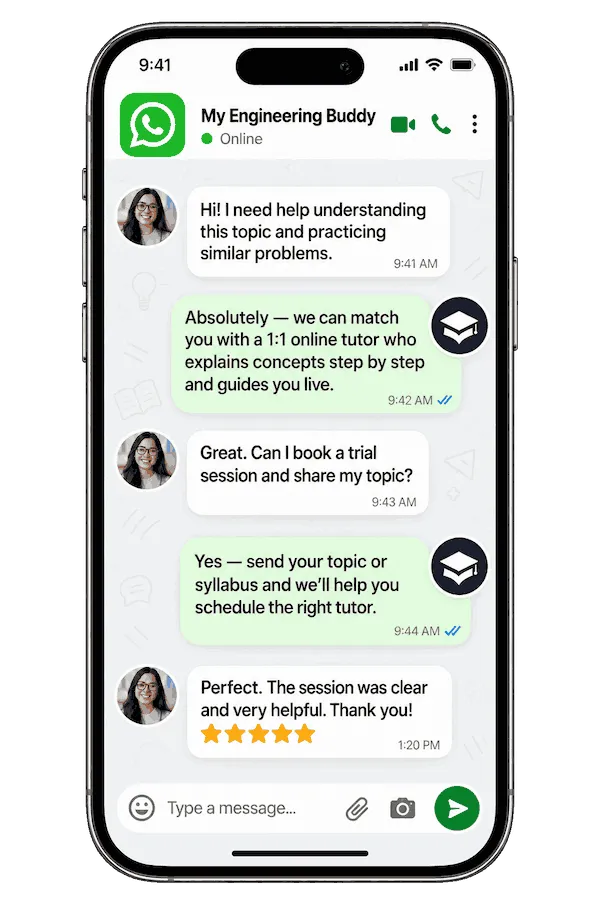
WhatsApp MEB for a quick quote — average response time under 1 minute.
Who This GCSE Statistics Tutoring Is For
GCSE Statistics draws in students from a wide range of starting points. Some take it alongside GCSE Maths to strengthen their data skills; others pick it as a standalone. Either way, the exam rewards precision — and that’s where most students lose marks.
- Students who find the data interpretation questions harder than the calculation questions
- Students retaking after a failed first attempt who need a different approach, not more of the same
- Students with a university conditional offer depending on this grade
- Students 4–6 weeks from the exam with significant gaps still to close — try the $1 trial and start immediately
- Parents watching a child’s confidence drop alongside their grades
- Students who need structured homework guidance on data collection projects or statistical investigations
Students who go on to A Level Maths, A Level Psychology, A Level Geography, or A Level Biology at institutions including the University of Edinburgh, University of Bristol, Durham University, King’s College London, and the University of Manchester often name GCSE Statistics as the qualification that gave them an early edge in data handling.
1:1 Tutoring vs Self-Study vs AI vs YouTube vs Online Courses
Self-study works if you’re disciplined — but GCSE Statistics questions are written to trip you up on wording, and there’s no one to catch that in real time. AI tools give fast definitions but can’t spot why you keep losing marks on the same question type. YouTube explains concepts clearly but stops the moment you’re stuck mid-problem. Online courses move at a fixed pace, which helps nobody who’s five weeks out and three topics behind. With MEB, you get a live tutor who sees exactly where your reasoning breaks down — on stratified sampling, on time series, on the specific wording AQA uses — and corrects it before it becomes a habit.
Outcomes: What You’ll Be Able To Do in GCSE Statistics
After working with a GCSE Statistics tutor, you’ll be able to solve multi-step probability problems — including combined and conditional events — without second-guessing your method. You’ll analyse scatter diagrams and describe correlation correctly using the language examiners expect. You’ll apply sampling techniques like stratified and systematic sampling to realistic scenarios. You’ll explain the difference between discrete and continuous data and choose the right diagram for each. And you’ll present statistical findings clearly enough to gain full marks on the written interpretation questions — the section where most students leave points on the table.
Supporting a student through GCSE Statistics? MEB works directly with parents to set up sessions, track progress, and keep coursework on schedule. WhatsApp MEB — average response time is under a minute, 24/7.
Based on feedback from 40,000+ sessions collected by MEB from 2022 to 2025, 58% of students improved by one full grade after approximately 20 hours of 1:1 tutoring in subjects like GCSE Statistics. A further 23% achieved at least a half-grade improvement.
Source: MEB session feedback data, 2022–2025.
At MEB, we’ve found that GCSE Statistics students lose the most marks not on calculations they can’t do — but on interpretations they wrote carelessly. A tutor reading your answer aloud back to you catches that in seconds. No revision guide does that.
What We Cover in GCSE Statistics (Syllabus / Topics)
Data Collection and Sampling
- Types of data: qualitative, quantitative, discrete, continuous
- Primary vs secondary data sources
- Sampling methods: random, systematic, stratified, quota, cluster
- Bias in data collection and how to identify it
- Questionnaire design: leading questions, response categories, pilot surveys
- Census vs sample — advantages and disadvantages
Recommended texts: GCSE Statistics for AQA (Oxford University Press), Edexcel GCSE Statistics Student Book (Pearson). The Pew Research Center publishes accessible real-world survey methodology examples at Pew Research Center — useful for understanding how sampling works in practice.
Statistical Measures and Distributions
- Mean, median, mode — from raw data and frequency tables
- Range, interquartile range, and standard deviation (higher tier)
- Cumulative frequency graphs and box plots
- Histograms with unequal class widths — frequency density calculations
- Normal distribution: properties and symmetry
- Skewness: positive, negative, and how to identify from diagrams
- Stem-and-leaf diagrams, including back-to-back
Recommended texts: GCSE Statistics by Gillian Dyer (Hodder Education), CGP GCSE Statistics Complete Revision & Practice. The GCSE Mathematics tutor page covers overlapping content on measures and graphs.

Probability and Hypothesis Testing
- Probability scale, equally likely outcomes, relative frequency
- Addition rule and multiplication rule (independent and conditional events)
- Tree diagrams and Venn diagrams
- Expected frequency and the law of large numbers
- Hypothesis testing: null and alternative hypotheses, significance level
- Spearman’s rank correlation coefficient — calculation and interpretation
- Chi-squared test: observed vs expected frequencies (higher tier)
Recommended texts: AQA GCSE Statistics (Collins), Edexcel GCSE Statistics Practice Book (Pearson). Students also working on GCSE Psychology homework help will find the hypothesis testing and correlation content directly overlapping.
| Paper | Content Focus | Weighting |
|---|---|---|
| Paper 1 (Written exam) | Data collection, representation, measures | 50% |
| Paper 2 (Written exam) | Probability, hypothesis testing, statistical inference | 50% |
| Both papers | Calculator allowed; questions span Foundation and Higher | — |
What a Typical GCSE Statistics Session Looks Like
The tutor opens by checking the previous session’s topic — often cumulative frequency or Spearman’s rank — and asking you to talk through one question unaided. From there, you work through two or three exam-style problems together: scatter diagrams with lines of best fit, or a hypothesis test from start to significance conclusion. The tutor writes each step on a digital pen-pad so you can see the working in real time, then hands the next question to you. If your frequency density calculation is off, the tutor catches it in the moment and traces it back to the step where the reasoning broke. The session ends with a specific practice task — usually two past-paper questions on the next topic — and a note of where you’ll start next time.
Students consistently tell us that seeing a worked hypothesis test written out live — step by step, with the tutor explaining every decision — changes everything. Reading it in a textbook and watching it happen in real time are completely different experiences.
How MEB Tutors Help You with GCSE Statistics (The Learning Loop)
Diagnose: In the first session, the tutor asks you to attempt a past-paper question unprompted — usually a two-part data interpretation question. What you write (and what you skip) tells the tutor exactly which topics need work first: whether that’s sampling bias, histogram construction, or how you phrase a hypothesis.
Explain: The tutor works through the problem live using a digital pen-pad on Google Meet. Every step is visible, every decision is spoken aloud. No “as you can see” hand-waving — the tutor explains why each method is chosen and what the examiner is marking for.
Practice: You attempt the next question while the tutor watches. This is where most of the session happens. Mistakes surface here — in real time, not on a marked paper three weeks later.
Feedback: The tutor goes through your attempt line by line. Not just “this is wrong” — but which step failed, why it costs marks, and how to rewrite it. GCSE Statistics mark schemes are precise, and your tutor knows them.
Plan: Before the session ends, the tutor sets two or three practice questions and notes the next topic in sequence. You leave with a clear task, not a vague instruction to “revise probability.”
Sessions run over Google Meet with a digital pen-pad or iPad and Apple Pencil. Before your first session, have a recent past paper attempt ready — even a partial one. The $1 trial — 30 minutes of live tutoring — doubles as your first diagnostic.
Whether you need a quick catch-up before the May exam window, structured revision over 4–8 weeks, or ongoing weekly support through the year, the tutor builds the session plan after the first diagnostic.
Try your first session for $1 — 30 minutes of live 1:1 tutoring or one homework question explained in full. No registration. No commitment. WhatsApp MEB now and get matched within the hour.
Tutor Match Criteria (How We Pick Your Tutor)
Not every strong maths tutor knows GCSE Statistics. The specification is distinct — it has its own syllabus, its own mark scheme logic, and its own question types. MEB matches on four criteria.
Subject depth: Tutors are verified on GCSE Statistics specifically — AQA or Edexcel specification, Foundation or Higher tier, depending on your paper.
Tools: Every tutor uses Google Meet with a digital pen-pad or iPad and Apple Pencil. No whiteboard photos. No lag.
Time zone: Matched to your region — UK, US, Gulf, Canada, or Australia — so sessions start when you’re alert, not at midnight.
Goals: Whether you need exam score improvement, homework support, or conceptual depth on the higher-tier content, the tutor is matched to that specific brief.
Unlike platforms where you fill out a form and wait, MEB responds in under a minute, 24/7. Tutor match takes under an hour. The $1 trial means you test before you commit. Everything runs over WhatsApp — no logins, no intake forms.
Pricing Guide
GCSE Statistics tutoring starts at $20/hr. Most students working toward a specific exam date fall in the $20–$35/hr range. Higher-tier content, compressed timelines, or tutors with A Level and undergraduate Statistics backgrounds are available at $35–$70/hr.
Rate factors: your tier (Foundation or Higher), topic complexity, how close you are to the exam, and tutor availability. Availability drops fast in the four weeks before the May exam window — book early if that’s your date.
For students targeting top university programmes in data-heavy subjects — Economics, Psychology, Geography, or Natural Sciences — tutors with undergraduate or postgraduate Statistics backgrounds are available at higher rates. Share your specific goal and MEB will match the tier to your ambition.
Start with the $1 trial — 30 minutes, no registration, no commitment. WhatsApp MEB for a quick quote.
MEB has covered GCSE and A Level subjects since 2008. Students working on GCSE Economics help and GCSE Geography tutoring regularly cross over into Statistics — both subjects use the same data interpretation skills the Statistics exam tests directly.
Source: My Engineering Buddy, 2008–2025.
FAQ
Is GCSE Statistics hard?
It’s more accessible than GCSE Maths for most students, but the written interpretation questions catch people off guard. Knowing the method isn’t enough — you have to use the exact phrasing examiners mark for. That’s where most marks are lost.
How many sessions are needed?
Students with 6–8 weeks and two or three gaps to close typically need 8–12 sessions. Students in the final two weeks before the exam focus on past papers and mark scheme language — four to six targeted sessions can still move the grade.
Can you help with homework and assignments?
Yes. MEB tutoring is guided learning — you understand the work, then submit it yourself. If you’re stuck on a data collection project or a statistical investigation task, the tutor explains the method and reasoning so you can complete and submit it independently. See our Academic Integrity policy and Why MEB page for full details on what we help with and what we don’t.
Will the tutor match my exact syllabus or exam board?
Yes. AQA and Edexcel GCSE Statistics have different specifications — the tutor is matched to yours. Share your exam board when you WhatsApp MEB and that information goes straight to the matching process.
What happens in the first session?
The tutor asks you to attempt a past-paper question cold. Your answer — right or wrong — tells the tutor where your reasoning breaks down. From there, the session covers one or two core topics and ends with a specific practice task and a plan for the next session.
Is online tutoring as effective as in-person?
For GCSE Statistics, yes. The digital pen-pad replicates whiteboard working, Google Meet keeps the conversation live, and past papers are shared on screen instantly. MEB students across the UK, US, and Gulf report the same session quality as in-person, without the commute.
What is the difference between AQA and Edexcel GCSE Statistics?
Both cover similar core content, but the paper structures, question styles, and some higher-tier topics differ. AQA places more emphasis on statistical investigation; Edexcel’s mark schemes tend to be more prescriptive. Your tutor is matched to your specific board from the start.
Do I need GCSE Maths to take GCSE Statistics?
No formal prerequisite exists, but strong numeracy helps. Most students take both simultaneously. If your GCSE Maths is shaky, the tutor flags overlapping content — particularly on measures of spread and probability — and addresses both in context. You can also get GCSE Mathematics help alongside Statistics sessions.
Can I get GCSE Statistics help at midnight?
Yes. MEB operates across time zones, and tutors are available in the Gulf, Australia, and North America, which covers most hours. WhatsApp MEB at any time — the median response is under a minute, and session booking can happen the same day.
What if I don’t like my assigned tutor?
Tell MEB via WhatsApp. You are not locked in. MEB will match you with a different tutor — usually the same day. The $1 trial exists specifically so you test the fit before committing to a block of sessions.
Is the higher tier content significantly harder than Foundation?
Yes, meaningfully so. Higher tier introduces standard deviation, chi-squared tests, Spearman’s rank, and more complex hypothesis testing. If you’re targeting a grade 7–9, a tutor who knows the higher tier mark scheme is worth more than extra revision time alone.
How do I get started?
Three steps: WhatsApp MEB with your exam board and current topic, get matched to a GCSE Statistics tutor within the hour, then start your $1 trial — 30 minutes of live tutoring or one full question explained. No registration, no commitment.
Trust & Quality at My Engineering Buddy
Every MEB tutor goes through subject-specific screening before they work with a student. For GCSE Statistics, that means demonstrating knowledge of the AQA and Edexcel specifications, working through actual exam questions live, and passing a demo session evaluation. Tutors are degree-educated, many with postgraduate or professional backgrounds in statistics, mathematics, or data science. Ongoing feedback from students and parents feeds back into the matching process — tutors with lower-rated sessions are reviewed and replaced. Rated 4.8/5 across 40,000+ verified reviews on Google.
MEB tutoring is guided learning — you understand the work, then submit it yourself. For full details on what we help with and what we don’t, read our Academic Integrity policy and Why MEB.
MEB has served 52,000+ students since 2008 across the US, UK, Canada, Australia, Gulf, and Europe — in 2,800+ subjects. Within the GCSE category, subjects like GCSE Biology tutoring and GCSE Chemistry help sit alongside Statistics in the most frequently requested subjects. The MEB tutoring methodology — diagnostic first session, structured feedback loop, exam-board-specific planning — applies to every subject, including GCSE Statistics.
A common pattern our tutors observe is that GCSE Statistics students who struggle with written interpretation haven’t been shown the examiner’s marking language — they’ve only been taught the maths. Knowing what to write, not just what to calculate, is what separates a grade 5 from a grade 7.
Students working with MEB on GCSE Computer Science tutoring often pick up GCSE Statistics alongside it — data representation and probability appear in both specifications, and covering them together accelerates progress in both.
Source: My Engineering Buddy, 2008–2025.
Explore Related Subjects
Students studying GCSE Statistics often also need support in:
Next Steps
Here’s what to do right now.
- Share your exam board (AQA or Edexcel), your hardest topic, and your exam date or deadline
- Share your availability and time zone
- MEB matches you with a verified GCSE Statistics tutor — usually within the hour
- Your first session starts with a diagnostic so every minute of tutoring is used on the right thing
Before your first session, have ready: your exam board and syllabus (or a recent past paper), a question or topic you’ve struggled with, and your exam date. The tutor handles the rest.
Visit www.myengineeringbuddy.com for more on how MEB works.
WhatsApp to get started or email [email protected].
Reviewed by Subject Expert
This page has been carefully reviewed and validated by our subject expert to ensure accuracy and relevance.




