




~1 min
Average Reply Time
~1 hour
To Be Matched With A Tutor
30 Min Trial
75% Find Their Tutor On The 1st Trial
$20-35+/hr
Premium Yet Affordable Learning
Most students who struggle with GCSE Combined Science aren’t bad at science — they’re missing one or two foundational concepts that quietly block everything above them.
GCSE Combined Science Tutor Online
GCSE Combined Science is a double-award qualification offered by AQA, OCR, and Edexcel, covering biology, chemistry, and physics. It is graded 1–9 (awarded twice) and prepares students for A Level sciences or related vocational pathways.
MEB provides 1:1 online tutoring and homework help in 2,800+ advanced subjects, including a full suite of GCSE tutoring across all major exam boards. Whether you’re searching for a GCSE Combined Science tutor near me or need flexible online sessions from the UK, US, Gulf, or Australia, MEB matches you with a verified subject specialist — usually within an hour. Students working consistently with a tutor close grade gaps faster than revision alone.
- 1:1 online sessions tailored to your exam board — AQA, OCR 21st Century, Edexcel, CCEA
- Expert-verified tutors with subject-specific knowledge across all three sciences
- Flexible time zones — UK, US, Canada, Australia, Gulf
- Structured learning plan built after an initial diagnostic session
- Ethical homework and assignment guidance — you understand the work, then submit it yourself
52,000+ students across the US, UK, Canada, Australia, and the Gulf have used MEB since 2008 — including students in GCSE subjects like GCSE Biology, GCSE Chemistry, and GCSE Physics, alongside Combined Science.
Source: My Engineering Buddy, 2008–2025.
How Much Does a GCSE Combined Science Tutor Cost?
Most GCSE Combined Science tutoring sessions run $20–$40/hr. If your target grade requires a specialist with exam board marking experience or a science degree background, rates can reach $60/hr. New students can start with the $1 trial — 30 minutes live or one homework question explained in full, no registration required.
Availability tightens in April and May during the main UK exam window. Book early if your exams are within six weeks.
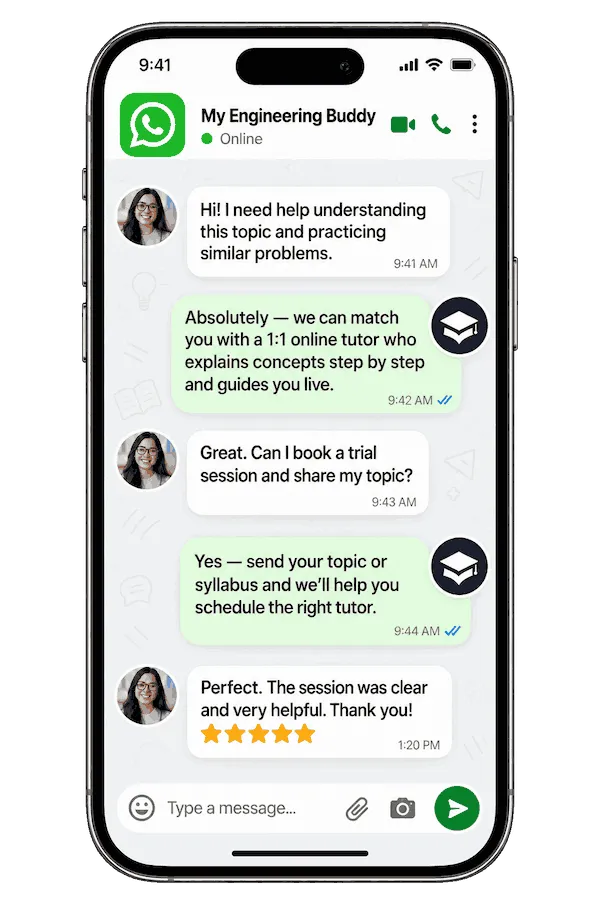
WhatsApp MEB for a quick quote — average response time under 1 minute.
Who This GCSE Combined Science Tutoring Is For
This isn’t a course for students who just want a few tips. It’s for students who’ve looked at a past paper and realised they can’t answer more questions than they can. If that’s you — or your child — this is the right place.
- Students retaking after a failed first attempt at Combined Science
- Students with a sixth-form or college conditional offer that depends on hitting grade 6-6 or above
- Students 4–6 weeks from their GCSE exams with significant topic gaps still to close
- Students confused by which topics overlap across Biology, Chemistry, and Physics papers — and which don’t
- Parents watching a child’s confidence drop alongside their science grades
- Students who need homework guidance and want to genuinely understand it before they hand it in
Students from schools across the UK, as well as international schools using UK-aligned syllabuses in the UAE, Qatar, Australia, and Canada, regularly work with MEB tutors on Combined Science. The $1 trial is a low-risk way to check the fit before committing to weekly sessions.
Supporting a student through GCSE Combined Science? MEB works directly with parents to set up sessions, track progress, and keep coursework on schedule. WhatsApp MEB — average response time is under a minute, 24/7.
1:1 Tutoring vs Self-Study vs AI vs YouTube vs Online Courses
Self-study works if you’re disciplined, but GCSE Combined Science has three sciences worth of content — most students skip the parts they find hard. AI tools give fast explanations but can’t tell whether you’ve actually understood the difference between ionic and covalent bonding or just read the definition. YouTube is excellent for overviews of topics like cell division or atomic structure, but stops when you’re stuck mid-question. Online courses move at a fixed pace that ignores your specific paper date. 1:1 tutoring with MEB is live, calibrated to your actual exam board, and corrects the exact errors costing you marks — not the ones a generic course assumes you’re making.
Outcomes: What You’ll Be Able To Do in GCSE Combined Science
After working consistently with an MEB tutor, students can solve multi-step calculation questions in chemistry — including moles, concentration, and yield — without reaching for a formula sheet. They can explain biological processes like respiration, photosynthesis, and homeostasis in the precise language examiners reward. Students learn to apply physics equations to unfamiliar contexts, which is where most marks are dropped. They can write structured six-mark answers that address every command word. And they approach their final papers knowing which topics carry the most marks and where their strongest answers are.
Based on feedback from 40,000+ sessions collected by MEB from 2022 to 2025, 58% of students improved by one full grade after approximately 20 hours of 1:1 tutoring in subjects like GCSE Combined Science. A further 23% achieved at least a half-grade improvement.
Source: MEB session feedback data, 2022–2025.
At MEB, we’ve found that Combined Science students often know more than they think — they’ve just never been shown how to structure a six-mark answer or which calculation steps an examiner actually checks. Two or three sessions spent on exam technique alone can shift a grade boundary.
What We Cover in GCSE Combined Science (Syllabus / Topics)

Biology Component
- Cell biology — structure, division (mitosis and meiosis), cell differentiation
- Organisation — tissues, organs, digestive and circulatory systems
- Infection and response — pathogens, immune response, vaccination, antibiotics
- Bioenergetics — photosynthesis and respiration (aerobic and anaerobic)
- Homeostasis — nervous system, hormones, thermoregulation, blood glucose
- Inheritance, variation, and evolution — DNA, genetics, natural selection
- Ecology — ecosystems, food chains, biodiversity, human impact
Core textbooks: AQA GCSE Combined Science Trilogy (Pollard et al.), Edexcel GCSE Combined Science (Miles et al.), Oxford Revise AQA GCSE Combined Science.
Chemistry Component
- Atomic structure and the periodic table — history, structure, electronic configuration
- Bonding, structure, and properties — ionic, covalent, metallic; giant structures vs molecular
- Quantitative chemistry — moles, concentration, percentage yield, atom economy
- Chemical changes — electrolysis, reactivity series, acids and bases
- Energy changes — exothermic and endothermic reactions, reaction profiles
- Rates of reaction and equilibrium — catalysts, factors affecting rate
- Organic chemistry and Earth’s resources — hydrocarbons, polymers, sustainability
Core textbooks: CGP GCSE Combined Science Chemistry Complete Revision & Practice, Edexcel GCSE Chemistry (Drummond), AQA GCSE Chemistry (Heslop).
Physics Component
- Forces — speed, acceleration, Newton’s laws, momentum, stopping distances
- Energy — stores, transfers, efficiency, power, renewable and non-renewable resources
- Waves — properties, sound, light, EM spectrum, uses and dangers
- Electricity — circuits, resistance, mains electricity, static charge
- Magnetism and electromagnetism — motors, generators, transformers
- Particle model and atomic structure — density, states of matter, radioactivity, half-life
- Space physics (higher tier) — stellar evolution, cosmology
Core textbooks: CGP GCSE Combined Science Physics Complete Revision & Practice, AQA GCSE Physics (Breithaupt), Edexcel GCSE Physics (Johnson).
| Paper | Content | Format | Weighting |
|---|---|---|---|
| Biology Papers 1 & 2 | All biology topics | Written exam, 1h 15m each | ~33% of total |
| Chemistry Papers 1 & 2 | All chemistry topics | Written exam, 1h 15m each | ~33% of total |
| Physics Papers 1 & 2 | All physics topics | Written exam, 1h 15m each | ~33% of total |
| Required Practicals | Practical skills assessed in written papers | Questions embedded in exams | Varies by board |
One area students consistently underestimate: required practicals. Exam boards embed practical-method questions directly into written papers, and they carry real marks. MEB tutors cover required practical methodology and data analysis as part of standard session prep. For reference on syllabus structure across boards, see Cambridge International Education and the individual UK board pages for AQA, OCR, and Edexcel.
Students consistently tell us that the biggest shock in GCSE Combined Science exams isn’t the hard questions — it’s losing marks on topics they thought they knew. That’s usually a sign of surface-level revision rather than genuine understanding. Our sessions go deeper.
What a Typical GCSE Combined Science Session Looks Like
The tutor opens by checking what happened with the previous session’s topic — say, moles calculations in chemistry or the cardiac cycle in biology. If it’s landed, they move on. If not, they rework it from a different angle before anything new is introduced. The main session block is a mix of worked examples and student attempts: the tutor solves a problem on a digital pen-pad while talking through every step, then the student replicates the process on a similar question. For six-mark extended answer questions, the tutor marks the student’s draft response live and explains precisely where marks would be awarded or lost. The session closes with a specific practice task — three past paper questions on the topic covered — and a note of the next topic in sequence.
How MEB Tutors Help You with GCSE Combined Science (The Learning Loop)
Diagnose: In the first session, the tutor works through a short set of questions across all three sciences to locate the exact gaps — not just the subjects a student says they find hard, but the foundational concepts underneath them. A student struggling with rates of reaction is often actually missing the concept of particle collisions first covered in atomic structure.
Explain: The tutor works through problems live using a digital pen-pad. Biological processes like protein synthesis, chemical mechanisms like electrolysis, and physics equations like the wave speed formula are all shown step-by-step — not just stated.
Practice: The student attempts questions with the tutor present. This isn’t homework — it’s real-time practice where errors are caught immediately rather than discovered the night before an exam.
Feedback: The tutor identifies exactly where marks would be lost and why. For calculation questions, this usually means a missing unit or rounding error. For extended answers, it’s missing command-word awareness — explaining when the question asked to evaluate, or describing when it asked to explain.
Plan: After each session the tutor sets the next topic, adjusts the sequence based on what came up in the session, and flags which required practicals need attention before the exam window.
Sessions run on Google Meet with a digital pen-pad or iPad with Apple Pencil. Before your first session, have your exam board confirmed, a recent past paper attempt or homework question you couldn’t finish, and your exam date. The first session is a diagnostic — every minute is used on your actual gaps. Start with the $1 trial — 30 minutes of live tutoring that also serves as your first diagnostic.
MEB’s tutoring structure — diagnose, explain, practice, feedback, plan — matches what education research identifies as the core cycle of deliberate practice. It’s how skills are actually built, not just reviewed.
Source: Ericsson & Pool, Peak: Secrets from the New Science of Expertise, 2016.
Tutor Match Criteria (How We Pick Your Tutor)
Not every science tutor can teach Combined Science well. The subject demands someone who can move fluently across biology, chemistry, and physics in a single session — and who knows which exam board’s mark scheme they’re preparing you for.
Subject depth: Tutors are matched by their primary degree discipline and exam board experience — AQA, OCR (21st Century or Gateway), Edexcel, or CCEA. A tutor who only knows one board won’t be matched to a student on a different one.
Tools: Every tutor uses Google Meet and a digital pen-pad or iPad with Apple Pencil. No whiteboard photos. No blurry handwriting.
Time zone: Matched to your region — UK evenings, US afternoons, Gulf mornings. No scheduling guesswork.
Goals: Whether you need to close a grade gap, prep for a specific paper, or get homework guidance — the tutor is briefed on your goal before the first session, not during it.
Unlike platforms where you fill out a form and wait, MEB responds in under a minute, 24/7. Tutor match takes under an hour. The $1 trial means you test before you commit. Everything runs over WhatsApp — no logins, no intake forms.
Study Plans (Pick One That Matches Your Goal)
After the first diagnostic session, your tutor maps a specific sequence. Most students fall into one of three plans: Catch-up (1–3 weeks before the exam — targeted work on highest-value topics and mark scheme technique); Exam prep (4–8 weeks — systematic coverage of all six papers, with required practicals built in); or Weekly support (ongoing through the academic year, aligned to school scheme of work and homework deadlines). The tutor builds the exact sequence — students don’t need to plan it themselves.
Pricing Guide
GCSE Combined Science tutoring starts at $20/hr for standard sessions. Tutors with first-class science degrees, previous examiner experience, or specialist knowledge of a particular exam board’s marking conventions may be priced at $40–$60/hr. Rate factors include grade target, time to exam, and session frequency.
Exam season creates real demand pressure — April and May availability fills faster than any other period. If your exams are within eight weeks, don’t delay matching.
For students targeting top grades at selective sixth forms or competitive A Level entry, tutors with examiner backgrounds are available at higher rates — share your specific grade target and MEB will match the right tier.
Start with the $1 trial — 30 minutes, no registration, no commitment. WhatsApp MEB for a quick quote.
Try your first session for $1 — 30 minutes of live 1:1 tutoring or one homework question explained in full. No registration. No commitment. WhatsApp MEB now and get matched within the hour.
FAQ
Is GCSE Combined Science hard?
It covers three sciences across six papers — that’s the main challenge. No single topic is especially difficult, but the volume is large and the required practicals add another layer. Students who struggle usually have a gap in one subject that quietly affects their confidence across all three. A targeted tutor catches this early.
How many sessions are needed?
It depends on your starting point and exam date. Students with 6–8 weeks usually need 10–15 sessions. Those doing ongoing support through the year typically do one or two sessions a week. The first diagnostic session gives a clearer picture — your tutor will outline a session plan after that.
Can you help with homework and assignments?
Yes. MEB tutoring is guided learning — you understand the work, then submit it yourself. Tutors explain the method, walk through similar examples, and check your reasoning. See our Academic Integrity policy and Why MEB page for full details on what we help with and what we don’t.
Will the tutor match my exact syllabus or exam board?
Yes. AQA Trilogy, AQA Synergy, OCR 21st Century, OCR Gateway, Edexcel, and CCEA all have meaningful syllabus differences. Your tutor is matched specifically to your board — they know which required practicals appear in your written papers and which topics are higher-tier only for your specification.
What happens in the first session?
The tutor runs a short diagnostic across biology, chemistry, and physics to locate your actual gaps — not just the topics you think you’re weak in. From there, they map a session sequence. If time allows, the first topic begins in the same session. Nothing is wasted.
Is online tutoring as effective as in-person?
For GCSE Combined Science, yes — and in some ways better. The tutor’s digital pen-pad makes worked solutions clearer than a physical whiteboard. Past papers can be shared on screen instantly. Students in the UK, UAE, and Australia consistently report the same quality of explanation online as they would expect in-person.
What is the difference between Combined Science and Triple Science at GCSE?
Combined Science (double award) gives two GCSEs and covers all three sciences in a shared qualification graded on a double-number scale (e.g. 6-6). Triple Science gives three separate GCSEs — Biology, Chemistry, Physics — with more content in each. MEB tutors cover both, and GCSE Biology tutoring, GCSE Chemistry tutoring, and GCSE Physics tutoring are available separately for Triple students.
Does Combined Science prepare me for A Level Sciences?
Yes, though most sixth forms prefer — and some require — Triple Science for Biology, Chemistry, or Physics A Levels. Combined Science meets entry requirements for many A Level science programmes, but check your specific sixth form’s entry criteria. MEB tutors can advise on bridging gaps if you’re moving from Combined to a Triple-level A Level subject.
Can I get GCSE Combined Science help at short notice — including evenings or weekends?
Yes. MEB operates across time zones 24/7. WhatsApp response is typically under a minute, and tutor matching takes under an hour in most cases. Evening and weekend sessions are available across UK, US, Gulf, and Australian time zones. Last-minute exam prep sessions are regularly arranged with 24 hours’ notice.
Do you offer help with GCSE Combined Science required practicals?
Yes. Required practicals — such as microscopy, osmosis, titrations, resistance investigations, and specific heat capacity — appear as questions in your written papers. MEB tutors cover the method, variables, results analysis, and the specific way each exam board words practical questions. This is part of standard Combined Science prep, not an add-on.
How do I get started?
Three steps: WhatsApp MEB, get matched to a verified GCSE Combined Science tutor (usually within an hour), then start your $1 trial — 30 minutes live or one homework question explained in full. No registration, no forms, no waiting days for a response.
Can I find a GCSE Combined Science tutor online if I’m outside the UK?
Yes. MEB works with students at international schools in the UAE, Qatar, Australia, Canada, Germany, and the Netherlands who follow UK-aligned GCSE syllabuses. Your tutor is matched to your board regardless of your location. Sessions are fully online via Google Meet — time zone matching is standard.
Trust & Quality at My Engineering Buddy
Every MEB tutor goes through subject-specific screening before taking sessions — not a generic interview, but a live evaluation of their ability to teach the relevant content. For GCSE Combined Science, that means demonstrating comfort across all three sciences and familiarity with at least one major UK exam board’s mark scheme. Ongoing session feedback is reviewed, and tutors with consistently low ratings are removed. Rated 4.8/5 across 40,000+ verified reviews on Google.
MEB tutoring is guided learning — you understand the work, then submit it yourself. For full details on what we help with and what we don’t, read our Academic Integrity policy and Why MEB.
MEB has served 52,000+ students across the US, UK, Canada, Australia, the Gulf, and Europe since 2008 — across 2,800+ subjects. GCSE is one of MEB’s most active categories, with strong demand for GCSE Mathematics tutoring and GCSE Computer Science help alongside Combined Science. For a full view of how sessions are structured and what students can expect, see our tutoring methodology.
A common pattern our tutors observe is that students who have missed one foundational lesson — often something as specific as how to write an ionic equation — carry that gap all the way to exam day. One session spent finding and fixing it changes everything that follows.
Source: MEB tutor observation, collated from session notes across 2022–2025.
Explore Related Subjects
Students studying GCSE Combined Science often also need support in:
- GCSE Mathematics
- GCSE Statistics
- GCSE Geography
- GCSE Psychology
- GCSE Astronomy
- GCSE Geology
- GCSE Design and Technology
Next Steps
Here’s what to do now:
- Share your exam board (AQA, OCR, Edexcel, or CCEA), your hardest component, and how many weeks to your exam
- Share your availability and time zone
- MEB matches you with a verified tutor — usually within an hour
- Your first session starts with a diagnostic so every minute is used on your actual gaps
Before your first session, have ready: your exam board and syllabus, a recent past paper attempt or homework question you couldn’t finish, and your exam or deadline date. The tutor handles the rest.
Visit www.myengineeringbuddy.com for more on how MEB works.
WhatsApp to get started or email [email protected].
Reviewed by Subject Expert
This page has been carefully reviewed and validated by our subject expert to ensure accuracy and relevance.




