




~1 min
Average Reply Time
~1 hour
To Be Matched With A Tutor
30 Min Trial
75% Find Their Tutor On The 1st Trial
$20-35+/hr
Premium Yet Affordable Learning
Most students don’t fail GCSE Electronics because the subject is impossible — they fail because nobody caught the circuit analysis gap in Week 3.
GCSE Electronics Tutor Online
GCSE Electronics is a UK qualification, typically assessed by OCR or WJEC, covering electronic circuit theory, components, systems, and practical design. It equips students to analyse, build, and evaluate real electronic circuits at GCSE level.
If you’re searching for a GCSE Electronics tutor near me, MEB’s 1:1 online tutoring and homework help covers every major exam board — OCR, WJEC, and related syllabuses. Part of MEB’s broader GCSE tutoring provision, this is targeted support for students who need to close specific gaps fast, not a generic science catch-all. One session can shift your understanding of a topic you’ve been guessing at for weeks.
- 1:1 online sessions tailored to your exact exam board and syllabus
- Expert-verified tutors with electronics-specific subject knowledge
- Flexible time zones — US, UK, Canada, Australia, Gulf
- Structured learning plan built after a diagnostic session
- Ethical homework and assignment guidance — you understand before you submit
52,000+ students across the US, UK, Canada, Australia, and the Gulf have used MEB since 2008 — including students in GCSE subjects like GCSE Physics tutoring, GCSE Design and Technology help, and GCSE Electronics.
Source: My Engineering Buddy, 2008–2025.
How Much Does a GCSE Electronics Tutor Cost?
Most GCSE Electronics sessions run at $20–$40/hr, depending on the topic depth and tutor’s background. Before you commit to anything, there’s a $1 trial — 30 minutes of live 1:1 tutoring or one homework question fully explained.
| Level / Need | Typical Rate | What’s Included |
|---|---|---|
| Standard GCSE level | $20–$35/hr | 1:1 sessions, homework guidance |
| Advanced / Specialist | $35–$70/hr | Expert tutor, niche circuit depth |
| $1 Trial | $1 flat | 30 min live session or 1 homework question |
Tutor availability tightens significantly in the four weeks before the May/June exam window. Book early if your exam date is fixed.
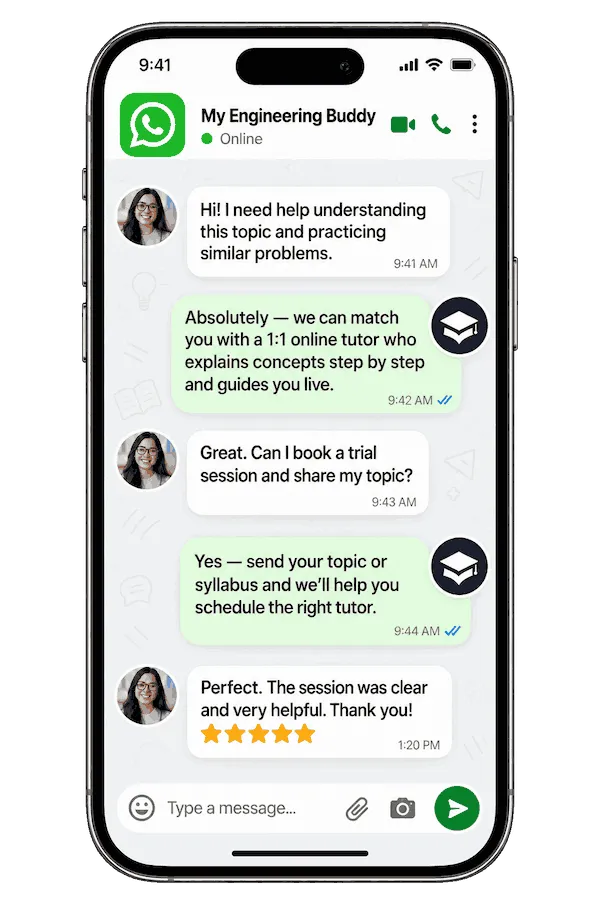
WhatsApp MEB for a quick quote — average response time under 1 minute.
Who This GCSE Electronics Tutoring Is For
This isn’t a subject where memorising definitions gets you through. GCSE Electronics rewards students who can apply component knowledge to unseen circuit problems under timed conditions — and that takes deliberate, corrected practice.
- Students who understand individual components but freeze when circuits combine them
- Students retaking after a failed first attempt — especially those who lost marks on the system design questions
- Students with a university or sixth-form conditional offer that depends on this grade
- Students 4–6 weeks from their exam with significant gaps still to close
- Parents watching a child’s confidence drop alongside their grades
- Students who need structured homework guidance that builds genuine understanding
Students from schools and sixth forms feeding into programmes at universities including Imperial College London, University of Southampton, University of Edinburgh, Loughborough University, and University of Bath regularly use MEB to consolidate their GCSE Electronics foundation before progressing to A Level or degree-level engineering.
At MEB, we’ve found that the students who struggle most with GCSE Electronics aren’t weak at science — they’ve just never had someone show them how to read a circuit systematically, from input to output, before trying to analyse it. That single shift changes everything.
1:1 Tutoring vs Self-Study vs AI vs YouTube vs Online Courses
Self-study works if you’re disciplined — but GCSE Electronics problems require feedback you can’t give yourself. AI tools explain fast but can’t watch you misread a Thevenin equivalent in real time. YouTube is great for component overviews, and stops there. Online courses move at a fixed pace regardless of your specific OCR or WJEC syllabus gaps. 1:1 tutoring with MEB is live, calibrated to your exact exam board, and corrects the specific error you’re making — not the average error students make.
Outcomes: What You’ll Be Able To Do in GCSE Electronics
After working with an MEB tutor, you’ll be able to analyse series and parallel circuits confidently using Ohm’s Law and Kirchhoff’s rules. You’ll explain the behaviour of key components — resistors, capacitors, diodes, transistors — and apply that knowledge to unseen exam questions. You’ll solve systems-level questions that ask you to trace signal flow from sensor through processor to output. You’ll interpret and draw circuit diagrams accurately under exam conditions. And you’ll apply fault-finding logic to identify why a given circuit wouldn’t work as described.
Supporting a student through GCSE Electronics? MEB works directly with parents to set up sessions, track progress, and keep coursework on schedule. WhatsApp MEB — average response time is under a minute, 24/7.
Based on feedback from 40,000+ sessions collected by MEB from 2022 to 2025, 58% of students improved by one full grade after approximately 20 hours of 1:1 tutoring in subjects like GCSE Electronics. A further 23% achieved at least a half-grade improvement.
Source: MEB session feedback data, 2022–2025.
What We Cover in GCSE Electronics (Syllabus / Topics)
MEB tutors cover OCR GCSE Electronics (J125) and WJEC GCSE Electronics in full. The assessment structure below reflects OCR J125 as a reference; your tutor confirms board-specific weightings at the first session.
| Component | Description | Typical Weighting |
|---|---|---|
| Written Examination (J125/01) | Circuit theory, components, systems — unseen questions | ~60% |
| Practical Coursework (J125/02) | Design, build, test, and evaluate an electronic system | ~40% |

Track 1: Circuit Theory and Components
- Ohm’s Law, Kirchhoff’s Voltage and Current Laws
- Series and parallel resistor networks — calculating equivalent resistance
- Capacitors: charge, discharge, time constants (RC circuits)
- Diodes: forward bias, reverse bias, rectification
- Transistors as switches and amplifiers (BJT focus)
- Potential dividers and their use in sensor circuits
- LDRs, thermistors, and variable resistors in system design
Key texts: GCSE Electronics for You (Owen Bishop), OCR GCSE Electronics Student Book. Both give worked circuit examples ideal for exam prep.
Track 2: Systems and Signal Processing
- Block diagrams: input → processor → output model
- Analogue vs digital signal distinction
- Logic gates: AND, OR, NOT, NAND, NOR, XOR — truth tables and applications
- Combinational logic circuit design from a specification
- Op-amps: comparator and inverting/non-inverting amplifier configurations
- 555 timer: astable and monostable modes
Key texts: Electronics: A Systems Approach (Neil Storey), WJEC GCSE Electronics revision guide. Both are useful for systems-level questions.
Track 3: Practical Coursework and Fault-Finding
- Design brief interpretation and circuit specification writing
- Breadboard prototyping and PCB layout principles
- Testing and measurement: oscilloscope, multimeter, signal generator use
- Fault-finding strategy: systematic open/short circuit diagnosis
- Evaluation: comparing actual vs expected performance with justification
- Health and safety in practical electronics work
Key texts: GCSE Electronics for You (Owen Bishop) — the practical chapters are especially relevant here. The IEEE Xplore database provides supplementary reading on electronic systems for students keen to go beyond the syllabus.
Students consistently tell us that the practical coursework in GCSE Electronics feels manageable once they’ve worked through the design brief with a tutor first. The panic comes from not knowing where to start — not from lacking the ability to do it.
What a Typical GCSE Electronics Session Looks Like
The tutor opens by checking the previous topic — usually a follow-up question on, say, the RC time constant calculation you attempted between sessions. From there, you move into the main problem set: working through a potential divider question involving an LDR and a transistor switch, with the tutor annotating the circuit in real time on a digital pen-pad while you follow on screen. You try the next question yourself. The tutor watches your working, not just your answer — and corrects the step where the logic breaks, not just the final number. The session closes with a specific task: two past-paper questions on logic gate circuits to attempt before the next session, and a note on what’s coming next (op-amp comparator configurations).
How MEB Tutors Help You with GCSE Electronics (The Learning Loop)
Diagnose: In the first session, the tutor works through a short set of diagnostic questions covering circuit theory, component behaviour, and systems knowledge. They identify exactly where your understanding breaks — not just which topics you haven’t revised, but where your reasoning goes wrong within a topic.
Explain: The tutor works problems live, using a digital pen-pad to annotate circuit diagrams and walk through each step. You see the logic, not just the answer. Every explanation is tied to the specific OCR or WJEC exam wording your marker will use.
Practice: You attempt the next question with the tutor present. This isn’t review — it’s real-time practice where errors get caught immediately, before they become habits.
Feedback: The tutor explains exactly why a step was wrong and what the examiner is looking for. Mark schemes are referenced directly. You know what earns marks and what doesn’t.
Plan: Each session ends with a clear next step: specific topics, specific past-paper questions, a timeline to your exam. Nothing vague.
Sessions run over Google Meet. The tutor uses a digital pen-pad or iPad with Apple Pencil for circuit work. Before your first session, share your exam board, your most recent past-paper attempt, and your exam date. The first session covers diagnostic + first topic correction. Start with the $1 trial — 30 minutes of live tutoring that also serves as your first diagnostic.
GCSE Electronics students often arrive knowing the component names. The gap is almost always in applying them — connecting LDR behaviour to a transistor switch to a relay output in a single question. That’s where 1:1 tutoring pays off fastest.
Source: MEB tutor observation data, 2022–2025.
Tutor Match Criteria (How We Pick Your Tutor)
Not every electronics tutor knows GCSE Electronics. The exam board matters. So does knowing which question types lose students the most marks.
Subject depth: Tutors are matched by exam board (OCR J125, WJEC) and syllabus section — not just “electronics” as a field. Tools: Every tutor uses Google Meet with a digital pen-pad or iPad and Apple Pencil — essential for live circuit annotation. Time zone: Matched to your region, whether you’re in the UK, US, Gulf, Canada, or Australia. Goals: Whether you need exam score improvement, coursework support, or homework guidance — the tutor is briefed before session one.
Unlike platforms where you fill out a form and wait, MEB responds in under a minute, 24/7. Tutor match takes under an hour. The $1 trial means you test before you commit. Everything runs over WhatsApp — no logins, no intake forms.
Study Plans (Pick One That Matches Your Goal)
If your exam is in three weeks or less, the tutor runs a compressed catch-up focusing on your highest-mark gap areas first — typically circuit analysis and systems questions. For a four-to-eight week window, sessions follow a structured revision sequence through all three tracks, with past-paper work from week three. For ongoing weekly support, the tutor aligns sessions to your school deadlines and coursework submission dates. The specific session sequence is mapped after the diagnostic — not guessed in advance.
Pricing Guide
GCSE Electronics tutoring runs at $20–$40/hr for most students. Specialist support — for students targeting electronics-heavy A Level pathways or needing deep coursework guidance — is available at higher rates from tutors with engineering degrees and industry backgrounds. Share your specific goal and MEB matches the tier to your timeline.
Rate factors: topic complexity, tutor background, session frequency, and how close you are to the exam window. Availability drops in April and May — the peak GCSE revision period.
For students targeting selective sixth forms or programmes at universities like Imperial College London or University of Southampton, tutors with professional electronics backgrounds are available at higher rates — share your specific goal and MEB will match accordingly.
Start with the $1 trial — 30 minutes, no registration, no commitment. WhatsApp MEB for a quick quote.
FAQ
Is GCSE Electronics hard?
It’s one of the more demanding GCSE options. The written exam requires applying component knowledge to unseen circuit problems — not just recall. Students who struggle most typically have gaps in circuit analysis rather than a weak grasp of individual components. One-to-one tutoring closes that gap directly.
How many sessions are needed to improve my grade?
Most students see a measurable shift in confidence and test performance within four to six sessions. Closing a full grade gap typically takes ten to twenty hours of focused 1:1 work, spread over four to eight weeks. Your tutor maps the sequence after the diagnostic.
Can you help with GCSE Electronics homework and assignments?
Yes — MEB tutoring is guided learning. You understand the work, then submit it yourself. The tutor explains the circuit or concept until you can complete the task independently. See our Academic Integrity policy and Why MEB page for full details on what we help with and what we don’t.
Will the tutor match my exact exam board?
Yes. OCR J125 and WJEC Electronics are the two main GCSE Electronics boards, and tutors are matched accordingly. The first session confirms your specific paper structure and mark scheme conventions — so the guidance is board-accurate, not generic.
What happens in the first session?
The tutor runs a short diagnostic — a handful of questions spanning circuit theory, components, and systems — to locate exactly where your understanding breaks. From that point, every session has a targeted focus. Nothing is guessed.
Is online tutoring as effective as in-person for GCSE Electronics?
For circuit-based subjects, yes — provided the tutor uses a digital pen-pad for live annotation. MEB tutors annotate circuit diagrams and work through problems in real time on screen. Students consistently report it’s easier to follow than a whiteboard across a desk.
What’s the difference between OCR and WJEC GCSE Electronics?
Both cover core circuit theory and systems, but differ in coursework structure, question style, and some topic emphasis. OCR J125 is more widely offered in England; WJEC is the primary board in Wales. Your tutor is matched to your specific board and uses the relevant past papers and mark schemes throughout.
Can I get GCSE Electronics help late at night or at weekends?
Yes. MEB operates 24/7 across all time zones. If you’re in the UK and need a session on a Sunday evening before a Monday deadline, that’s a normal request. WhatsApp MEB and you’ll typically be matched within the hour.
Do MEB tutors help with the GCSE Electronics practical coursework?
Yes — the coursework component (typically around 40% of the final grade) is one of the areas students most often need support with. Tutors help with interpreting the design brief, planning circuit prototypes, structuring evaluation write-ups, and fault-finding logic. You build and submit the work yourself.
What if my school doesn’t offer GCSE Electronics and I’m self-studying?
Self-study candidates are a significant portion of MEB’s GCSE Electronics students. The tutor provides the full structure your school would have given — syllabus walkthrough, past-paper practice, coursework guidance, and exam board registration advice. Share which board you’re registered with and the tutor takes it from there.
How do I get started with GCSE Electronics tutoring?
WhatsApp MEB — share your exam board, your weakest topic, and your exam date. MEB matches you to a tutor, usually within an hour. Your first session is the $1 trial: 30 minutes of live 1:1 tutoring, or one homework question explained in full. No forms. No waiting.
Trust & Quality at My Engineering Buddy
Every MEB tutor goes through subject-specific screening: a live demo session evaluated against the relevant syllabus, degree-level verification, and ongoing review based on student feedback. For GCSE Electronics, that means tutors who know the OCR and WJEC mark schemes — not just electronics as a field. Rated 4.8/5 across 40,000+ verified reviews on Google.
MEB tutoring is guided learning — you understand the work, then submit it yourself. For full details on what we help with and what we don’t, read our Academic Integrity policy and Why MEB.
MEB has served 52,000+ students across the US, UK, Canada, Australia, the Gulf, and Europe since 2008 — across 2,800+ subjects. GCSE Electronics sits within a wide GCSE provision that includes GCSE Computer Science tutoring, GCSE Mathematics help, and GCSE Chemistry tutoring. The methodology behind every session is documented at MEB’s tutoring methodology page.
GCSE Electronics is offered by a small subset of UK schools — which means fewer resources, fewer past papers in circulation, and fewer teachers who know the syllabus deeply. That’s exactly the gap MEB fills.
Source: MEB tutor intake data, 2022–2025.
Try your first session for $1 — 30 minutes of live 1:1 tutoring or one homework question explained in full. No registration. No commitment. WhatsApp MEB now and get matched within the hour.
Explore Related Subjects
Students studying GCSE Electronics often also need support in:
Next Steps
Getting started takes one WhatsApp message. Here’s what to have ready:
- Your exam board (OCR, WJEC) and the component you find hardest
- Your exam date or coursework deadline
- Your availability and time zone
Before your first session, have ready: your exam board and syllabus (or course outline), a recent past-paper attempt or homework question you struggled with, and your exam or deadline date. The tutor handles the rest.
MEB matches you with a verified GCSE Electronics tutor — usually within 24 hours. The first session starts with a diagnostic so every minute is used well.
Visit www.myengineeringbuddy.com for more on how MEB works.
WhatsApp to get started or email [email protected].
Our experience across thousands of sessions shows that students who bring a specific past-paper question to their first GCSE Electronics session make faster progress than those who start with a vague topic request. Come with a question you couldn’t answer. That’s the best starting point.
Reviewed by Subject Expert
This page has been carefully reviewed and validated by our subject expert to ensure accuracy and relevance.




