~1 min
Average Reply Time
~1 hour
To Be Matched With A Tutor
30 Min Trial
75% Find Their Tutor On The 1st Trial
$20-35+/hr
Premium Yet Affordable Learning
Hire The Best MCAT Chemistry Tutor

Most students who fail the MCAT Chemistry section don’t lack intelligence — they lack a tutor who can show them exactly where their reasoning breaks down.
MCAT Chemistry Tutor Online
MCAT Chemistry covers the general and organic chemistry content tested on the MCAT’s Chemical and Physical Foundations section, equipping pre-med students with the scientific reasoning skills required for medical school admission in the US and Canada.
MEB connects you with a verified MCAT Chemistry tutor online who knows the AAMC blueprint section by section. Whether you’re trying to push your score past 510 or rebuilding acid-base chemistry from scratch, a MCAT Chemistry tutor near me search ends here — sessions run live over Google Meet, matched to your time zone across the US, UK, Canada, Australia, and the Gulf. For a full overview of MCAT preparation across all sections, see our MCAT tutoring page.
- 1:1 online sessions tailored to the AAMC MCAT Chemistry blueprint
- Expert-verified tutors with subject-specific medical admissions knowledge
- Flexible time zones — US, UK, Canada, Australia, Gulf
- Structured learning plan built after a diagnostic session
- Ethical homework and assignment guidance — you understand before you submit
52,000+ students across the US, UK, Canada, Australia, and the Gulf have used MEB since 2008 — including students preparing for the MCAT across Chemistry, MCAT Biology tutoring, and MCAT Physics help.
Source: My Engineering Buddy, 2008–2025.
How Much Does an MCAT Chemistry Tutor Cost?
Most MCAT Chemistry tutoring sessions run $20–$40/hr. Graduate-level or specialist tutors with medical school research backgrounds go up to $100/hr. The $1 trial gives you 30 minutes of live tutoring or a full explanation of one problem — no registration, no commitment.
Availability tightens sharply in the 6–8 weeks before MCAT testing windows. Book early if your exam date is set.
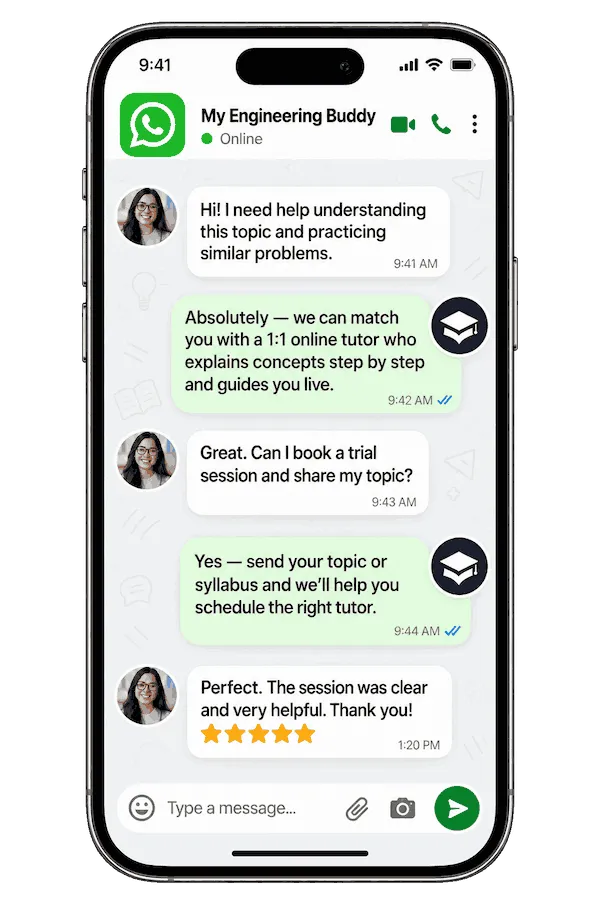
WhatsApp MEB for a quick quote — average response time under 1 minute.
Who This MCAT Chemistry Tutoring Is For
This is for pre-med students who know the MCAT Chemistry section is holding their total score back. It’s also for students who passed general chemistry in college but find the MCAT’s application-style questions a different challenge entirely.
- Students retaking after a failed first attempt who need targeted gap work, not another full course
- Students 4–6 weeks from their test date with significant chemistry gaps still to close
- Pre-med students whose conditional medical school offer depends on reaching a specific MCAT score
- Students who understand lecture content but lose points on MCAT-style passage-based questions
- Parents supporting a child through their first MCAT cycle who want structured, accountable progress
- Students who need MCAT Chemical and Physical Foundations of Biological Systems help alongside focused chemistry work
Students preparing at Johns Hopkins, University of Michigan, UCLA, McGill, University of Edinburgh, University of Toronto, Australian National University, and King Abdulaziz University all use MEB to prep for the MCAT.
1:1 Tutoring vs Self-Study vs AI vs YouTube vs Online Courses
Self-study works if you’re disciplined, but the MCAT Chemistry section punishes isolated memorization — there’s no feedback when your reasoning pattern is wrong. AI tools give fast definitions, but can’t probe why you keep misapplying Le Chatelier’s principle on passage questions. YouTube explains concepts well enough at the surface; it stops when your specific passage throws an unusual electrochemistry framing. Online prep courses are structured but fixed-pace — they don’t wait for you to actually understand buffer calculations before moving on. 1:1 tutoring with MEB is live, calibrated to your exact MCAT Chemistry gaps, and corrects errors in the moment before they become habits.
Outcomes: What You’ll Be Able To Do in MCAT Chemistry
After targeted 1:1 sessions, you’ll solve acid-base equilibrium problems without second-guessing your Henderson-Hasselbalch setup. You’ll analyze electrochemical cell diagrams and apply spontaneity reasoning under timed conditions. You’ll model reaction mechanisms — nucleophilic substitution, carbonyl additions, and elimination pathways — well enough to predict products from an unfamiliar passage. You’ll explain thermodynamic relationships between Gibbs free energy, enthalpy, and entropy in biological contexts. Apply stoichiometric reasoning to real clinical scenarios. These aren’t vague goals — they map directly to the AAMC content categories your tutor will track session by session.
Supporting a student through MCAT Chemistry? MEB works directly with parents to set up sessions, track progress, and keep preparation on schedule. WhatsApp MEB — average response time is under a minute, 24/7.
Based on feedback from 40,000+ sessions collected by MEB from 2022 to 2025, 58% of students improved their MCAT Chemistry score by 5–10 points after approximately 20 hours of 1:1 tutoring. A further 21% reported measurable improvement within the first 10 hours.
Source: MEB session feedback data, 2022–2025.
At MEB, we’ve found that MCAT Chemistry students who struggle with passage-based questions are almost never weak on content alone — they’re applying isolated facts instead of reasoning through the passage context. That shift in approach, practised live, is what moves scores.
What We Cover in MCAT Chemistry (Syllabus / Topics)
MEB MCAT Chemistry tutoring follows the AAMC content outline. Sessions target the Chemical and Physical Foundations of Biological Systems section, which accounts for a significant portion of your total scaled score.
| MCAT Chemistry Component | Description | Approx. Weighting |
|---|---|---|
| General Chemistry | Equilibrium, acids/bases, electrochemistry, thermodynamics, kinetics | ~30% |
| Organic Chemistry | Reaction mechanisms, stereochemistry, functional groups, spectroscopy | ~15% |
| Biochemistry | Amino acids, enzyme kinetics, metabolic pathways, protein structure | ~25% |
| Physics (Chem-relevant) | Fluids, thermodynamics, optics as applied to biological systems | ~25% |
| Research & Data Analysis | Passage-based experimental reasoning, graph interpretation, error analysis | ~5% |
General Chemistry and Physical Chemistry
- Acid-base equilibria, pH, pKa, and buffer calculations
- Electrochemical cells, Nernst equation, and redox reactions
- Thermodynamics: Gibbs free energy, enthalpy, entropy, and spontaneity
- Chemical kinetics: rate laws, activation energy, and catalysis
- Gas laws, solutions, and colligative properties
- Atomic structure, periodic trends, and chemical bonding
Recommended texts: General Chemistry by Ebbing & Gammon; Examkrackers 101 Passages in MCAT General Chemistry; AAMC Official Guide to the MCAT Exam.
Organic Chemistry and Biochemistry
- Nucleophilic substitution (SN1/SN2) and elimination (E1/E2) mechanisms
- Carbonyl chemistry: aldehydes, ketones, carboxylic acids, and derivatives
- Stereochemistry: chirality, enantiomers, diastereomers, and optical activity
- Amino acid structure, peptide bonds, and protein folding
- Enzyme kinetics: Michaelis-Menten, inhibition types, and allosteric regulation
- Metabolic pathways: glycolysis, TCA cycle, oxidative phosphorylation, and lipid metabolism
- NMR and IR spectroscopy for structure determination on MCAT passages
Recommended texts: Organic Chemistry as a Second Language by Klein; Kaplan MCAT Biochemistry Review; Princeton Review MCAT Organic Chemistry Review.
Passage-Based Reasoning and Experimental Analysis
- Reading scientific passages quickly and identifying the testable claim
- Interpreting data tables, graphs, and experimental designs under time pressure
- Applying chemistry knowledge to novel clinical or biological scenarios
- Distinguishing what the passage says from what you already know
- Error analysis, significant figures, and unit conversions in context
Recommended texts: AAMC Official MCAT Practice Exams; Blueprint MCAT Full-Length Exams; Gold Standard MCAT by Ferdinand.

What a Typical MCAT Chemistry Session Looks Like
The tutor opens by checking where the previous session ended — usually a specific reaction mechanism or a buffer problem you were shaky on. You pull up an AAMC passage together on screen. The tutor asks you to work through a question out loud, then stops you at the first reasoning error — not the answer, the step where the logic slipped. They annotate in real time with a digital pen-pad. You redo the same style of question independently while the tutor watches. By the end of the session, you have three to five practice problems of the same type to complete before the next session, and the next topic is already noted on your prep timeline.
How MEB Tutors Help You with MCAT Chemistry (The Learning Loop)
Diagnose: In the first session, the tutor runs a short diagnostic covering general chemistry, organic chemistry, and biochemistry fundamentals. They identify whether your gaps are conceptual, mechanical, or passage-strategy problems — these need different fixes.
Explain: The tutor works through problems live, annotating every step with a digital pen-pad. You see the reasoning, not just the answer. For MCAT Chemistry, this often means unpacking why a wrong answer choice is constructed to exploit a common misconception.
Practice: You attempt the next problem with the tutor present. No shortcuts. The goal is that you can reproduce the reasoning independently under timed conditions.
Feedback: The tutor identifies exactly where your logic broke — not just “wrong answer” but “you applied the strong acid approximation to a weak acid buffer, which shifts your pH by nearly a full unit.” Specific, correctable.
Plan: Each session closes with a concrete list: what to review, what to practice, and what the next session targets. The tutor tracks your progress against your test date.
Sessions run over Google Meet with a digital pen-pad or iPad and Apple Pencil. Before your first session, have your most recent practice test score, the specific chemistry topics you’re weakest on, and your exam date ready. The first session covers your diagnostic and builds your session plan from there. Start with the $1 trial — 30 minutes of live tutoring that also serves as your first diagnostic.
Students consistently tell us that the MCAT Chemistry section feels different once they stop trying to memorise every reaction and start reading passages the way the AAMC intends — as reasoning tests that happen to use chemistry. That mindset shift usually lands in session two or three.
Tutor Match Criteria (How We Pick Your Tutor)
Every tutor is matched on four criteria before you see their name.
Subject depth: Tutors hold degrees in chemistry, biochemistry, or pre-medical sciences and have direct MCAT preparation experience — not just general chemistry teaching. Tools: All MCAT Chemistry tutors use Google Meet plus a digital pen-pad or iPad and Apple Pencil — essential for working through mechanisms and equilibrium diagrams in real time. Time zone: Matched to your region — US, UK, Canada, Australia, or Gulf — so session times are practical, not disruptive. Goals: Whether you need a score push from 508 to 515, a full content rebuild, or focused MCAT Biological and Biochemical Foundations of Living Systems tutoring alongside chemistry, the tutor is selected for that specific objective.
Unlike platforms where you fill out a form and wait, MEB responds in under a minute, 24/7. Tutor match takes under an hour. The $1 trial means you test before you commit. Everything runs over WhatsApp — no logins, no intake forms.
Study Plans (Pick One That Matches Your Goal)
After the first diagnostic session, your tutor builds a specific sequence. Most students fit one of three structures: a catch-up plan (1–3 weeks, used when gaps are well-defined and the exam date is close), a structured exam prep plan (4–8 weeks, working through all MCAT Chemistry content categories with timed practice built in), or weekly ongoing support aligned to your overall MCAT study schedule alongside other sections. The plan shifts if practice test data shows a different priority emerging.
Pricing Guide
MCAT Chemistry tutoring starts at $20/hr for standard sessions. Graduate-level tutors or those with medical research or admissions backgrounds charge up to $100/hr. Rate factors include topic complexity, tutor level, your timeline, and availability in your region.
Availability tightens in the 6–8 weeks before MCAT testing windows — January, April, June, and September are the busiest periods. Book early.
For students targeting top US medical schools — Johns Hopkins School of Medicine, Harvard Medical School, UCSF — tutors with research and clinical backgrounds are available at higher rates. Share your target program and MEB will match the tier to your ambition.
Start with the $1 trial — 30 minutes, no registration, no commitment. WhatsApp MEB for a quick quote.
The MCAT runs 7.5 hours on test day. The chemistry and physics section alone is 95 minutes, 59 questions. Students who work with a tutor on passage strategy — not just content — consistently report that the exam feels shorter. That’s not a feeling. That’s practice paying off.
Source: AAMC MCAT exam structure data; MEB session feedback, 2022–2025.
FAQ
Is MCAT Chemistry hard?
Yes — but not because the content is obscure. Most students have seen general and organic chemistry before. The difficulty is applying it to unfamiliar passages under timed pressure. That’s a skill, and it improves with the right practice structure.
How many sessions are needed?
Students with focused gaps typically see meaningful progress in 8–12 sessions. A full chemistry rebuild from a low baseline takes 20+ sessions. Your tutor maps the sequence after the diagnostic and adjusts as practice test data comes in.
Can you help with homework and assignments?
MEB tutoring is guided learning — you understand the work, then submit it yourself. See our Academic Integrity policy and Why MEB page for full details on what we help with and what we don’t.
Will the tutor match my exact syllabus or exam board?
Yes. MCAT Chemistry tutors follow the AAMC content outline and the Chemical and Physical Foundations of Biological Systems blueprint. If you’re also preparing for the MCAT Critical Analysis and Reasoning Skills section, a separate tutor can cover that alongside.
What happens in the first session?
The tutor runs a short diagnostic covering your weakest chemistry areas, reviews your most recent practice test if available, identifies whether your gaps are content or strategy problems, and builds your session plan before you log off.
Is online tutoring as effective as in-person?
For MCAT Chemistry, yes — the digital pen-pad replicates whiteboard work precisely. Many students find screen annotation clearer than a physical board because every step stays visible and reviewable after the session.
Can I get MCAT Chemistry help at midnight?
Yes. MEB operates 24/7 across time zones. Students in the Gulf and Australia book late-night US sessions regularly. WhatsApp MEB anytime — the response is typically under a minute regardless of the hour.
What if I don’t like my assigned tutor?
Tell MEB over WhatsApp. A replacement tutor is matched within hours. The $1 trial exists precisely so you can test the fit before committing to a full session block.
Do you offer group MCAT Chemistry sessions?
No. MEB is 1:1 only. Every session is built around one student’s gaps, one student’s exam date, and one student’s reasoning errors. Group sessions don’t allow for the real-time correction that moves MCAT scores.
What is the difference between MCAT general chemistry and MCAT organic chemistry prep?
General chemistry prep focuses on equilibrium, thermodynamics, electrochemistry, and kinetics in biological contexts. Organic chemistry prep targets mechanisms, stereochemistry, and functional group reactions. The MCAT tests both, and most students have a weaker area — the diagnostic identifies which one needs more time.
How does MCAT Chemistry scoring work and what score should I target?
The Chemical and Physical Foundations section is scored 118–132. A score of 127+ places you in a competitive range for most US medical schools. Your tutor works backward from your target school’s median MCAT to set a section-level goal for chemistry.
How do I get started?
WhatsApp MEB, get matched with a verified MCAT Chemistry tutor — usually within an hour — then start your $1 trial: 30 minutes of live tutoring or one full question explained. Three steps. No forms. No waiting.
Trust & Quality at My Engineering Buddy
Every MEB tutor goes through subject-specific screening — not a generic interview. For MCAT Chemistry, that means verified academic credentials in chemistry, biochemistry, or pre-medical sciences, a live demo session evaluation, and ongoing review based on student feedback. Rated 4.8/5 across 40,000+ verified reviews on Google.
MEB tutoring is guided learning — you understand the work, then submit it yourself. For full details on what we help with and what we don’t, read our Academic Integrity policy and Why MEB.
MEB has served 52,000+ students in 2,800+ subjects since 2008, across the US, UK, Canada, Australia, the Gulf, and Europe. MCAT preparation — including MCAT Psychological, Social, and Biological Foundations of Behavior tutoring and Chemical and Physical Foundations help — is one of the platform’s most active subject areas. Tutors are matched by subject depth, tools, and your specific exam target, not by whoever is available. See our tutoring methodology for how sessions are structured and how progress is tracked.
Explore Related Subjects
Students studying MCAT Chemistry often also need support in:
- MCAT Biological and Biochemical Foundations of Living Systems
- MCAT Critical Analysis and Reasoning Skills
- MCAT Physics
- MCAT Psychological, Social, and Biological Foundations of Behavior
Next Steps
Before your first session, have ready: your exam board and current practice test score (or the score you’re aiming for), the specific chemistry topics giving you the most trouble, and your test date.
- Share your exam date, hardest chemistry topic, and current score range
- Share your availability and time zone
- MEB matches you with a verified MCAT Chemistry tutor — usually within 24 hours
The first session starts with a diagnostic so every minute after that is pointed at the right gaps. Visit www.myengineeringbuddy.com for more on how MEB works.
WhatsApp to get started or email [email protected].
Reviewed by Subject Expert
This page has been carefully reviewed and validated by our subject expert to ensure accuracy and relevance.