~1 min
Average Reply Time
~1 hour
To Be Matched With A Tutor
30 Min Trial
75% Find Their Tutor On The 1st Trial
$20-35+/hr
Premium Yet Affordable Learning
Hire The Best Google Colab Tutor

Your Google Colab notebook keeps crashing, your GPU quota runs out, and the error messages mean nothing — let’s fix that in one session.
Google Colab Tutor Online
Google Colab is a cloud-based Jupyter notebook environment by Google that runs Python code on hosted CPUs, GPUs, and TPUs, enabling data science, machine learning, and deep learning workflows without local installation or hardware setup.
MEB provides 1:1 online tutoring and project help in 2800+ advanced subjects — including Google Colab and the broader software engineering stack. If you’re searching for a Google Colab tutor near me, every MEB session runs live over Google Meet with a verified tutor who knows the platform from runtime errors to full ML pipeline deployment. One session can close gaps that hours of documentation-reading won’t.
- 1:1 online sessions tailored to your specific course, project, or research pipeline
- Expert-verified tutors with hands-on Google Colab and Python ML experience
- Flexible time zones — US, UK, Canada, Australia, Gulf
- Structured learning plan built after a diagnostic of your current notebook and workflow
- Guided project support — we explain the logic, you write and run the code
52,000+ students across the US, UK, Canada, Australia, and the Gulf have used MEB since 2008 — including students working on software engineering tools like Google Colab, Jupyter Notebook, and Anaconda.
Source: My Engineering Buddy, 2008–2025.
How Much Does a Google Colab Tutor Cost?
Most Google Colab tutoring sessions run $20–$40/hr. Advanced ML pipeline work or PhD-level research sessions may reach $60–$100/hr depending on complexity and tutor background. Not sure what tier fits you? Start with the $1 trial — 30 minutes of live tutoring, no registration required.
| Level / Need | Typical Rate | What’s Included |
|---|---|---|
| Standard (most levels) | $20–$35/hr | 1:1 sessions, notebook debugging, project guidance |
| Advanced / Specialist | $35–$100/hr | Expert tutor, ML pipelines, GPU/TPU optimization |
| $1 Trial | $1 flat | 30 min live session or one project question explained |
Tutor availability tightens significantly at semester ends and around major project submission windows — book early if your deadline is within three weeks.
WhatsApp MEB for a quick quote — average response time under 1 minute.
Who This Google Colab Tutoring Is For
Google Colab sits at the intersection of Python, cloud compute, and ML — which means the people who get stuck come from very different starting points. Some are data science students who can write Python but have never managed GPU sessions. Others are researchers trying to run training loops on large datasets without burning through free quota.
- Undergraduate and graduate students in data science, machine learning, or AI courses using Colab for assignments and projects
- Researchers at institutions like MIT, Stanford, ETH Zurich, or University of Toronto who need efficient notebook workflows for experiments
- Students whose capstone, thesis, or final project depends on a working ML pipeline in Colab
- Students who submitted a project, got it back with errors they can’t reproduce or fix, and have a resubmission deadline approaching
- Professionals transitioning into data science who need to get a working Colab portfolio up fast
- Parents supporting a student whose coursework marks are slipping because the coding environment itself is the obstacle
If your course runs on Google Colab and you’re losing time to environment issues rather than the actual subject matter, a single session with an online Google Colab tutor can recover that time.
1:1 Tutoring vs Self-Study vs AI vs YouTube vs Online Courses
Self-study works if you have the time and can debug independently — most students can’t. AI tools like ChatGPT explain concepts fast but can’t watch your specific notebook fail in real time and tell you exactly why. YouTube covers Colab setup and basic workflows well; it stops when your custom training loop throws a shape mismatch at epoch 3. Online courses give you structure but run at a fixed pace regardless of where you’re actually stuck. 1:1 tutoring with MEB is calibrated to your exact notebook, your dataset, your error — corrected live, not in a forum thread three days later.
Outcomes: What You’ll Be Able To Do in Google Colab
After working with an MEB Google Colab tutor, you’ll be able to structure and run a complete ML experiment — from data ingestion and preprocessing through model training, evaluation, and saving checkpoints — without losing work to runtime disconnections. You’ll apply GPU and TPU acceleration correctly, manage Colab’s file system and Google Drive mounting without data loss, and write clean, reproducible notebooks that collaborators or supervisors can re-run without errors. You’ll debug shape mismatches, memory errors, and dependency conflicts on the spot. And you’ll present your notebook as a professional project deliverable — not a broken draft.
Supporting a student through Google Colab? MEB works directly with parents to set up sessions, track project progress, and keep coursework submissions on schedule. WhatsApp MEB — average response time is under a minute, 24/7.
Based on feedback from 40,000+ sessions collected by MEB from 2022 to 2025, 58% of students improved by one full grade after approximately 20 hours of 1:1 tutoring in subjects like Google Colab. A further 23% achieved at least a half-grade improvement.
Source: MEB session feedback data, 2022–2025.
What We Cover in Google Colab (Syllabus / Topics)

Track 1: Environment Setup, Runtime Management & Notebook Structure
- Connecting to GPU and TPU runtimes — checking allocation and avoiding quota exhaustion
- Mounting Google Drive and managing persistent file paths across sessions
- Installing packages with pip and conda inside Colab without breaking the runtime
- Notebook cell structure, magic commands, and execution order pitfalls
- Using Colab forms, widgets, and interactive elements for cleaner project presentation
- Sharing, versioning, and collaborating on notebooks — permissions and revision history
Useful reference: Python Data Science Handbook by Jake VanderPlas; Hands-On Machine Learning with Scikit-Learn, Keras, and TensorFlow by Aurélien Géron.
Track 2: Data Science & Machine Learning Workflows
- Loading and preprocessing datasets — CSV, JSON, APIs, and Kaggle datasets directly into Colab
- Exploratory data analysis with Matplotlib and Seaborn inside notebook cells
- Building and evaluating classification, regression, and clustering models with Scikit-learn
- Training deep learning models with Keras and PyTorch on Colab GPUs
- Saving and loading model checkpoints to Drive to survive session timeouts
- Debugging shape mismatches, NaN losses, and out-of-memory errors during training
- Exporting trained models and generating reproducible experiment reports
Useful reference: Deep Learning with Python by François Chollet; Pattern Recognition and Machine Learning by Bishop.
Track 3: Advanced Colab — Kaggle Integration, Custom Environments & Research Use
- Connecting Colab to Kaggle APIs for dataset download and competition submission
- Using Colab Pro and Pro+ features — background execution, high-memory runtimes
- Integrating with Google Cloud Platform for large-scale data and storage
- Setting up reproducible research environments with requirements.txt and environment snapshots
- Using Colab for NLP tasks — tokenization, fine-tuning transformers (BERT, GPT variants)
- Automating notebook execution and scheduling with Colab’s API and GitHub Actions
Useful reference: Natural Language Processing with Transformers by Lewis Tunstall et al.; Google’s official Colab documentation.
At MEB, we’ve found that most Google Colab problems aren’t Python problems — they’re environment problems. Students waste hours reinstalling packages or losing training progress to session timeouts when a tutor could show them a two-minute fix. That’s where the first session usually starts.
Platforms, Tools & Textbooks We Support
Google Colab sessions at MEB are run inside the Colab environment itself — the tutor connects live and can view or co-navigate your notebook during the session. We support workflows involving TensorFlow, PyTorch, Keras, Scikit-learn, Pandas, NumPy, Matplotlib, Seaborn, Hugging Face Transformers, and the Kaggle API. Tutors are also familiar with Colab’s integration with Google Drive, GitHub, and Google Cloud Storage.
- Google Colab (Free, Pro, Pro+)
- Google Drive — persistent storage and dataset hosting
- GitHub — notebook version control and sharing
- Kaggle — dataset access and competition workflows
- Google Cloud Platform — large-scale storage and compute
- TensorFlow / Keras / PyTorch / Scikit-learn / Hugging Face
What a Typical Google Colab Session Looks Like
The tutor opens by checking where you left off — usually a specific cell that fails, a training loop that won’t converge, or a Drive mounting error from last time. You share your notebook link and the tutor pulls it up live. You work through the problem together on screen: the tutor might trace a shape mismatch back three cells, show you why the GPU isn’t being called despite the runtime showing GPU connected, or walk through why your model’s validation loss diverges after epoch 5. You try the fix yourself in a new cell while the tutor watches and corrects in real time. Session closes with a concrete task — run the corrected training loop, export predictions, clean up the notebook for submission — and the next topic noted.
How MEB Tutors Help You with Google Colab (The Learning Loop)
Diagnose: In the first session, the tutor reviews your notebook, identifies where the workflow breaks down — whether that’s runtime configuration, data pipeline errors, or a misunderstood model architecture — and maps what needs to be fixed versus what needs to be learned.
Explain: The tutor walks through the fix live, narrating every step. Not just what the correct code is, but why the previous approach failed — which is the part documentation never covers clearly.
Practice: You rewrite or adapt the solution in your own notebook while the tutor is present. No copying a working cell and moving on — you have to produce it and explain the logic.
Feedback: The tutor catches errors as they happen and explains exactly what the consequence would be — wrong tensor shape now means garbage output at inference, not a visible crash. That specificity is what makes the correction stick.
Plan: Each session ends with a clear next step — which Colab feature, model type, or workflow stage to tackle next, and what to attempt independently before the following session.
Sessions run over Google Meet. The tutor uses a digital pen-pad or iPad with Apple Pencil for annotating diagrams, model architectures, and data flow explanations. Before your first session, share your notebook link (or a description of your project), your course or research context, and any error messages you’re seeing. The first session covers a full diagnostic and resolves at least one blocking issue before the hour is up.
Start with the $1 trial — 30 minutes of live Google Colab tutoring that also serves as your first diagnostic.
Try your first session for $1 — 30 minutes of live 1:1 tutoring or one project question explained in full. No registration. No commitment. WhatsApp MEB now and get matched within the hour.
Tutor Match Criteria (How We Pick Your Tutor)
Not every Python tutor knows Colab’s specific constraints — GPU quota management, Drive persistence, runtime disconnection handling. MEB matches on specifics, not general subject labels.
Subject depth: Tutors have hands-on experience with Google Colab workflows at the level you need — coursework ML, research pipelines, or Kaggle competition preparation.
Tools: Every tutor uses Google Meet with screen sharing and a digital pen-pad or iPad with Apple Pencil for live annotation of code logic and architecture diagrams.
Time zone: Matched to your region — US, UK, Gulf, Canada, Australia — so session times don’t require you to work at 2 a.m.
Goals: Whether you need a working project submission, deeper understanding of model training, or ongoing support through a research semester, the tutor is matched to that specific outcome.
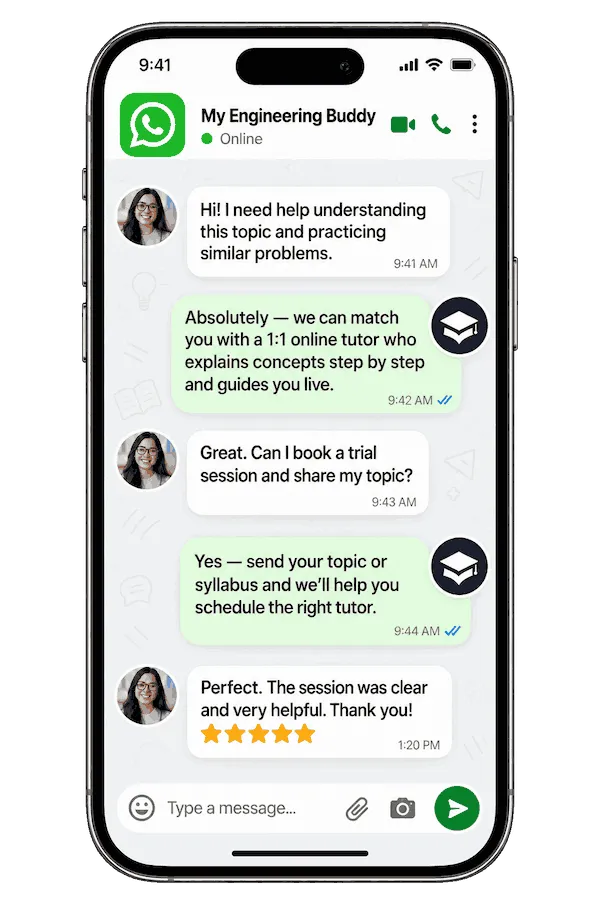
Unlike platforms where you fill out a form and wait, MEB responds in under a minute, 24/7. Tutor match takes under an hour. The $1 trial means you test before you commit. Everything runs over WhatsApp — no logins, no intake forms.
Students who arrive with a broken notebook and a deadline three days out consistently leave MEB’s first session with a working pipeline and a clear plan for the remaining sessions. Environment problems are almost always solvable in under an hour.
Source: My Engineering Buddy, tutor session observations, 2022–2025.
Students consistently tell us that Google Colab feels harder than it is because the errors are environment errors, not logic errors — and those look identical if you don’t know what to look for. A tutor who has seen 200 Colab sessions spots the difference in under two minutes.
Pricing Guide
Google Colab tutoring starts at $20/hr for coursework-level support. Graduate and research-level sessions — fine-tuning large language models, building multi-GPU training pipelines, or preparing a research notebook for publication — typically run $50–$100/hr depending on tutor background and session complexity.
Rate factors include the level of the work, how niche the ML task is, timeline pressure, and tutor availability. Slots fill quickly at semester ends and around capstone submission periods.
For students targeting top ML research programs or roles at organisations where Colab-based portfolio work matters, tutors with professional ML engineering or research backgrounds are available at higher rates — share your specific goal and MEB will match the tier to your ambition.
Start with the $1 trial — 30 minutes, no registration, no commitment. WhatsApp MEB for a quick quote.
FAQ
Is Google Colab hard to learn?
The Python itself is standard. What catches people is Colab’s cloud environment — GPU allocation, session timeouts, Drive mounting, and dependency conflicts. These are fixable quickly with the right guidance, but confusing without it.
How many sessions will I need?
Most students resolve an immediate project blocker in one or two sessions. Building a full working ML workflow from scratch typically takes four to eight sessions depending on your Python background and project scope.
Can you help with projects and portfolio work?
Yes. MEB tutors guide you through the logic, structure, and debugging of your Google Colab projects. MEB provides guided learning support — all project work is produced and submitted by you. See our Policies page for full details on what we help with and what we don’t.
Will the tutor match my exact syllabus or course structure?
Yes. Share your course outline, assignment brief, or research context before the session. The tutor tailors the session to your specific notebook, dataset, and deliverable — not a generic Colab curriculum.
What happens in the first session?
The tutor reviews your notebook or project brief, identifies what’s blocking you, and works through at least one concrete fix live. You leave with a working solution and a clear plan for what comes next.
Is online Google Colab tutoring as effective as in-person?
For Colab specifically, online is arguably better. The tutor connects to the same cloud environment you’re in — no screen resolution issues, no hardware mismatch. Notebook sharing and live debugging work seamlessly over Google Meet.
Can I get Google Colab help late at night or on weekends?
Yes. MEB tutors are available across US, UK, Gulf, Canada, and Australian time zones. WhatsApp response is under a minute around the clock. Deadline at 9 a.m. tomorrow is not disqualifying.
What if I don’t get along with my assigned tutor?
Tell MEB on WhatsApp. A replacement is arranged without forms, waiting periods, or explanations required. The goal is a working session, not a managed complaint process.
Do you cover Colab Pro and Pro+ features, or just the free tier?
Both. Tutors are familiar with free-tier constraints — quota limits, session timeouts, standard GPU allocation — and with Pro and Pro+ features including background execution, high-RAM runtimes, and longer session durations. The session is tailored to whichever tier you’re on.
How do I find a Google Colab tutor if I’m not in the US?
MEB covers the US, UK, Canada, Australia, Gulf, and Europe. Time zone matching is part of the tutor selection process. Location is irrelevant — every session runs online via Google Meet.
What’s the difference between Google Colab and Jupyter Notebook — do I need a tutor for both?
Colab runs on Google’s cloud infrastructure; Jupyter runs locally or on a server you manage. The Python syntax is nearly identical. MEB tutors cover both. If you’re moving between them for a project, one session is usually enough to bridge the gap.
How do I get started?
Start with the $1 trial — 30 minutes of live tutoring or one project question explained. Three steps: WhatsApp MEB, get matched with a tutor (usually within the hour), and begin your trial session. No registration, no commitment.
Trust & Quality at My Engineering Buddy
Every MEB tutor goes through subject-specific vetting — not just a CV review. Tutors demonstrate Google Colab proficiency in a live evaluation, including notebook debugging, GPU session management, and ML workflow explanation. Ongoing session feedback keeps standards consistent. Rated 4.8/5 across 40,000+ verified reviews on Google. MEB has served 52,000+ students across the US, UK, Canada, Australia, Gulf, and Europe since 2008 across 2,800+ subjects.
MEB provides guided learning support. All project work is produced and submitted by the student. See our Policies page for details.
MEB covers software engineering subjects at every level — from introductory Python and data pipelines to production-grade Docker and Kubernetes workflows. The same tutor network that supports Google Colab projects also covers Apache Spark and Amazon Web Services — so students moving from prototype in Colab to production in the cloud can stay with the same platform throughout. Visit Times Higher Education for context on how universities are integrating cloud-based tools into data science curricula.
MEB has operated since 2008 across 2,800+ advanced subjects. The tutor network covers the full software engineering and data science stack — from Google Colab notebooks to cloud deployment, testing, and production systems.
Source: My Engineering Buddy, 2008–2025.
Our experience across thousands of sessions shows that students who struggle with Google Colab almost always have one underlying issue — they don’t know which errors are Colab’s fault and which are theirs. That distinction alone changes how you debug, how long it takes, and how confident you feel running the next notebook.
Explore Related Subjects
Students studying Google Colab often also need support in:
Next Steps
Getting started takes about two minutes.
- Share your course outline or project brief, the specific error or gap you’re working on, and your deadline
- Share your availability and time zone
- MEB matches you with a verified Google Colab tutor — usually within an hour
- First session starts with a diagnostic so every minute is used on the actual problem
Before your first session, have ready: your course outline or assignment brief (or a description of your research project), your current notebook with any errors visible, and your submission or exam date. The tutor handles the rest.
Visit www.myengineeringbuddy.com for more on how MEB works.
WhatsApp to get started or email [email protected].
Reviewed by Subject Expert
This page has been carefully reviewed and validated by our subject expert to ensure accuracy and relevance.