~1 min
Average Reply Time
~1 hour
To Be Matched With A Tutor
30 Min Trial
75% Find Their Tutor On The 1st Trial
$20-35+/hr
Premium Yet Affordable Learning
Hire The Best Anaconda (Software) Tutor


Your Anaconda environment won’t resolve — and your data science project is due in 48 hours.
Anaconda (Software) Tutor Online
Anaconda is an open-source Python and R distribution designed for data science, machine learning, and scientific computing. It bundles Conda package management, Jupyter Notebook, and over 1,500 pre-installed packages, equipping users to build reproducible data workflows.
MEB connects you with a verified Anaconda (Software) tutor online who knows exactly where students get stuck — environment conflicts, Conda channel errors, broken kernels, and broken virtual environments mid-project. If you’ve searched for an Anaconda (Software) tutor near me, MEB’s 1:1 online sessions work across every time zone from day one, with tutors matched to your specific tools, course, and project goals. This is applied software tutoring and project help in 2,800+ advanced subjects, not a generic help desk. For broader software engineering tutoring, MEB covers the full stack.
- 1:1 online sessions tailored to your Conda environment, Jupyter setup, and project workflow
- Expert verified tutors with hands-on data science and Python experience
- Flexible time zones — US, UK, Canada, Australia, Gulf
- Structured learning plan built after a diagnostic session
- Guided project support — we explain the fix, you implement it
How Much Does an Anaconda (Software) Tutor Cost?
Most Anaconda tutoring sessions run $20–$40/hr. Advanced topics — custom Conda builds, large-scale data pipeline debugging, ML environment orchestration — can reach $60–$100/hr depending on tutor specialisation. The $1 trial gets you 30 minutes of live 1:1 project help or a full explanation of one specific problem, no registration required.
| Level / Need | Typical Rate | What’s Included |
|---|---|---|
| Standard (most levels) | $20–$35/hr | 1:1 sessions, environment setup, project guidance |
| Advanced / Specialist | $35–$100/hr | Expert tutor, ML pipelines, custom Conda environments |
| $1 Trial | $1 flat | 30 min live session or one project problem explained in full |
Tutor availability tightens during semester-end project deadlines and summer bootcamp intakes — book early if your deadline is within two weeks.
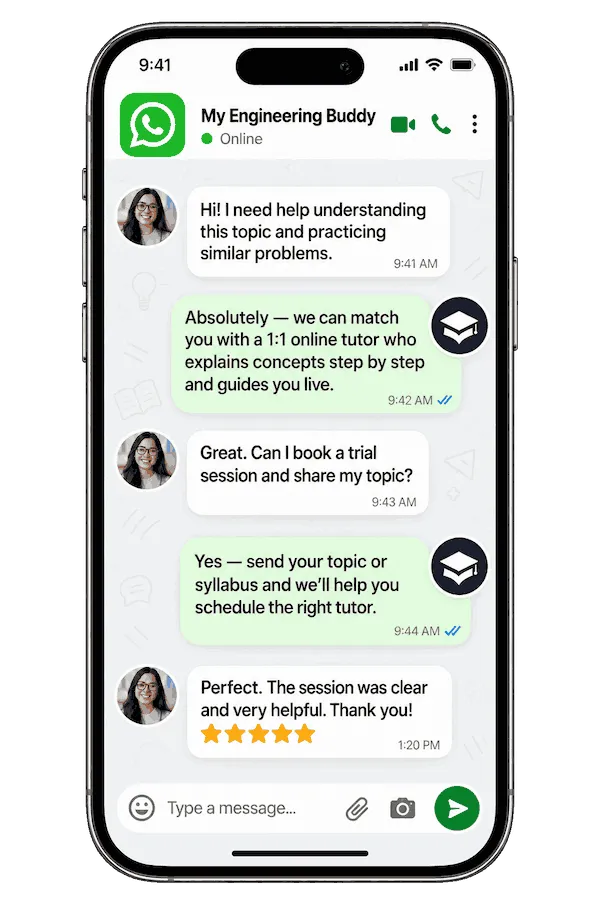
WhatsApp MEB for a quick quote — average response time under 1 minute.
52,000+ students across the US, UK, Canada, Australia, and the Gulf have used MEB since 2008 — including students in Software Engineering subjects like Anaconda, Jupyter Notebook tutoring, and Python.
Source: My Engineering Buddy, 2008–2025.
Who This Anaconda (Software) Tutoring Is For
If your Conda environment throws dependency errors the night before a submission, or your Jupyter kernel dies mid-analysis, you don’t need documentation — you need someone who can look at your setup and fix it with you, live.
- Undergraduate and graduate students in data science, bioinformatics, or computational science courses
- Students whose capstone or thesis project depends on a working Anaconda pipeline
- Students retaking a data science module after a failed first attempt, with environment issues still unresolved
- Researchers setting up reproducible Conda environments for the first time
- Professionals transitioning into data roles who need structured guidance on Anaconda workflows
- Students needing guided project support — getting Pandas, NumPy, or Scikit-learn to run correctly inside their environment
MEB tutors have worked with students from institutions including MIT, University of Toronto, University of Edinburgh, ETH Zurich, University of Melbourne, Carnegie Mellon, and Imperial College London — across data science, computer science, and engineering programmes.
At MEB, we’ve found that most Anaconda problems students bring to tutors aren’t conceptual — they’re environmental. A broken PATH variable or a mismatched Conda channel can waste six hours. A tutor who’s seen it before resolves it in twenty minutes.
1:1 Tutoring vs Self-Study vs AI vs YouTube vs Online Courses
Self-study works if you can interpret cryptic Conda error messages on your own. AI tools answer fast but can’t see your actual environment or trace the real conflict. YouTube covers installations well but stops when your specific package versions clash. Online courses teach the theory of Anaconda without touching your broken setup. 1:1 tutoring with MEB means a tutor looks at your actual environment, identifies the conflict — say, a NumPy/SciPy ABI mismatch or a broken base channel — and walks you through fixing it correctly, not just patching it temporarily.
Outcomes: What You’ll Be Able To Do in Anaconda (Software)
After working with an MEB Anaconda tutor online, you’ll be able to solve Conda dependency conflicts without brute-force reinstalling everything. You’ll apply virtual environment best practices — creating isolated envs per project, exporting environment.yml files, and sharing reproducible setups with collaborators. You’ll analyze data pipelines end-to-end inside Jupyter Notebook running inside a clean Anaconda environment. You’ll model the difference between Conda, pip, and Mamba and know when to use each. You’ll present project notebooks that run first time on any machine — not just yours.
Based on feedback from 40,000+ sessions collected by MEB from 2022 to 2025, students working 1:1 on Anaconda consistently report faster resolution of environment conflicts, clearer understanding of Conda’s package resolution logic, and greater confidence running end-to-end data science workflows without external help. Progress varies by starting level and project complexity.
Source: MEB session feedback data, 2022–2025.
Start with the $1 trial — 30 minutes of live project help that also doubles as your first diagnostic.
What We Cover in Anaconda (Software) (Syllabus / Topics)

Track 1: Environment Setup and Conda Package Management
- Installing Anaconda and Miniconda on Windows, macOS, and Linux
- Creating, activating, and deactivating Conda environments
- Managing channels: defaults, conda-forge, bioconda
- Resolving dependency conflicts and version pinning
- Exporting and importing
environment.ymlfor reproducibility - Mamba as a faster Conda alternative
- Updating and removing packages without breaking existing envs
Recommended references: Python for Data Analysis by Wes McKinney; Learning Anaconda by Dario Radecic; official arXiv Computer Science preprints for Conda-adjacent tooling research.
Track 2: Jupyter Notebook and JupyterLab Inside Anaconda
- Launching and configuring Jupyter Notebook from an Anaconda environment
- Kernel management — installing, switching, and restarting kernels
- Running Jupyter Notebook with custom environment kernels via ipykernel
- Notebook extensions and widgets (nbextensions, ipywidgets)
- Exporting notebooks to HTML, PDF, and script formats
- Debugging slow notebooks and memory-heavy cells
Recommended references: Jupyter Notebook for Data Science by Dan Toomey; Data Science from Scratch by Joel Grus.
Track 3: Data Science Workflows with Core Anaconda Libraries
- NumPy arrays — indexing, broadcasting, vectorised operations
- Pandas DataFrames — loading, cleaning, merging, groupby operations
- Matplotlib and Seaborn visualisations inside Jupyter
- Scikit-learn model training pipelines inside Conda environments
- Managing GPU-enabled environments for TensorFlow and PyTorch
- Connecting Anaconda environments to VS Code and PyCharm
Recommended references: Hands-On Machine Learning with Scikit-Learn, Keras, and TensorFlow by Aurélien Géron; Python Data Science Handbook by Jake VanderPlas.
Students consistently tell us that the moment Anaconda clicks is when they stop treating environments as a formality and start seeing them as the foundation every reliable project is built on. That shift takes one good session to establish.
Platforms, Tools & Textbooks We Support
Anaconda tutoring at MEB covers the full local and cloud-based toolkit that data science students actually use. Tutors are familiar with all of the following environments and can work within whichever setup your course requires.
- Anaconda Navigator (GUI-based environment management)
- Google Colab (cloud Jupyter alternative, often used alongside Anaconda)
- PyCharm with Conda interpreter configuration
- Visual Studio Code with Anaconda extension
- Kaggle Notebooks (for competition-oriented data science workflows)
- Miniconda (lightweight alternative for server and CI environments)
- Windows Subsystem for Linux (WSL2) with Conda
What a Typical Anaconda (Software) Session Looks Like
The tutor opens by checking where you left off — usually a specific error message or a stalled project task, such as a failing conda install or a kernel that won’t connect to your environment. From there, you and the tutor work through the problem together on screen: the tutor uses a digital pen-pad to annotate the terminal output, trace the dependency tree, or sketch out the environment architecture. You replicate each fix step by step in your own terminal — not just watching. The tutor asks you to explain what each command does before you run it. The session closes with a concrete next task: exporting your working environment.yml, testing the environment on a fresh directory, or tackling the next notebook cell — and the next topic is noted for session two.
How MEB Tutors Help You with Anaconda (Software) (The Learning Loop)
Diagnose: In the first session, the tutor asks you to share your terminal output, your current environment list, and the exact command that failed. Within ten minutes, the tutor identifies whether the issue is a channel conflict, a PATH misconfiguration, or a pip-inside-Conda collision — the three most common root causes.
Explain: The tutor walks through the fix live, using a digital pen-pad to annotate the dependency resolution graph or the Conda environment structure. No copy-pasting commands you don’t understand — every step is explained before it’s run.
Practice: You replicate the fix in your own terminal. Then the tutor introduces a second scenario — a deliberate conflict — so you solve it yourself while the tutor watches. This is where the understanding sticks.
Feedback: The tutor flags every shortcut that will cause problems later: using pip install inside a Conda environment without caution, not pinning versions in environment.yml, mixing base and project environments. These are the habits that cause the next failure.
Plan: The session ends with a clear next step — a specific task you complete before session two, whether that’s setting up a fresh project environment from scratch or getting Scikit-learn running cleanly inside your target env.
Sessions run on Google Meet. The tutor uses a digital pen-pad or iPad with Apple Pencil to annotate your shared screen. Before your first session, share the exact error message you’re seeing, your OS, and your Anaconda version. The first session covers environment diagnosis, at least one live fix, and a project plan for sessions ahead. Start with the $1 trial — 30 minutes of live Anaconda project help that also serves as your first diagnostic.
Tutor Match Criteria (How We Pick Your Tutor)
Match quality is the difference between a session that fixes the problem and one that creates three new ones.
Subject depth: Tutors are matched by their hands-on experience with Conda environments, data science pipelines, and the specific libraries your project uses — not just “Python tutor” generalists.
Tools: Every tutor uses Google Meet and a digital pen-pad or iPad with Apple Pencil — so annotation and live screen review are standard, not optional.
Time zone: Matched to your region — US, UK, Gulf, Canada, or Australia — so sessions happen when you actually need them.
Goals: Whether you need a one-off environment fix, structured project support over four weeks, or ongoing help through a data science semester, the tutor is matched to that scope.
Unlike platforms where you fill out a form and wait, MEB responds in under a minute, 24/7. Tutor match takes under an hour. The $1 trial means you test before you commit. Everything runs over WhatsApp — no logins, no intake forms.
Pricing Guide
Anaconda tutoring runs $20–$40/hr for most undergraduate and bootcamp-level project work. Graduate-level and research-grade environment work — Conda on HPC clusters, GPU environment configuration for deep learning, or large-scale pipeline debugging — reaches up to $100/hr.
Rate factors: your level, the complexity of the environment issue, how close your deadline is, and tutor availability. Availability is tightest in the two weeks before semester project deadlines.
For students building production-grade data science pipelines or targeting roles at companies with rigorous technical screens, tutors with professional data engineering or ML infrastructure backgrounds are available at higher rates — share your specific goal and MEB will match the tier to your ambition.
Start with the $1 trial — 30 minutes, no registration, no commitment. WhatsApp MEB for a quick quote.
MEB has served 52,000+ students since 2008 across data science, software engineering, and adjacent technical fields — with tutors rated 4.8/5 across 40,000+ verified reviews. Anaconda tutoring is part of that same verified network.
Source: My Engineering Buddy, 2008–2025.
FAQ
Is Anaconda hard to learn?
The concepts aren’t complex, but the error messages are. Dependency conflicts, channel mismatches, and broken PATH configurations trip up students who are otherwise strong programmers. Most students get unblocked within one or two sessions with a tutor who’s seen those errors before.
How many sessions will I need?
One session often resolves an acute environment problem. For students building a full data science workflow from scratch — environments, Jupyter, Pandas, and ML pipelines — four to eight sessions is typical. Your tutor sets a realistic plan after the diagnostic.
Can you help with projects and portfolio work?
MEB provides guided project support. The tutor explains the fix, the approach, and the reasoning — you implement it and submit your own work. MEB provides guided learning support. All project work is produced and submitted by the student. See our Policies page for details.
Will the tutor match my exact course or project stack?
Yes. Share your course outline, the libraries you’re using, and your OS when you book. MEB matches tutors to your specific stack — not just “data science” broadly. Tutors cover everything from base Anaconda setups to GPU-enabled PyTorch environments.
What happens in the first session?
The tutor reviews your environment setup, asks to see your current error or project brief, and runs a live diagnostic. By the end of the first session you’ll have at least one concrete fix applied and a clear plan for what follows.
Are online sessions as effective as in-person for something like Anaconda?
For software tools, online is often better. Screen sharing lets the tutor see your exact terminal output and file structure. The digital pen-pad allows live annotation. Most environment issues are faster to resolve when the tutor can see the real setup, not a description of it.
What’s the difference between Anaconda and Miniconda — and which should I use?
Anaconda ships with 1,500+ pre-installed packages and a GUI; Miniconda is a minimal installer — just Conda and Python. For coursework and data science projects, Anaconda is easier to start with. For servers, CI pipelines, or when disk space matters, Miniconda is more practical. Your tutor helps you choose based on your actual use case.
Can I get help with Conda vs pip conflicts inside my Anaconda environment?
This is one of the most common issues MEB tutors handle. Mixing pip and Conda in the same environment without care breaks package resolution. A tutor walks through exactly why the conflict occurred, how to audit your environment, and how to structure installs correctly going forward.
Can I get Anaconda help at midnight or on weekends?
Yes. MEB operates 24/7 and tutors are available across time zones — US, UK, Gulf, Australia. WhatsApp MEB at any hour and you’ll typically be matched within the hour. Project deadlines don’t keep business hours, and neither do we.
What if I don’t like my assigned tutor?
Say so — immediately. MEB replaces the tutor, no questions asked. The $1 trial is specifically designed to let you evaluate the match before spending more. If it’s not right, we fix it before your next session.
How do I get started?
Three steps: WhatsApp MEB, share your environment issue or project brief, and start your $1 trial — 30 minutes of live Anaconda tutoring or one problem explained in full. You’re matched and in session, usually within the hour. No forms. No waiting.
Do you offer group Anaconda tutoring sessions?
MEB specialises in 1:1 sessions — that’s the model. Group study has its place, but for environment debugging and project-specific help, individual sessions are almost always faster and more effective. Your tutor focuses entirely on your setup, not a shared one.
Trust & Quality at My Engineering Buddy
Every MEB tutor goes through subject-specific vetting — not a general teaching test. For Anaconda and data science tools, tutors demonstrate hands-on experience with Conda environment management, Jupyter configuration, and at least two of the core data science libraries before they’re approved. They complete a live demo session, and ongoing feedback from students is reviewed after every five sessions. Rated 4.8/5 across 40,000+ verified reviews on Google. Tutors hold degrees in computer science, data science, or closely related engineering disciplines — and many have professional experience in data engineering or ML infrastructure.
MEB provides guided learning support. All project work is produced and submitted by the student. For full details on what we help with and what we don’t, read our Academic Integrity policy and Why MEB.
MEB has been running since 2008 and now serves students across the US, UK, Canada, Australia, Gulf, and Europe in 2,800+ subjects. Within Software Engineering, that includes Docker tutoring, Kubernetes help, and Apache Spark tutoring alongside Anaconda — all covered by the same verified tutor network. See our tutoring methodology for how session structure and tutor accountability work.
Our experience across thousands of sessions shows that students who share their exact error output before the first session get roughly twice as much resolved in that opening hour. Preparation isn’t optional — it’s the first skill the tutor teaches.
Explore Related Subjects
Students studying Anaconda often also need support in:
Next Steps
Ready to fix the environment, finish the project, or build the workflow from scratch?
- Share your OS, Anaconda version, and the exact error or project goal
- Share your availability and time zone
- MEB matches you with a verified tutor — usually within the hour
- First session starts with a live diagnostic so no time is wasted
Before your first session, have ready: your course outline or project brief, the exact error message you’re seeing (paste it — don’t paraphrase it), and your deadline date. The tutor handles the rest.
Visit www.myengineeringbuddy.com for more on how MEB works.
WhatsApp to get started or email [email protected].
Reviewed by Subject Expert
This page has been carefully reviewed and validated by our subject expert to ensure accuracy and relevance.