

Hire Verified & Experienced
Affine Geometry Tutors
Email: [email protected]
4.8/5 40K+ session ratings collected on the MEB platform



Hire The Best Affine Geometry Tutor
Top Tutors, Top Grades. Without The Stress!
Most students who struggle with Affine Geometry hit the same wall: transformations look mechanical until the coordinate-free logic clicks — and that moment rarely comes from a textbook alone.
Affine Geometry Tutor Online
Affine geometry is a branch of geometry studying properties preserved under affine transformations — including parallelism, ratios of lengths, and collinearity — independent of distance or angle measurement, used across pure mathematics and computer graphics.
MEB provides 1:1 online tutoring and homework help in 2,800+ advanced subjects, including geometry tutoring across every major branch. Whether you’re searching for an Affine Geometry tutor near me or need structured help with a university module on affine spaces, MEB matches you with a verified specialist — usually within the hour. Sessions are live, diagnostic-first, and built around your exact course structure.
- 1:1 online sessions tailored to your module syllabus or course outline
- Expert verified tutors with subject-specific knowledge in affine and related geometries
- Flexible time zones — US, UK, Canada, Australia, Gulf
- Structured learning plan built after a diagnostic session
- Ethical homework and assignment guidance — you understand the work before you submit
How Much Does an Affine Geometry Tutor Cost?
Most Affine Geometry tutoring sessions run $20–$40/hr depending on level and topic depth. Graduate-level or research-support sessions can reach up to $100/hr. Not sure if it’s right for you? Start with the $1 trial — 30 minutes of live tutoring or one homework question explained in full, no registration required.
| Level / Need | Typical Rate | What’s Included |
|---|---|---|
| Standard (undergraduate) | $20–$35/hr | 1:1 sessions, homework guidance |
| Advanced / Graduate | $35–$100/hr | Expert tutor, research-level depth |
| $1 Trial | $1 flat | 30 min live session or 1 homework question |
Tutor availability tightens significantly during end-of-semester and finals periods. Book early if your exam or submission deadline is within four weeks.
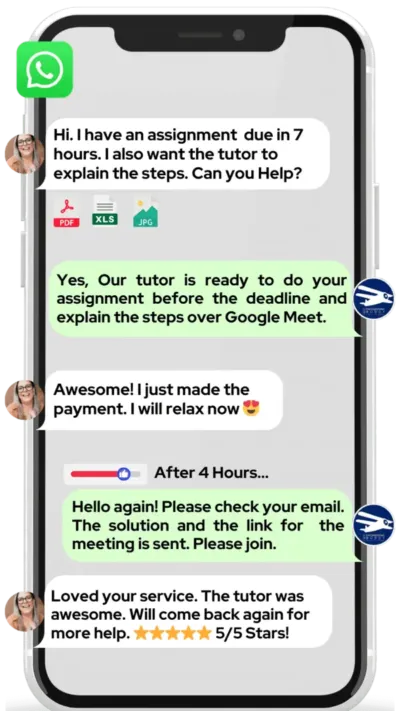
WhatsApp MEB for a quick quote — average response time under 1 minute.
52,000+ students across the US, UK, Canada, Australia, and the Gulf have used MEB since 2008 — including students in Geometry subjects like Affine Geometry, Projective Geometry, and Differential Geometry.
Source: My Engineering Buddy, 2008–2025.
Who This Affine Geometry Tutoring Is For
Affine Geometry sits at an awkward level in most mathematics programmes — abstract enough to demand rigorous proof writing, applied enough to appear in computer graphics, robotics, and optimization coursework. Students often arrive underprepared for that dual demand.
- Undergraduate and postgraduate mathematics students tackling affine spaces and transformations for the first time
- Computer science students needing affine geometry for graphics pipelines or computational geometry modules
- Students 4–6 weeks from an exam with significant gaps in affine maps, barycentric coordinates, or quotient spaces still to close
- Students retaking a module after a failed first attempt who need to rebuild from the foundations
- PhD candidates whose research in algebraic geometry or convex analysis requires a stronger affine geometry base
- Parents watching a child’s confidence drop alongside their grades in a proof-heavy mathematics course
MEB tutors have supported students at MIT, Cambridge, ETH Zürich, University of Toronto, University of Melbourne, NYU, and Imperial College London. If your programme covers affine subspaces, affine independence, or affine combinations, your tutor will know it.
At MEB, we’ve found that students who struggle with affine geometry usually haven’t got lost in the formulas — they’ve lost the geometric picture behind them. Rebuilding that picture in the first two sessions changes everything that follows.
1:1 Tutoring vs Self-Study vs AI vs YouTube vs Online Courses
Self-study works if you’re disciplined, but affine geometry proofs with no feedback loop let errors compound silently. AI tools give fast definitions of affine maps but can’t diagnose why your proof of the affine hull theorem keeps breaking down. YouTube covers the overview of affine transformations well and stops cold when you need to work through a specific barycentric coordinate problem. Online courses move at a fixed pace with no room for the question that’s actually blocking you. With MEB’s 1:1 Affine Geometry tutoring, the tutor sees exactly where the reasoning fails — and corrects it live, in the same session.
Outcomes: What You’ll Be Able To Do in Affine Geometry
After a structured run of sessions, students can solve problems involving affine combinations and independence without defaulting to coordinates. They can analyze affine maps and prove preservation of parallelism and ratio — not just recite the definition. Students learn to apply barycentric coordinates to locate centroids, medians, and intersection points in a clean, coordinate-free argument. They can explain the relationship between affine and Euclidean geometry clearly enough to answer the comparison questions that appear in exam papers and viva voce settings. They can present proofs about affine subspaces and affine hulls with the logical structure that earns full marks.
Supporting a student through Affine Geometry? MEB works directly with parents to set up sessions, track progress, and keep coursework on schedule. WhatsApp MEB — average response time is under a minute, 24/7.
Based on feedback from 40,000+ sessions collected by MEB from 2022 to 2025, 58% of students improved by one full grade after approximately 20 hours of 1:1 tutoring in subjects like Affine Geometry. A further 23% achieved at least a half-grade improvement.
Source: MEB session feedback data, 2022–2025.
Try your first session for $1 — 30 minutes of live 1:1 tutoring or one homework question explained in full. No registration. No commitment. WhatsApp MEB now and get matched within the hour.
What We Cover in Affine Geometry (Syllabus / Topics)

Foundations: Affine Spaces and Structures
- Definition of affine spaces — points, vectors, and the underlying field
- Affine combinations, affine independence, and affine hulls
- Affine subspaces: lines, planes, hyperplanes, and their intersections
- Barycentric coordinates and their use in locating points
- Relationship between affine spaces and vector spaces
- Affine frames and changes of affine frame
Core references: Geometry by Audin; Linear Algebra and Geometry by Kostrikin and Manin.
Affine Transformations and Maps
- Definition of affine maps and their matrix-vector representation
- Preservation properties: parallelism, collinearity, ratio of division
- Composition of affine transformations and invertibility
- Translations, dilations, and shears as special affine maps
- Fixed points, invariant subspaces, and classification of affine maps
- Affine isomorphisms and their role in Euclidean geometry tutoring comparisons
Core references: Affine and Projective Geometry by Bennett; Classical Geometry by Leonard, Lewis, Liu, and Tokarsky.
Advanced Topics: Convexity, Duality, and Applications
- Convex sets in affine spaces and their affine-geometric properties
- Affine duality and its connection to projective geometry help
- Affine varieties and the bridge to algebraic geometry
- Applications in computer graphics: homogeneous coordinates, perspective projection
- Affine geometry in optimization: feasible regions and linear programming geometry
- Introduction to computational geometry tutoring methods that rely on affine structure
Core references: Convex Analysis by Rockafellar; Ideals, Varieties, and Algorithms by Cox, Little, and O’Shea.
What a Typical Affine Geometry Session Looks Like
The tutor opens by checking the previous topic — usually barycentric coordinates or the proof structure from affine independence — to confirm what landed and what didn’t. Then the session moves into the current problem: student and tutor work through affine maps or affine subspace intersection problems on a shared screen, with the tutor using a digital pen-pad to annotate diagrams and write proofs step by step. The student replicates the argument or explains each line of reasoning aloud — the tutor stops the moment the logic slips. The session closes with a concrete practice set targeting the exact proof type or computation the student found hardest, and the next topic is noted so neither party arrives unprepared.
How MEB Tutors Help You with Affine Geometry (The Learning Loop)
Diagnose: In the first session, the tutor identifies whether the gap is definitional — a shaky understanding of what an affine space actually is — or procedural, such as errors in composing affine maps or misapplying barycentric coordinates in proofs.
Explain: The tutor works through live examples on a digital pen-pad — writing out the full affine combination argument, annotating the geometric picture, and making the coordinate-free reasoning visible step by step.
Practice: The student attempts the next problem with the tutor present. No skipping to the answer. The attempt itself is where the learning happens.
Feedback: Errors in proof structure, sign errors in affine map matrices, and logical gaps in affine hull arguments are corrected immediately — with a clear explanation of why the step failed and what the correct reasoning looks like.
Plan: At the end of each session, the tutor sets the next topic in sequence and notes any recurring error patterns to revisit. Students don’t arrive at the next session blind.
Sessions run on Google Meet with a digital pen-pad or iPad and Apple Pencil for live annotation. Before your first session, have your module outline or lecture notes ready, plus any problem sets or past papers you’ve attempted. The first session doubles as your diagnostic. Start with the $1 trial — 30 minutes of live tutoring that also serves as your first diagnostic. Whether you need a quick catch-up before an exam, structured revision over 4–8 weeks, or ongoing weekly support through the semester, the tutor maps the session plan after that first meeting.
Students consistently tell us that the moment affine geometry starts making sense is when they stop thinking of transformations as matrix operations and start seeing them as geometric actions. Our tutors build that shift deliberately — it doesn’t happen by accident.
Tutor Match Criteria (How We Pick Your Tutor)
Not every mathematics tutor knows affine geometry at the level your course demands. MEB matches on four criteria.
Subject depth: The tutor must have covered affine spaces, affine maps, and the relevant advanced topics at undergraduate level or beyond — not just linear algebra with a passing mention of affine transformations.
Tools: Every tutor uses Google Meet with a digital pen-pad or iPad and Apple Pencil. Visual proof-writing is non-negotiable for geometry.
Time zone: Matched to your region — US, UK, Gulf, Canada, or Australia — so sessions run at reasonable hours without early-morning compromises.
Goals: Whether you’re targeting exam scores, working through a specific proof-heavy assignment, or building a research foundation in algebraic geometry, the tutor is briefed on your aim before session one.
Unlike platforms where you fill out a form and wait, MEB responds in under a minute, 24/7. Tutor match takes under an hour. The $1 trial means you test before you commit. Everything runs over WhatsApp — no logins, no intake forms.
Pricing Guide
Affine Geometry tutoring starts at $20/hr for standard undergraduate modules. Graduate-level work, research support, or sessions requiring a tutor with algebraic geometry or advanced convexity background can reach $100/hr. Rate factors include your level, the complexity of the specific topics, your timeline, and tutor availability in your time zone.
For students targeting programmes at leading mathematics departments or research positions where affine and algebraic geometry foundations are essential, tutors with research backgrounds in pure mathematics or computational geometry are available at higher rates — share your specific goal and MEB will match the tier to your ambition.
Availability is limited during end-of-semester exam periods. Book as early as possible if your deadline is within four weeks.
Start with the $1 trial — 30 minutes, no registration, no commitment. WhatsApp MEB for a quick quote.
Affine geometry sits at the intersection of pure mathematics and applied computation — it’s the language of computer graphics transformations, optimization feasible regions, and the foundations of algebraic geometry. Getting it right opens doors on both sides.
Source: My Engineering Buddy, 2008–2025.
FAQ
Is Affine Geometry hard?
It’s abstract in a specific way — the shift from coordinates to coordinate-free reasoning trips most students. The concepts aren’t numerous, but the proof discipline required is high. Students who’ve done solid linear algebra cope faster; those without that base need more groundwork in the first two sessions.
How many sessions are needed?
For a module catch-up, most students see a clear improvement in 6–10 sessions of one hour each. Covering the full course from affine spaces through transformation classification to advanced topics typically takes 15–20 hours, depending on starting level and how often the student practices between sessions.
Can you help with homework and assignments?
MEB tutoring is guided learning — you understand the work, then submit it yourself. The tutor explains the relevant affine geometry theory, works through a comparable example, and checks your reasoning. See our Academic Integrity policy and Why MEB page for full details on what we help with and what we don’t.
Will the tutor match my exact syllabus or exam board?
Yes. Before the first session, share your module outline or course notes. Affine geometry is taught differently across pure mathematics, applied mathematics, and computer science programmes — the tutor is briefed on your exact curriculum so no session time is wasted on material you won’t be assessed on.
What happens in the first session?
The tutor runs a diagnostic — asking you to explain a recent topic or attempt a short problem — to locate the specific gap. That takes roughly 15 minutes. The remaining 45 minutes go into direct instruction on the most pressing topic. You leave with a practice task and a session plan for the weeks ahead.
Is online tutoring as effective as in-person?
For geometry subjects, the digital pen-pad and shared-screen setup is actually better than most in-person scenarios — the tutor can annotate diagrams, write proofs, and highlight errors in real time while you watch the reasoning build. Students across the US, UK, and Australia consistently report it as more efficient than face-to-face sessions.
What’s the difference between affine geometry and Euclidean geometry?
Euclidean geometry preserves distances, angles, and shapes. Affine geometry preserves only parallelism, collinearity, and ratios of lengths — not distances or angles. Every Euclidean transformation is an affine transformation, but not vice versa. Affine geometry is the more general framework; Euclidean geometry adds metric structure on top of it.
Does affine geometry come up in computer science or engineering courses?
Regularly. Affine transformations underpin 3D graphics pipelines, robotics kinematics, and image processing. Homogeneous coordinates — used in OpenGL and rendering engines — are directly affine-geometric. Engineering students who need help with these applications can get support from tutors who know both the mathematics and its computational implementation.
Can I get Affine Geometry help at midnight?
MEB operates 24/7. Message on WhatsApp at any hour and you’ll get a response within minutes. Tutor availability depends on time zone matching, but for major regions — US, UK, Australia, Gulf — there is almost always a tutor available within an hour, including late-night sessions before deadlines.
What if I don’t like my assigned tutor?
Request a switch immediately. MEB replaces tutors without question — no forms, no waiting period. The $1 trial exists precisely to test the match before you commit to a longer engagement. If the first session doesn’t feel right, say so on WhatsApp and a new tutor is lined up the same day.
How do I find an Affine Geometry tutor in my city?
You don’t need to. All MEB sessions are online via Google Meet, which means your location doesn’t limit your tutor options. Students in New York, London, Dubai, Sydney, and Toronto all access the same pool of verified Affine Geometry specialists. Time zone matching handles the rest.
How do I get started?
Three steps. First, WhatsApp MEB with your module details and exam date. Second, MEB matches you with a verified Affine Geometry tutor — usually within an hour. Third, your first session starts with the $1 trial — 30 minutes of live tutoring or one homework question explained fully, no commitment beyond that.
Trust & Quality at My Engineering Buddy
Every MEB tutor goes through subject-specific screening before their first session — including a live demo evaluation, degree and experience verification, and ongoing review of student feedback. Tutors covering Affine Geometry hold postgraduate qualifications in mathematics, computer science, or related fields, and are assessed on their ability to explain abstract proof-based material clearly. Rated 4.8/5 across 40,000+ verified reviews on Google.
MEB tutoring is guided learning — you understand the work, then submit it yourself. For full details on what we help with and what we don’t, read our Academic Integrity policy and Why MEB.
MEB has served 52,000+ students across the US, UK, Canada, Australia, the Gulf, and Europe since 2008, covering 2,800+ subjects. Within Geometry, MEB supports students in differential geometry tutoring, analytic geometry help, and non-Euclidean geometry tutoring — as well as Affine Geometry at all levels. See our tutoring methodology for how session structure is built.
Explore Related Subjects
Students studying Affine Geometry often also need support in:
Next Steps
Before your first session, have ready: your exam board and syllabus (or course outline), a recent past paper attempt or homework problem you struggled with, and your exam or deadline date. The tutor handles the rest.
- Share your module name, hardest topic, and current timeline
- Share your availability and time zone
- MEB matches you with a verified Affine Geometry tutor — usually within 24 hours
The first session starts with a diagnostic so every minute is used well. Visit www.myengineeringbuddy.com for more on how MEB works.
WhatsApp to get started or email [email protected].
A common pattern our tutors observe is that students underestimate how much of their later coursework in algebraic geometry, optimization, or graphics pipelines depends on a clean understanding of affine structure. The students who invest early don’t scramble later.
52,000+ Happy Students From Various Universities



How Much For Private 1:1 Tutoring & Hw Help?
Private 1:1 Tutoring and HW help Cost $20 – 35 per hour* on average.
Reviewed by Subject Expert
This page has been carefully reviewed and validated by our subject expert to ensure accuracy and relevance.

