Contact MEB Today To Get The Best
Certified in Financial Forensics (CFF®) Tutoring Online
Email: [email protected]



~1 min
Average Reply Time
~1 hour
To Be Matched With A Tutor
30 Min Trial
75% Find Their Tutor On The 1st Trial
$20-35+/hr
Premium Yet Affordable Learning
Most CFF® candidates don’t fail on accounting knowledge. They fail on the forensic application questions they’ve never practiced under pressure.
Certified in Financial Forensics (CFF®) Tutor Online
The Certified in Financial Forensics (CFF®) is a specialty credential awarded by the AICPA to CPAs who demonstrate expertise in forensic accounting — covering fraud investigation, bankruptcy analysis, economic damages, and litigation support. It equips holders to apply accounting skills in legal and investigative contexts.
If you’re searching for a Certified in Financial Forensics (CFF®) tutor near me, MEB’s 1:1 online CFF® tutoring connects you with verified experts who know the AICPA exam blueprint, the Forensic and Valuation Services body of knowledge, and the specific question types that catch candidates off guard. Sessions run live over Google Meet, structured around your weakest domains. You understand the material. You sit the exam ready.
- 1:1 online sessions tailored to your CFF® exam domain and current gap areas
- Verified tutors with forensic accounting, litigation support, or fraud examination backgrounds
- Flexible scheduling across US, UK, Canada, Australia, and Gulf time zones
- Structured learning plan built after a first-session diagnostic
- Ethical homework and assignment guidance — you understand the work before you submit it
52,000+ students across the US, UK, Canada, Australia, and the Gulf have used MEB since 2008 — across 2,800+ subjects, from AP Calculus to A Level Music Technology to Data Science.
Source: My Engineering Buddy, 2008–2025.
How Much Does a Certified in Financial Forensics (CFF®) Tutor Cost?
CFF® tutoring at MEB starts at $20/hr for foundational domain review, with specialist forensic accounting tutors available up to $100/hr for advanced litigation support, damages quantification, or intensive exam-week preparation. A $1 trial gets you 30 minutes of live tutoring or one full question worked through with explanation — plain text, no link needed to get started.
Availability tightens in the weeks before AICPA testing windows. Book early if you have a fixed exam date.
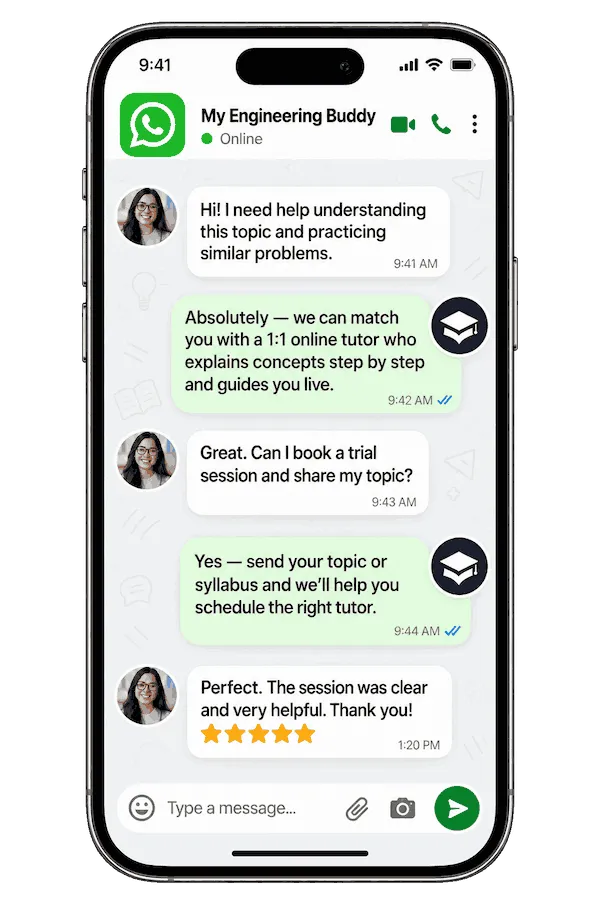
WhatsApp MEB for a quick quote — average response time under 1 minute.
Who This Certified in Financial Forensics (CFF®) Tutoring Is For
CFF® tutoring at MEB works for CPA candidates adding a forensic specialty, practicing accountants preparing for the credential exam, and professionals moving into litigation support or fraud advisory roles. If you passed the CPA but the forensic domains feel like a different language, that’s exactly the gap a tutor addresses.
- CPA holders studying for the CFF® credential exam for the first time
- Candidates who sat the CFF® exam once and need targeted help on specific domains before their next attempt
- Candidates with a firm promotion, role change, or client engagement contingent on passing the CFF® — where the stakes are career-level, not just academic
- Forensic accounting professionals wanting to fill gaps in economic damages or bankruptcy analysis
- Accounting students at universities such as NYU, the University of Toronto, LSE, UNSW, or Erasmus preparing for post-qualification forensic pathways
- Academic staff or administrators needing support building or reviewing forensic accounting curriculum
1:1 Tutoring vs Self-Study vs AI Tools
Self-study works for motivated candidates, but the CFF® exam tests applied judgment — and when you’re working through a fraud scheme scenario alone, there’s no one to tell you your reasoning is close but legally wrong. AI tools can define “economic damages” or summarize the Daubert standard, but they cannot watch you work through a business interruption calculation, spot where your methodology breaks down, and correct it in real time. The CFF® specifically tests how you connect accounting evidence to a legal conclusion — that kind of feedback requires a qualified human. MEB tutoring gives you the online flexibility of self-study with the structured correction loop that accelerates actual exam readiness. Ratings and GARP’s risk and finance professional standards both confirm that applied credentials improve pass rates when candidates practice with expert feedback, not just reading materials.
Outcomes: What You’ll Be Able To Do in Certified in Financial Forensics (CFF®)
After structured CFF® tutoring, you’ll be able to analyze a set of financial records and identify fraud indicators using the fraud risk framework tested in the AICPA blueprint. You’ll apply economic damages methodologies to business interruption and lost profits scenarios with the precision the exam demands. You’ll explain the legal standards that govern expert witness testimony — Daubert, FRE 702 — and how they constrain an accountant’s report. You’ll present a defensible forensic accounting conclusion that connects the numbers to a litigation theory. You’ll solve bankruptcy and insolvency questions under the specific asset and liability frameworks the CFF® exam tests.
Based on feedback from 40,000+ sessions collected by MEB from 2022 to 2025, 58% of students improved by one full grade after approximately 20 hours of 1:1 tutoring in a single subject. A further 23% achieved at least a half-grade improvement.
Source: MEB session feedback data, 2022–2025.
What We Cover in Certified in Financial Forensics (CFF®) (Syllabus / Topics)

| Exam Domain | Description | Approx. Weighting |
|---|---|---|
| Professional Responsibilities & Practice Management | Ethics, engagement standards, expert witness obligations | Varies by blueprint version |
| Fraud Prevention, Detection & Response | Fraud schemes, risk assessment, investigative procedures | Varies by blueprint version |
| Litigation Support & Dispute Resolution | Expert testimony, discovery support, damages quantification | Varies by blueprint version |
| Bankruptcy, Insolvency & Reorganisation | Asset tracing, fraudulent transfers, trustee reporting | Varies by blueprint version |
| Economic Damages | Lost profits, business interruption, personal injury valuations | Varies by blueprint version |
Domain 1: Fraud Prevention, Detection and Response
- Fraud risk assessment frameworks and red flag identification
- Asset misappropriation schemes: skimming, larceny, payroll fraud
- Financial statement fraud: revenue manipulation, improper disclosures
- Interview techniques and behavioral indicators in fraud investigations
- Digital evidence collection and chain of custody principles
- Internal controls review and control environment assessment
- Advanced auditing techniques applied to forensic engagements
Core texts include Albrecht et al.’s Fraud Examination (5th ed.) and the ACFE’s Report to the Nations as supplementary reference for current fraud statistics and scheme typologies.
Domain 2: Litigation Support, Damages and Bankruptcy
- Economic damages methodologies: before-and-after, yardstick, market approaches
- Business interruption loss calculation and indemnity period analysis
- Expert witness standards: Daubert, Kumho Tire, FRE 702
- Bankruptcy and insolvency accounting: fraudulent conveyance, preference payments
- Asset tracing across complex ownership structures
- Bankruptcy and insolvency accounting as a standalone discipline
- Forensic report writing: structure, defensibility, opposing expert considerations
Recommended texts include Financial Forensics Body of Knowledge by Darrell Dorrell and Gregory Gadawski, and Shannon Pratt’s Valuing a Business for damages valuation context.
Domain 3: Professional Responsibilities and Valuation Context
- AICPA standards for forensic and valuation services (SSVS No. 1)
- Engagement letters, scope limitations, and independence in forensic work
- Business valuation approaches relevant to forensic engagements
- Marital dissolution and shareholder dispute quantification
- Financial statement analysis in litigation contexts
- Cross-examination preparation and rebuttal report strategy
The AICPA’s Forensic and Valuation Services Practice Aid series and the CFF Exam Preparation Guide published by the AICPA are the primary study references for this domain.
At MEB, we’ve found that CFF® candidates who can explain the logic behind a damages calculation — not just follow a formula — consistently perform better on the applied judgment questions that determine pass or fail in the forensic accounting exam.
What a Typical Certified in Financial Forensics (CFF®) Session Looks Like
The tutor opens by checking your work on the previous session’s topic — usually a specific area like economic damages calculation or fraud scheme classification. From there, you and the tutor work through a practice exam scenario on screen: the tutor annotates live with a digital pen-pad, showing exactly how a forensic accountant connects financial evidence to a legal conclusion. You then attempt a parallel problem yourself while the tutor watches your reasoning, not just your answer. If your methodology for a lost profits calculation is wrong in a way that would cost marks, the tutor catches it at step two, not after you’ve submitted. The session closes with a concrete practice task — two more damages scenarios or a fraud interview write-up — and the next topic is locked in before you disconnect.
How MEB Tutors Help You with Certified in Financial Forensics (CFF®) (The Learning Loop)
Diagnose: In the first session, the tutor maps your current CFF® knowledge against the AICPA exam blueprint, identifying which domains you’ve covered, which you’ve misunderstood, and where you’re losing marks on practice questions. This shapes every session that follows.
Explain: The tutor works through live examples — a business interruption calculation, a fraudulent transfer analysis, an expert report structure — using a digital pen-pad so you can follow each step. No slides. No pre-recorded explanations you half-watch.
Practice: You attempt the next problem with the tutor present. The goal isn’t to get it right the first time. The goal is to expose the reasoning gaps while someone qualified is there to catch them.
Feedback: The tutor gives step-by-step correction — specifically why a particular damages methodology was wrong, or why your fraud risk conclusion wouldn’t hold under cross-examination. That’s the feedback loop that recorded lectures don’t provide.
Plan: At the end of each session, the tutor notes what you’ve consolidated and what comes next. Progress is tracked across sessions so no domain is left unreviewed before your exam date.
Sessions run over Google Meet. The tutor uses a digital pen-pad or iPad with Apple Pencil for annotated problem-solving. Before your first session, send your current practice exam scores by domain and your exam date. The first session covers diagnostic gap analysis and begins the highest-priority domain immediately. Whether you need a quick catch-up before an exam, structured revision over 4–8 weeks, or ongoing weekly support through the exam cycle, the tutor maps the session plan after the first diagnostic.
Start with the $1 trial — 30 minutes of live tutoring that also serves as your first diagnostic.
Try your first session for $1 — 30 minutes of live 1:1 tutoring or one homework question explained in full. No registration. No commitment. WhatsApp MEB now and get matched within the hour.
Tutor Match Criteria (How We Pick Your Tutor)
Not every accountant knows forensic work. Not every forensic accountant knows the CFF® exam. MEB matches on both.
Subject depth: Tutors hold CPA credentials with forensic accounting specialization, fraud examination experience (CFE or equivalent), or professional backgrounds in litigation support, economic damages, or bankruptcy advisory. They know the AICPA FVS body of knowledge, not just general accounting.
Tools: All sessions run over Google Meet. Tutors use a digital pen-pad or iPad with Apple Pencil to annotate calculations and annotated forensic reports in real time.
Time zone: MEB covers all US time zones (New York, Chicago, Los Angeles), UK, Dubai, Toronto, Sydney, Melbourne, and major European centres — evenings and weekends included.
Learning style: Calibrated from the first session diagnostic — some candidates need methodology drilling, others need exam technique and question management under timed conditions.
Communication: Tutors explain in clear English, adapted to your existing accounting foundation. No jargon introduced before the concept is grounded.
Goals: Whether you’re targeting exam passage, building practical forensic skills for client work, or filling specific domain gaps, the tutor is matched to that aim — not assigned generically.
Unlike platforms where you fill out a form and wait, MEB responds in under a minute, 24/7. Tutor match takes under an hour. The $1 trial means you test before you commit. Everything runs over WhatsApp — no logins, no intake forms.
Source: My Engineering Buddy, 2008–2025.
Pricing Guide
CFF® tutoring rates at MEB run $20–$40/hr for standard domain review and exam preparation. Specialist tutors with litigation support or expert witness professional backgrounds are available up to $100/hr — share your specific forensic focus area and MEB matches the tier to what the work actually requires.
Rate factors include domain complexity, your timeline to exam, and tutor specialization. Availability in the weeks before AICPA testing windows is limited — this is not a warning, it’s accurate.
For candidates targeting senior forensic accounting roles at Big Four firms, boutique litigation consultancies, or in-house positions at major financial institutions, tutors with direct professional experience in those environments are available at higher rates.
Start with the $1 trial — 30 minutes, no registration, no commitment. WhatsApp MEB for a quick quote.
FAQ
Is the CFF® exam hard?
The CFF® is considered demanding because it tests applied forensic judgment, not just accounting recall. Candidates with strong CPA foundations still find the litigation support and economic damages domains challenging. Most candidates report that the applied scenario questions require specific preparation beyond standard accounting study.
How many sessions will I need?
Most CFF® candidates need between 10 and 25 sessions depending on domain gaps and their exam timeline. Candidates close to their exam date with one or two weak domains often see meaningful improvement in 6–10 targeted sessions. The first diagnostic determines the specific number.
Can you help with CFF® exam assignments and homework?
Yes. MEB tutors guide you through forensic accounting problems, practice scenarios, and exam-style questions — explaining methodology so you understand and can apply it yourself. MEB tutoring is guided learning — you understand the work, then submit it yourself. For full details on what we help with and what we don’t, read our Academic Integrity policy and Why MEB.
Will the tutor match my exact CFF® exam domain and syllabus?
Yes. MEB matches tutors to the AICPA CFF® exam blueprint specifically — not generic forensic accounting or auditing. If you’re weak in a particular domain, that’s what the tutor focuses on. Bring your practice exam results and the tutor builds from there.
What happens in the first session?
The tutor runs a diagnostic: reviewing your current exam scores by domain, identifying where your methodology breaks down, and establishing which topics need the most work before your exam date. The second half of the first session begins that highest-priority domain immediately.
Is online CFF® tutoring as effective as in-person?
For a credential like the CFF® — which involves annotated calculations, forensic report review, and structured question practice — the digital pen-pad and screen-sharing format used in MEB sessions replicates in-person work closely. Most candidates find no meaningful difference in learning quality.
Can I get CFF® help late at night or on weekends?
Yes. MEB operates 24/7 across all major time zones. US candidates on Pacific or Eastern time, UK and Gulf candidates, and Australian candidates all find sessions available evenings and weekends. WhatsApp MEB to check tutor availability for your specific time slot.
What if I don’t get on with my assigned tutor?
Request a change on WhatsApp. MEB re-matches without fees, delays, or intake forms. Most re-matches happen within the hour. The $1 trial is specifically designed so you assess fit before committing to a block of sessions.
Do you offer group CFF® study sessions?
MEB specializes in 1:1 sessions. Group sessions are not offered — the diagnostic-led, domain-specific approach that makes CFF® preparation effective requires individual attention that group formats cannot replicate for a credential this specialized.
How do I get started with CFF® tutoring?
Three steps: WhatsApp MEB with your exam date and weakest domains, get matched to a verified CFF®-specialist tutor within the hour, then start the $1 trial — 30 minutes of live tutoring that doubles as your first diagnostic session. No registration. No commitment first.
Trust & Quality at My Engineering Buddy
MEB has operated since 2008 and served 52,000+ students across the US, UK, Canada, Australia, the Gulf, and Europe. Every tutor goes through subject-specific screening: a live demo session evaluated against the relevant exam blueprint or professional standard, verified credentials, and ongoing review based on student feedback. Rated 4.8/5 across 40,000+ verified reviews on Google. For CFF® tutors, that means confirmed CPA status, demonstrable forensic accounting or litigation support experience, and tested ability to explain methodology — not just solve problems. See the Financial Conduct Authority’s guidance on financial professional standards as one benchmark for the rigor MEB applies in vetting finance-specialist tutors.
MEB tutoring is guided learning — you understand the work, then submit it yourself. For full details on what we help with and what we don’t, read our Academic Integrity policy and Why MEB.
MEB covers 2,800+ subjects from introductory accounting to advanced forensic and valuation specialisms. If you’re also working on related areas alongside your CFF® preparation, MEB offers auditing tutoring, financial analysis help, and support for the Certified Internal Auditor (CIA) exam — all from verified subject specialists.
Students consistently tell us that the biggest shift in their CFF® preparation came when they stopped reading about fraud schemes and started working through live case scenarios with someone who could push back on their reasoning. That’s what the sessions are built to do.
Explore Related Subjects
Students studying the CFF® often also need support in:
- Advanced Auditing Techniques
- Financial Accounting
- Corporate Governance
- Accounting Ethics
- Certified Management Accountant (CMA)
- Financial Reporting
- Internal Auditing
Next Steps
Before your first session, have ready: your AICPA CFF® exam domain scores or practice test results, a recent practice question or scenario you struggled with, and your exam date or target window. The tutor handles the rest.
- Share your weakest CFF® domains and your exam timeline
- Share your time zone and preferred session times
- MEB matches you with a verified CFF® specialist — usually within the hour
The first session opens with a full diagnostic so every minute is used on what actually moves your score. Visit www.myengineeringbuddy.com for more on how MEB structures exam credential preparation.
WhatsApp to get started or email [email protected].
Reviewed by Subject Expert
This page has been carefully reviewed and validated by our subject expert to ensure accuracy and relevance.