

Contact MEB Today To Get The Best
Bankruptcy and Insolvency Accounting Tutoring Online
Email: [email protected]



~1 min
Average Reply Time
~1 hour
To Be Matched With A Tutor
30 Min Trial
75% Find Their Tutor On The 1st Trial
$20-35+/hr
Premium Yet Affordable Learning
Distress analysis tripped you up. The reorganization plan made no sense. Your examiner’s comments filled half the margin.
Bankruptcy and Insolvency Accounting Tutor Online
Bankruptcy and Insolvency Accounting covers the financial reporting, valuation, and legal accounting procedures applied when an entity becomes insolvent or enters formal bankruptcy proceedings. It equips students to analyze distressed financial statements, apply relevant accounting standards, and support restructuring decisions under frameworks such as US GAAP and IFRS.
Finding a Bankruptcy and Insolvency Accounting tutor near me used to mean settling for a generalist who had never read a Chapter 11 reorganization plan. MEB connects you with a verified specialist — someone who knows debtor-in-possession financing, fresh-start accounting, and proof-of-claim schedules — from $20/hr. Sessions are online, structured, and built around your exact course or exam board. You understand the material before anything gets submitted.
- 1:1 online sessions matched to your syllabus, course outline, or exam specification
- Expert verified tutors with subject-specific knowledge in distressed accounting and restructuring
- Flexible time zones — US, UK, Canada, Australia, Gulf, Europe
- Structured learning plan built after a diagnostic session
- Ethical homework and assignment guidance — you understand the work before you submit it
52,000+ students across the US, UK, Canada, Australia, and the Gulf have used MEB since 2008 — across 2,800+ subjects, from AP Calculus to A Level Music Technology to Data Science.
Source: My Engineering Buddy, 2008–2025.
How Much Does a Bankruptcy and Insolvency Accounting Tutor Cost?
Most students pay $20–$40/hr for 1:1 online Bankruptcy and Insolvency Accounting tutoring. Graduate and specialist sessions — covering areas like cross-border insolvency or forensic claim analysis — run up to $100/hr. There is also a $1 trial: 30 minutes of live tutoring or a full explanation of one homework question.
| Level / Need | Typical Rate | What’s Included |
|---|---|---|
| Undergraduate (most levels) | $20–$35/hr | 1:1 sessions, homework guidance |
| Graduate / Specialist (insolvency law, forensic) | $35–$100/hr | Expert tutor, niche topic depth |
| $1 Trial | $1 flat | 30 min live session or 1 HW question |
Tutor availability tightens around end-of-semester exam periods. Book early if your deadline is within four weeks.
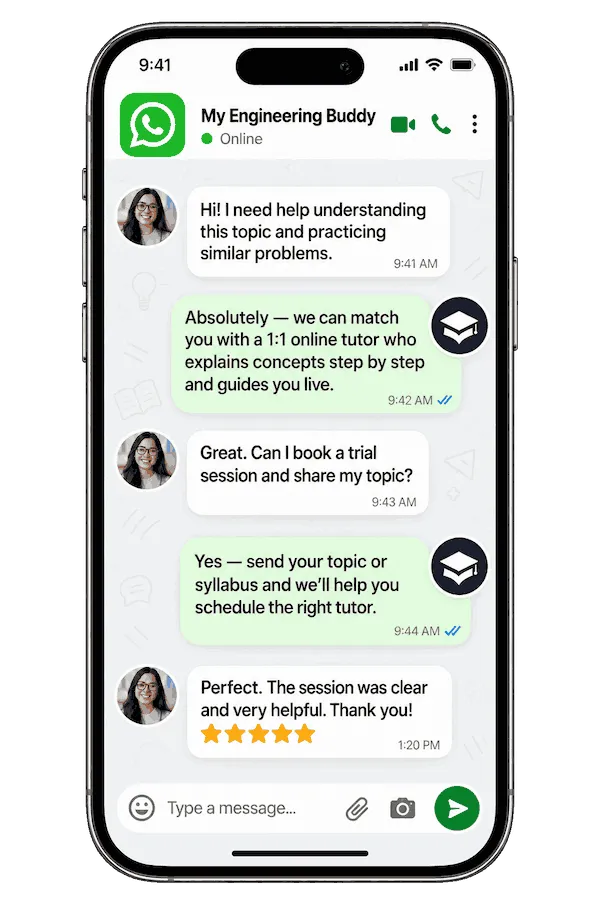
WhatsApp MEB for a quick quote — average response time under 1 minute.
Who This Bankruptcy and Insolvency Accounting Tutoring Is For
This is for students who can follow a standard income statement but lose the thread the moment a company files for protection or enters administration. If distressed-entity accounting feels like a different language, a specialist tutor cuts through it fast.
- Undergraduate accounting and finance students whose course module covers insolvency and restructuring
- Graduate students working through advanced financial reporting or corporate distress coursework
- Students retaking an exam after a failed first attempt in financial accounting or corporate law electives
- CFF or CMA candidates whose exam blueprint includes distressed-entity sections
- Students at universities such as NYU Stern, Warwick Business School, Melbourne Business School, Queen’s University (Canada), and IE Business School who need specialist support outside standard office hours
- Anyone with a coursework or assignment submission deadline within the next two to four weeks and significant gaps still to close
1:1 Tutoring vs Self-Study vs AI Tools
Self-study with a textbook works for foundational accounting, but insolvency accounting involves judgment calls — when to apply fresh-start reporting, how to value claims under a plan of reorganization — that a textbook cannot adapt to your specific misunderstanding. AI tools can define debtor-in-possession financing quickly, but they cannot watch you attempt a distressed balance sheet restatement, catch where your priority-of-claims logic breaks down, and correct it in real time. That live annotation step — tutor marking up your working line by line — is where the actual learning happens in this subject. MEB gives you online flexibility with that structured feedback loop, calibrated to your exact course materials and exam format.
Outcomes: What You’ll Be Able To Do in Bankruptcy and Insolvency Accounting
After targeted 1:1 sessions, you will be able to apply fresh-start accounting entries when an entity emerges from Chapter 11, analyze a debtor-in-possession balance sheet and identify which liabilities sit above and below the line of impairment, explain the order of priority in a liquidation waterfall with reference to specific claim classes, present a restructured set of financial statements that reflects a confirmed reorganization plan, and solve exam problems on cross-border insolvency recognition under IFRS 5 and related standards. These are not general accounting skills — they are the specific outputs your examiner or course rubric is looking for.
Supporting a student through Bankruptcy and Insolvency Accounting? MEB works directly with parents to set up sessions, track progress, and keep coursework on schedule. WhatsApp MEB — average response time is under a minute, 24/7.
Based on feedback from 40,000+ sessions collected by MEB from 2022 to 2025, 58% of students improved by one full grade after approximately 20 hours of 1:1 tutoring in a single subject. A further 23% achieved at least a half-grade improvement.
Source: MEB session feedback data, 2022–2025.
What We Cover in Bankruptcy and Insolvency Accounting (Syllabus / Topics)

Track 1: Financial Reporting for Distressed Entities
- Going-concern assessment and disclosure requirements under US GAAP and IFRS
- Fresh-start reporting: recognition criteria, asset revaluation, and reorganization value
- Debtor-in-possession (DIP) accounting — classification of pre- and post-petition liabilities
- Statement of financial affairs and schedules of assets and liabilities
- ASC 852 — Reorganizations: scope, application, and journal entries
- Impairment testing on distressed asset portfolios
- Disclosure requirements for entities in or emerging from bankruptcy proceedings
Core texts for this track include Bankruptcy and Insolvency Accounting by Grant Newton (Wiley) and relevant FASB ASC 852 guidance documents.
Track 2: Liquidation, Claims, and Creditor Accounting
- Statement of affairs under liquidation basis — asset realization values vs. book values
- Priority of claims: secured, administrative, priority unsecured, and general unsecured
- Proof-of-claim schedules and reconciliation with the debtor’s books
- Trustee accounting and reporting — receipts, disbursements, and final account
- Preferences, fraudulent transfers, and their accounting implications
- Cross-border insolvency recognition and accounting under IFRS 5 and Chapter 15
Recommended texts include Financial Distress, Restructuring, and Corporate Turnaround by Stuart Gilson (Harvard Business Press) and INSOL International technical papers.
Track 3: Restructuring Plans and Valuation in Distress
- Enterprise valuation of distressed firms — income, market, and asset approaches
- Debt-for-equity swap accounting and dilution effects on existing shareholders
- Plan of reorganization: financial projections, feasibility analysis, and confirmation accounting
- Cram-down provisions and their effect on creditor class accounting
- Exit financing — accounting for new debt instruments on emergence
- Post-confirmation reporting and compliance under court-supervised plans
Students at this level frequently reference Corporate Financial Distress, Restructuring, and Bankruptcy by Altman, Hotchkiss, and Wang (Wiley) alongside SSRN working papers on distressed debt accounting — a useful resource available at SSRN Finance and Accounting.
What a Typical Bankruptcy and Insolvency Accounting Session Looks Like
The tutor opens by checking where you left off — usually the going-concern disclosure you drafted or the DIP liability classification exercise from the previous session. From there, you and the tutor work through a specific problem on screen: say, a fresh-start revaluation entry where you have misclassified reorganization value, or a priority waterfall where your ordering of administrative claims is off. The tutor uses a digital pen-pad to annotate your working in real time — showing exactly where the logic breaks and what the correct journal entry looks like. You then replicate the correction yourself, explaining your reasoning aloud. The session closes with a concrete practice problem set around the next topic — typically plan-of-reorganization projections or cross-border recognition — noted and ready for next time.
How MEB Tutors Help You with Bankruptcy and Insolvency Accounting (The Learning Loop)
Diagnose: In the first session, the tutor reviews a past paper attempt, a failed assignment, or a specific problem you have brought. The goal is to pinpoint exactly where the gap sits — whether it is the conceptual trigger for fresh-start accounting or the mechanics of claim prioritization — before any teaching begins.
Explain: The tutor works through a live example on screen using a digital pen-pad — annotating every step of a reorganization journal entry or a distressed valuation model. No lecture slides. Real problems, worked in full.
Practice: You attempt the next problem while the tutor is present. This is where most self-study fails — students skip this step and discover the gap only in the exam.
Feedback: The tutor goes through your attempt step by step. Every error gets a reason — not just “this is wrong” but specifically why the claim classification fails or why the fresh-start entry does not balance.
Plan: Each session ends with a clear next topic and a short task. Progress is tracked. If a topic needs revisiting, it comes back before you move on.
Sessions run on Google Meet with a digital pen-pad or iPad and Apple Pencil for annotation. Before your first session, share your course outline or exam board specification and any recent work you struggled with. The first session starts with the diagnostic — so every subsequent minute is used on the right material. Start with the $1 trial — 30 minutes of live tutoring that also serves as your first diagnostic.
Try your first session for $1 — 30 minutes of live 1:1 tutoring or one homework question explained in full. No registration. No commitment. WhatsApp MEB now and get matched within the hour.
Tutor Match Criteria (How We Pick Your Tutor)
Not every accounting tutor has read a Chapter 11 filing. Here is what MEB checks before matching you.
Subject depth: The tutor must have demonstrable knowledge of insolvency accounting specifically — not just general financial reporting. That means familiarity with ASC 852, IFRS 5, or the equivalent framework your course uses, at the level your syllabus requires.
Tools: All sessions use Google Meet with a digital pen-pad or iPad and Apple Pencil. Annotation is live — your working, marked up in real time.
Time zone: Tutors cover New York, Los Angeles, Chicago, London, Dubai, Toronto, Sydney, Melbourne — and all standard US, UK, Gulf, Canadian, Australian, and European time zones, including evenings and weekends.
Learning style: Calibrated from the first session. Some students need heavy worked examples first; others need to attempt the problem before any explanation lands. The tutor adjusts after session one.
Communication: Clear English, adapted to the student’s level. No jargon without explanation.
Goals: Exam score, homework completion, conceptual depth for dissertation research, or professional exam preparation — the tutor is briefed on your specific target before you meet.
Unlike platforms where you fill out a form and wait, MEB responds in under a minute, 24/7. Tutor match takes under an hour. The $1 trial means you test before you commit. Everything runs over WhatsApp — no logins, no intake forms.
Study Plans (Pick One That Matches Your Goal)
If you have one to three weeks before a submission or exam, the tutor focuses immediately on your highest-priority gaps — typically fresh-start accounting or claim prioritization — and builds a tight daily practice sequence. For a four-to-eight week exam prep block, sessions follow a structured topic-by-topic progression through the full syllabus with past-paper practice built in from week three. Ongoing weekly support runs in parallel with your semester schedule, aligned to assignment deadlines and module assessments. The tutor maps the exact sequence after the first diagnostic session.
Pricing Guide
Standard undergraduate Bankruptcy and Insolvency Accounting tutoring runs $20–$40/hr. Graduate-level work — covering distressed valuation models, cross-border insolvency, or forensic claim analysis — is priced at $40–$100/hr depending on topic complexity, tutor availability, and how quickly you need to start.
Rate factors include the level of the course, how niche the topic is, your timeline, and when you book. Availability tightens significantly in the four weeks before end-of-semester exams.
For students targeting roles in restructuring advisory, forensic accounting, or insolvency practice at firms where technical accounting depth matters, tutors with professional restructuring or CFF backgrounds are available at higher rates — share your specific goal and MEB will match the right tier.
Start with the $1 trial — 30 minutes, no registration, no commitment. WhatsApp MEB for a quick quote.
FAQ
Is Bankruptcy and Insolvency Accounting hard?
It is genuinely difficult for most students. The subject combines accounting standards, legal frameworks, and valuation judgment in ways that standard financial accounting courses do not prepare you for. Fresh-start reporting and claim prioritization are the two areas where students most commonly lose marks.
How many sessions are needed?
Most students covering one module or exam topic see clear improvement within six to ten hours of focused 1:1 work. Students with broader gaps — covering the full insolvency accounting syllabus from scratch — typically need fifteen to twenty hours spread across four to eight weeks.
Can you help with homework and assignments?
Yes. MEB tutors explain the concepts and methods so you can complete the work yourself. The tutor walks through the reasoning — you produce and submit the answer. MEB tutoring is guided learning — you understand the work, then submit it yourself. For full details on what we help with and what we don’t, read our Academic Integrity policy and Why MEB.
Will the tutor match my exact syllabus or exam board?
Yes. Before matching, MEB reviews your course outline, exam specification, or module guide. Tutors are selected for familiarity with the specific framework — ASC 852, IFRS 5, or a professional exam blueprint — not just general insolvency knowledge.
What happens in the first session?
The tutor runs a short diagnostic — reviewing a past paper attempt, a recent assignment, or a problem you bring. This identifies the exact gaps before any teaching starts. You leave the first session with a clear topic sequence and a concrete practice task for before the next meeting.
Is online tutoring as effective as in-person?
For accounting subjects, yes — often more so. The digital pen-pad annotation on Google Meet replicates exactly what a whiteboard does in person. Students can share their own working on screen for the tutor to mark up in real time, which most in-person sessions do not do efficiently.
Can I get Bankruptcy and Insolvency Accounting help at midnight?
MEB operates across all major time zones — US, UK, Gulf, Australia, Canada, Europe — with tutors available for evening and weekend sessions. WhatsApp MEB at any hour and you typically get a response within a minute. Sessions can be booked for the same day in most cases.
What if I do not get on with my assigned tutor?
Tell MEB on WhatsApp after the trial session. The match is changed immediately — no forms, no delay, no charge for the swap. The $1 trial exists precisely so you can test the fit before committing to a block of sessions.
Do you offer group Bankruptcy and Insolvency Accounting sessions?
MEB specialises in 1:1 sessions. Two students from the same course who want to book together can arrange a shared session — message MEB on WhatsApp to discuss. The rate and structure are adjusted to reflect the group format.
How do I get started?
Three steps: WhatsApp MEB with your course details and exam date, get matched with a verified tutor — usually within the hour — then start the $1 trial. Thirty minutes of live tutoring or one full homework question explained. No registration required.
Trust & Quality at My Engineering Buddy
Every MEB tutor goes through subject-specific screening — a live demo session, a review of their academic and professional background, and ongoing feedback checks after every ten sessions. Tutors covering Bankruptcy and Insolvency Accounting hold degrees in accounting, finance, or law with demonstrable coursework or professional experience in distressed-entity work. Rated 4.8/5 across 40,000+ verified reviews on Google.
MEB has been operating since 2008 and has served 52,000+ students across the US, UK, Canada, Australia, the Gulf, and Europe — across 2,800+ subjects. If you need advanced auditing techniques tutoring, financial statement analysis help, or CFF exam tutoring, the same matching process applies. Visit www.myengineeringbuddy.com to see the full subject list.
MEB tutoring is guided learning — you understand the work, then submit it yourself. For full details on what we help with and what we don’t, read our Academic Integrity policy and Why MEB.
MEB covers 2,800+ advanced subjects — from consolidation accounting tutoring to corporate taxation help — with verified tutors across every major time zone.
Source: My Engineering Buddy, 2008–2025.
At MEB, we’ve found that students who bring one specific problem to the first session — a misunderstood journal entry, a failed assignment question — make faster progress than those who ask for a general overview. Specificity is what makes a 30-minute diagnostic session worth three hours of re-reading the textbook.
Explore Related Subjects
Students studying Bankruptcy and Insolvency Accounting often also need support in:
- Advanced Accounting
- Financial Accounting
- Corporate Governance
- Auditing
- International Financial Reporting Standards (IFRS)
- Tax Law
- Cash Flow Analysis
Next Steps
Before your first session, have ready:
- Your exam board or course outline — even a module guide or syllabus PDF
- A recent past paper attempt or homework question you struggled with
- Your exam date or assignment deadline
Share your availability and time zone when you message. MEB matches you with a verified Bankruptcy and Insolvency Accounting tutor — usually within 24 hours, often within the hour. The first session starts with a diagnostic so no time is wasted on topics you already have under control.
Visit www.myengineeringbuddy.com for more on how the MEB process works.
WhatsApp to get started or email [email protected].
Students consistently tell us that the biggest shift happens not when the tutor explains fresh-start accounting for the first time — but when the student works through the second problem alone and gets it right. That moment of independent accuracy is what we build every session toward.
Reviewed by Subject Expert
This page has been carefully reviewed and validated by our subject expert to ensure accuracy and relevance.




