




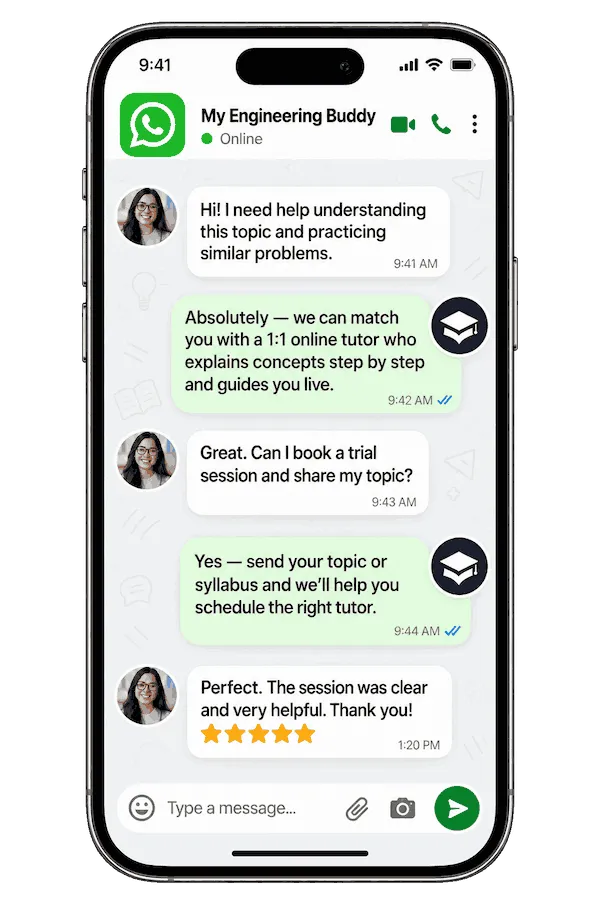
~1 min
Average Reply Time
~1 hour
To Be Matched With A Tutor
30 Min Trial
75% Find Their Tutor On The 1st Trial
$20-35+/hr
Premium Yet Affordable Learning
Most accounting ethics students don’t fail because they can’t argue a position — they fail because they apply the right framework to the wrong scenario.
Accounting Ethics Tutor Online
Accounting ethics is the study of moral principles, professional codes, and regulatory standards — including GAAP, IFRS, and AICPA guidelines — that govern honest financial reporting and accountant conduct. An accounting ethics tutor helps students apply these frameworks to real case scenarios and assessment questions.
MEB offers 1:1 online tutoring and homework help across 2,800+ advanced subjects. If you’ve searched for an accounting ethics tutor near me, MEB’s verified tutors work with you live, across every time zone, on the exact cases and frameworks your course uses. Sessions are flexible, structured, and built around where you actually are — not a generic syllabus overview.
- 1:1 online sessions tailored to your course syllabus and exam board
- Expert verified tutors with accounting and business ethics backgrounds
- Flexible time zones — US, UK, Canada, Australia, Gulf
- Structured learning plan built after a diagnostic session
- Ethical homework and assignment guidance — you understand before you submit
52,000+ students across the US, UK, Canada, Australia, and the Gulf have used MEB since 2008 — across 2,800+ subjects, from AP Calculus to A Level Music Technology to Data Science.
Source: My Engineering Buddy, 2008–2025.
How Much Does an Accounting Ethics Tutor Cost?
Most accounting ethics tutoring sessions run $20–$40/hr. Advanced coursework, CPA exam ethics components, or specialist case-study support can run higher. The $1 trial gets you 30 minutes of live tutoring or one assignment question explained in full — no registration needed.
| Level / Need | Typical Rate | What’s Included |
|---|---|---|
| Standard (most undergrad levels) | $20–$35/hr | 1:1 sessions, case analysis, homework guidance |
| Advanced / CPA or CMA Ethics | $35–$70/hr | Expert tutor, professional code depth, scenario work |
| $1 Trial | $1 flat | 30 min live session or one homework question explained |
Tutor availability gets tight in November and April — peak exam periods for most business and accounting programmes. Book early if your deadline is within six weeks.
WhatsApp MEB for a quick quote — average response time under 1 minute.
Who This Accounting Ethics Tutoring Is For
Accounting ethics appears at every level of business education — and it catches students off guard more often than any technical accounting topic. If the concepts feel abstract or the case questions feel unpredictable, you’re not alone.
- Undergraduate accounting or business students working through professional codes and CSR frameworks
- Students sitting CPA, CMA, or CIA exams where an ethics component is tested separately
- Graduate students writing ethics-heavy essays or dissertation chapters on corporate governance and financial fraud
- Students with a university conditional offer at risk — if a borderline grade in this module is the deciding factor, targeted sessions matter now, not next week
- Students at universities including the University of Toronto, University of Melbourne, University of Amsterdam, King’s College London, and NYU Stern who need support matched to their specific course structure
- Parents supporting a student who has a case study assignment due and isn’t sure where to start
1:1 Tutoring vs Self-Study vs AI Tools
Self-study works for building background knowledge, but accounting ethics is almost entirely scenario-dependent — without feedback, you can memorise frameworks and still apply them incorrectly in every case question. AI tools can explain the AICPA Code of Professional Conduct or outline stakeholder theory clearly, but they cannot watch you reason through a whistleblowing scenario in real time, catch the moment you conflate deontological and consequentialist reasoning, and correct it before it costs marks. That real-time diagnostic is where a 1:1 financial accounting tutor or accounting ethics specialist makes the difference. MEB combines the flexibility of online sessions with a structured feedback loop — calibrated to your exact course, not a generic ethics survey.
Outcomes: What You’ll Be Able To Do in Accounting Ethics
After structured 1:1 accounting ethics tutoring, you’ll be able to apply the AICPA or IFAC codes to independence and conflict-of-interest scenarios with confidence. You’ll analyze a corporate fraud case — like earnings manipulation or auditor collusion — and identify the specific ethical breach and its regulatory consequence. You’ll write a structured ethics essay that moves cleanly from stakeholder identification to duty-based reasoning to recommendation. Explain how CSR reporting obligations interact with IFRS disclosure rules. Present a reasoned position on a whistleblower protection case without losing marks to vague generalisation. These are specific, assessable skills — not abstract outcomes.
Based on feedback from 40,000+ sessions collected by MEB from 2022 to 2025, 58% of students improved by one full grade after approximately 20 hours of 1:1 tutoring in a single subject. A further 23% achieved at least a half-grade improvement.
Source: MEB session feedback data, 2022–2025.
Supporting a student through accounting ethics? MEB works directly with parents to set up sessions, track progress, and keep coursework on schedule. WhatsApp MEB — average response time is under a minute, 24/7.
What We Cover in Accounting Ethics (Syllabus / Topics)
< >
>
Professional Codes and Standards
- AICPA Code of Professional Conduct — independence, objectivity, integrity
- IFAC International Ethics Standards Board for Accountants (IESBA) framework
- Confidentiality obligations and when they are legally overridden
- Auditor independence rules — financial interests, family relationships, employment
- Threats and safeguards model for professional judgement
- Disciplinary consequences and regulatory enforcement mechanisms
Key texts include Ethics in Accounting by Gordon Klein and the AICPA Professional Standards handbook. The Nobel Prize in Economics archive offers useful context on incentive structures that underpin many ethics cases.
Corporate Governance and Financial Fraud
- Board structures, audit committees, and the role of the external auditor
- Earnings management vs. fraudulent financial reporting — where the line sits
- Case analysis: Enron, WorldCom, Wirecard — what failed and why
- Sarbanes-Oxley Act (SOX) provisions and their effect on audit culture
- Whistleblower protections under Dodd-Frank and equivalent international frameworks
- ESG reporting obligations and their ethical dimensions
- Bribery and corruption — FCPA and UK Bribery Act in accounting contexts
Recommended reading includes Financial Shenanigans by Howard Schilit and Corporate Governance by Robert Monks and Nell Minow. Students working on corporate governance tutoring often pair it with this track.
Ethical Frameworks Applied to Accounting Decisions
- Utilitarianism, deontology, and virtue ethics — applied to financial reporting decisions
- Stakeholder theory vs. shareholder primacy in practice
- Social contract theory and professional accountability
- Ethical reasoning models — Tucker’s 5-question framework, Rest’s four-component model
- CSR and sustainability accounting — reporting standards and ethical obligations
- Resolving conflicts between employer pressure and professional duty
Texts include Business Ethics: Ethical Decision Making and Cases by Ferrell, Fraedrich and Ferrell, and Ethics and the Conduct of Business by John Boatright. Students also benefit from auditing tutoring when this track intersects with audit independence questions.
At MEB, we’ve found that students who struggle with accounting ethics case questions aren’t missing knowledge — they’re missing a repeatable reasoning structure. Once a tutor installs that structure in a few live sessions, the same student who was getting 50% on case scenarios starts hitting 70%+ consistently.
What a Typical Accounting Ethics Session Looks Like
The tutor opens by checking what happened in the previous session — usually a specific case question or framework, like the IESBA threats-and-safeguards model. From there, the student and tutor work through a live scenario on screen: the tutor annotates the case text using a digital pen-pad, marking up stakeholder relationships and flagging where the ethical breach occurs. The student then works through the reasoning aloud — identifying duties, consequences, and the applicable code provision — while the tutor listens and redirects when the argument drifts. A concrete practice question is set before the session ends, and the next topic — often moving from independence rules to fraud detection — is noted so both parties arrive prepared.
How MEB Tutors Help You with Accounting Ethics (The Learning Loop)
Diagnose: In the first session, the tutor asks you to work through one past exam case question unprompted. This reveals exactly where your reasoning breaks — whether you’re skipping stakeholder identification, misapplying the AICPA code, or confusing ethical frameworks.
Explain: The tutor works through the same question live on a digital pen-pad, annotating each reasoning step — duty identification, conflict assessment, code reference, recommendation. You see the full thought process, not just the answer.
Practice: You attempt a parallel case while the tutor watches. No interrupting mid-reasoning — the tutor waits until you’ve committed to an argument, then identifies precisely where it holds and where it doesn’t.
Feedback: Every error is traced to its source. If you lost marks for missing an independence threat, the tutor shows you the exact IESBA provision and rebuilds that reasoning step from scratch.
Plan: Each session ends with a written summary of what was covered, what improved, and what gets worked on next — so progress is visible and not just felt.
Sessions run on Google Meet. Tutors use a digital pen-pad or iPad with Apple Pencil to annotate case texts and reasoning maps in real time. Before your first session, share your course outline and one case question you’ve attempted and struggled with. Start with the $1 trial — 30 minutes of live tutoring that also serves as your first diagnostic.
Students consistently tell us that accounting ethics feels different from every other accounting paper — less about calculation, more about argument. Our tutors treat it that way: the session is a structured debate with evidence, not a lecture on rules.
Tutor Match Criteria (How We Pick Your Tutor)
Every accounting ethics tutor match is built around your specific course — not a general ethics background.
Subject depth: Tutors hold degrees in accounting, finance, or business ethics and have demonstrable knowledge of the specific framework your course uses — AICPA, IESBA, or IFAC, depending on your programme and region.
Tools: All sessions run on Google Meet with digital pen-pad or iPad and Apple Pencil annotation. No specialist software required — just a stable connection and your course materials.
Time zone: MEB tutors cover New York, Los Angeles, Chicago, London, Dubai, Toronto, Sydney, and Melbourne — evenings and weekends included across all major US, UK, Gulf, Canadian, Australian, and European time zones.
Learning style: Whether you process best by arguing out loud, reading annotated examples, or working through structured templates, the tutor calibrates the approach from session one.
Communication: Clear English, adapted to your level — no jargon without explanation, no assumption that you already know what the tutor knows.
Goals: Whether you need to pass one ethics assignment, raise a borderline module grade, or prepare for the CPA ethics examination, the match reflects that specific target.
Unlike platforms where you fill out a form and wait, MEB responds in under a minute, 24/7. Tutor match takes under an hour. The $1 trial means you test before you commit. Everything runs over WhatsApp — no logins, no intake forms.
Study Plans (Pick One That Matches Your Goal)
Students come to accounting ethics tutoring at different points. A catch-up plan (one to three weeks) focuses on the highest-yield case frameworks and gets you through the most common exam scenarios fast. An exam prep plan (four to eight weeks) covers the full syllabus systematically, with regular timed case practice and feedback. Weekly support runs through the semester, aligned to your assignment deadlines and lecture schedule. After the first diagnostic session, the tutor builds the specific sequence — no generic revision plan.
Pricing Guide
Accounting ethics tutoring starts at $20/hr for standard undergraduate coursework. Graduate-level support, CPA exam ethics modules, or sessions requiring deep regulatory knowledge run $35–$100/hr depending on tutor expertise and the complexity of the material.
Rate factors include your level of study, the specific exam or assignment you’re preparing for, how quickly you need sessions, and tutor availability. Rates are confirmed before the first session — no surprises.
For students targeting top-tier graduate programmes or CPA licensure, tutors with professional practice or academic research backgrounds are available at higher rates. Share your specific goal and MEB matches the tier to your target.
Slots fill fast in November and April. Don’t leave it to the week before. Start with the $1 trial — 30 minutes, no registration, no commitment. WhatsApp MEB for a quick quote.
FAQ
Is accounting ethics hard?
It depends on the student. Technical accounting students often find the shift to argumentation and ethical reasoning unfamiliar. The frameworks are learnable, but applying them correctly to unseen case scenarios takes structured practice — which is exactly what 1:1 tutoring addresses.
How many sessions are needed to see improvement?
Most students notice sharper case reasoning within three to five sessions. Sustained grade improvement — moving a full band — typically takes eight to twelve sessions of focused, feedback-driven work. The diagnostic session clarifies this for your specific situation.
Can you help with homework and assignments?
Yes. MEB tutors work through the concepts and reasoning with you so you understand the material fully before you write anything yourself. MEB tutoring is guided learning — you understand the work, then submit it yourself. For full details on what we help with and what we don’t, read our Academic Integrity policy and Why MEB.
Will the tutor match my exact syllabus or exam board?
Yes. When you message MEB, share your course name, institution, and the specific frameworks or codes your syllabus references. The tutor match is built around that — not a generic accounting ethics overview. This applies whether your course uses AICPA, IESBA, or a regional professional standard.
What happens in the first session?
The tutor runs a short diagnostic — usually one unprompted case question — to see where your reasoning currently sits. From that, they map what needs work, in what order, and how quickly. The rest of the session addresses your most urgent gap immediately.
Is online accounting ethics tutoring as effective as in-person?
For case-based reasoning and essay structure work, yes. The tutor’s digital pen-pad annotation is often clearer than a whiteboard. The ability to share your assignment text on screen in real time makes the session more targeted than most in-person alternatives.
Can I get accounting ethics help at midnight or on weekends?
Yes. MEB operates 24/7 across all major time zones. Message via WhatsApp at any hour and expect a response within minutes. Tutors across US, UK, Gulf, Australian, and European time zones mean there is almost always someone available immediately, including late nights before a deadline.
What if I don’t get on with my assigned tutor?
Tell MEB. A replacement tutor is matched within the hour. There is no formal process, no form to fill out — just a WhatsApp message. The goal is a working session, not an administrative procedure. Most re-matches happen before the next scheduled slot.
Do you cover the ethics components of professional exams like the CPA or CMA?
Yes. The CPA ethics examination, CMA professional standards section, and CIA ethics components are all supported. Share which exam and which ethics module you’re targeting — the tutor match reflects the exact regulatory framework and question style that exam uses.
How do I get started?
Message MEB on WhatsApp with your course name and what you need help with. You get matched with a verified accounting ethics tutor — usually within an hour. The $1 trial covers 30 minutes of live tutoring or one full homework question explained. No registration. No commitment.
Trust & Quality at My Engineering Buddy
Every MEB tutor goes through subject-specific vetting — not a general interview. For accounting ethics, that means demonstrating knowledge of the AICPA Code, IESBA framework, and corporate governance case analysis before they work with any student. Tutors hold degrees in accounting, finance, or business, and many have professional practice backgrounds in audit or compliance. Performance is reviewed continuously through session feedback. Rated 4.8/5 across 40,000+ verified reviews on Google.
MEB has served 52,000+ students across 2,800+ subjects since 2008. Tutoring methodology is built around a five-stage learning loop — diagnose, explain, practice, feedback, plan — applied consistently across every subject and every level.
Source: MEB Tutoring Methodology.
MEB tutoring is guided learning — you understand the work, then submit it yourself. For full details on what we help with and what we don’t, read our Academic Integrity policy and Why MEB.
A common pattern our tutors observe is that students who arrive with the right answer but the wrong reasoning fail the next case question anyway. Marking what is correct isn’t enough — the tutor has to mark why it’s correct, and that’s what every MEB session is built around.
MEB is a platform serving students in the US, UK, Canada, Australia, the Gulf, and across Europe in 2,800+ subjects since 2008. Whether you need advanced auditing techniques tutoring, financial reporting help, or managerial accounting tutoring, the same matching and delivery process applies.
Explore Related Subjects
Students studying accounting ethics often also need support in:
- Auditing
- Corporate Governance
- Financial Accounting
- Internal Auditing
- Financial Reporting
- Advanced Auditing Techniques
- Generally Accepted Accounting Principles (GAAP)
Next Steps
Getting started takes one message. Before your first session, have ready:
- Your course name, institution, and the specific framework or exam component you’re working on
- A recent case question or assignment you attempted and struggled with
- Your exam date or assignment deadline, and your availability by time zone
MEB matches you with a verified accounting ethics tutor — usually within 24 hours, often faster. The first session starts with a diagnostic so every minute is spent on what actually needs fixing.
Visit www.myengineeringbuddy.com for more on how the MEB process works, from matching to ongoing sessions.
WhatsApp to get started or email [email protected].
Reviewed by Subject Expert
This page has been carefully reviewed and validated by our subject expert to ensure accuracy and relevance.




