~1 min
Average Reply Time
~1 hour
To Be Matched With A Tutor
30 Min Trial
75% Find Their Tutor On The 1st Trial
$20-35+/hr
Premium Yet Affordable Learning
Hire The Best Firebase Tutor



Your Firebase project compiles. It runs locally. Then you push to production and Firestore returns permission-denied on every read — and you’ve been staring at security rules for three hours.
Firebase Tutor Online
Firebase is a Google-backed platform offering real-time databases, cloud storage, authentication, and serverless hosting. It equips developers to build and scale web and mobile applications without managing server infrastructure.
MEB’s 1:1 online tutoring and project help covers 2,800+ advanced subjects — including Firebase and the wider software engineering stack. If you’re searching for a Firebase tutor near me, MEB works across every time zone: US, UK, Canada, Australia, and the Gulf. One diagnostic session. One tutor who knows Firestore security rules, Cloud Functions cold starts, and Flutter-Firebase integration — not just the introductory docs.
- 1:1 online sessions tailored to your project, course, or deployment goal
- Expert-vetted tutors with hands-on Firebase and Google Cloud experience
- Flexible time zones — US, UK, Canada, Australia, Gulf
- Structured learning plan built after a diagnostic session
- Guided project support — we explain every decision, you build and ship
52,000+ students across the US, UK, Canada, Australia, and the Gulf have used MEB since 2008 — including students working on software engineering subjects like Firebase, Flutter, and Google Cloud Platform.
Source: My Engineering Buddy, 2008–2025.
How Much Does a Firebase Tutor Cost?
Most Firebase tutoring sessions run $20–$40/hr. Advanced topics — Firestore at scale, custom auth flows, Cloud Functions with Pub/Sub triggers — may reach $60–$100/hr depending on tutor depth and timeline. The $1 trial gets you 30 minutes of live 1:1 help or a full explanation of one project problem, no registration required.
| Level / Need | Typical Rate | What’s Included |
|---|---|---|
| Standard (most levels) | $20–$40/hr | 1:1 sessions, project guidance |
| Advanced / Specialist | $40–$100/hr | Expert tutor, niche depth |
| $1 Trial | $1 flat | 30 min live session or 1 project Q |
Tutor availability tightens fast around capstone deadlines and semester-end sprints. Book early if you have a hard submission date.
WhatsApp MEB for a quick quote — average response time under 1 minute.
Who This Firebase Tutoring Is For
Firebase looks approachable until something breaks in production. Most students hit a wall at security rules, real-time listener performance, or wiring up Cloud Functions — and the official docs don’t explain the why behind any of it.
- Undergraduate and graduate students building Firebase-backed capstone or final-year projects
- Students with a project submission deadline in the next 2–4 weeks and unresolved integration errors
- Students retaking a course after a failed first attempt who need to close specific Firebase gaps before the next assessment
- Bootcamp graduates who can follow tutorials but struggle to architect a real app from scratch
- Developers at companies including those placing engineers at Google, Meta, and Shopify who need Firebase-specific depth before a technical interview
- Students using Firebase within broader app development or full-stack courses at institutions across the US, UK, Canada, and Australia
If you’ve ever pushed a working local app to Firebase Hosting and watched it fail silently in production, this is for you. Start with the $1 trial — it also functions as your first diagnostic.
1:1 Tutoring vs Self-Study vs AI vs YouTube vs Online Courses
Self-study works if you can debug your own blind spots — most people can’t. AI tools give fast answers but can’t watch you implement and catch where your mental model breaks. YouTube covers setup and basics, then stops when your Firestore query returns empty for a reason specific to your data structure. Online courses give you the Firebase feature tour at a fixed pace with no room for your actual project. 1:1 tutoring with MEB is live, built around your codebase, and corrects mistakes the moment they’re made — not after you’ve shipped broken auth logic to 500 users.
Outcomes: What You’ll Be Able To Do in Firebase
After working with a Firebase tutor online through MEB, you’ll be able to model Firestore collections and documents for real query performance rather than just data storage. You’ll write security rules that actually reflect your app’s access logic — not rules copied from Stack Overflow that pass reads but block writes in edge cases. Apply Cloud Functions triggers to handle background tasks like email notifications and Stripe webhooks without blocking your client. Explain Firebase Authentication flows — including federated identity, custom tokens, and session handling — well enough to defend your architecture in a code review or viva. Present a deployed Firebase project with live data, working auth, and monitoring through the Google Cloud console.
Based on feedback from 40,000+ sessions collected by MEB from 2022 to 2025, 58% of students improved by one full grade after approximately 20 hours of 1:1 tutoring in subjects like Firebase. A further 23% achieved at least a half-grade improvement.
Source: MEB session feedback data, 2022–2025.
Try your first session for $1 — 30 minutes of live 1:1 tutoring or one project problem explained in full. No registration. No commitment. WhatsApp MEB now and get matched within the hour.
What We Cover in Firebase (Topics)

Firebase Core Services
- Firestore data modelling — collections, documents, subcollections, and query design
- Realtime Database vs Firestore — when to use each and why
- Firebase Authentication — email/password, Google OAuth, custom tokens, anonymous auth
- Firebase Hosting — deployment pipeline, custom domains, caching headers
- Firebase Storage — upload rules, download URLs, resumable uploads
- Security rules for Firestore and Storage — role-based access, validation logic
- Firebase Remote Config and A/B testing setup
Recommended references: Firebase documentation (Google), “Firebase in Action” by David Hoyt, “Programming Firebase” by Nik Bühler.
Cloud Functions and Backend Logic
- HTTP-triggered Cloud Functions — writing, deploying, and debugging
- Firestore triggers — onCreate, onUpdate, onDelete handlers
- Pub/Sub messaging with Firebase and Google Cloud
- Callable functions vs HTTP functions — choosing the right pattern
- Cold start latency — causes and mitigation strategies
- Environment variables, secrets management with Secret Manager
- Unit testing Cloud Functions with the Firebase Emulator Suite
Recommended references: Google Cloud Functions documentation, “Cloud Native Patterns” by Cornelia Davis, Firebase Emulator Suite official guides.
Firebase with Frontend and Mobile Frameworks
- Firebase SDK integration with React, Vue.js, and Angular
- Firebase with Flutter — FlutterFire plugins, StreamBuilder patterns
- Firebase with Android — Kotlin SDK setup, Crashlytics, Analytics
- Real-time listeners — onSnapshot, unsubscribe patterns, memory leak prevention
- Offline persistence in Firestore and Realtime Database
- Firebase Performance Monitoring — traces, custom metrics
Recommended references: FlutterFire documentation, “React and Firebase” tutorials via Firebase docs, Android Firebase SDK release notes.
Platforms, Tools & Textbooks We Support
Firebase development spans several tools your tutor will work with directly in session. Sessions run over Google Meet with screen sharing so your tutor can see your actual console errors, not a sanitised description of them.
- Firebase Console (all service dashboards)
- Firebase Emulator Suite (local testing environment)
- Google Cloud Console (IAM, Secret Manager, Pub/Sub, billing)
- Visual Studio Code with Firebase extensions
- Postman (testing Cloud Functions HTTP endpoints)
- GitHub and Git (version control for Firebase projects)
- Node.js and npm (Cloud Functions runtime environment)
What a Typical Firebase Session Looks Like
The tutor opens by checking where you left off — usually a specific Firestore security rule or a Cloud Function that’s deploying but not triggering as expected. You share your screen. They pull up the same Firebase Console alongside you and walk through your data structure document by document. When the query logic is wrong, they don’t just tell you — they rewrite it on a digital pen-pad, explain exactly which index is missing and why, then have you replicate the fix in your own code. If you’re working on Flutter with Firebase, they’ll trace the StreamBuilder lifecycle until the data flow makes sense. Session closes with one concrete task — write the security rule for the admin role, test it in the Emulator, then run the same test against production before the next session.
How MEB Tutors Help You with Firebase (The Learning Loop)
Diagnose: The first session maps exactly where you’re stuck — whether that’s Firestore data modelling, broken auth state, or a Cloud Function that times out under load. The tutor identifies which gaps are conceptual and which are just syntax.
Explain: The tutor works through live problems on a digital pen-pad — walking through a Firestore security rule line by line, or tracing a Firebase Auth token lifecycle from sign-in to Firestore read permission. No copy-paste explanations.
Practice: You attempt the next problem while the tutor watches. This is where most online courses fail — they never see you try. The tutor catches the misunderstanding before it becomes a pattern.
Feedback: Every error gets a specific explanation. Not “that’s wrong” — but “your rule allows reads on any document because you’re checking request.auth != null at the collection level instead of the document level.” That precision is what changes how you write code.
Plan: Each session ends with a named next topic and a task you complete before the following session. Progress is tracked so you’re never revisiting ground you’ve already covered.
Sessions run over Google Meet. Tutors use a digital pen-pad or iPad with Apple Pencil to annotate code and diagrams in real time. Before your first session, share your project repo link or paste the relevant code sections, your Firebase Console error logs, and your project deadline. The first session covers diagnostics and closes a specific, named gap — you’ll leave knowing exactly what to fix and how. Start with the $1 trial — 30 minutes of live Firebase tutoring that also serves as your first diagnostic.
At MEB, we’ve found that the biggest Firebase mistakes aren’t syntax errors — they’re data modelling decisions made in the first hour that create permission nightmares three weeks later. A tutor who catches that in session one saves days of debugging.
Tutor Match Criteria (How We Pick Your Tutor)
Not every developer who knows Firebase is the right tutor for your project.
Subject depth: MEB matches on your specific use case — Flutter-Firebase, React-Firebase, Cloud Functions architecture, or security rule design — not just “Firebase” as a category.
Tools: Every tutor uses Google Meet with screen sharing plus a digital pen-pad or iPad and Apple Pencil for annotating code and diagrams live.
Time zone: Matched to your region — US, UK, Gulf, Canada, or Australia — so sessions don’t require anyone to work at 3am.
Goals: Whether you need to pass a course assessment, ship a capstone project, or prep for a technical interview, the tutor is matched to that specific outcome — not assigned generically.
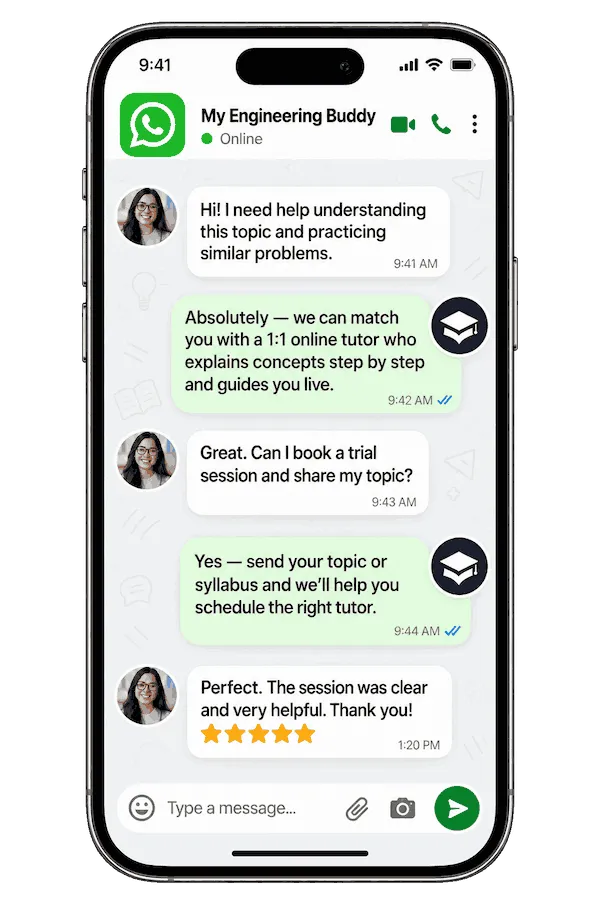
Unlike platforms where you fill out a form and wait, MEB responds in under a minute, 24/7. Tutor match takes under an hour. The $1 trial means you test the match before you commit. Everything runs over WhatsApp — no logins, no intake forms.
MEB has been matching students to expert tutors since 2008 — across full-stack development, cloud architecture, and Firebase specifically. Rated 4.8/5 across 40,000+ verified reviews.
Source: My Engineering Buddy, 2008–2025.
Study Plans (Pick One That Matches Your Goal)
Catch-up (1–3 weeks): for students with a specific broken feature, a failed submission to resubmit, or a gap in one Firebase service — tutor focuses only on what’s blocking you. Exam prep or project sprint (4–8 weeks): structured session sequence from data modelling through Cloud Functions to deployment, aligned to your project deadline or course assessment date. Ongoing weekly support: one or two sessions per week through the semester, tracking your Firebase coursework as it develops. The tutor maps the exact sequence after the first diagnostic — not before it.
Pricing Guide
Firebase tutoring starts at $20/hr for standard undergraduate-level project support. Graduate-level work — distributed Firestore architecture, serverless microservices with Cloud Functions, Firebase at production scale — runs $60–$100/hr. Rate depends on topic depth, your timeline, and tutor availability.
For students targeting roles at companies with competitive technical hiring bars — including firms that use Firebase in production at scale — tutors with professional Google Cloud or full-stack engineering backgrounds are available at higher rates. Share your specific goal and MEB will match the tier to where you’re aiming.
Availability tightens at semester end and capstone deadlines. If you have a hard date, don’t wait. Start with the $1 trial — 30 minutes, no registration, no commitment. WhatsApp MEB for a quick quote.
Students consistently tell us that the first session changes how they read Firebase error messages. One hour of someone showing you how to interpret a permission-denied response — tracing it back through security rules to the exact document field — is worth more than ten Stack Overflow threads.
FAQ
Is Firebase hard to learn?
The basics — adding Firebase to a project and reading data — take an afternoon. The hard parts are security rules, Firestore query limits, and Cloud Functions debugging. Most students hit a wall at the security layer, not the setup. A Firebase tutor online closes that gap fast.
How many sessions will I need?
Most students resolve a specific project blocker in 2–4 sessions. Building Firebase confidence from scratch across Auth, Firestore, and Cloud Functions typically takes 8–15 hours. Your tutor maps the plan after the first diagnostic so you’re not guessing at a number.
Can you help with projects and portfolio work?
Yes — MEB provides guided project support for Firebase. The tutor explains architecture decisions, walks through implementation options, and reviews your code. You write and submit everything yourself. See our Policies page for full details on what we help with and what we don’t.
Will the tutor match my exact syllabus or exam board?
For university coursework or a specific bootcamp curriculum, share the brief before your first session. The tutor adapts to your assessment criteria, not a generic Firebase curriculum. If your course specifies Firestore over Realtime Database, or requires Cloud Functions in a particular runtime, the tutor works to those constraints.
What happens in the first session?
The tutor reviews your project or course materials, identifies the most urgent gap — whether that’s a broken Cloud Function, a misconfigured security rule, or a data modelling issue — and starts closing it immediately. You leave with a named fix and a concrete task for before session two.
Are online Firebase sessions as effective as in-person?
For technical subjects like Firebase, online is often better. Screen sharing lets the tutor see your exact console errors and codebase. The digital pen-pad handles anything that needs annotation. Students across the US, UK, and Australia consistently report faster progress online than they expected.
Can I get Firebase help at midnight?
Yes. MEB operates 24/7 across time zones. WhatsApp response time averages under a minute. If you’re debugging a production issue at midnight before a deadline, that’s exactly when MEB is available. Tutor availability varies by time slot, but late-night coverage across US and Gulf time zones is consistent.
What if I don’t like my assigned tutor?
Request a different tutor — no friction. The $1 trial is specifically designed so you test the match before committing to a full session block. If the first tutor isn’t the right fit for your Firebase project or communication style, MEB reassigns. Most matches hold, but the option is always open.
Do you cover Firestore security rules specifically, or just Firebase generally?
Firestore security rules are one of the most-requested topics MEB tutors cover. The tutor can work through your exact rules file — line by line — explaining why a rule passes in the Emulator but fails in production, how to structure role-based access, and how to write validation logic for nested documents. This is a specific, deep topic — not a surface overview.
How do Firestore and Realtime Database differ, and which should I use?
Firestore supports complex queries, subcollections, and scales better for most modern apps. Realtime Database is simpler, lower-latency for basic sync use cases, and cheaper at very low data volumes. The right answer depends on your query patterns. Your tutor will map this to your specific project before you commit to a structure you’ll need to migrate later.
How do I get started?
WhatsApp MEB — you’ll be matched with a verified Firebase tutor within the hour. First step is the $1 trial: 30 minutes of live 1:1 project help or one problem explained in full. Three steps: WhatsApp → matched → start trial. No forms, no delay.
Trust & Quality at My Engineering Buddy
Every MEB Firebase tutor goes through subject-specific vetting — not a generic technical screen. That means a live demo session, a review of their Firebase project portfolio, and ongoing feedback monitoring from student sessions. Tutors hold degrees in computer science, software engineering, or a directly related field, and most have shipped Firebase applications in production environments. Rated 4.8/5 across 40,000+ verified reviews on Google.
MEB provides guided learning support. All project work is produced and submitted by the student. See our Policies page for details.
MEB has served 52,000+ students since 2008 across 2,800+ subjects in the US, UK, Canada, Australia, the Gulf, and Europe. Software engineering subjects — including Node.js tutoring, help with Docker, and Kubernetes support — are among the most-requested alongside Firebase. The platform’s tutoring methodology has stayed the same since 2008: diagnostic first, personalised plan second, live correction throughout.
Our experience across thousands of sessions shows that Firebase students who share their actual codebase before session one make faster progress than those who describe their problem verbally. The error message is always more specific than the description of it.
52,000+ students. 18 years. 2,800+ subjects. MEB’s approach to expert tutor matching is why students in software engineering come back for the next tool, the next framework, the next deadline.
Source: My Engineering Buddy, 2008–2025.
Explore Related Subjects
Students working with Firebase often also need support in:
Next Steps
Share your Firebase project details, the specific error or gap you’re stuck on, your timeline, and your time zone. MEB matches you with a verified tutor — usually within the hour.
- Before your first session, have ready: your project repo or code files, the Firebase Console error logs or security rules you’re working with, and your submission or deployment deadline.
- Share your availability and time zone — sessions are matched across US, UK, Gulf, Canada, and Australia.
- The tutor handles the diagnostic in session one — you don’t need to prepare a perfect brief, just bring the actual problem.
Visit www.myengineeringbuddy.com for more on how MEB works.
WhatsApp to get started or email [email protected].
Reviewed by Subject Expert
This page has been carefully reviewed and validated by our subject expert to ensure accuracy and relevance.