~1 min
Average Reply Time
~1 hour
To Be Matched With A Tutor
30 Min Trial
75% Find Their Tutor On The 1st Trial
$20-35+/hr
Premium Yet Affordable Learning
Hire The Best App development Tutor

You picked up React Native or Flutter, got three tutorials deep, and your app still won’t build. That’s where most self-taught developers stall — and where a 1:1 tutor changes everything.
App Development Tutor Online
App development is the process of designing, building, and deploying software applications for mobile or web platforms, covering front-end interfaces, back-end logic, APIs, and deployment pipelines to equip developers with end-to-end build skills.
If you’ve searched for an app development tutor near me, you already know generic tutorials won’t close the gap between a broken build and a working product. MEB connects you with a 1:1 software engineering tutor who narrows the focus to your exact stack, your current error, and your deadline. Across 52,000+ students served since 2008, our tutors have helped developers move from confused beginner to confident builder — one session at a time.
- 1:1 online sessions tailored to your framework, course, or project brief
- Expert-verified tutors with hands-on app development experience
- Flexible time zones — US, UK, Canada, Australia, Gulf
- Structured learning plan built after a diagnostic session
- Ethical homework and assignment guidance — you understand the work before you submit
52,000+ students across the US, UK, Canada, Australia, and the Gulf have used MEB since 2008 — including students in Software Engineering subjects like app development, mobile app development, and full-stack development.
Source: My Engineering Buddy, 2008–2025.
How Much Does an App Development Tutor Cost?
Most app development tutoring sessions run $20–$40/hr. Specialist tutors covering advanced topics — system design, cloud deployment, or production-grade architecture — go up to $100/hr. Start with the $1 trial: 30 minutes of live 1:1 tutoring or a full explanation of one homework question.
| Level / Need | Typical Rate | What’s Included |
|---|---|---|
| Standard (most levels) | $20–$35/hr | 1:1 sessions, homework guidance |
| Advanced / Specialist | $35–$100/hr | Expert tutor, niche depth |
| $1 Trial | $1 flat | 30 min live session or 1 homework question |
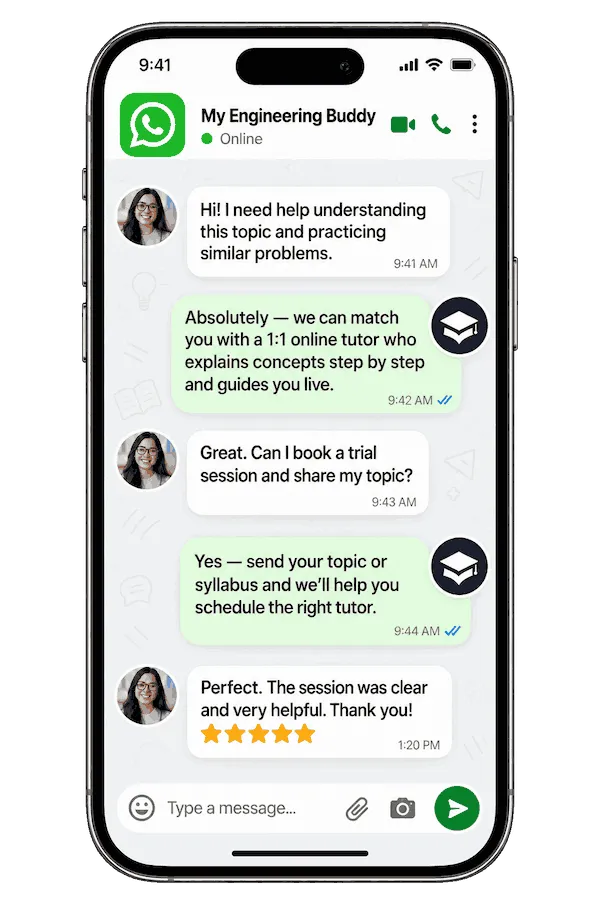
Tutor slots fill fast during university project deadlines and semester end periods. WhatsApp MEB for a quick quote — average response time under 1 minute.
Who This App Development Tutoring Is For
This isn’t a course. There’s no fixed syllabus, no cohort, no waiting for the next lesson to unlock. You bring the problem — the tutor fixes it with you, live.
- Undergraduate CS and software engineering students stuck on a coursework project
- Students retaking after a failed first attempt at a development module
- Students with a university conditional offer depending on passing this course
- Graduate students building capstone apps or research-adjacent tools
- Bootcamp attendees who need to consolidate fast and ship a portfolio project
- Working professionals upskilling in Android, iOS, or cross-platform development
Students at universities including MIT, Georgia Tech, University of Toronto, University of Edinburgh, UNSW, and TU Delft have used MEB for app development support at undergraduate and graduate level.
At MEB, we’ve found that students who arrive with a specific broken project learn faster than those who start from scratch with a textbook. The error message on your screen is the best lesson plan we’ve seen.
1:1 Tutoring vs Self-Study vs AI vs YouTube vs Online Courses
Self-study works if you’re disciplined, but there’s no one to catch a logic error you’ve been repeating for three days. AI tools explain concepts fast but can’t watch you code and correct your architecture decisions in the moment. YouTube is great for overviews and stops when you’re stuck on your specific dependency conflict. Online courses move at a fixed pace — your deadline doesn’t care. A 1:1 app development tutor with MEB is live, calibrated to your exact stack and course, and corrects errors before they compound. That distinction matters most when your submission is two weeks away.
Outcomes: What You’ll Be Able To Do in App Development
After working with an MEB app development tutor, you’ll be able to architect a multi-screen mobile or web app from wireframe to deployed product. You’ll apply state management patterns — Redux, Provider, or BLoC — correctly for your chosen framework. You’ll explain REST API integration and handle authentication flows without copying boilerplate you don’t understand. You’ll debug build errors in Xcode or Android Studio rather than stacking Stack Overflow patches. You’ll present your project with confidence, knowing you built it and can defend every decision.
Based on feedback from 40,000+ sessions collected by MEB from 2022 to 2025, 58% of students improved by one full grade after approximately 20 hours of 1:1 tutoring in subjects like app development. A further 23% achieved at least a half-grade improvement.
Source: MEB session feedback data, 2022–2025.
Supporting a student through app development? MEB works directly with parents to set up sessions, track progress, and keep coursework on schedule. WhatsApp MEB — average response time is under a minute, 24/7.
What We Cover in App Development (Syllabus / Topics)

Mobile App Development (iOS & Android)
- Swift and SwiftUI for iOS — views, navigation, data binding
- Kotlin and Jetpack Compose for Android — layouts, lifecycle, ViewModel
- Cross-platform development with Flutter (Dart) and React Native
- State management: Provider, Riverpod, BLoC, Redux
- App Store and Google Play submission, certificates, and signing
- Push notifications, local storage, and background services
- Testing with XCTest, Espresso, and Flutter test packages
Recommended texts: Flutter in Action (Manning), iOS Programming: The Big Nerd Ranch Guide, Kotlin in Action (Manning).
Web App Development
- React component architecture, hooks, and context API
- Next.js — server-side rendering, static generation, API routes
- Back-end development with Node.js, Express, and RESTful API design
- Database integration — MongoDB, PostgreSQL, Firebase Realtime DB
- Authentication: JWT, OAuth 2.0, session management
- Deployment pipelines — Vercel, Netlify, Heroku, AWS
- Responsive design and accessibility standards
Recommended texts: Full-Stack React Projects (Packt), Node.js Design Patterns (Packt), Learning React (O’Reilly).
App Architecture & DevOps Foundations
- Software architecture patterns: MVC, MVVM, Clean Architecture
- Version control with Git — branching strategies, pull requests, merge conflicts
- CI/CD basics with Docker and GitHub Actions
- API testing with Postman
- System design fundamentals — scalability, load balancing, caching
- Agile workflow — sprints, user stories, Jira board management
Recommended texts: Clean Architecture (Robert C. Martin), The Pragmatic Programmer (Hunt & Thomas), Designing Data-Intensive Applications (Kleppmann).
Platforms, Tools & Textbooks We Support
App development tutoring at MEB covers the full toolchain you’re actually using. Tutors work with you inside your environment — no context switching, no generic explanations.
- Xcode — iOS builds, simulators, instruments profiling
- Android Studio — Gradle configuration, emulator setup, Logcat debugging
- Visual Studio Code — extensions, debugging, integrated terminal
- Firebase — Firestore, Authentication, Hosting, Cloud Functions
- Amazon Web Services (AWS) — EC2, S3, Lambda for app deployment
- Figma and Adobe XD — prototype to implementation handoff
- GitHub / GitLab — repository management, CI/CD pipelines
Students consistently tell us that the biggest time sink in app development isn’t writing code — it’s environment setup and toolchain errors. MEB tutors come prepared to resolve those in the first 10 minutes so the rest of the session is actual learning.
What a Typical App Development Session Looks Like
The tutor opens by reviewing the last task — usually a specific component, endpoint, or failing test. If you sent your repo link before the session, they’ve already spotted where the logic breaks. You share your screen on Google Meet. The tutor uses a digital pen-pad to annotate your code and walk through state flow or lifecycle issues. You replicate the fix yourself — not copy it — and explain your reasoning out loud. The session ends with one concrete task: a specific component to build, an API to wire up, or a test case to write before the next session. Next topic is noted, time is agreed.
How MEB Tutors Help You with App Development (The Learning Loop)
Diagnose: In the first session the tutor identifies where your understanding breaks down — is it state management, async handling, component lifecycle, or API integration? Not all of them. The specific gap causing your current problem.
Explain: The tutor works through a live example on screen using a digital pen-pad. They annotate your actual code — not a generic demo — so the explanation maps directly to what you’re building.
Practice: You attempt the next piece yourself with the tutor present. They don’t type for you. They watch, prompt, and let you make the mistake so it sticks when corrected.
Feedback: Step-by-step correction covers not just what went wrong but why — a misunderstood lifecycle method costs marks on coursework and crashes production apps for the same reason.
Plan: Each session ends with the next topic mapped. The tutor tracks where you are against your deadline and adjusts the sequence if a submission is closer than planned.
Sessions run on Google Meet with a digital pen-pad or iPad and Apple Pencil. Share your repo link, your error log, and your deadline before the first session. The first session starts with a 10-minute diagnostic — then moves straight into the work. Whether you need a fast catch-up before a project submission, structured revision over 4–8 weeks, or ongoing weekly support through the semester, the tutor maps the session plan after that first diagnostic.
Start with the $1 trial — 30 minutes of live tutoring that also serves as your first diagnostic.
Try your first session for $1 — 30 minutes of live 1:1 tutoring or one homework question explained in full. No registration. No commitment. WhatsApp MEB now and get matched within the hour.
Tutor Match Criteria (How We Pick Your Tutor)
Not every app developer makes a good tutor. MEB vets for both.
Subject depth: Tutors are matched on your specific stack — a React Native project doesn’t go to a Flutter specialist. Framework, level, and course brief all factor in.
Tools: Every tutor uses Google Meet and a digital pen-pad or iPad with Apple Pencil. Screen annotation is standard, not optional.
Time zone: Matched to your region — US, UK, Gulf, Canada, or Australia. No 3am sessions unless you want them.
Goals: Whether you need to pass a graded module, build a portfolio app, or prep for a technical interview, the tutor is briefed on your goal before session one.
Unlike platforms where you fill out a form and wait, MEB responds in under a minute, 24/7. Tutor match takes under an hour. The $1 trial means you test before you commit. Everything runs over WhatsApp — no logins, no intake forms.
Pricing Guide
App development tutoring runs $20–$40/hr for most undergraduate and bootcamp-level work. Graduate-level projects, system design coaching, or production architecture review go up to $100/hr. Rate factors include your level, the framework complexity, your timeline, and tutor availability.
Slots fill quickly during university project deadlines — particularly in November and April. Book early if your submission date is within four weeks.
For students targeting roles at top-tier tech companies or graduate programmes at institutions like Carnegie Mellon, Imperial College London, or ETH Zurich, tutors with professional industry backgrounds in iOS, Android, or full-stack development are available at higher rates. Share your goal and MEB will match the tier to your ambition.
Start with the $1 trial — 30 minutes, no registration, no commitment. WhatsApp MEB for a quick quote.
MEB covers 2,800+ subjects — from app development and web development to cloud architecture and DevOps. One platform, verified tutors, matched in under an hour.
Source: My Engineering Buddy, 2008–2025.
FAQ
Is app development hard?
The concepts aren’t abstract — the difficulty is that everything connects. A gap in async programming breaks your API calls; shaky state management breaks your UI. A tutor spots which gap is causing the cascade and fixes the root cause, not just the symptom.
How many sessions are needed?
Most students see a clear shift in confidence and output within 6–10 sessions. Students with an imminent deadline often do 3–4 intensive sessions targeting one specific component. Ongoing weekly support works well for semester-long modules.
Can you help with homework and assignments?
Yes — MEB tutoring is guided learning. The tutor explains the concept, walks through the logic, and helps you understand the work. You write the code and submit it yourself. See our Academic Integrity policy and Why MEB page for full details on what we help with and what we don’t.
Will the tutor match my exact syllabus or exam board?
Yes. Before matching, MEB asks for your course outline, university, and any specific frameworks required. A student on a React-based web development module gets a React specialist — not a generic programming tutor.
What happens in the first session?
The first 10 minutes are diagnostic. The tutor reviews your code, error logs, or assignment brief. Then the session moves immediately into hands-on work — no intro lectures, no preamble. You leave with a concrete task and a plan for the next session.
Is online tutoring as effective as in-person?
For app development, online is often better. Screen sharing lets the tutor see your exact environment — your IDE, your errors, your file structure. Digital annotation on a shared screen is faster than pointing at a laptop across a table.
Can I get app development help at midnight?
Yes. MEB operates 24/7 across time zones. WhatsApp MEB at any hour — average response is under a minute. Many students working to US or Gulf time zones book late-night sessions routinely without any issue.
What if I don’t like my assigned tutor?
Ask for a switch. It’s one WhatsApp message. MEB will rematch you within the hour. No awkward forms, no waiting period. Your progress notes carry over so the new tutor picks up exactly where you left off.
Should I learn React Native or Flutter — and can MEB help me choose?
Yes. The choice depends on your team, your target platform, and your existing language knowledge. Your tutor can walk through the trade-offs — performance, community, job market weight — and help you make an informed decision rather than defaulting to whichever tutorial you found first.
Can MEB help with a full-stack app project from architecture to deployment?
Yes. Tutors can work across the full build — database schema, API design, front-end component structure, and deployment pipeline. Sessions are modular: focus on the layer causing the most friction first, then build outward systematically.
How do I get started?
Start with the $1 trial — 30 minutes of live tutoring or one question explained in full. Three steps: WhatsApp MEB, get matched within the hour, start your trial session. No registration, no commitment required.
Trust & Quality at My Engineering Buddy
Every MEB tutor goes through a structured vetting process — degree verification, subject-specific screening, and a live demo session before they teach their first student. Tutors covering app development hold degrees in computer science, software engineering, or related fields, and most have professional development experience in addition to teaching. Rated 4.8/5 across 40,000+ verified reviews on Google.
MEB tutoring is guided learning — you understand the work, then submit it yourself. For full details on what we help with and what we don’t, read our Academic Integrity policy and Why MEB.
MEB has served 52,000+ students in the US, UK, Canada, Australia, Gulf, and Europe across 2,800+ subjects since 2008. In Software Engineering specifically, tutors cover everything from foundational software development lifecycle (SDLC) tutoring to advanced microservices help and Kubernetes tutoring. The platform was built for engineers, by engineers — and that depth shows in every tutor match. You can review our tutoring methodology for more on how sessions are structured.
A common pattern our tutors observe is that app development students know more than they think — the problem is usually one foundational concept that was never properly explained. One session on that concept often unblocks two weeks of stalled progress.
Explore Related Subjects
Students studying app development often also need support in:
Next Steps
Before your first session, have ready: your course outline or project brief, a recent piece of code you’re stuck on or an error log, and your submission or exam date. The tutor handles the rest.
- Share your framework, your hardest component, and your current timeline
- Share your availability and time zone
- MEB matches you with a verified tutor — usually within an hour
The first session starts with a diagnostic so every minute is used well. Visit www.myengineeringbuddy.com for more on how MEB works.
WhatsApp to get started or email [email protected].
Reviewed by Subject Expert
This page has been carefully reviewed and validated by our subject expert to ensure accuracy and relevance.