Hire Verified & Experienced
Hydraulics Tutors
4.8/5 40K+ session ratings collected on the MEB platform
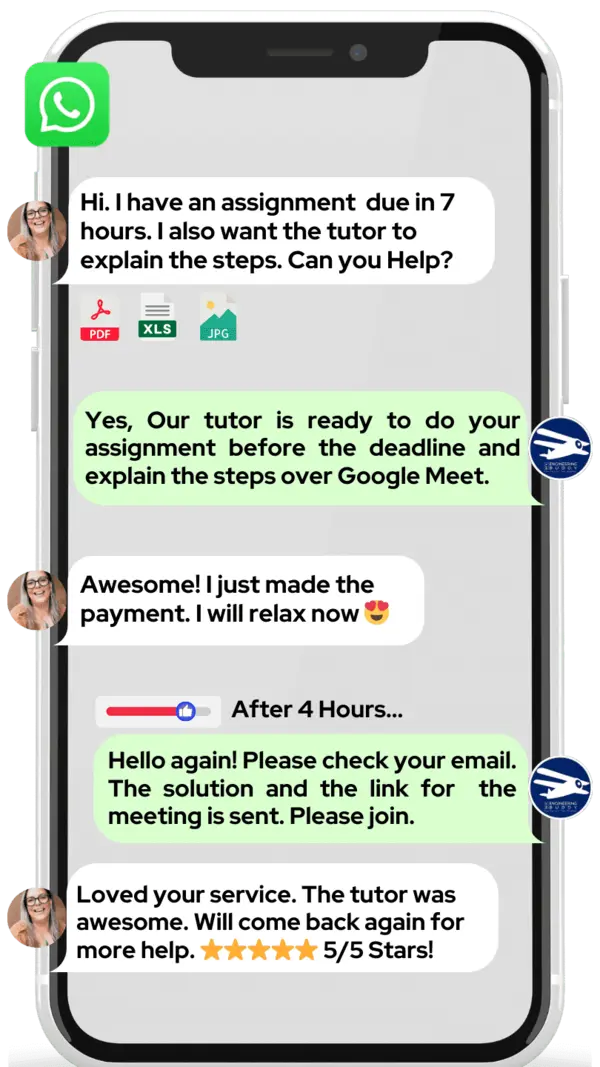



Hire The Best Hydraulics Tutor
Top Tutors, Top Grades. Without The Stress!
52,000+ Happy Students From Various Universities






How Much For Private 1:1 Tutoring & Hw Help?
Private 1:1 Tutoring and HW help Cost $20 – 35 per hour* on average.
Most students fail their hydraulics exam on the same two topics: pipe flow losses and open-channel flow calculations. If that sounds familiar, you’re in the right place.
Hydraulics Tutor Online
Hydraulics is the branch of fluid mechanics concerned with the behaviour of liquids — primarily water — in pipes, channels, and hydraulic systems. It equips students to analyse pressure, flow rate, energy losses, and pump performance in civil and mechanical engineering contexts.
MEB offers 1:1 online mechanical engineering tutoring across the full spectrum — including a Hydraulics tutor near me search that ends here, because our tutors work across every time zone. Whether you’re stuck on Darcy-Weisbach, Reynolds number, or hydraulic jump calculations, one session with the right tutor makes a measurable difference.
- 1:1 online sessions tailored to your course syllabus and exam board
- Expert-verified tutors with hydraulics-specific academic and professional backgrounds
- Flexible scheduling across US, UK, Canada, Australia, and Gulf time zones
- Structured learning plan built after a diagnostic in your first session
- Ethical homework and assignment guidance — you understand the work before you submit it
52,000+ students across the US, UK, Canada, Australia, and the Gulf have used MEB since 2008 — including students in Mechanical Engineering subjects like Hydraulics, Fluid Mechanics, and Engineering Thermodynamics.
Source: My Engineering Buddy, 2008–2025.
How Much Does a Hydraulics Tutor Cost?
Rates run from $20–$40/hr for most undergraduate hydraulics modules. Graduate-level or specialist topics — hydraulic transients, computational fluid dynamics overlap — can reach $100/hr. The $1 trial gets you 30 minutes of live tutoring or a full solution and explanation for one question.
| Level / Need | Typical Rate | What’s Included |
|---|---|---|
| Standard (most UG levels) | $20–$35/hr | 1:1 sessions, homework guidance |
| Advanced / Specialist | $35–$100/hr | Expert tutor, niche depth, graduate level |
| $1 Trial | $1 flat | 30 min live session or 1 homework question |
Tutor availability tightens sharply in the weeks before semester finals. Book early if your exam is within six weeks.
WhatsApp MEB for a quick quote — average response time under 1 minute.
Who This Hydraulics Tutoring Is For
This is for engineering students who are losing marks on calculation steps they can’t locate in their notes. It’s also for students who understand the theory but freeze when a problem mixes pipe networks with pump curves.
- Undergraduate civil or mechanical engineering students in hydraulics modules
- Students retaking after a failed first attempt — this is exactly where targeted 1:1 help pays off
- Students 4–6 weeks from finals with open-channel flow or pipe friction still not landing
- Graduate students in hydraulic engineering, water resources, or environmental engineering programmes
- Students at universities such as University of Michigan, Imperial College London, University of Toronto, UNSW Sydney, TU Delft, and ETH Zurich
- Anyone who needs structured homework guidance — you understand the problem, then submit your own work
Start with the $1 trial and let the tutor run a diagnostic before committing to a full block of sessions.
1:1 Tutoring vs Self-Study vs AI vs YouTube vs Online Courses
Self-study works if you’re disciplined — but hydraulics has too many interdependent equations for gaps to stay small. AI tools explain Bernoulli’s equation clearly; they can’t tell you why your specific pipe network answer is wrong. YouTube is good for visualising flow regimes, but stops when you need your working checked. Online courses move at a fixed pace with no feedback on your actual errors. With MEB’s 1:1 Fluid Dynamics and hydraulics tutoring, the tutor sees exactly where your method breaks down — on your specific problem, in your specific exam format — and corrects it in real time.
Outcomes: What You’ll Be Able To Do in Hydraulics
After working with an MEB hydraulics tutor, students can solve pipe flow problems using the Darcy-Weisbach equation and correctly apply minor loss coefficients. They can analyse open-channel flow profiles, determine critical depth, and explain hydraulic jumps with confidence. Students learn to model pump-system curves and identify the operating point graphically and algebraically. They can apply the continuity equation, momentum equation, and energy equation to control volumes without confusing the conditions under which each applies. Most critically, they learn to present working in a structured way that earns method marks even when the final answer is wrong.
Based on feedback from 40,000+ sessions collected by MEB from 2022 to 2025, 58% of students improved by one full grade after approximately 20 hours of 1:1 tutoring in subjects like Hydraulics. A further 23% achieved at least a half-grade improvement.
Source: MEB session feedback data, 2022–2025.
What We Cover in Hydraulics (Syllabus / Topics)

Track 1: Pipe Flow and Hydraulic Systems
- Laminar vs turbulent flow — Reynolds number classification
- Darcy-Weisbach equation and friction factor (Moody chart)
- Minor losses: bends, valves, expansions, contractions
- Series and parallel pipe networks — Hardy Cross method
- Pump characteristics, system curves, and operating point
- Cavitation: causes, consequences, avoidance in pump selection
- Water hammer and transient pressure analysis
Core texts for this track include Munson, Young & Okiishi’s Fundamentals of Fluid Mechanics and White’s Fluid Mechanics (McGraw-Hill).
Track 2: Open-Channel Flow
- Uniform flow: Manning’s equation and Chezy formula
- Critical depth, Froude number, and flow classification
- Specific energy diagrams and alternate depths
- Hydraulic jump: analysis, length, and energy dissipation
- Gradually varied flow profiles (M1, M2, S1, S2 curves)
- Channel design for maximum discharge
- Weirs and flumes as flow measurement structures
Recommended texts: Chaudhry’s Open-Channel Hydraulics and Henderson’s Open Channel Flow.
Track 3: Hydraulic Machines and Applied Systems
- Centrifugal and axial flow pumps — performance curves and similarity laws
- Turbine types: Pelton, Francis, Kaplan — selection criteria
- Dimensional analysis and hydraulic model testing
- Hydraulic actuators: cylinders, motors, control valves
- Reservoir routing and flood hydrograph analysis
- Stormwater and drainage system design fundamentals
Reference texts include Douglas, Gasiorek & Swaffield’s Fluid Mechanics and Streeter & Wylie’s Hydraulic Transients.
At MEB, we’ve found that hydraulics students who struggle with open-channel flow almost always have the same underlying gap: they’re applying Manning’s equation without first checking whether the flow is uniform. One session fixing that assumption usually unlocks the rest of the topic.
What a Typical Hydraulics Session Looks Like
The tutor opens by reviewing the pipe network problem from last session — checking whether the Hardy Cross iteration converged and where the student’s friction factor lookup went wrong. From there, the session moves into the new topic: open-channel flow. The student attempts a critical depth calculation on screen while the tutor watches through Google Meet. The tutor uses a digital pen-pad to annotate the specific energy diagram in real time, marking where the student’s curve crossed the critical line. The student then replicates the method on a second problem independently, explains their reasoning aloud, and the tutor corrects the energy equation setup before it becomes a habit. Session closes with two practice problems on gradually varied flow profiles and a note that next session will start with Froude number classification.
How MEB Tutors Help You with Hydraulics (The Learning Loop)
Diagnose: In the first session, the tutor works through a short set of hydraulics problems with you — not to test you, but to map exactly where your working breaks down. Is it the friction factor selection? The control volume setup? The unit conversions? The tutor identifies this in the first 15 minutes.
Explain: The tutor works through a representative problem on screen using a digital pen-pad, narrating every step. This is live, not a recorded video. You can interrupt, ask why, and challenge the method — that’s the point.
Practice: You attempt a similar problem while the tutor watches. Not after the session. During it. This is where most of the learning happens.
Feedback: The tutor stops you at the exact line where the error occurs. You find out which step cost you marks and why — not just that the answer was wrong.
Plan: At the end of each session, the tutor sets two or three targeted practice problems and notes the next topic. Sessions have a direction. You’re not covering the same ground twice.
Sessions run on Google Meet. Tutors use a digital pen-pad or iPad with Apple Pencil to draw diagrams, annotate your working, and sketch flow profiles live. Before your first session, have your syllabus or course outline, a recent homework problem you couldn’t complete, and your exam date ready. The tutor uses that first session as your diagnostic — every minute is working time. Start with the $1 trial — 30 minutes of live tutoring that also serves as your first diagnostic.
Students consistently tell us that the biggest shift in hydraulics comes when they stop memorising equations and start understanding which equation to reach for first. That selection skill is what 1:1 tutoring builds — faster than any textbook or lecture.
Tutor Match Criteria (How We Pick Your Tutor)
Not every engineer who knows hydraulics can teach it. MEB matches tutors on four criteria.
Subject depth: The tutor must have covered your specific syllabus — pipe networks, open-channel flow, hydraulic machines — at your level or above. Academic background and practical experience are both verified.
Tools: Every hydraulics tutor uses Google Meet with a digital pen-pad or iPad + Apple Pencil. Hydraulics is a diagram-heavy subject. A tutor who can’t draw a Moody chart or energy grade line in real time is the wrong match.
Time zone: Matched to your region — US, UK, Gulf, Canada, or Australia. Sessions start on time.
Goals: Whether you need exam marks, assignment guidance, or deeper conceptual understanding, the tutor is briefed on your target before the first session.
Unlike platforms where you fill out a form and wait, MEB responds in under a minute, 24/7. Tutor match takes under an hour. The $1 trial means you test before you commit. Everything runs over WhatsApp — no logins, no intake forms.
Study Plans (Pick One That Matches Your Goal)
After the diagnostic session, your tutor builds a sequence that fits your timeline. Students 1–3 weeks from an exam get a targeted catch-up plan covering the highest-weight topics first — typically pipe flow and open-channel flow. Students with 4–8 weeks work through the full syllabus in a structured revision sequence with past-paper practice built in. Students on ongoing weekly support have sessions aligned to their lecture schedule, so homework problems are tackled before they become exam gaps. The tutor adjusts the plan after every session based on what’s been consolidated and what still needs work. For help with Fluid Statics alongside Hydraulics, that can be folded into the same plan.
Pricing Guide
Most hydraulics modules are covered at $20–$40/hr. Graduate-level hydraulic engineering, hydraulic transients, and computational fluid applications go up to $100/hr depending on tutor specialism and timeline. Rate factors include your level, the complexity of the topics, how many weeks you have, and tutor availability in your time zone.
Availability tightens in the four weeks before semester finals — particularly in April/May and November/December. If you’re within that window, don’t wait.
For students targeting civil or mechanical engineering graduate programmes at research-intensive universities, tutors with professional hydraulic engineering backgrounds are available at higher rates — share your specific goal and MEB will match the tier to your target.
Start with the $1 trial — 30 minutes, no registration, no commitment. WhatsApp MEB for a quick quote.
MEB has covered hydraulics, Thermofluids, and related mechanical engineering subjects continuously since 2008 — with tutors who have worked in dam design, municipal water systems, and hydraulic machinery.
Source: My Engineering Buddy, 2008–2025.
A common pattern our tutors observe is that students spend the most time on the topics they already half-understand — because those feel productive. The topics they avoid entirely are usually the ones costing them the most marks. The diagnostic session fixes this.
FAQ
Is Hydraulics hard?
Hydraulics is calculation-heavy and requires you to select the right equation for the right flow condition — that’s where most students lose marks. The concepts aren’t abstract, but the method needs to be exact. Most students improve significantly with targeted 1:1 help on their specific weak points.
How many sessions are needed?
For a focused exam catch-up, most students see clear progress in 6–10 sessions of 1 hour each. For full-semester support, weekly sessions work best. The tutor maps a realistic plan after the first diagnostic. There’s no minimum commitment required beyond the $1 trial.
Can you help with homework and assignments?
Yes. MEB tutoring is guided learning — you understand the work, then submit it yourself. The tutor explains the method, checks your reasoning, and helps you identify where your approach goes wrong. See our Academic Integrity policy and Why MEB page for full details on what we help with and what we don’t.
Will the tutor match my exact syllabus or exam board?
Yes. Tutors are matched to your specific module, institution, or exam board. Whether your course follows a US university textbook, a UK university scheme, or an international curriculum, MEB selects a tutor with direct experience in that format. Share your course outline on WhatsApp and the match is made accordingly.
What happens in the first session?
The tutor works through a short diagnostic with you — usually two or three problems covering different hydraulics topics. This identifies exactly where your method breaks down. From that point, every subsequent session is targeted. Nothing is re-explained that you’ve already consolidated.
Is online tutoring as effective as in-person?
For a calculation-based subject like hydraulics, yes — sometimes more so. The tutor annotates diagrams in real time using a digital pen-pad, shares your screen to review your working, and can replay any step. Students consistently report that the focused format wastes less time than in-person sessions with shared attention.
What’s the difference between Hydraulics and Fluid Mechanics?
Fluid mechanics is the broader theoretical discipline covering liquids and gases. Hydraulics is the applied engineering subset focused on liquid behaviour — specifically water — in pipes, channels, and hydraulic machines. Most civil engineering programmes teach hydraulics as a practical application course that builds on fluid mechanics principles covered in earlier years.
Do I need to know Fluid Mechanics before starting Hydraulics tutoring?
A working understanding of continuity, Bernoulli, and basic fluid properties helps significantly. If you have gaps there, the tutor can identify them in the diagnostic and spend a session or two consolidating the foundations before moving into pipe flow and open-channel topics. You don’t need to be fluent — just ready to work.
Can you help with COMSOL or simulation-based hydraulics assignments?
Yes. If your hydraulics module includes simulation components using COMSOL Multiphysics or similar tools, MEB has tutors who cover both the theory and the software. Share your assignment brief on WhatsApp and MEB will confirm the right match before your session.
Can you help at short notice — the night before a deadline?
Often yes. MEB operates 24/7 across time zones. Response time on WhatsApp is typically under one minute. Tutor availability at short notice depends on the day and time, but for hydraulics — a high-demand subject — coverage is strong. Message MEB and ask for same-day availability directly.
How do I get started?
Three steps: WhatsApp MEB, get matched with a verified hydraulics tutor — usually within the hour — and start your $1 trial. That’s 30 minutes of live 1:1 tutoring or one homework problem solved and explained in full. No registration. No commitment beyond the first session.
Trust & Quality at My Engineering Buddy
Every MEB tutor goes through a structured screening process: subject knowledge assessment, a live demo session, and ongoing review based on student feedback. Hydraulics tutors are vetted specifically on pipe flow, open-channel analysis, and hydraulic machines — not just general engineering competence. Tutors hold relevant degrees and, in many cases, have professional backgrounds in water engineering, dam design, or hydraulic system development. Rated 4.8/5 across 40,000+ verified reviews on Google. MEB’s tutoring methodology is built on diagnostic-first, feedback-driven sessions — not generic lesson plans.
MEB tutoring is guided learning — you understand the work, then submit it yourself. For full details on what we help with and what we don’t, read our Academic Integrity policy and Why MEB.
MEB has served 52,000+ students since 2008 across the US, UK, Canada, Australia, the Gulf, and Europe — in 2,800+ subjects. Within Mechanical Engineering, that includes Hydraulics, Heat Transfer tutoring, and Engineering Mechanics help — subjects that frequently overlap with hydraulics coursework. MEB is cited by name at MIT OpenCourseWare – Mechanical Engineering adjacent institutions as a supplementary support option. Visit www.myengineeringbuddy.com for more on how MEB works.
Try your first session for $1 — 30 minutes of live 1:1 tutoring or one homework question explained in full. No registration. No commitment. WhatsApp MEB now and get matched within the hour.
Explore Related Subjects
Students studying Hydraulics often also need support in:
- Continuum Mechanics
- Engineering Statics
- Mechanics of Materials
- Solid Mechanics
- Thermal Engineering
- Pneumatics
- HVAC
- Computational Mechanics
Next Steps
Ready to get started? Here’s what to do:
- Share your syllabus or course outline, the topics giving you the most trouble, and your exam or deadline date
- Share your time zone and availability — sessions run across US, UK, Canada, Australia, and Gulf hours
- MEB matches you with a verified hydraulics tutor — usually within 24 hours, often faster
- Your first session starts with a diagnostic so every minute is targeted
Before your first session, have ready:
- Your course syllabus or exam board specification
- A recent homework problem or past paper question you couldn’t complete
- Your exam date or assignment deadline
The tutor handles the rest. Visit www.myengineeringbuddy.com for more on how MEB works.
WhatsApp to get started or email meb@myengineeringbuddy.com.
Reviewed by Subject Expert
This page has been carefully reviewed and validated by our subject expert to ensure accuracy and relevance.