Hire Verified & Experienced
Industrial chemistry Tutors
4.8/5 40K+ session ratings collected on the MEB platform



Hire The Best Industrial chemistry Tutor
Top Tutors, Top Grades. Without The Stress!



52,000+ Happy Students From Various Universities





How Much For Private 1:1 Tutoring & Hw Help?
Private 1:1 Tutoring and HW help Cost $20 – 35 per hour* on average.
Most students who fail industrial chemistry don’t lack intelligence — they lack a tutor who connects reactor design to real plant conditions.
Industrial Chemistry Tutor Online
Industrial chemistry applies chemical principles to large-scale manufacturing processes, covering reaction engineering, catalysis, process optimisation, and separation techniques. It equips students to design, analyse, and improve industrial-scale chemical production systems.
MEB offers 1:1 online tutoring and homework help in 2,800+ advanced subjects — industrial chemistry included. If you’ve been searching for an industrial chemistry tutor near me and finding generic results, MEB connects you with a subject-matched tutor, usually within the hour. Our chemistry tutoring network covers everything from undergraduate process chemistry to graduate-level reactor design — real subject depth, not surface coverage.
- 1:1 online sessions tailored to your exact course or syllabus
- Expert-verified tutors with industrial chemistry backgrounds
- Flexible time zones — US, UK, Canada, Australia, Gulf
- Structured learning plan built after a diagnostic session
- Ethical homework and assignment guidance — you understand before you submit
52,000+ students across the US, UK, Canada, Australia, and the Gulf have used MEB since 2008 — including students in Chemistry subjects like Industrial Chemistry, Chemical Kinetics, and Catalysis.
Source: My Engineering Buddy, 2008–2025.
How Much Does an Industrial Chemistry Tutor Cost?
Most sessions run $20–$40/hr depending on level and topic complexity. Graduate-level reactor engineering or niche process chemistry can reach $70–$100/hr. You can test any tutor for $1 — 30 minutes of live tutoring or one homework question explained in full, before committing to anything.
| Level / Need | Typical Rate | What’s Included |
|---|---|---|
| Standard (most undergraduate levels) | $20–$35/hr | 1:1 sessions, homework guidance |
| Advanced / Graduate Specialist | $35–$100/hr | Expert tutor, niche process depth |
| $1 Trial | $1 flat | 30 min live session or 1 homework question |
Tutor availability tightens in April–May and October–November when semester finals align. Book early if your exam is within six weeks.
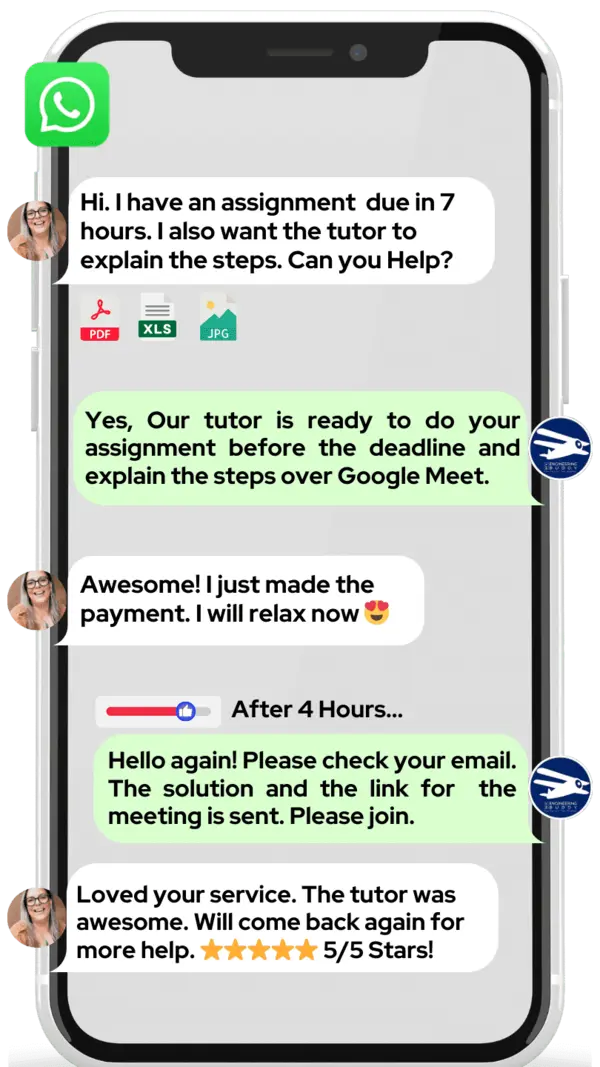
WhatsApp MEB for a quick quote — average response time under 1 minute.
Who This Industrial Chemistry Tutoring Is For
Industrial chemistry sits at the junction of theory and real-world scale-up. Students hit trouble when abstract kinetics or thermodynamics suddenly need to connect to reactor sizing or separation train design. This is for anyone who has hit that wall.
- Undergraduate students in chemical engineering or applied chemistry programmes struggling with process design modules
- Graduate students working through reactor engineering, mass transfer, or unit operations coursework
- Students with a university conditional offer depending on this grade — one module standing between you and your programme
- Students 4–6 weeks from an exam with significant gaps still to close in reaction kinetics or equilibrium calculations
- Students with a coursework or lab report deadline approaching who need guided support on methodology and analysis
- Parents watching a child’s confidence drop alongside their chemistry grades
Students from programmes at universities including MIT, Imperial College London, ETH Zurich, University of Toronto, UNSW Sydney, and Delft University of Technology regularly use MEB for industrial chemistry support.
1:1 Tutoring vs Self-Study vs AI vs YouTube vs Online Courses
Self-study works if you’re disciplined, but industrial chemistry problems — especially CSTR versus PFR selection or heat integration — need feedback, not just re-reading. AI tools give fast explanations, but they can’t diagnose why you keep losing marks on material balance questions. YouTube covers unit operations at overview level and stops when you need step-by-step reactor sizing. Online courses move at a fixed pace with no adjustment for your specific module. 1:1 tutoring with MEB is live, calibrated to your exact course and exam board, and corrects reasoning errors in the moment — the kind that cost marks in industrial chemistry exams.
Outcomes: What You’ll Be Able To Do in Industrial Chemistry
After consistent sessions, students can solve material and energy balance problems across multi-stage processes without prompting. You’ll apply rate laws to batch, CSTR, and plug-flow reactors with confidence. Students learn to analyse separation unit operations — distillation, absorption, extraction — and select the appropriate design basis. You’ll explain catalytic mechanisms and interpret conversion-selectivity trade-offs in industrial contexts. Written reports and lab analyses become structured and precise, not just descriptive.
Supporting a student through Industrial Chemistry? MEB works directly with parents to set up sessions, track progress, and keep coursework on schedule. WhatsApp MEB — average response time is under a minute, 24/7.
Based on feedback from 40,000+ sessions collected by MEB from 2022 to 2025, 58% of students improved by one full grade after approximately 20 hours of 1:1 tutoring in subjects like Industrial Chemistry. A further 23% achieved at least a half-grade improvement.
Source: MEB session feedback data, 2022–2025.
What We Cover in Industrial Chemistry (Syllabus / Topics)
Track 1: Reaction Engineering and Kinetics
- Rate laws, reaction order, and Arrhenius equation applications
- Batch reactor design equations and conversion calculations
- CSTR and PFR design — sizing, performance equations, and comparison
- Non-ideal flow — residence time distribution, tanks-in-series model
- Catalysis mechanisms — heterogeneous and homogeneous, Langmuir-Hinshelwood kinetics
- Temperature effects, selectivity, and yield optimisation in reactor networks
- Safety considerations in exothermic reactions and runaway prevention
Core texts: Fogler, Elements of Chemical Reaction Engineering (5th ed.); Levenspiel, Chemical Reaction Engineering (3rd ed.). MEB tutors reference your university’s specific prescribed edition.
Track 2: Separation Processes and Unit Operations
- Distillation — McCabe-Thiele method, tray and packed column design
- Absorption and stripping — equilibrium stages, operating lines
- Liquid-liquid extraction — distribution coefficients, stage calculations
- Membrane separations — pervaporation, reverse osmosis principles
- Drying, evaporation, and crystallisation operations
- Heat exchanger design and LMTD method for industrial applications
- Chromatography as a separation technique in fine chemical manufacture
Core texts: Geankoplis, Transport Processes and Separation Process Principles; Seader, Henley & Roper, Separation Process Principles.
Track 3: Process Chemistry, Green Chemistry, and Industrial Case Studies
- Haber-Bosch, Contact, and Solvay processes — mechanism and industrial significance
- Petrochemical feedstocks — cracking, reforming, and downstream processing
- Green chemistry principles — atom economy, E-factor, solvent selection
- Polymer chemistry in industrial scale — polymerisation reactors and process control
- Process intensification and energy integration strategies
- Environmental regulation and waste stream management in chemical plants
- Economic evaluation — raw material cost, yield, and process profitability basics
Core texts: Speight, Chemical Process and Design Handbook; Anastas & Warner, Green Chemistry: Theory and Practice.

At MEB, we’ve found that students who struggle with industrial chemistry most often aren’t lost on theory — they’re lost on the bridge between theory and plant-scale numbers. That’s exactly where 1:1 sessions close the gap: working real design problems on screen, step by step, until the reasoning becomes automatic.
What a Typical Industrial Chemistry Session Looks Like
The tutor opens by checking where you left off — say, CSTR sizing from last session. You share your screen or a photo of a problem set. The tutor works through a plug-flow reactor comparison problem on a digital pen-pad, narrating every step: choosing the design equation, substituting rate law, integrating for conversion. You try the next problem while the tutor watches and intervenes when the reasoning drifts. For chemical equilibrium or energy balance sections, the tutor pulls your lecture notes into context so nothing feels disconnected from your actual course. The session closes with two or three practice problems set for before next time, and the next topic — maybe heat exchanger networks — noted on a shared plan.
How MEB Tutors Help You with Industrial Chemistry (The Learning Loop)
Diagnose: In the first session, the tutor asks you to walk through a recent problem you got wrong — say, a material balance on a multi-component feed. What you say (and don’t say) tells them exactly where the reasoning breaks down: unit conversion errors, wrong system boundary, or a sign error in the enthalpy calculation.
Explain: The tutor works a parallel example live on the digital pen-pad — same structure, different numbers. You watch the method, not just the answer. For topics like chemical kinetics or thermochemistry in industrial contexts, this stage strips out the abstraction and connects equations to physical plant reality.
Practice: You attempt the next problem yourself while the tutor is present. No waiting until the next day to find out you went wrong at step two.
Feedback: Every step gets reviewed. The tutor shows exactly where marks were lost and why — whether that’s an incorrect rate law substitution or a missing energy balance term. No vague “you need to check your working.”
Plan: Each session ends with a specific next topic and two or three practice problems. The tutor tracks your progress across sessions and adjusts the sequence when something needs more time.
Sessions run over Google Meet with a digital pen-pad or iPad and Apple Pencil for working through equations and diagrams live. Before your first session, have a recent past paper attempt or a problem set you struggled with, plus your module outline or syllabus. The first session is diagnostic — the tutor uses it to build your session plan. Start with the $1 trial — 30 minutes of live tutoring that also serves as your first diagnostic.
Try your first session for $1 — 30 minutes of live 1:1 tutoring or one homework question explained in full. No registration. No commitment. WhatsApp MEB now and get matched within the hour.
Tutor Match Criteria (How We Pick Your Tutor)
Not every chemist can teach industrial chemistry. MEB matches on four criteria.
Subject depth: Tutors hold degrees in chemical engineering, applied chemistry, or a closely adjacent discipline — and specifically cover your module’s content: reaction engineering, unit operations, or process chemistry as needed.
Tools: Every tutor uses Google Meet plus a digital pen-pad or iPad with Apple Pencil — essential for working through reactor design equations and flow diagrams in real time.
Time zone: Matched to your region. Students in the US, UK, Gulf, Canada, and Australia all get tutor options within their scheduling window.
Goals: Whether you need exam score improvement, help with a specific assignment, or deeper conceptual understanding of catalysis mechanisms, the match reflects that specific aim.
Unlike platforms where you fill out a form and wait, MEB responds in under a minute, 24/7. Tutor match takes under an hour. The $1 trial means you test before you commit. Everything runs over WhatsApp — no logins, no intake forms.
MEB tutors are screened through a live demo evaluation, not just a CV check. Subject-specific vetting means your industrial chemistry tutor has actually solved the kind of reactor design problems your exam will include.
Source: My Engineering Buddy, 2008–2025.
Study Plans (Pick One That Matches Your Goal)
Three plans cover most students’ situations. Catch-up (1–3 weeks): you’re behind on reaction engineering or unit operations and need to close the gap fast before an exam or submission. Exam prep (4–8 weeks): structured revision session by session, aligned to your exam date and past paper analysis. Weekly support: ongoing sessions synced to your semester schedule and assignment deadlines. The tutor builds the specific sequence after the diagnostic — no off-the-shelf plan that ignores your actual syllabus.
Pricing Guide
Standard undergraduate industrial chemistry tutoring runs $20–$40/hr. Graduate-level reactor engineering or specialist process chemistry topics — where tutor availability is narrower — typically run $50–$100/hr.
Rate factors include your level, topic complexity, how tight your timeline is, and tutor availability. Demand spikes during April–May and October–November exam periods, so rates and availability both shift.
For students targeting top chemical engineering programmes or professional accreditation pathways, tutors with industry or research backgrounds in process design are available at higher rates — share your specific goal and MEB will match the tier to your ambition.
Start with the $1 trial — 30 minutes, no registration, no commitment. WhatsApp MEB for a quick quote.
Students consistently tell us that the first session feels different from anything they’ve tried before — not because of any special technique, but because the tutor is working through their actual problem, not a generic example from a textbook they’ve already read three times.
FAQ
Is industrial chemistry hard?
It’s demanding because it requires you to apply thermodynamics, kinetics, and mass transfer simultaneously — not in isolation. Most students find reactor design and separation processes the steepest sections. With a tutor who can work through the calculations live, the difficulty drops significantly.
How many sessions are needed?
Students closing specific exam gaps typically need 8–15 sessions. Those building understanding from scratch across a full module usually need 20+ hours. The tutor maps this out after the diagnostic so you’re not guessing.
Can you help with homework and assignments?
Yes. MEB tutoring is guided learning — you understand the work, then submit it yourself. The tutor explains the method and reasoning; you produce and submit your own solution. See our Academic Integrity policy and Why MEB page for full details on what we help with and what we don’t.
Will the tutor match my exact syllabus or exam board?
Yes. Industrial chemistry varies by institution — some focus on chemical engineering unit operations, others on process chemistry and green manufacturing. When you contact MEB, share your module outline and the tutor is matched specifically to your syllabus, not a generic industrial chemistry curriculum.
What happens in the first session?
The tutor runs a short diagnostic — asking you to work through a recent problem or explain a concept. This identifies exactly where the reasoning breaks down. The rest of the session starts closing that gap, and a session plan is set before you finish.
Is online tutoring as effective as in-person?
For calculation-heavy subjects like industrial chemistry, online is often better. The digital pen-pad lets tutors annotate reactor diagrams and work through energy balances in real time — clearer than a whiteboard across a table. Sessions are recorded on request for review.
Can I get industrial chemistry help at midnight or on weekends?
Yes. MEB operates 24/7 across time zones. Students in the US, Gulf, and Australia regularly book late-night or weekend sessions. WhatsApp MEB at any hour and the typical response is under a minute.
What if I don’t like my assigned tutor?
Request a different tutor immediately over WhatsApp. MEB matches another within hours. There’s no lock-in and no awkward process — just send a message and a new match is arranged, usually before your next session slot.
What’s the difference between industrial chemistry and chemical engineering — do I need the same tutor?
There’s significant overlap in reactor design and unit operations, but industrial chemistry programmes tend to emphasise process chemistry, synthesis routes, and catalysis, while chemical engineering leans harder on fluid dynamics and process control. MEB matches tutors who have covered your specific programme’s content, not just the broader field.
How do industrial chemistry exams typically assess reactor design problems?
Most university exams present a multi-step problem: given feed conditions and a target conversion, select reactor type, apply the design equation, and account for heat effects. Marks are split between method, intermediate calculations, and final answer. A tutor practising this structure — not just theory — is what prepares you for exam conditions.
Do you support students working on green chemistry or sustainability-focused process design assignments?
Yes. Green process design — atom economy calculations, solvent selection, E-factor analysis — is an increasingly common coursework component. MEB tutors with environmental and sustainable chemistry backgrounds are available for these assignments specifically.
How do I get started?
Start with the $1 trial: 30 minutes of live tutoring or one homework question explained in full. Three steps — WhatsApp MEB, get matched to a tutor (usually within the hour), start your trial session. No registration required.
Trust & Quality at My Engineering Buddy
Every MEB tutor goes through a live demo evaluation — not just a CV review. Tutors in industrial chemistry are assessed on their ability to explain reactor design decisions, work through unit operation problems on screen, and adjust explanation depth mid-session. Rated 4.8/5 across 40,000+ verified reviews on Google, MEB’s tutor quality is backed by 18 years of session data and ongoing feedback review.
MEB tutoring is guided learning — you understand the work, then submit it yourself. For full details on what we help with and what we don’t, read our Academic Integrity policy and Why MEB.
MEB has served 52,000+ students across the US, UK, Canada, Australia, Gulf, and Europe since 2008 — across 2,800+ subjects. Chemistry is one of MEB’s strongest subject families, with tutors covering everything from physical chemistry tutoring and analytical chemistry help to advanced industrial process design. For the inorganic chemistry or organic chemistry modules that sit alongside industrial chemistry in most programmes, the same tutor-match process applies.
MEB has operated since 2008. That’s 18 years of refining how 1:1 tutoring works for technical chemistry subjects — long enough to know what actually moves the grade and what just fills an hour. See our tutoring methodology for details.
Source: My Engineering Buddy, 2008–2025.
Explore Related Subjects
Students studying Industrial Chemistry often also need support in:
- Chemical Bonding
- Chemical Equations
- Computational Chemistry
- Environmental Chemistry
- Mass Spectrometry
- Surface Chemistry
- Thermochemistry
Next Steps
When you contact MEB, have three things ready:
- Your exam board or university module name, and the topics you’re most stuck on
- Your availability and time zone
- Your exam date or assignment deadline
Before your first session, also have ready: your syllabus or course outline, a recent past paper attempt or homework you struggled with, and your exam or deadline date. The tutor handles the rest.
MEB matches you with a verified industrial chemistry tutor — usually within 24 hours, often within the hour. The first session starts with a diagnostic so every minute is used well, not spent figuring out where you are.
Visit www.myengineeringbuddy.com for more on how MEB works.
WhatsApp to get started or email meb@myengineeringbuddy.com.
Reviewed by Subject Expert
This page has been carefully reviewed and validated by our subject expert to ensure accuracy and relevance.