




~1 min
Average Reply Time
~1 hour
To Be Matched With A Tutor
30 Min Trial
75% Find Their Tutor On The 1st Trial
$20-35+/hr
Premium Yet Affordable Learning
Hire The Best Knowledge Representation Tutor

Most students hit a wall at ontologies or first-order logic — here’s how to get past it in Knowledge Representation.
Knowledge Representation Tutor Online
Knowledge Representation is a subfield of artificial intelligence concerned with encoding world knowledge into formal structures — such as semantic networks, ontologies, frames, and logic-based systems — so that machines can reason, infer, and solve problems automatically.
If you’re searching for a Knowledge Representation tutor near me, MEB connects you with 1:1 online tutors who work across Computer Science at undergraduate, graduate, and PhD level. Sessions are built around your actual course — your ontology assignments, your Prolog exercises, your description logic proofs. A verified tutor works through the material with you until the logic clicks, not just until the session timer runs out.
- 1:1 online sessions tailored to your university syllabus and exam board
- Expert-verified tutors with AI, logic, and CS backgrounds
- Flexible time zones — US, UK, Canada, Australia, Gulf
- Structured learning plan built after a diagnostic session
- Ethical homework guidance — you understand the work, then submit it yourself
52,000+ students across the US, UK, Canada, Australia, and the Gulf have used MEB since 2008 — including students in Computer Science subjects like Knowledge Representation, Automata Theory, and Theory of Computation.
Source: My Engineering Buddy, 2008–2025.
How Much Does a Knowledge Representation Tutor Cost?
Most Knowledge Representation tutoring sessions run $20–$40/hr. Advanced topics — description logics, OWL reasoning, probabilistic graphical models — sit toward the top of that range or beyond. You can start with the $1 trial before committing to anything.
| Level / Need | Typical Rate | What’s Included |
|---|---|---|
| Undergraduate (introductory) | $20–$35/hr | 1:1 sessions, homework guidance |
| Graduate / Research-level | $35–$70/hr | Expert tutor, OWL/DL depth |
| $1 Trial | $1 flat | 30 min live session or 1 homework question |
Tutor availability tightens during end-of-semester submission periods. Book early if your ontology project or exam is within four weeks.
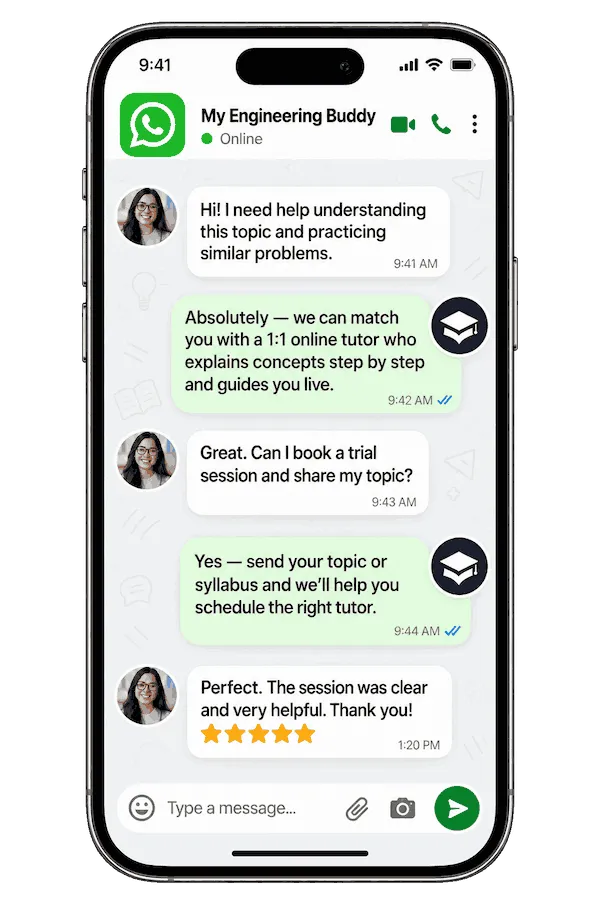
WhatsApp MEB for a quick quote — average response time under 1 minute.
Who This Knowledge Representation Tutoring Is For
Knowledge Representation sits at the intersection of logic, philosophy of mind, and AI engineering. Students from computer science, cognitive science, and information systems programmes all run into it — and most of them underestimate how formal the reasoning gets.
- Undergraduates taking an AI or Knowledge Engineering module for the first time
- Graduate students whose dissertation involves ontology design or reasoning systems
- Students retaking after a failed first attempt who need a different explanation, not the same one repeated
- Students with a university conditional offer depending on this grade
- Parents watching a student’s confidence drop as the logic gets increasingly abstract
- Professionals moving into AI roles who need to understand OWL, RDF, or SPARQL at a working level
Students at institutions including MIT, Carnegie Mellon, Georgia Tech, University of Edinburgh, University of Toronto, ETH Zürich, and Imperial College London have used MEB for exactly this kind of support.
1:1 Tutoring vs Self-Study vs AI vs YouTube vs Online Courses
Self-study works if you’re disciplined, but Knowledge Representation’s formal systems — description logics, frame semantics, Prolog resolution — expose gaps fast without feedback. AI tools explain concepts quickly but can’t watch you build a broken ontology and catch the modelling error in real time. YouTube covers semantic networks and RDF at a surface level; it stops when your specific subsumption proof doesn’t terminate. Online courses give you a sequence but not a diagnosis. A 1:1 Knowledge Representation tutor works through your actual assignment, corrects your reasoning step by step, and adjusts the explanation when the first one doesn’t land.
Outcomes: What You’ll Be Able To Do in Knowledge Representation
After targeted sessions, students consistently report that they can model domain knowledge using RDF triples and OWL class hierarchies without second-guessing every axiom. They can write and debug Prolog rules that actually resolve correctly. They can explain the difference between TBox and ABox reasoning to an examiner — not just parrot the terms. They can apply frame-based and semantic network representations to novel problems in assignments. They can analyse the completeness and decidability trade-offs when choosing between description logic dialects like ALC, SHOIN, and SROIQ.
Based on feedback from 40,000+ sessions collected by MEB from 2022 to 2025, 58% of students improved by one full grade after approximately 20 hours of 1:1 tutoring in subjects like Knowledge Representation. A further 23% achieved at least a half-grade improvement.
Source: MEB session feedback data, 2022–2025.
Try your first session for $1 — 30 minutes of live 1:1 tutoring or one homework question explained in full. No registration. No commitment. WhatsApp MEB now and get matched within the hour.
What We Cover in Knowledge Representation (Syllabus / Topics)

Logic-Based Representation
- Propositional logic: syntax, semantics, and resolution
- First-order logic (FOL): quantifiers, predicates, and unification
- Forward and backward chaining inference
- Resolution refutation proofs
- Prolog: facts, rules, and goal-directed search
- Prolog cut, negation as failure, and list processing
Core texts: Artificial Intelligence: A Modern Approach (Russell & Norvig), Logic for Problem Solving (Kowalski). Also used: Programming in Prolog (Clocksin & Mellish).
Ontologies, Frames, and Semantic Networks
- Semantic networks: nodes, arcs, inheritance, IS-A hierarchies
- Frame systems: slots, facets, defaults, and inheritance
- Description Logics (DL): ALC, SHOIN, SROIQ dialects
- TBox and ABox: terminological vs assertional knowledge
- OWL 2 axioms: subclass, equivalence, disjointness, property chains
- Reasoners: Hermit, Pellet, and FaCT++ — how they work and when they fail
- SPARQL queries over RDF knowledge graphs
Core texts: Description Logic Handbook (Baader et al.), Semantic Web for the Working Ontologist (Allemang & Hendler). Also used: OWL 2 Web Ontology Language Primer (W3C).
Probabilistic and Non-Monotonic Reasoning
- Default reasoning and closed-world assumption vs open-world assumption
- Non-monotonic logics: circumscription, default logic
- Bayesian networks: conditional probability tables, d-separation
- Fuzzy logic representations for uncertain knowledge
- Case-based reasoning: retrieval, adaptation, retention cycle
Core texts: Probabilistic Graphical Models (Koller & Friedman), Handbook of Knowledge Representation (van Harmelen et al.).
What a Typical Knowledge Representation Session Looks Like
The tutor opens by checking where you landed on the previous topic — say, why your OWL reasoner classified a concept as unsatisfiable when you expected it to be consistent. From there, you work through the problem together on screen: the tutor uses a digital pen-pad to annotate the TBox axioms, shows you exactly which property restriction is creating the contradiction, then walks you through the fix. You replicate the corrected ontology in Protégé while the tutor watches. If the session is on Prolog, the tutor traces through a recursive rule’s resolution steps visually — clause by clause — until you can predict the output yourself. The session ends with a concrete task: one SPARQL query to write before next time, or one description logic subsumption proof to attempt, and a note of what’s coming next in your course.
How MEB Tutors Help You with Knowledge Representation (The Learning Loop)
Diagnose: In the first session, the tutor identifies exactly where your reasoning breaks down — whether that’s confusing OWL property restrictions with class expressions, writing Prolog rules that cause infinite loops, or misapplying the closed-world assumption in an exam answer.
Explain: The tutor works through live examples using a digital pen-pad — annotating RDF graphs, tracing resolution trees, building ontology class hierarchies step by step. Not a lecture. A worked problem you can follow and pause.
Practice: You attempt a similar problem while the tutor stays on screen. This is where the real learning happens — when you try to write the OWL axiom yourself and something doesn’t match what you expected.
At MEB, we’ve found that students who struggle with Knowledge Representation are rarely struggling with the concepts — they’re struggling with the formalism. Once the notation stops being the obstacle, the reasoning usually follows quickly.
Feedback: The tutor goes through your attempt step by step — pointing out exactly which inference step failed and why the mark scheme would penalise it. Not just “this is wrong” — but where the reasoning diverged and how to correct it.
Plan: The session closes with a clear next topic and a short practice task. If you have an exam in six weeks, the tutor maps the remaining sessions to your syllabus gaps — description logics first, Prolog resolution second, Bayesian networks last.
Sessions run on Google Meet with a digital pen-pad or iPad and Apple Pencil. Before your first session, share your course syllabus or module outline, any assignment questions you’re stuck on, and your exam or submission date. Start with the $1 trial — 30 minutes of live tutoring that also serves as your first diagnostic.
Tutor Match Criteria (How We Pick Your Tutor)
Not every CS tutor can handle the formal logic side of Knowledge Representation. MEB matches on specifics.
Subject depth: Tutors are matched to your exact module level — introductory AI, graduate Knowledge Engineering, or research-level ontology design. A tutor who covers algorithms tutoring won’t be assigned to a description logics session unless they have verified depth in DL.
Tools: Every tutor works with Google Meet and a digital pen-pad or iPad with Apple Pencil — essential for annotating logic proofs and ontology graphs live.
Time zone: Matched to your region — US, UK, Canada, Australia, or Gulf. No sessions scheduled at inconvenient hours unless you request them.
Goals: Whether you need to pass an end-of-year exam, fix a specific ontology assignment, or build a knowledge base for a dissertation chapter, the match reflects that goal — not a generic “AI tutor” pool.
Unlike platforms where you fill out a form and wait, MEB responds in under a minute, 24/7. Tutor match takes under an hour. The $1 trial means you test before you commit. Everything runs over WhatsApp — no logins, no intake forms.
Study Plans (Pick One That Matches Your Goal)
If you’re three weeks from an exam and haven’t touched description logics yet, the tutor maps a catch-up plan — prioritising the highest-weight exam topics first. For a structured eight-week revision block, sessions follow the syllabus in order with past-paper practice built in from week four. Ongoing weekly support aligns to your semester schedule and coursework deadlines. The tutor confirms the sequence after the diagnostic — it’s built around where you actually are, not a default template.
Pricing Guide
Rates run $20–$40/hr for most undergraduate Knowledge Representation modules. Graduate-level topics — OWL 2 reasoning, probabilistic graphical models, research-oriented ontology engineering — reach $70–$100/hr depending on tutor background and topic depth. Rate factors include your level, the complexity of the topic, how close your deadline is, and tutor availability.
Availability tightens at end-of-semester. If your submission is within three weeks, confirm your slot sooner rather than later.
For students building knowledge graphs or reasoning systems for research or industry, tutors with professional AI and semantic web backgrounds are available at higher rates — share your specific goal and MEB will match the tier to your project.
Start with the $1 trial — 30 minutes, no registration, no commitment. WhatsApp MEB for a quick quote.
Students consistently tell us that the hardest part of Knowledge Representation isn’t the maths — it’s building a mental model of how inference engines actually traverse the knowledge base. One good session with a pen-pad changes that faster than a week of re-reading notes.
FAQ
Is Knowledge Representation hard?
It’s formally demanding. The transition from intuitive reasoning to first-order logic, description logics, and OWL axioms trips up most students. The concepts aren’t abstract — the notation is the obstacle. Most students find it manageable once the formalism is walked through with worked examples.
How many sessions are needed?
Students with specific assignment gaps often resolve them in two to four sessions. For a full module covering logic, ontologies, and probabilistic reasoning, six to twelve sessions across a semester is more realistic. The tutor confirms a session plan after the first diagnostic.
Can you help with homework and assignments?
MEB tutoring is guided learning — you understand the work, then submit it yourself. See our Academic Integrity policy and Why MEB page for full details on what we help with and what we don’t.
Will the tutor match my exact syllabus or exam board?
Yes. Share your course outline or module descriptor before the first session. Tutors are matched to your specific syllabus — whether that’s a Russell & Norvig-based AI course, an Edinburgh Knowledge Representation module, or a custom graduate-level ontology engineering programme.
What happens in the first session?
The tutor runs a short diagnostic — asking you to walk through a problem or explain a concept — to locate the exact gap. The rest of the session addresses the most pressing issue, and the tutor closes with a plan for what follows. No time is spent on topics you already understand.
Is online tutoring as effective as in-person?
For Knowledge Representation, it’s often better. The digital pen-pad lets tutors annotate RDF graphs, OWL class hierarchies, and Prolog resolution trees in real time — something a whiteboard in a room doesn’t replicate as cleanly. The session recording is also available to review.
What’s the difference between OWL and RDF, and why does it matter for my exam?
RDF provides the triple-based data model; OWL adds formal semantics and reasoning capability on top. Most exams test whether you can distinguish their expressivity, choose the right language for a given problem, and write correct OWL axioms. Getting this wrong is one of the most common sources of lost marks.
Can a tutor help me use Protégé to build an ontology for an assignment?
Yes. Tutors walk through Protégé hands-on — building class hierarchies, adding property restrictions, running the reasoner, and interpreting the output. If your assignment requires a working OWL ontology, the tutor can help you build it correctly without doing it for you.
Do you offer Knowledge Representation help for PhD-level research?
Yes. MEB has tutors with research backgrounds in knowledge graphs, semantic web, and formal ontology. Support at PhD level focuses on reasoning about your specific knowledge base design, helping you understand foundational papers, or working through formal proofs for a dissertation chapter.
Can I get Knowledge Representation help at midnight?
Yes. MEB operates 24/7 across time zones. If you’re in the US or Gulf and your assignment is due tomorrow morning, WhatsApp MEB — a tutor can often be matched within the hour, regardless of the time.
How do I get started?
Start with the $1 trial — 30 minutes of live tutoring or one assignment question explained in full. Three steps: WhatsApp MEB, get matched to a verified Knowledge Representation tutor, then start your trial session. No forms, no waiting days.
What if I don’t understand my tutor’s explanation in the first session?
Tell MEB immediately — over WhatsApp, within the session or after. The tutor adjusts their approach or MEB replaces them. You don’t lose the session fee if the first session doesn’t work for you.
Trust & Quality at My Engineering Buddy
Every Knowledge Representation tutor on MEB holds a degree in Computer Science, AI, or a closely related field, with demonstrated competence in formal logic, ontology engineering, or knowledge systems. Tutors go through subject-specific vetting — not just a CV review — and complete a live demo evaluation before being assigned to students. Rated 4.8/5 across 40,000+ verified reviews on Google, MEB has been running since 2008 and has served 52,000+ students across the US, UK, Canada, Australia, and the Gulf. Ongoing session feedback is reviewed to flag any drop in quality, and tutors are reassigned or replaced when the feedback warrants it.
MEB tutoring is guided learning — you understand the work, then submit it yourself. For full details on what we help with and what we don’t, read our Academic Integrity policy and Why MEB.
MEB covers 2,800+ subjects across Computer Science and adjacent fields. Students working on Fuzzy Logic tutoring, Formal Languages help, and Algorithms tutoring regularly move between subjects with the same tutor pool. See MEB’s tutoring methodology for how sessions are structured across the platform.
A common pattern our tutors observe is that students who’ve read the textbook cover-to-cover still can’t write a correct OWL subclass axiom under exam conditions. Reading and doing are not the same thing in Knowledge Representation — they never were.
Explore Related Subjects
Students studying Knowledge Representation often also need support in:
- Data Structures and Algorithms (DSA)
- Graph Algorithms
- Design and Analysis of Algorithms
- Compiler Design
- Distributed Systems
- Object-Oriented Programming (OOP)
- Database Design
Next Steps
Before your first session, have ready: your module syllabus or course outline, a recent assignment or past paper you struggled with, and your exam or submission deadline. The tutor handles everything else from there.
- Share your exam board or university module, your hardest topic, and your current deadline
- Share your time zone and availability — sessions are matched to your region
- MEB matches you with a verified Knowledge Representation tutor, usually within an hour
The first session starts with a diagnostic so the tutor knows exactly where to begin — no time wasted on topics you already know. Visit www.myengineeringbuddy.com for more on how MEB works.
WhatsApp to get started or email [email protected].
Reviewed by Subject Expert
This page has been carefully reviewed and validated by our subject expert to ensure accuracy and relevance.




