Hire Verified & Experienced
Solid Mechanics Tutors
4.8/5 40K+ session ratings collected on the MEB platform
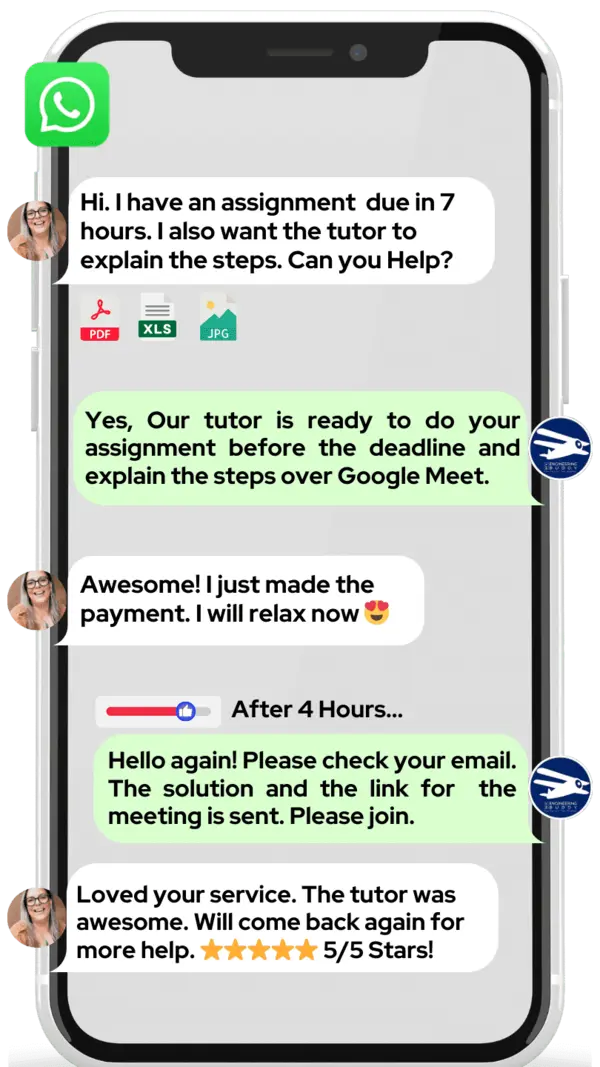



Hire The Best Solid Mechanics Tutor
Top Tutors, Top Grades. Without The Stress!
52,000+ Happy Students From Various Universities






How Much For Private 1:1 Tutoring & Hw Help?
Private 1:1 Tutoring and HW help Cost $20 – 35 per hour* on average.
Stress tensors at 11 PM. Beam deflection wrong again. Sound familiar?
Solid Mechanics Tutor Online
Solid Mechanics is a branch of mechanics studying the behaviour of solid materials under external loads — covering stress, strain, deformation, elasticity, and failure. It equips engineers to analyse structural integrity and predict material response.
MEB offers 1:1 online tutoring and homework help in 2800+ advanced subjects, including Solid Mechanics. Whether you’re searching for a Solid Mechanics tutor near me or need live sessions at midnight before a submission, MEB connects you with a verified expert — fast. If you’re already working through Mechanical Engineering coursework, Solid Mechanics is where most students hit their first serious wall.
- 1:1 online sessions tailored to your exact course and syllabus
- Expert-verified tutors with subject-specific postgraduate knowledge
- Flexible time zones — US, UK, Canada, Australia, Gulf
- Structured learning plan built after a diagnostic session
- Ethical homework and assignment guidance — you understand before you submit
52,000+ students across the US, UK, Canada, Australia, and the Gulf have used MEB since 2008 — including students in Mechanical Engineering subjects like Solid Mechanics, Mechanics of Materials, and Engineering Statics.
Source: My Engineering Buddy, 2008–2025.
How Much Does a Solid Mechanics Tutor Cost?
Most Solid Mechanics sessions run $20–$40/hr. Graduate-level or FEA-integrated work can reach $100/hr. Not sure what tier you need? Start with the $1 trial — 30 minutes of live tutoring or one full homework question explained.
| Level / Need | Typical Rate | What’s Included |
|---|---|---|
| Undergraduate (standard) | $20–$35/hr | 1:1 sessions, homework guidance |
| Advanced / Graduate | $35–$70/hr | Expert tutor, specialist depth |
| FEA / Research-Level | Up to $100/hr | Advanced simulation, thesis support |
| $1 Trial | $1 flat | 30 min live session or 1 HW question |
Tutor availability tightens in April and November — the peak exam months for most engineering programmes. Book early if your deadline is close.
WhatsApp MEB for a quick quote — average response time under 1 minute.
Who This Solid Mechanics Tutoring Is For
Solid Mechanics trips up students at every level — from second-year undergraduates meeting Mohr’s Circle for the first time to postgraduates working through nonlinear stress analysis. If any of the following fits, you’re in the right place.
- Undergraduate engineers in mechanical, civil, or aerospace programmes struggling with stress-strain relationships or beam theory
- Graduate students working on structural simulation or material failure research
- Students retaking after a failed first attempt — this is one of the most common reasons students contact MEB for Solid Mechanics help
- Students with a university conditional offer depending on this grade
- Students 4–6 weeks from an exam with significant gaps still to close
- Those needing assignment help on topics like torsion, buckling, or fatigue analysis
Students come from engineering programmes at institutions including MIT, Imperial College London, University of Toronto, ETH Zurich, UNSW Sydney, Delft University of Technology, and Georgia Tech — among many others.
At MEB, we’ve found that most Solid Mechanics students don’t struggle with the maths itself — they struggle with knowing which model applies to which problem. Once that clicks, the rest follows faster than they expect.
1:1 Tutoring vs Self-Study vs AI vs YouTube vs Online Courses
Self-study works if you’re disciplined, but Solid Mechanics problems require feedback — you won’t know your free-body diagram is wrong until someone tells you. AI tools explain concepts but can’t catch the specific sign error you keep making in your Mohr’s Circle construction. YouTube is useful for overviews of beam bending or stress transformation, but stops short when you’re stuck on your actual assignment. Online courses are structured but fixed-pace with no personalisation. With a 1:1 Solid Mechanics tutor online from MEB, every session targets your exact course, your current gaps, and corrects errors in real time — the moment they happen.
Outcomes: What You’ll Be Able To Do in Solid Mechanics
After working with an online Solid Mechanics tutor from MEB, students consistently report sharper problem-solving across the subject’s hardest areas. You’ll be able to solve statically indeterminate beam problems using compatibility equations. You’ll be able to analyse stress transformation and apply Mohr’s Circle correctly under combined loading. You’ll be able to model elastic deformation and predict yield onset using von Mises or Tresca criteria. You’ll be able to apply fracture mechanics concepts to fatigue-crack growth scenarios. You’ll be able to explain your reasoning in written assignments — not just arrive at a number.
Based on feedback from 40,000+ sessions collected by MEB from 2022 to 2025, 58% of students improved by one full grade after approximately 20 hours of 1:1 tutoring in subjects like Solid Mechanics. A further 23% achieved at least a half-grade improvement.
Source: MEB session feedback data, 2022–2025.
Try your first session for $1 — 30 minutes of live 1:1 tutoring or one homework question explained in full. No registration. No commitment. WhatsApp MEB now and get matched within the hour.
What We Cover in Solid Mechanics (Syllabus / Topics)
MEB tutors cover all standard undergraduate and graduate Solid Mechanics syllabi. Most university programmes follow a structure close to the following tracks.

Track 1: Stress, Strain, and Material Behaviour
- Normal and shear stress, stress components on oblique planes
- Strain definitions, compatibility equations, generalised Hooke’s Law
- Stress transformation and Mohr’s Circle for 2D and 3D states
- Principal stresses and maximum shear stress
- Yield criteria: von Mises, Tresca, and their application to design
- Elastic constants: Young’s modulus, Poisson’s ratio, shear modulus, bulk modulus
Core textbooks for this track: Mechanics of Materials by Hibbeler; Strength of Materials by Timoshenko; Solid Mechanics by Chadwick.
Track 2: Beams, Torsion, and Structural Analysis
- Shear force and bending moment diagrams for statically determinate beams
- Flexure formula, shear stress distribution in beams
- Beam deflection: double integration, Macaulay’s method, moment-area method
- Statically indeterminate beams: compatibility and superposition methods
- Torsion of circular shafts — solid and hollow; angle of twist
- Combined loading: axial, bending, torsion, and transverse shear acting together
- Column buckling: Euler’s formula, effective length, slenderness ratio
Core textbooks: Mechanics of Materials by Beer, Johnston & DeWolf; Advanced Mechanics of Materials by Boresi & Schmidt.
Track 3: Advanced Topics — Elasticity, Fatigue, and Fracture
- Theory of elasticity: equilibrium equations, compatibility, Airy stress function
- Thick-walled cylinders and rotating discs under pressure
- Stress concentration factors and notch sensitivity
- Fatigue: S-N curves, Goodman and Gerber criteria, cycle counting
- Fracture mechanics: stress intensity factor K, fracture toughness KIC, Paris Law
- Introduction to Finite Element Analysis for stress problems
Core textbooks: Elasticity by Timoshenko & Goodier; Fracture Mechanics by Anderson; Advanced Strength and Applied Stress Analysis by Budynas.
What a Typical Solid Mechanics Session Looks Like
The tutor opens by checking what happened with the previous topic — usually something like Mohr’s Circle or the compatibility method for an indeterminate beam. If the student got it wrong in their last assignment, that’s where the session starts. From there, the tutor and student work through problems together on screen — for example, drawing the correct shear force and bending moment diagrams for a propped cantilever, or setting up the stress tensor for a shaft under combined torsion and bending. The tutor uses a digital pen-pad to work through each step live. The student then replicates the method or explains the reasoning aloud. By the end, a specific practice problem is assigned — matched to what’s coming next in the course — and the next topic is flagged so the student knows what to prepare.
How MEB Tutors Help You with Solid Mechanics (The Learning Loop)
Diagnose: In the first session, the tutor identifies exactly where the student’s understanding breaks down — whether that’s the sign convention in bending, misapplication of superposition, or confusion between engineering strain and true strain. Nothing is assumed.
Explain: The tutor works through problems live using a digital pen-pad, showing every step — not just the answer. For Solid Mechanics, this often means annotating free-body diagrams in real time and walking through the physical reasoning behind each equation.
Practice: The student attempts a similar problem with the tutor present. This is where most errors surface — and where they get fixed, not glossed over.
Feedback: The tutor identifies exactly which step went wrong and why — whether it’s a sign error in the moment equation, a missed boundary condition, or an incorrect failure criterion. Students learn where marks are lost and how to stop losing them.
Plan: At the end of each session, the tutor maps the next topic, flags what to review, and sets a concrete task. Progress is tracked session to session — not left to chance.
Sessions run on Google Meet. Tutors use a digital pen-pad or iPad with Apple Pencil. Before your first session, share your course outline or syllabus, a recent assignment or past paper question you struggled with, and your exam or submission date. The first session doubles as your diagnostic. Start with the $1 trial — 30 minutes of live tutoring that also serves as your first diagnostic.
Students consistently tell us that Solid Mechanics finally made sense when they stopped memorising formulas and started drawing the physical picture first. The tutor’s job is to make that shift happen, not to lecture through slides.
Tutor Match Criteria (How We Pick Your Tutor)
Not every Solid Mechanics expert is the right fit for every student. Here’s what MEB looks at.
Subject depth: Tutors hold postgraduate degrees in mechanical, civil, or aerospace engineering — with demonstrated coursework or research in Solid Mechanics, not just general engineering. Tutors covering Continuum Mechanics or Nonlinear Finite Element Analysis at research level are matched separately from those covering standard undergraduate beam theory.
Tools: All tutors use Google Meet plus a digital pen-pad or iPad with Apple Pencil. No whiteboard apps that drop out mid-session.
Time zone: Matched to your region — US Eastern, UK/Europe, Gulf, Canada, or Australia. Sessions don’t run at 3 AM your time unless you ask for it.
Goals: Whether you need exam prep, help closing a specific homework gap, or support through a full semester of Engineering Mechanics, the tutor is matched to your actual objective — not assigned generically.
Unlike platforms where you fill out a form and wait, MEB responds in under a minute, 24/7. Tutor match takes under an hour. The $1 trial means you test before you commit. Everything runs over WhatsApp — no logins, no intake forms.
Study Plans (Pick One That Matches Your Goal)
After the diagnostic session, the tutor builds a specific sequence — but most students fall into one of three plans. Catch-up (1–3 weeks): closing targeted gaps before a submission or resit. Exam prep (4–8 weeks): structured revision across the full syllabus for a set exam date, with past paper practice built in. Weekly support: ongoing sessions aligned to lecture pace, so coursework problems and assignments don’t pile up. The tutor decides the exact sequence after seeing where you are — not before.
Pricing Guide
Standard Solid Mechanics tutoring runs $20–$40/hr for most undergraduate levels. Graduate-level work — covering elasticity theory, fracture mechanics, or FEA — runs $35–$100/hr depending on tutor specialisation and timeline pressure.
Rate factors include: topic complexity, level of study, how quickly you need sessions, and tutor availability. Rates are confirmed before your first session — no surprises.
For students targeting roles in structural engineering firms, aerospace companies, or graduate research programmes, tutors with active research or industry backgrounds in solid and structural mechanics are available at higher rates. Share your specific goal and MEB will match the tier to your ambition.
Availability tightens sharply in April and November. If your exam is within six weeks, book now. Start with the $1 trial — 30 minutes, no registration, no commitment. WhatsApp MEB for a quick quote.
Solid Mechanics sits at the intersection of mathematics and physical intuition. Students who improve fastest are those who treat every problem as a physical scenario first — and a calculation second.
Source: MEB tutor consensus, compiled from session feedback 2022–2025.
FAQ
Is Solid Mechanics hard?
Yes — it’s consistently rated one of the harder core modules in mechanical and civil engineering. The difficulty comes from combining physical intuition with rigorous mathematics. Students who struggle most are usually those trying to memorise formulas without understanding the underlying model.
How many sessions are needed?
Most students see meaningful improvement in 6–10 sessions. Students starting with major gaps — particularly in beam theory or stress transformation — typically need 15–20 hours to work through the full syllabus and past paper practice effectively.
Can you help with homework and assignments?
MEB tutoring is guided learning — you understand the work, then submit it yourself. The tutor explains the method, you apply it. See our Academic Integrity policy and Why MEB page for full details on what we help with and what we don’t.
Will the tutor match my exact syllabus or exam board?
Yes. Before the first session, share your course outline or module guide. MEB matches tutors to your specific university programme and syllabus — whether that’s a UK BEng module, a North American undergraduate course, or a Gulf-region engineering degree.
What happens in the first session?
The tutor runs a short diagnostic — usually by working through one or two problems with you — to pinpoint exactly where understanding breaks down. The session plan for subsequent weeks is built from that, not from a generic template.
Is online tutoring as effective as in-person?
For Solid Mechanics, yes — provided the tutor uses a digital pen-pad or tablet, which all MEB tutors do. Drawing free-body diagrams and stress elements live on screen is as clear as a whiteboard. Most MEB students prefer it: no commute, no scheduling friction.
What’s the difference between Solid Mechanics and Mechanics of Materials?
They overlap heavily. Mechanics of Materials typically covers the applied, design-focused content — beams, shafts, columns. Solid Mechanics goes further into elasticity theory, tensor notation, and continuum treatment. Many programmes use the terms interchangeably for the same module. Need help with Mechanics of Materials? MEB covers both.
Do I need to know FEA to study Solid Mechanics at graduate level?
Not always — but most graduate programmes introduce FEA as a tool for solving problems that have no closed-form solution. MEB tutors cover the analytical foundation first, then support the transition to software like COMSOL Multiphysics or NASTRAN if your programme requires it.
Can I get Solid Mechanics help at midnight?
Yes. MEB operates 24/7 across time zones. Students in the US, Gulf, and Australia regularly book late-night sessions. WhatsApp MEB any time — the average response is under a minute, and a tutor can often be matched the same night.
What if I don’t like my assigned tutor?
Request a replacement immediately over WhatsApp. MEB re-matches without fuss. The $1 trial is specifically designed so you can test the tutor match before spending more — no pressure, no awkward commitment.
How do I get started?
Three steps: WhatsApp MEB, share your course and exam date, get matched with a verified Solid Mechanics tutor — usually within an hour. Your first session is the $1 trial: 30 minutes of live tutoring or one full homework question explained from start to finish.
Trust & Quality at My Engineering Buddy
Every MEB tutor goes through subject-specific vetting — not a generic skills test. For Solid Mechanics, that means tutors hold a postgraduate degree in a relevant engineering discipline and demonstrate working knowledge of the specific topics students are assessed on: stress transformation, beam analysis, fracture mechanics, and FEA foundations. Tutors go through a live demo evaluation before joining the platform, and ongoing session feedback drives tutor ratings. Rated 4.8/5 across 40,000+ verified reviews on Google. That number comes from 18 years of operation and 52,000+ students served since 2008 — not a recent surge.
MEB tutoring is guided learning — you understand the work, then submit it yourself. For full details on what we help with and what we don’t, read our Academic Integrity policy and Why MEB.
MEB serves students across the US, UK, Canada, Australia, Gulf, and Europe in 2,800+ subjects. Within Mechanical Engineering, the platform covers Solid Mechanics alongside subjects including Engineering Dynamics, Fluid Mechanics, and Heat Transfer — all under one platform, all with the same tutor quality standard. Read more about the approach at MEB’s tutoring methodology.
A common pattern our tutors observe is that students arrive having re-read their notes five times and still feel stuck. Reading and doing are different things entirely. Every session at MEB is built around doing — not reviewing.
Explore Related Subjects
Students studying Solid Mechanics often also need support in:
- Computational Mechanics
- Strength of Materials
- Mechanical Vibrations
- Engineering Thermodynamics
- Finite Element Method
- Design of Machine Elements
- Fluid Dynamics
ASTM International maintains materials testing standards that underpin much of what Solid Mechanics students apply in fatigue and fracture analysis — understanding the source of these values matters as much as using them.
Source: ASTM International.
Next Steps
To get matched with a Solid Mechanics tutor, have the following ready:
- Your exam board or university programme name, and the specific module or course
- Your availability and time zone
- Your exam date or assignment deadline
Before your first session, have ready: your syllabus or course outline, a recent past paper attempt or homework problem you struggled with, and your exam or deadline date. The tutor handles the rest.
MEB matches you with a verified tutor — usually within 24 hours. The first session starts with a diagnostic so every minute is used well. Visit www.myengineeringbuddy.com for more on how MEB works.
WhatsApp to get started or email meb@myengineeringbuddy.com.
Reviewed by Subject Expert
This page has been carefully reviewed and validated by our subject expert to ensure accuracy and relevance.