Hire Verified & Experienced
Transport Phenomena (Momentum Heat & Mass) Tutors
Email: [email protected]
4.8/5 40K+ session ratings collected on the MEB platform



Hire The Best Transport Phenomena (Momentum Heat & Mass) Tutor
Top Tutors, Top Grades. Without The Stress!


Most students hit a wall on the momentum equation before Week 4. Shell balances, Navier-Stokes, coupled heat and mass transfer — the gap between lecture notes and a worked solution can cost you the whole course.
Transport Phenomena (Momentum Heat & Mass) Tutor Online
Transport Phenomena is a graduate-level chemical engineering course covering momentum transfer, heat transfer, and mass transfer using unified mathematical frameworks, equipping students to model fluid flow, conduction, convection, and diffusion in industrial and biological systems.
MEB provides 1:1 online tutoring and homework help in 2800+ advanced subjects — including a chemical engineering tutor online for every level from sophomore fundamentals to doctoral research. If you’ve searched for a Transport Phenomena tutor near me and found nobody who can actually work through the Bird, Stewart, and Lightfoot problems with you line by line, MEB can match you with a verified specialist — usually within the hour.
- 1:1 online sessions tailored to your course syllabus and problem sets
- Expert-verified tutors with graduate-level subject knowledge in transport theory
- Flexible time zones — US, UK, Canada, Australia, Gulf
- Structured learning plan built after a diagnostic session
- Ethical homework and assignment guidance — you understand the work, then submit it yourself
52,000+ students across the US, UK, Canada, Australia, and the Gulf have used MEB since 2008 — including students in Chemical Engineering subjects like Transport Phenomena, Reaction Engineering tutoring, and Separation Processes.
Source: My Engineering Buddy, 2008–2025.
How Much Does a Transport Phenomena Tutor Cost?
Rates start at $20–$40/hr for most undergraduate levels. Graduate and doctoral-level Transport Phenomena work, including coupled PDE systems and CFD integration, runs $40–$100/hr depending on tutor depth and timeline. The $1 trial gets you 30 minutes of live tutoring or a full worked solution to one homework question — no registration required.
| Level / Need | Typical Rate | What’s Included |
|---|---|---|
| Undergraduate (junior/senior) | $20–$40/hr | 1:1 sessions, homework guidance, shell balance walkthroughs |
| Graduate / Doctoral | $40–$100/hr | Advanced PDE systems, tensor notation, research-level support |
| $1 Trial | $1 flat | 30 min live session or one full homework question explained |
Tutor availability tightens significantly during end-of-semester exam windows. Book early if your finals are within six weeks.
WhatsApp MEB for a quick quote — average response time under 1 minute.
Who This Transport Phenomena Tutoring Is For
Transport Phenomena sits at the intersection of applied mathematics, fluid mechanics, and thermodynamics. Most students who struggle here aren’t weak at engineering — they’re under-supported when the math and the physics collide at the same time.
- Junior and senior chemical engineering students working through BSL (Bird, Stewart, Lightfoot) for the first time
- Graduate students whose programs assume fluency in tensor calculus and dimensional analysis they never fully built
- Students retaking after a failed first attempt — often one exam away from losing a conditional graduate program offer
- Students 4–6 weeks from finals with shell balance derivations, Nusselt number correlations, or diffusion boundary conditions still unclear
- Students needing homework and assignment guidance on coupled heat-and-mass problems, Graetz problems, or Stokes flow derivations
- Students at universities including MIT, Georgia Tech, UC Berkeley, University of Michigan, University of Manchester, Delft University of Technology, and ETH Zurich
If you’re in a program that uses BSL or Deen’s Analysis of Transport Phenomena and the problem sets feel like reading a foreign language, this is where MEB helps.
1:1 Tutoring vs Self-Study vs AI vs YouTube vs Online Courses
Self-study works if you’re already comfortable with vector calculus and the physics — most Transport Phenomena students aren’t, not yet. AI tools like ChatGPT can sketch a derivation but can’t tell you why your sign is wrong in the stress tensor or where your boundary condition breaks down. YouTube covers Reynolds Transport Theorem at a survey level and stops before the hard BSL problems. Online courses move at a fixed pace — useless when you have a problem set due Thursday. With MEB, a tutor works through your specific shell balance or energy equation in real time, finds the error, and makes sure you can replicate it. That feedback loop is what Transport Phenomena actually requires.
Outcomes: What You’ll Be Able To Do in Transport Phenomena (Momentum Heat & Mass)
After consistent sessions with an MEB tutor, students can solve shell momentum balances for laminar flow in standard geometries without scaffolding. They can apply the Navier-Stokes equations to creeping flow and Couette flow problems. Students learn to analyze heat conduction with specified boundary conditions and calculate Nusselt numbers for internal and external flows. They can model binary diffusion and apply Fick’s Law to membrane and absorption problems. They present dimensional analysis arguments using the Buckingham Pi theorem — and explain every step in exam conditions, not just follow a worked example.
Based on feedback from 40,000+ sessions collected by MEB from 2022 to 2025, 58% of students improved by one full grade after approximately 20 hours of 1:1 tutoring in subjects like Transport Phenomena (Momentum Heat & Mass). A further 23% achieved at least a half-grade improvement.
Source: MEB session feedback data, 2022–2025.
At MEB, we’ve found that Transport Phenomena students who struggle most are often those who skipped the full derivation in class and memorised the final equation instead. When the exam changes the geometry, they freeze. The fix is going back to first principles — and doing it with someone who can show you exactly where your reasoning breaks down.
What We Cover in Transport Phenomena (Momentum Heat & Mass) (Syllabus / Topics)

Track 1: Momentum Transfer (Fluid Mechanics)
- Viscosity, Newton’s Law of Viscosity, non-Newtonian fluids
- Shell momentum balances for plane, cylindrical, and annular geometries
- Equation of motion and Navier-Stokes equations in rectangular, cylindrical, and spherical coordinates
- Creeping flow (Stokes flow) and lubrication approximation
- Boundary layer theory — laminar flat-plate boundary layer, Blasius solution
- Turbulence: Reynolds averaging, eddy viscosity, log-law profiles
- Dimensional analysis and similitude: Reynolds, Froude, and Weber numbers
Core texts: Bird, Stewart & Lightfoot, Transport Phenomena (2nd ed.); White, Fluid Mechanics (8th ed.). Chapters 1–6 of BSL cover this track in full.
Track 2: Heat Transfer
- Fourier’s Law of heat conduction; thermal conductivity and its temperature dependence
- Shell energy balances; temperature profiles in slabs, cylinders, and spheres
- Equations of energy — viscous dissipation, pressure work terms
- Forced convection: Graetz problem, Nusselt number correlations for pipe and flat-plate flow
- Natural convection: Boussinesq approximation, Grashof and Rayleigh numbers
- Radiation heat transfer: black-body, grey-body, view factors
- Heat exchangers: LMTD and NTU-effectiveness methods
Core texts: Bird, Stewart & Lightfoot, Transport Phenomena, Chapters 9–14; Incropera & DeWitt, Fundamentals of Heat and Mass Transfer (7th ed.).
Track 3: Mass Transfer
- Fick’s First and Second Laws; binary diffusion coefficients
- Shell mass balances; concentration profiles with homogeneous reaction
- Equations of continuity for multicomponent mixtures
- Convective mass transfer: film theory, penetration theory, surface renewal theory
- Mass transfer coefficients and Sherwood number correlations
- Simultaneous heat and mass transfer: wet-bulb temperature, evaporative cooling
- Interphase mass transfer: two-film theory applied to absorption and extraction
Core texts: Bird, Stewart & Lightfoot, Chapters 16–24; Deen, Analysis of Transport Phenomena (2nd ed.), MIT Press. The National Science Foundation supports ongoing transport phenomena research that informs graduate curriculum at US programs.
Students consistently tell us that the moment Transport Phenomena clicks is when they stop treating momentum, heat, and mass as three separate subjects and start seeing them as the same set of equations wearing different clothes. That shift usually happens in one session — if the tutor is working from first principles rather than plugging into correlation tables.
What a Typical Transport Phenomena Session Looks Like
The tutor opens by checking the previous session’s topic — usually a shell momentum balance or a specific boundary condition the student got wrong on a problem set. The student shares their screen with the attempted derivation visible. Working through the Navier-Stokes simplification or the energy equation together, the tutor uses a digital pen-pad to annotate every step, writes the full tensor notation where needed, and asks the student to fill in the next line before revealing it. When the student replicates the method on a parallel problem — a different geometry, the same physics — and gets it right, that’s when the session closes. A specific practice problem is assigned, and the next topic (say, the Graetz problem or penetration theory for mass transfer) is noted for the following session. Nothing is left open-ended.
How MEB Tutors Help You with Transport Phenomena (Momentum Heat & Mass) (The Learning Loop)
Diagnose: In the first session, the tutor identifies exactly where the student’s understanding breaks — whether it’s vector calculus foundations, coordinate system transformations, or the physical interpretation of the stress tensor. This isn’t a quiz; it’s a ten-minute conversation around one problem.
Explain: The tutor works through the derivation live, using a digital pen-pad — not slides, not a textbook photo. Every step is spoken aloud. The student sees the reasoning, not just the answer.
Practice: The student attempts the next problem with the tutor present. No jumping ahead. If the sign is wrong on the momentum flux, the tutor catches it before the student has written three more lines on a false premise.
Feedback: Errors are corrected step by step — the tutor explains not just what is wrong but why it costs marks in an exam and how the examiner’s marking scheme reads that specific kind of error.
Plan: Every session ends with a written note on what was covered, what the student should attempt before next time, and which topic is scheduled next. Progress is tracked against the course syllabus, not vague goals.
Sessions run on Google Meet. The tutor uses a digital pen-pad or iPad with Apple Pencil. Before the first session, share your course syllabus, a recent problem set you struggled with, and your exam date if known. The first session is diagnostic — the tutor will map your gaps and set a topic sequence from there. Start with the $1 trial — 30 minutes of live tutoring that also serves as your first diagnostic.
Tutor Match Criteria (How We Pick Your Tutor)
Every Transport Phenomena tutor at MEB is matched on four criteria before the first session is confirmed.
Subject depth: Graduate-level coursework in Transport Phenomena, with demonstrable fluency in BSL chapters, tensor notation, and coupled transport problems. Tutors working with doctoral students hold research backgrounds in fluid dynamics, process engineering, or computational transport.
Tools: All tutors work on Google Meet with a digital pen-pad or iPad and Apple Pencil. No whiteboard photos. No typed-only sessions for a subject that requires live derivation.
Time zone: Matched to your region — US, UK, Gulf, Canada, or Australia — so session times are practical, not inconvenient.
Goals: Whether you need to pass a final exam, close a gap in one specific track, or get support for a research-level transport problem, the tutor is selected to match that scope — not assigned generically.
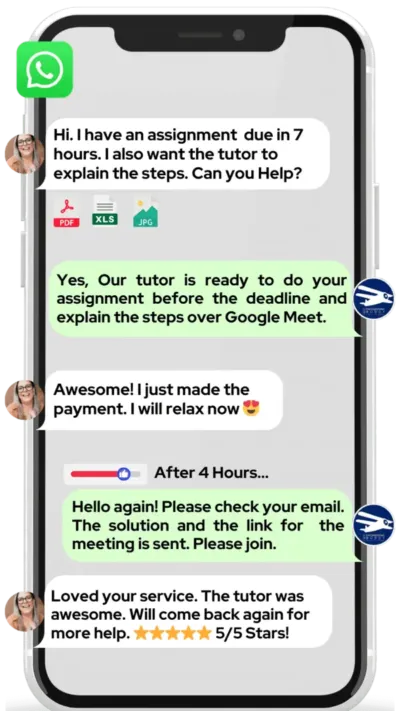
Unlike platforms where you fill out a form and wait, MEB responds in under a minute, 24/7. Tutor match takes under an hour. The $1 trial means you test before you commit. Everything runs over WhatsApp — no logins, no intake forms.
Study Plans (Pick One That Matches Your Goal)
Catch-up (1–3 weeks): for students who have fallen behind on shell balances, boundary conditions, or dimensional analysis with a problem set or midterm approaching. Intensive, targeted, nothing wasted. Exam prep (4–8 weeks): structured revision covering all three tracks — momentum, heat, and mass — mapped to your course’s exam topics and weighted by difficulty. Weekly support: ongoing sessions aligned to your semester schedule, covering each new topic as it lands and reinforcing the ones your course builds on. After the first diagnostic session, the tutor builds the exact sequence — not a generic revision plan.
Pricing Guide
Transport Phenomena tutoring starts at $20/hr for undergraduate-level work. Graduate and doctoral support, particularly for advanced PDE systems, tensor formulation, or research-adjacent problems, runs up to $100/hr. Rate factors include level, topic complexity, session frequency, and tutor availability during peak periods.
For students targeting top graduate programs — MIT ChE, Stanford, ETH Zurich, Imperial College — tutors with research backgrounds in computational fluid dynamics or process modelling are available at higher rates. Share your specific program and goal, and MEB will match the tutor tier accordingly.
Availability is limited during end-of-semester and finals periods. Book before your course reaches the heat transfer or mass transfer chapters if possible.
Start with the $1 trial — 30 minutes, no registration, no commitment. WhatsApp MEB for a quick quote.
Transport Phenomena is consistently rated one of the most mathematically demanding required courses in chemical engineering programs — alongside courses like Separation Processes help and Reaction Engineering tutoring. Most students who fail it the first time were never shown the derivation in full — only the result.
Source: My Engineering Buddy, 2008–2025.
Try your first session for $1 — 30 minutes of live 1:1 tutoring or one homework question explained in full. No registration. No commitment.
WhatsApp MEB now
and get matched within the hour.
FAQ
Is Transport Phenomena hard?
Yes — it’s genuinely one of the harder required courses in chemical engineering. The difficulty comes from needing strong vector calculus, physical intuition, and mathematical rigour at the same time. Most students who struggle do so because one of those three foundations has a gap, not because the course is conceptually impossible.
How many sessions are needed?
For exam prep starting 4–6 weeks out, most students book 10–15 hours spread across the three tracks. For specific homework support on one problem set, a single session is often enough. The first diagnostic session maps what’s actually needed — no generic package is pushed on you.
Can you help with homework and assignments?
MEB tutoring is guided learning — you understand the work, then submit it yourself. The tutor explains the method and reasoning; you produce and submit the solution. See our Academic Integrity policy and Why MEB page for full details on what we help with and what we don’t.
Will the tutor match my exact syllabus or exam board?
Yes. Before the first session, you share your course syllabus or textbook chapters. If your course uses BSL, Deen, or a department-written course pack, the tutor works from that — not a generic curriculum. University-specific problem styles, notation conventions, and exam formats are all taken into account.
What happens in the first session?
The tutor runs a short diagnostic — usually one problem from each track you’ve covered so far. This identifies exactly where the gaps are. The session then focuses on the highest-priority gap, and a topic plan is set before the session ends. You leave with a clear next step, not just a homework answer.
Is online tutoring as effective as in-person?
For derivation-heavy subjects like Transport Phenomena, the digital pen-pad on Google Meet is often cleaner than a physical whiteboard — the student sees every step annotated in real time, and the session recording can be reviewed after. Most MEB students report no meaningful difference versus in-person, once the setup is familiar.
Do I need to have studied BSL specifically, or do you cover other textbooks?
MEB tutors cover BSL, Deen, Welty et al. (Fundamentals of Momentum, Heat, and Mass Transfer), and departmental course notes. If your program uses a specific text or problem set style, share it before the first session and the tutor will align the approach accordingly.
What’s the difference between Transport Phenomena and Fluid Mechanics or Heat Transfer as separate courses?
Transport Phenomena treats momentum, heat, and mass transfer as a unified framework using the same governing equations and mathematical structure. Standalone Fluid Mechanics or Heat Transfer courses typically cover less of the tensor formalism and rarely address the coupling between all three. BSL-based courses are mathematically more demanding than most standalone alternatives.
Can I get Transport Phenomena help late at night or on weekends?
Yes. MEB operates 24/7 across time zones. Students in the US, Gulf, and Australia regularly book sessions outside standard business hours. WhatsApp MEB at any time and a response typically comes within a minute, even on weekends during exam season.
How do I get started?
WhatsApp MEB, share your course level and the topic you’re stuck on, and you’ll be matched with a tutor — usually within the hour. The first session is the $1 trial: 30 minutes of live tutoring or one full problem explained from scratch. Three steps: WhatsApp → matched → start trial.
What if I’m stuck specifically on tensor notation and index notation — can MEB help with that?
Yes. Tensor and index notation in Transport Phenomena (particularly in the full Navier-Stokes derivation and the equations of change) are a common sticking point. MEB tutors with graduate mathematics and engineering backgrounds work through the notation system specifically, not just the final result. It usually takes one dedicated session to resolve the confusion.
Does MEB help with Transport Phenomena problems involving numerical methods or CFD?
MEB provides OpenFOAM tutoring and supports students where Transport Phenomena problems require numerical solution — finite difference, finite element, or CFD solver interpretation. If your coursework involves COMSOL, FLUENT, or OpenFOAM applied to transport problems, share that detail when you contact MEB.
Trust & Quality at My Engineering Buddy
Every Transport Phenomena tutor on MEB passes a subject-specific screening process — not a general engineering screen. Tutors demonstrate working knowledge of BSL chapters, tensor calculus application, and multicomponent transport problems through a live evaluation before being listed. Ongoing session feedback is reviewed, and tutors with declining ratings are removed. Rated 4.8/5 across 40,000+ verified reviews on Google, MEB has operated since 2008 across 2,800+ advanced subjects. The platform serves students in the US, UK, Canada, Australia, the Gulf, and Europe.
MEB tutoring is guided learning — you understand the work, then submit it yourself. For full details on what we help with and what we don’t, read our Academic Integrity policy and Why MEB.
MEB covers the full breadth of chemical engineering tutoring — from first-year fundamentals through doctoral research. Subjects closely related to Transport Phenomena include Energy and Mass Balance tutoring and Chemical Process Calculation and Equipment Design help. Tutors in all three are drawn from the same pool of verified chemical engineering specialists.
MEB has served students across Combustion Engineering tutoring, Electrochemical Engineering help, and Transport Phenomena since 2008 — across 18 years and 52,000+ students. Read more about how MEB selects and evaluates tutors at our tutoring methodology page.
Source: My Engineering Buddy, 2008–2025.
A common pattern our tutors observe is that students arrive having memorised the continuity equation but having no idea how it was derived or what it physically means. Transport Phenomena demands both. The derivation isn’t extra — it’s the exam. Students who can derive from scratch score significantly higher than those who only recognise the final form.
Explore Related Subjects
Students studying Transport Phenomena often also need support in:
Next Steps
When you contact MEB, share your exam board or university course code, the specific track or problem type giving you the most trouble, and how many weeks you have before your next assessment. Share your time zone and a few available slots. MEB matches you with a verified Transport Phenomena tutor — usually within 24 hours, often faster.
Before your first session, have ready: your course syllabus or BSL chapter list, a recent problem set or exam question you struggled with, and your exam or submission date. The tutor handles the rest.
- Share your exam board and hardest component
- Share your availability and time zone
- MEB matches you with a verified tutor — usually within 24 hours
Visit www.myengineeringbuddy.com for more on how MEB works.
WhatsApp to get started or email [email protected].
52,000+ Happy Students From Various Universities






How Much For Private 1:1 Tutoring & Hw Help?
Private 1:1 Tutoring and HW help Cost $20 – 35 per hour* on average.
Reviewed by Subject Expert
This page has been carefully reviewed and validated by our subject expert to ensure accuracy and relevance.