~1 min
Average Reply Time
~1 hour
To Be Matched With A Tutor
30 Min Trial
75% Find Their Tutor On The 1st Trial
$20-35+/hr
Premium Yet Affordable Learning
Hire The Best Food Science Tutor

Most students who struggle with Food Science aren’t bad at science — they’re missing the connection between chemistry, microbiology, and what actually happens to food during processing.
Food Science Tutor Online
Food Science is the study of the physical, chemical, and biological properties of food — covering food composition, preservation, safety, processing, and quality control — equipping students to apply scientific principles to food production and regulatory compliance.
MEB offers 1:1 online tutoring and homework help in 2,800+ advanced subjects, including Food Science. Part of a broader Chemical Engineering tutoring curriculum, Food Science sits at the intersection of chemistry, microbiology, and engineering. If you’ve searched for a Food Science tutor near me, MEB matches you with a verified expert — typically within an hour — for sessions built around your exact course, not a generic syllabus.
- 1:1 online sessions tailored to your university module, exam board, or course outline
- Expert-verified tutors with subject-specific Food Science knowledge and research backgrounds
- Flexible time zones — US, UK, Canada, Australia, Gulf
- Structured learning plan built after a diagnostic session
- Ethical homework and assignment guidance — you understand the work, then submit it yourself
52,000+ students across the US, UK, Canada, Australia, and the Gulf have used MEB since 2008 — including students in Chemical Engineering subjects like Food Science, Food Processing, and Food Biotechnology.
Source: My Engineering Buddy, 2008–2025.
How Much Does a Food Science Tutor Cost?
Most Food Science tutoring sessions run $20–$40/hr. Graduate-level or highly specialised topics — such as food rheology or regulatory toxicology — can reach $70–$100/hr. The $1 trial gives you 30 minutes of live 1:1 tutoring or a full explanation of one homework question before you commit to anything.
| Level / Need | Typical Rate | What’s Included |
|---|---|---|
| Undergraduate (most modules) | $20–$35/hr | 1:1 sessions, homework guidance |
| Advanced / Graduate / Specialist | $35–$100/hr | Expert tutor, niche depth, research support |
| $1 Trial | $1 flat | 30 min live session or 1 homework question explained |
Tutor availability tightens significantly during final exam periods. Book early if you’re within six weeks of a submission deadline or end-of-semester exam.
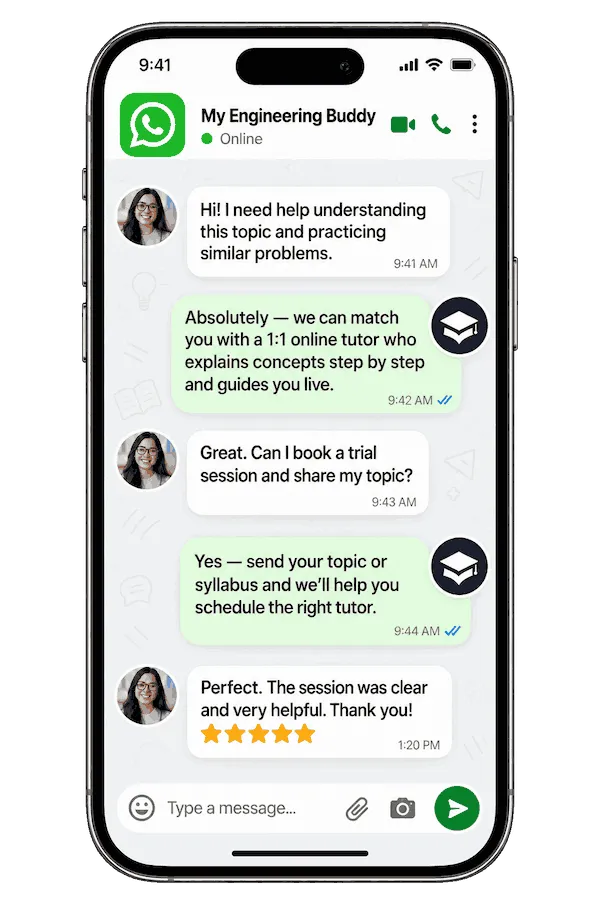
WhatsApp MEB for a quick quote — average response time under 1 minute.
Who This Food Science Tutoring Is For
Food Science spans undergraduate programmes in food technology, nutrition science, and chemical engineering — and the difficulty spikes fast once you hit heat transfer in processing, microbial kinetics, or food safety regulation. This tutoring is for students who need someone to actually work through the material with them.
- Undergraduate students in food science, food technology, or nutrition programmes struggling with core modules
- Graduate students working on food safety, quality assurance, or food product development coursework
- Students retaking after a failed first attempt at a food science module
- Students with a university conditional offer depending on passing their food science unit
- Students 4–6 weeks from an exam with significant gaps in food chemistry or microbiology still to close
- Students with a coursework or lab report submission deadline approaching
Students working through Food Science programmes at universities across the US, UK, Canada, Australia, and the Gulf — including programmes at institutions like Cornell, UC Davis, Wageningen, Reading, and Queensland — have used MEB for targeted support at module level.
At MEB, we’ve found that Food Science students often hit a wall at the same point: they understand the biology and they understand the chemistry, but connecting both to what happens inside an industrial processing line takes a different kind of explanation — one that only comes from working through it live, with someone who’s been there.
1:1 Tutoring vs Self-Study vs AI vs YouTube vs Online Courses
Self-study works if you’re disciplined — but Food Science has too many interconnected systems for gap-finding to happen reliably on your own. AI tools explain fast but can’t adapt when your question is about your specific lab protocol or your professor’s marking scheme. YouTube is useful for overviews of pasteurisation or Maillard reactions, but it stops when you’re stuck on a specific calculation. Online courses give structure at a fixed pace, with no room for the topic that’s blocking you right now. With a 1:1 online Food Science tutor at MEB, sessions are calibrated to your exact module — errors get corrected as they happen, not after the exam.
Outcomes: What You’ll Be Able To Do in Food Science
After working with an MEB Food Science tutor, you’ll be able to solve mass and energy balance problems in food processing systems, analyze microbial growth curves and apply them to shelf-life prediction, explain the chemistry behind emulsification, gelation, and starch retrogradation, apply HACCP principles to a food production scenario from farm to retail, and write lab reports that correctly interpret water activity, pH, and texture data. These aren’t generic outcomes — they’re the competencies that separate students who pass from students who understand.
Supporting a student through Food Science? MEB works directly with parents to set up sessions, track progress, and keep coursework on schedule. WhatsApp MEB — average response time is under a minute, 24/7.
Based on feedback from 40,000+ sessions collected by MEB from 2022 to 2025, 58% of students improved by one full grade after approximately 20 hours of 1:1 tutoring in subjects like Food Science. A further 23% achieved at least a half-grade improvement.
Source: MEB session feedback data, 2022–2025.
What We Cover in Food Science (Syllabus / Topics)

Food Chemistry and Composition
- Water activity, moisture content, and their role in food stability
- Carbohydrate chemistry: starch gelatinisation, retrogradation, and hydrocolloids
- Protein functionality: denaturation, gelation, emulsification, and foaming
- Lipid oxidation, rancidity mechanisms, and antioxidant systems
- Maillard reaction, caramelisation, and colour development in processed foods
- Vitamins, minerals, and bioavailability across different processing conditions
Core texts: Food Chemistry by Belitz, Grosch & Schieberle; Introduction to Food Chemistry by Coultate — used across most undergraduate food science programmes.
Food Microbiology and Safety
- Microbial growth kinetics: lag, log, stationary, and death phases
- Foodborne pathogens: Salmonella, Listeria, E. coli O157:H7, and Campylobacter
- Predictive microbiology and shelf-life modelling
- HACCP system design, critical control points, and verification procedures
- Hurdle technology and combined preservation strategies
- Regulatory frameworks: FDA Food Safety Modernization Act (FSMA), EU food hygiene regulations
Core texts: Modern Food Microbiology by Jay, Loessner & Golden; Food Safety Handbook by Schmidt & Rodrick — standard references in US and UK programmes.
Food Processing and Engineering
- Heat and mass transfer in thermal processing: pasteurisation and sterilisation calculations
- D-values, Z-values, and F-values in thermal death kinetics
- Energy and mass balance applied to food production systems
- Evaporation, drying, and freeze-drying: principles and equipment selection
- Separation processes in food manufacturing: filtration, centrifugation, membrane technology
- Packaging materials, modified atmosphere packaging, and active packaging systems
- Rheology and texture measurement in food products
Core texts: Introduction to Food Engineering by Singh & Heldman; Food Process Engineering and Technology by Berk — widely used in undergraduate chemical and food engineering courses.
What a Typical Food Science Session Looks Like
The tutor opens by checking the previous topic — usually something like D-value calculations or HACCP critical limits — to see what landed and what didn’t. From there, you and the tutor work through the current problem on screen: maybe it’s a thermal processing calculation, a microbial growth curve you can’t interpret, or a food chemistry question about why an emulsion broke. The tutor uses a digital pen-pad to work through equations in real time, and you replicate the reasoning or explain it back — not just copy the answer. If your food preservation assignment is due next week, that becomes the focus. The session closes with a specific practice task set and the next topic identified so there’s no dead time at the start of your next session.
How MEB Tutors Help You with Food Science (The Learning Loop)
Diagnose: In the first session, the tutor identifies whether your gaps are in the chemistry (food composition, reactions), the microbiology (growth kinetics, pathogen behaviour), the engineering calculations (heat transfer, mass balance), or the applied frameworks (HACCP, regulatory compliance). Most students have gaps in more than one area — the diagnostic maps them precisely.
Explain: The tutor works through live examples using a digital pen-pad — not slides, not pre-recorded content. You see the working in real time. A calculation for F-value in sterilisation looks very different when someone builds it line by line than when you read it in a textbook.
Practice: You attempt similar problems with the tutor present. The tutor watches for where reasoning breaks down — not just where the answer is wrong.
Feedback: Every error gets a step-by-step explanation of what went wrong and why that specific mistake costs marks. If you misapply the Arrhenius equation to a shelf-life calculation, the tutor explains both the concept error and the calculation error separately.
Plan: The tutor maps the next topic, sets a concrete task, and checks back at the start of the following session. No session ends without a clear next step.
Sessions run over Google Meet. The tutor uses a digital pen-pad or iPad with Apple Pencil for working problems live. Before your first session, share your course outline or module handbook, a past exam paper or assignment you’ve struggled with, and your exam or submission date. Start with the $1 trial — 30 minutes of live tutoring that also serves as your first diagnostic.
Try your first session for $1 — 30 minutes of live 1:1 tutoring or one homework question explained in full. No registration. No commitment. WhatsApp MEB now and get matched within the hour.
Tutor Match Criteria (How We Pick Your Tutor)
Not every Food Science tutor is right for every student. MEB matches on four criteria.
Subject depth: The tutor must have worked at the specific level you’re studying — undergraduate food chemistry is very different from a graduate food safety regulatory module. Exam board and syllabus fit matter.
Tools: Every tutor uses Google Meet with a digital pen-pad or iPad and Apple Pencil — essential for working through calculations and diagrams live.
Time zone: Matched to your region — US, UK, Gulf, Canada, or Australia — so session times are practical, not 2am compromises.
Goals: Whether you need to close specific exam gaps, work through food processing coursework, understand food chemistry conceptually, or get homework guidance — the tutor’s approach is calibrated to that goal.
Unlike platforms where you fill out a form and wait, MEB responds in under a minute, 24/7. Tutor match takes under an hour. The $1 trial means you test before you commit. Everything runs over WhatsApp — no logins, no intake forms.
Students consistently tell us that what surprised them most wasn’t the tutor’s knowledge — it was how quickly the tutor found the exact point where their understanding had broken down, often within the first 20 minutes of the first session.
Source: My Engineering Buddy, student session feedback, 2022–2025.
Study Plans (Pick One That Matches Your Goal)
After the first diagnostic, the tutor builds a session plan around one of three structures. Catch-up (1–3 weeks): for students with specific gaps to close before an exam or submission — fast, focused, no wasted sessions. Exam prep (4–8 weeks): structured revision across all exam components, with past paper practice built in from week two. Weekly support: ongoing, aligned to your semester schedule and coursework deadlines, with food biotechnology or related modules added as they appear on your course. The tutor decides the specific sequence after the diagnostic — not before it.
Pricing Guide
Food Science tutoring starts at $20/hr for most undergraduate modules. Graduate-level work, specialist topics like food rheology or novel food regulation, and tight-timeline requests can reach $70–$100/hr. Rate factors include academic level, topic complexity, your exam date, and tutor availability.
Availability shrinks fast in the four weeks before end-of-semester exams. If you’re within that window, book early.
For students targeting graduate programmes in food science at research universities or positions in regulatory bodies like the FDA or EFSA, tutors with food industry or research backgrounds are available at higher rates — share your specific goal and MEB matches the tier to your ambition.
Start with the $1 trial — 30 minutes, no registration, no commitment. WhatsApp MEB for a quick quote.
Students consistently tell us that the sessions that make the biggest difference aren’t the ones before the exam — they’re the ones three weeks before, when there’s still time to actually fix the gap rather than just flag it.
FAQ
Is Food Science hard?
It’s genuinely multi-disciplinary — you’re applying chemistry, microbiology, and engineering simultaneously. Most students find food chemistry and thermal processing calculations the steepest parts. With a tutor working through these areas systematically, the difficulty drops fast.
How many sessions are needed?
For a specific exam gap, 4–8 sessions usually make a measurable difference. For ongoing support across a semester with multiple modules, weekly sessions work better. The first diagnostic determines what’s realistic for your timeline and starting point.
Can you help with homework and assignments?
Yes. MEB tutoring is guided learning — you understand the work, then submit it yourself. See our Academic Integrity policy and Why MEB page for full details on what we help with and what we don’t. Lab reports, problem sets, and case study assignments are all in scope.
Will the tutor match my exact syllabus or exam board?
Yes. Before matching, MEB checks your course outline, module handbook, or exam board. A tutor familiar with your specific syllabus — whether that’s a US university module, a UK undergraduate programme, or a Gulf institution’s curriculum — is selected before the first session.
What happens in the first session?
The tutor runs a diagnostic — working through a past paper question or problem set with you to identify where reasoning breaks down. By the end of the first session, you have a clear picture of your gaps and a plan for the next two to four sessions.
Is online tutoring as effective as in-person?
For calculation-heavy subjects like Food Science, online is often better. The tutor writes and draws in real time on a digital pen-pad, you see every step, and sessions are recorded or noted so you can revisit them. No commute, no scheduling friction.
Can you help with HACCP assignments and food safety case studies?
Yes. HACCP system design, critical control point identification, and food safety management case studies are covered regularly. Tutors walk through the seven HACCP principles applied to real processing scenarios — not just the theory from the textbook.
Do you cover food regulations like FSMA, EU food law, or Codex Alimentarius?
Yes. Regulatory frameworks are a distinct area of Food Science that many students underestimate. MEB tutors cover FSMA requirements, EU food hygiene regulations, and Codex Alimentarius standards — particularly for students in food quality, regulatory affairs, or food safety modules.
Can I get Food Science help at midnight or on weekends?
Yes. MEB operates 24/7 across time zones. Students in the US, UK, Gulf, and Australia regularly book late-night or weekend sessions around their schedules. WhatsApp MEB any time — response is typically under a minute.
What if I don’t like my assigned tutor?
Tell MEB via WhatsApp. A replacement is matched within hours, no questions asked. The $1 trial is specifically designed so you test the tutor before committing to a paid session block.
How do I get started?
Three steps: WhatsApp MEB → get matched with a verified Food Science tutor, usually within an hour → start the $1 trial (30 minutes live or one question fully explained). No registration form, no upfront payment beyond $1.
Trust & Quality at My Engineering Buddy
Every MEB tutor goes through subject-specific vetting: a screening interview, a live demo session evaluated against subject criteria, and ongoing review based on student feedback. Tutors teaching Food Science hold degrees in food science, food technology, chemical engineering, or closely related disciplines — many with industry experience in food manufacturing, quality assurance, or regulatory compliance. Rated 4.8/5 across 40,000+ verified reviews on Google.
MEB tutoring is guided learning — you understand the work, then submit it yourself. For full details on what we help with and what we don’t, read our Academic Integrity policy and Why MEB.
MEB has served 52,000+ students across the US, UK, Canada, Australia, the Gulf, and Europe in 2,800+ subjects since 2008. Within Chemical Engineering and related applied sciences, the platform covers Reaction Engineering tutoring, Chemical Process Safety help, and Molecular Engineering tutoring alongside Food Science. The MEB tutoring methodology is built on a diagnostic-first structure used consistently across all subjects.
18 years of operation, 52,000+ students, and a 4.8/5 rating aren’t marketing numbers — they’re the result of matching the right tutor to the right student and not accepting a session that doesn’t move the student forward.
Source: My Engineering Buddy, 2008–2025. ScienceDirect Life Sciences is one of the primary research databases MEB tutors reference when students need journal-level source support for food science assignments.
Explore Related Subjects
Students studying Food Science often also need support in:
- Aspen HYSYS
- Aspen Plus
- Chemical Process Calculation, Control & Equipment Design
- Electrochemistry
- Combustion Engineering
- Transport Phenomena: Momentum, Heat & Mass
- OpenFOAM
Next Steps
When you contact MEB, have three things ready: your exam board or course outline, the specific topic or assignment you’re stuck on, and your exam or submission date. That’s all the tutor needs to start.
- Share your syllabus, hardest component, and current timeline
- Share your availability and time zone
- MEB matches you with a verified Food Science tutor — usually within 24 hours
- First session starts with a diagnostic so every minute is used well
Before your first session, have ready: your exam board and syllabus (or course outline), a recent past paper attempt or homework you struggled with, and your exam or deadline date. The tutor handles the rest.
Visit www.myengineeringbuddy.com for more on how MEB works.
WhatsApp to get started or email [email protected].
Reviewed by Subject Expert
This page has been carefully reviewed and validated by our subject expert to ensure accuracy and relevance.