~1 min
Average Reply Time
~1 hour
To Be Matched With A Tutor
30 Min Trial
75% Find Their Tutor On The 1st Trial
$20-35+/hr
Premium Yet Affordable Learning
Most AP Drawing portfolios score lower than they should — not because the student can’t draw, but because no one taught them how to write a sustained investigation that holds together.
AP Art and Design: Drawing Tutor Online
AP Art and Design: Drawing is a College Board portfolio-based course in which students develop a body of work demonstrating sustained inquiry, technical drawing skills, and conceptual coherence. An AP Art and Design Drawing tutor helps students build a portfolio that meets College Board scoring criteria.
Looking for an AP Art and Design Drawing tutor near me who understands sustained investigation, quality versus quantity, and the specific rubric language College Board scorers use? MEB matches you with a 1:1 online AP Art and Design: 2-D Design tutoring-level specialist who knows the AP Drawing portfolio inside and out. Sessions are structured around your current work, your investigation arc, and your submission deadline — not a generic art syllabus.
- 1:1 online sessions tailored to your AP Drawing portfolio and College Board rubric
- Expert verified tutors with AP Art and Design subject-specific knowledge
- Flexible time zones — US, UK, Canada, Australia, Gulf
- Structured learning plan built after a diagnostic review of your current work
- Ethical assignment guidance — you understand the feedback, then develop your own work
52,000+ students across the US, UK, Canada, Australia, and the Gulf have used MEB since 2008 — across 2,800+ subjects, from AP Calculus to A Level Music Technology to Data Science.
Source: My Engineering Buddy, 2008–2025.
How Much Does an AP Art and Design: Drawing Tutor Cost?
Most AP Drawing tutoring sessions run $20–$40/hr depending on the tutor’s experience and how close you are to your submission window. You can start for $1 — 30 minutes of live 1:1 guidance or a full critique of one portfolio piece.
| Level / Need | Typical Rate | What’s Included |
|---|---|---|
| Standard AP Drawing | $20–$35/hr | 1:1 sessions, portfolio critique, investigation guidance |
| Advanced / Specialist | $35–$70/hr | Expert tutor, in-depth rubric coaching, college art prep |
| $1 Trial | $1 flat | 30 min live session or one portfolio piece critiqued in full |
Tutor availability tightens significantly in March and April as submission deadlines approach. Book early if your portfolio window is close.
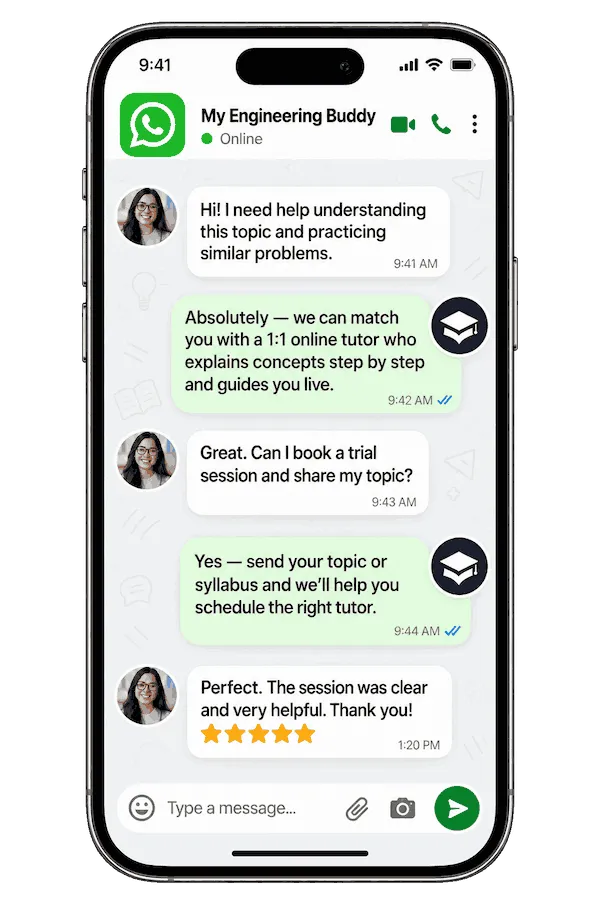
WhatsApp MEB for a quick quote — average response time under 1 minute.
Who This AP Art and Design: Drawing Tutoring Is For
AP Drawing is one of the most open-ended AP courses — and that freedom trips students up. A tutor helps you build direction and coherence into work that might otherwise feel scattered.
- Students who have strong drawing skills but no clear sustained investigation thread
- Students whose portfolio pieces feel disconnected from each other
- Students with a coursework submission deadline approaching and significant gaps still to close
- Students aiming for scores of 3, 4, or 5 and wanting specific rubric feedback
- Students preparing art portfolios for colleges such as RISD, Pratt, the School of the Art Institute of Chicago, Parsons, or UCLA
- Parents watching a student produce strong individual pieces but struggle to unify them into a coherent body of work
Students who have already attempted their portfolio and received low scores in a practice submission also benefit significantly from 1:1 AP Art and Design: 3-D Design tutoring-adjacent guidance on conceptual framing and technical execution.
1:1 Tutoring vs Self-Study vs AI Tools
Self-study works for isolated technique practice — gesture drawing, mark-making, tonal range — but it gives you no feedback on whether your investigation has a coherent arc, and you can spend three months developing a portfolio that misses the College Board rubric entirely without realising it. AI tools can generate critique language quickly, but they cannot look at your actual drawings, assess whether your sustained investigation holds together visually and conceptually, or tell you in real time why a specific piece is pulling your score down. In AP Drawing, the difference between a 3 and a 5 often comes down to how well a human scorer reads your intent — and that requires live, annotated feedback from someone who knows what scorers look for. MEB sessions give you that feedback online, matched to your exact College Board submission requirements.
Outcomes: What You’ll Be Able To Do in AP Art and Design: Drawing
After working with an MEB AP Drawing tutor, you will be able to apply sustained investigation principles to connect every piece in your portfolio to a single, legible artistic inquiry. You will analyze your own work using College Board rubric language — quality, quantity, and sustained investigation — and explain your choices with the clarity that scores well. You will present a body of work in which medium, subject, and concept reinforce each other rather than pull in different directions. You will write an artist statement that accurately represents your process and intent. You will solve common portfolio weaknesses such as inconsistent mark quality or an investigation that shifts focus halfway through.
Supporting a student through AP Art and Design: Drawing? MEB works directly with parents to set up sessions, track progress, and keep portfolio submissions on schedule. WhatsApp MEB — average response time is under a minute, 24/7.
Based on feedback from 40,000+ sessions collected by MEB from 2022 to 2025, 58% of students improved by one full grade after approximately 20 hours of 1:1 tutoring in a single subject. A further 23% achieved at least a half-grade improvement.
Source: MEB session feedback data, 2022–2025.
What We Cover in AP Art and Design: Drawing (Syllabus / Topics)
AP Drawing portfolios are assessed on three components: sustained investigation, works of art and design, and selected works. MEB tutors work across all three, with sessions structured around where your portfolio currently sits and what the rubric requires.
Track 1: Sustained Investigation
- Defining and refining a central inquiry question or artistic idea
- Connecting each portfolio piece back to the investigation thread
- Using written process documentation to support visual work
- Developing a coherent conceptual arc across 15 works
- Avoiding the most common scoring failure: investigation that shifts focus mid-portfolio
- Reviewing College Board sample portfolios to benchmark against scored examples
Useful references include The AP Art and Design Student Handbook (College Board) and Drawing on the Right Side of the Brain by Betty Edwards for foundational practice.
Track 2: Technical Drawing Skills
- Line quality, mark-making, and tonal range across wet and dry media
- Gesture drawing and observational accuracy
- Compositional structure and use of negative space
- Figure drawing, portraiture, still life, and architectural subjects
- Mixed media integration when appropriate to the investigation
- Building consistency across all 15 portfolio works
Recommended references: Keys to Drawing by Bert Dodson and The Natural Way to Draw by Kimon Nicolaïdes.
Track 3: Portfolio Submission and Scoring Strategy
- Understanding how College Board scorers apply the AP Drawing rubric
- Selecting and sequencing the five works for the selected works section
- Photographing and digitising work to meet submission quality standards
- Writing and editing the written evidence component
- Identifying and replacing weak pieces before the submission window closes
The College Board AP Art and Design Course and Exam Description (CED) is the definitive guide — available at apstudents.collegeboard.org under the Art and Design section.

What a Typical AP Art and Design: Drawing Session Looks Like
The tutor opens by reviewing what you worked on since the last session — usually a specific portfolio piece or a written process entry. You share your screen or a photo of the work in progress, and the tutor annotates it live using a digital pen-pad, pointing out exactly where the investigation thread is visible in the piece and where it isn’t. You might spend 20 minutes on a single drawing that isn’t landing — the tutor identifies whether the problem is technical (mark quality, composition) or conceptual (the piece doesn’t connect to your inquiry). You then revise or sketch an alternative approach in real time, with the tutor present. The session closes with a clear task: finish the revised piece, shoot it against a neutral background, and bring the next two planned works to the following session.
How MEB Tutors Help You with AP Art and Design: Drawing (The Learning Loop)
Diagnose: In the first session the tutor reviews your full portfolio-in-progress — all current works, your stated investigation idea, and any written process notes. They identify which pieces are scoring well, which are pulling the portfolio down, and whether your investigation has a coherent thread.
Explain: The tutor walks through the College Board rubric live, using your actual portfolio as the example. They annotate your work on screen, showing precisely what a scorer would see and what language they’d use to describe it.
Practice: You work on a new piece or revise an existing one while the tutor is present. Real-time feedback means you aren’t guessing whether the changes are moving in the right direction.
Feedback: After you complete a piece independently, the tutor gives structured critique — what’s working, what isn’t, and exactly what to adjust. No vague praise. Specific, rubric-anchored observations.
Plan: Each session ends with a written task list: which pieces to complete, what to photograph, what written evidence to draft. The tutor tracks your progress against your submission deadline.
Sessions run over Google Meet. The tutor uses a digital pen-pad or iPad with Apple Pencil to annotate your work directly. Before your first session, photograph your current portfolio pieces and bring any written process notes or your investigation statement draft. The first session is your diagnostic — the tutor maps your portfolio against the rubric and sets the work sequence from there. Whether you need a quick catch-up before your submission window, structured development over 8–10 weeks, or ongoing weekly support through the school year, the tutor maps the session plan after that first diagnostic.
Start with the $1 trial — 30 minutes of live portfolio critique that also serves as your first diagnostic.
Try your first session for $1 — 30 minutes of live 1:1 tutoring or one homework question explained in full. No registration. No commitment. WhatsApp MEB now and get matched within the hour.
Tutor Match Criteria (How We Pick Your Tutor)
Not every art tutor understands the AP Drawing rubric. MEB matches on specific criteria.
Subject depth: Tutors hold degrees in fine art, illustration, or a related field, and have direct familiarity with College Board AP Art and Design assessment — including the sustained investigation component and how selected works are scored.
Tools: Sessions run on Google Meet. Tutors use a digital pen-pad or iPad with Apple Pencil for live annotation of your portfolio work. No generic video call with no visual feedback.
Time zone: MEB covers all US time zones (New York, Los Angeles, Chicago), plus London, Dubai, Toronto, Sydney, Melbourne, and all major European time zones. Evenings and weekends available.
Learning style: Calibrated from the first session — some students need close direction, others need space to develop ideas with light-touch feedback. The tutor adjusts.
Communication: Clear English, adapted to the student’s level. No jargon-heavy critique that leaves you more confused than before.
Goals: Whether you’re targeting a 5, trying to avoid a 2, or building a portfolio for college admissions beyond the AP score itself, the tutor works toward your specific outcome.
At MEB, we’ve found that students who bring three or four existing portfolio pieces to their first session — even unfinished ones — get far more from the diagnostic than students who start from scratch. The tutor can see your instincts and your gaps immediately, and that shapes every session that follows.
Unlike platforms where you fill out a form and wait, MEB responds in under a minute, 24/7. Tutor match takes under an hour. The $1 trial means you test before you commit. Everything runs over WhatsApp — no logins, no intake forms.
Study Plans (Pick One That Matches Your Goal)
The tutor builds a specific sequence after the diagnostic. Three plans cover most situations: a catch-up track for students 1–3 weeks from submission with incomplete works, an 8–10 week structured development track for students earlier in the portfolio cycle who need to build and refine work systematically, and an ongoing weekly support track for students working through the full school year alongside their AP Drawing class. Tell MEB your submission date and your current piece count — the tutor does the rest.
Pricing Guide
AP Drawing tutoring starts at $20/hr for most levels. Tutors with professional fine art or college-level teaching backgrounds are available at higher rates — typically $50–$100/hr — for students building portfolios aimed at RISD, the School of the Art Institute of Chicago, or similar programmes where portfolio quality directly affects admission decisions.
Rate factors include your current portfolio stage, how close you are to the submission window, and the level of critique depth required. Availability tightens in March and April — lock in a tutor before the rush.
Start with the $1 trial — 30 minutes, no registration, no commitment. WhatsApp MEB for a quick quote.
FAQ
Is AP Art and Design: Drawing hard?
It depends less on raw drawing ability than most students expect. The sustained investigation component — building 15 coherent works around a single inquiry — is where most students struggle. Technical skill matters, but conceptual coherence and rubric awareness are what separate a 3 from a 5.
How many sessions are needed?
Students starting early in the portfolio cycle typically benefit from 10–15 sessions over a semester. Students 4–6 weeks from submission often need 6–8 intensive sessions focused on completing and sequencing existing work. The first diagnostic session clarifies exactly how many you’ll need.
Can you help with AP Drawing homework and assignments?
Yes. MEB tutors help you understand the feedback your teacher has given, plan your next portfolio pieces, and develop your written process documentation. You produce and submit all work yourself.
MEB tutoring is guided learning — you understand the work, then submit it yourself. For full details on what we help with and what we don’t, read our Academic Integrity policy and Why MEB.
Will the tutor match my exact syllabus or exam board?
Yes. AP Drawing is a College Board course with a fixed portfolio structure and rubric. MEB tutors work directly from the College Board Course and Exam Description, not a generic art curriculum. Your tutor will know the sustained investigation requirements, the selected works criteria, and the written evidence component.
What happens in the first session?
The tutor reviews your current portfolio work, your investigation idea, and your submission timeline. They identify which pieces are working, which aren’t, and what the clearest path to a stronger score looks like. You leave with a specific task list for the week ahead.
Is online AP Drawing tutoring as effective as in-person?
For portfolio-based subjects, yes — often more so. Digital annotation tools let the tutor mark up your work in real time on screen. You can share photographs of physical drawings instantly. The flexibility also means you can book a session the evening before a critique without rearranging your schedule.
Can I get AP Drawing help late at night or on weekends?
Yes. MEB operates 24/7 across all time zones. Students in the US, UK, Canada, Australia, and the Gulf regularly book evening and weekend sessions. WhatsApp MEB at any hour — average response time is under a minute.
What if I don’t like my assigned tutor?
Tell MEB over WhatsApp and a new tutor is matched, usually within the hour. The $1 trial is specifically designed so you can test the match before committing to paid sessions. No awkward conversations, no forms to fill in.
How do I find a good AP Drawing tutor near me?
Location doesn’t limit your options with MEB. All sessions are online via Google Meet, which means you get access to tutors with genuine AP Drawing rubric experience regardless of where you’re based. Students across the US, UK, Gulf, and Australia use MEB for exactly this reason.
How do I get started?
Start with the $1 trial — 30 minutes of live tutoring or one portfolio piece critiqued in full. Three steps: WhatsApp MEB, get matched with an AP Drawing tutor, start your trial session. No registration required.
Trust & Quality at My Engineering Buddy
Every MEB tutor goes through subject-specific screening before their first session. For AP Drawing, that means a live demo evaluation reviewed for rubric knowledge, critique quality, and annotation technique — not just a CV check. Tutors hold degrees in fine art, illustration, design, or education, and are reviewed continuously through student feedback. Rated 4.8/5 across 40,000+ verified reviews on Google.
MEB tutoring is guided learning — you understand the work, then submit it yourself. We guide — you submit your own work. Read our Academic Integrity policy for the full picture on what we help with.
MEB has served 52,000+ students across the US, UK, Canada, Australia, the Gulf, and Europe since 2008 — in 2,800+ subjects. Students working on related AP courses often also need AP Art History tutoring, AP English Language and Composition homework help, or AP Seminar assignment help to support the written and analytical components of their portfolio work. See how MEB structures its tutoring methodology for more detail on the diagnostic-led approach used across all subjects.
Students consistently tell us that the most useful thing about their first session wasn’t the drawing feedback — it was finally understanding what the College Board rubric was actually asking for. Once that clicks, the portfolio direction becomes much clearer.
Explore Related Subjects
Students studying AP Art and Design: Drawing often also need support in:
- AP Art and Design: 2-D Design
- AP Art and Design: 3-D Design
- AP Art History
- AP English Language and Composition
- AP Seminar
- AP Research
- AP African American Studies
Next Steps
Getting started takes about two minutes.
- Share your AP Drawing submission date, how many portfolio pieces you have completed, and your biggest current gap — investigation coherence, technical quality, or scoring strategy
- Share your availability and time zone
- MEB matches you with a verified AP Drawing tutor — usually within 24 hours, often faster
Before your first session, have ready: your College Board course outline or teacher syllabus, photographs of your current portfolio pieces (even unfinished ones), and your investigation statement draft if you have one. The tutor handles the rest.
Visit www.myengineeringbuddy.com for more on how MEB matches students with subject-specific tutors and structures the first session.
WhatsApp to get started or email [email protected].
Our experience across thousands of sessions shows that the students who close the gap fastest aren’t always the strongest drawers. They’re the ones who understand exactly what the rubric is measuring — and who get honest, specific feedback on every piece before the submission window closes.
Reviewed by Subject Expert
This page has been carefully reviewed and validated by our subject expert to ensure accuracy and relevance.