




~1 min
Average Reply Time
~1 hour
To Be Matched With A Tutor
30 Min Trial
75% Find Their Tutor On The 1st Trial
$20-35+/hr
Premium Yet Affordable Learning
Most students who struggle with Functions aren’t bad at programming — they just never had someone explain scope, purity, and recursion in the right order.
Functions Tutor Online
Functions in computer science are self-contained blocks of code that accept inputs, perform defined operations, and return outputs. They are foundational to modular programming, algorithm design, and software engineering across undergraduate and graduate CS curricula.
MEB connects you with a 1:1 online Functions tutor who knows your exact course structure — whether you’re working through first-year CS fundamentals, a Computer Science degree module, or a graduate-level software engineering unit. If you’ve searched for a Functions tutor near me and found generic results, MEB offers something more specific: a tutor matched to your syllabus, your current gaps, and your deadline.
- 1:1 online sessions tailored to your course or syllabus
- Expert-verified tutors with subject-specific knowledge in Functions
- Flexible time zones — US, UK, Canada, Australia, Gulf
- Structured learning plan built after a diagnostic session
- Ethical homework and assignment guidance — you understand before you submit
52,000+ students across the US, UK, Canada, Australia, and the Gulf have used MEB since 2008 — including students in Computer Science subjects like Functions, Recursion, and Algorithms.
Source: My Engineering Buddy, 2008–2025.
How Much Does a Functions Tutor Cost?
Most Functions tutoring sessions run $20–$40/hr. Graduate-level or niche advanced topics can reach $100/hr. Not sure if it’s worth it? Start with the $1 trial — 30 minutes of live tutoring or one homework question explained in full, before you commit to anything.
| Level / Need | Typical Rate | What’s Included |
|---|---|---|
| Standard (most undergrad levels) | $20–$35/hr | 1:1 sessions, homework guidance |
| Advanced / Graduate-level | $35–$100/hr | Expert tutor, niche depth, research support |
| $1 Trial | $1 flat | 30 min live session or 1 homework question |
Tutor availability tightens around semester finals and project submission deadlines. Book early if you’re working to a fixed date.
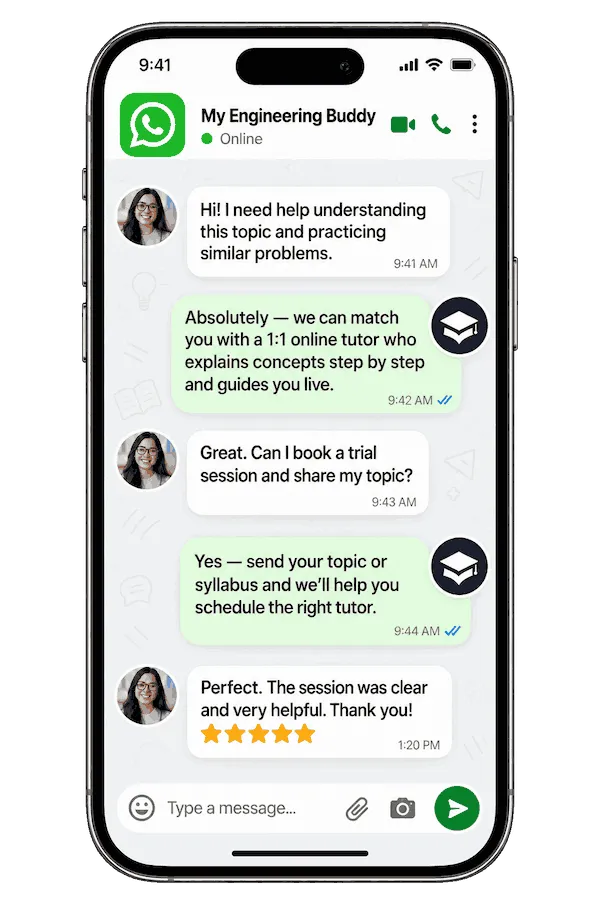
WhatsApp MEB for a quick quote — average response time under 1 minute.
Who This Functions Tutoring Is For
Functions tutoring at MEB is used by students at every stage — from those hitting their first wall with return values and scope, to graduate students debugging higher-order function logic in production-grade code.
- Undergraduates in first or second-year CS who can’t get function calls and parameter passing to click
- Students retaking a CS module after a failed first attempt
- Students with a university conditional offer depending on this grade
- Graduate students working through functional programming paradigms in languages like Haskell or Scala
- Students 4–6 weeks from a final exam with recursion, closures, or lambda expressions still unresolved
- Parents watching a child’s confidence drop alongside their CS grades
Students who come to MEB are often preparing for programmes at institutions like MIT, Carnegie Mellon, University of Toronto, Imperial College London, ETH Zurich, or the University of Melbourne. They need more than a textbook — they need a tutor who can spot exactly where the reasoning breaks down.
At MEB, we’ve found that Functions trips students up not because the concept is abstract — it’s because most introductory courses move from definition to recursion in three lectures, skipping the mental model that makes everything else make sense.
1:1 Tutoring vs Self-Study vs AI vs YouTube vs Online Courses
Self-study works if you’re disciplined, but there’s no one to tell you your mental model of closures is wrong. AI tools give fast answers — they can’t watch you write a recursive function and catch the moment you misplace the base case. YouTube is useful for overviews of syntax but stops the moment your specific assignment diverges from the example. Online courses move at a fixed pace with no adjustment for what you already know. With a 1:1 Data Structures and Algorithms or Functions tutor at MEB, the session is live, calibrated to your exact course, and corrects errors in real time — not after you’ve already submitted.
Outcomes: What You’ll Be Able To Do in Functions
After working with an online Functions tutor through MEB, you’ll solve problems involving parameter passing, return types, and scope without second-guessing yourself. You’ll analyze recursive function behaviour — including stack frames and base cases — and explain why a function produces a specific output. You’ll model solutions using higher-order functions like map, filter, and reduce across common programming languages. You’ll apply closure and lambda concepts in assignments that require functional programming approaches. And you’ll write clean, modular code that your marker or interviewer can follow — because the logic is sound, not just syntactically correct.
Supporting a student through Functions? MEB works directly with parents to set up sessions, track progress, and keep coursework on schedule. WhatsApp MEB — average response time is under a minute, 24/7.
Based on feedback from 40,000+ sessions collected by MEB from 2022 to 2025, 58% of students improved by one full grade after approximately 20 hours of 1:1 tutoring in subjects like Functions. A further 23% achieved at least a half-grade improvement.
Source: MEB session feedback data, 2022–2025.
What We Cover in Functions (Syllabus / Topics)

Track 1: Core Function Concepts
- Function definition, declaration, and invocation syntax
- Parameters vs arguments — pass by value vs pass by reference
- Return types, return statements, and void functions
- Scope: local, global, block-level, and lexical scope
- Function overloading and default parameters
- Anonymous functions and function expressions
- Pure functions vs side effects
Key texts: Structure and Interpretation of Computer Programs (Abelson & Sussman), Clean Code (Robert C. Martin), Programming Language Pragmatics (Scott).
Track 2: Recursion and Higher-Order Functions
- Recursive function structure — base case, recursive case
- Stack frames and call stack behaviour during recursion
- Tail recursion and tail-call optimisation
- Higher-order functions: map, filter, reduce / fold
- Closures — what they capture and when that matters
- Lambda expressions and first-class functions
- Memoisation and dynamic programming via function decomposition
Key texts: Functional Programming in Scala (Chiusano & Bjarnason), Introduction to the Theory of Computation (Sipser), Haskell Programming from First Principles (Allen & Moronuki).
Track 3: Functions in Software Engineering Contexts
- Modular design — when and how to decompose logic into functions
- Callbacks and event-driven programming patterns
- Asynchronous functions — async/await, promises, futures
- Function signatures and interface design in OOP contexts
- Testing functions: unit tests, mocking, and test coverage
- Functions in APIs — REST endpoints, handler functions, middleware
Key texts: The Pragmatic Programmer (Hunt & Thomas), Designing Data-Intensive Applications (Kleppmann), JavaScript: The Good Parts (Crockford).
Students consistently tell us that the moment recursion finally clicks, the rest of their CS coursework starts to feel more manageable. It’s not a coincidence — recursive thinking is the foundation for tree traversal, graph algorithms, and dynamic programming.
What a Typical Functions Session Looks Like
The tutor opens by checking where you left off — usually a specific concept like closure behaviour or why your recursive function hits a stack overflow instead of returning. From there, you and the tutor work through targeted problems on screen: tracing a recursive call through its stack frames, rewriting a loop as a higher-order function, or debugging why a closure isn’t capturing the variable you expect. The tutor uses a digital pen-pad to annotate live — you can see the call stack drawn out in real time. Then you replicate the reasoning yourself, explaining each step back. The session closes with a concrete practice task: two or three function problems aligned to your next assignment or exam topic, with the next concept mapped out for the session after.
How MEB Tutors Help You with Functions (The Learning Loop)
Diagnose: In the first session, the tutor identifies exactly which part of Functions is causing problems — whether it’s conceptual (you don’t have a working mental model of scope) or procedural (you understand the concept but can’t translate it into code under exam conditions).
Explain: The tutor works through live examples using a digital pen-pad — drawing call stacks, annotating code, tracing variable scope across function calls. No slides. No pre-recorded content. Real-time explanation shaped by your questions.
Practice: You attempt problems with the tutor present — not after the session. This matters because most errors in Functions (wrong base case, misplaced return, incorrect closure reference) are invisible to the student until someone watches them happen.
Feedback: The tutor goes through your errors step by step — not just marking wrong answers but explaining what the marker or autograder is actually looking for and where the logic broke down.
Plan: Each session ends with a clear next topic, a specific practice task, and a note on what to review before the next session. The tutor tracks your progress across sessions.
Sessions run over Google Meet with a digital pen-pad or iPad and Apple Pencil for live annotation. Before your first session, have your course syllabus or assignment sheet, any code you’ve already attempted, and your exam or submission date. The first session is diagnostic — the tutor maps where you are before building the plan. Start with the $1 trial — 30 minutes of live tutoring that also serves as your first diagnostic.
A common pattern MEB tutors observe is that students who struggle with Object-Oriented Programming or Design Patterns often have an unresolved gap in how functions, scope, and encapsulation actually interact — fixing Functions first makes the downstream topics far easier.
Source: My Engineering Buddy, 2008–2025.
Try your first session for $1 — 30 minutes of live 1:1 tutoring or one homework question explained in full. No registration. No commitment. WhatsApp MEB now and get matched within the hour.
Tutor Match Criteria (How We Pick Your Tutor)
Not every CS tutor is the right fit for Functions. MEB matches on four criteria.
Subject depth: The tutor must have demonstrable experience with your specific level — first-year CS fundamentals, functional programming at upper-undergrad level, or software engineering at graduate level. Exam board or course framework knowledge is verified before matching.
Tools: Every tutor works on Google Meet with a digital pen-pad or iPad and Apple Pencil — because annotating code live is not optional in Functions tutoring.
Time zone: Matched to your region. US, UK, Gulf, Canada, and Australia all have tutor availability across standard waking hours.
Goals: Whether you need to pass a resit, close a gap before finals, or develop genuine depth in functional programming for a technical interview, the tutor match reflects that goal — not a generic profile.
Unlike platforms where you fill out a form and wait, MEB responds in under a minute, 24/7. Tutor match takes under an hour. The $1 trial means you test before you commit. Everything runs over WhatsApp — no logins, no intake forms.
Study Plans (Pick One That Matches Your Goal)
After a diagnostic first session, the tutor builds a specific sequence. Three common structures: a catch-up plan (1–3 weeks) for students with immediate gaps to close before an assignment or test; an exam prep plan (4–8 weeks) for students working toward a structured end-of-semester or resit exam, covering all tracks in the syllabus above; and ongoing weekly support aligned to your semester schedule and coursework deadlines. The tutor adjusts the plan as your understanding develops — it’s not fixed after session one.
Pricing Guide
Functions tutoring starts at $20/hr for standard undergraduate levels. Advanced topics — functional programming paradigms, compiler-level function analysis, graduate-level software engineering — run $35–$100/hr depending on tutor specialisation and session demand.
Rate factors include: course level, topic complexity, your timeline, and tutor availability in your time zone.
Availability tightens during semester finals and submission periods. If you have a fixed deadline, book sooner rather than later.
For students targeting competitive graduate programmes or technical roles at top-tier firms, tutors with professional software engineering or research backgrounds are available at higher rates — share your specific goal and MEB will match the tier to your ambition.
Start with the $1 trial — 30 minutes, no registration, no commitment. WhatsApp MEB for a quick quote.
FAQ
Is Functions hard?
It’s conceptually straightforward but procedurally tricky. The gap between understanding what a function does and being able to write, trace, and debug one under exam conditions is where most students stall. A tutor closes that gap faster than independent practice alone.
How many sessions are needed?
Most students need 6–12 sessions to move from persistent confusion to solid exam performance in Functions. Students with specific assignment deadlines often see meaningful improvement in 3–4 focused sessions on the relevant topics.
Can you help with homework and assignments?
Yes. MEB tutoring is guided learning — you understand the work, then submit it yourself. The tutor explains the concept, works through a similar example, and helps you reason through your own solution. See our Academic Integrity policy and Why MEB page for full details on what we help with and what we don’t.
Will the tutor match my exact syllabus or exam board?
Yes. Before matching, MEB asks for your course outline, university, and the specific topics giving you trouble. The tutor is selected based on that information — not assigned randomly from a general pool.
What happens in the first session?
The tutor runs a short diagnostic — asking you to explain or attempt a function problem while they observe. This shows exactly where the breakdown is. The rest of the session addresses the most urgent gap, and a plan for follow-up sessions is outlined.
Is online tutoring as effective as in-person?
For Functions specifically, online is often better — the tutor can annotate your actual code, share screen, draw call stacks live, and review your previous attempts file-by-file. In-person sessions rarely allow that level of real-time code interaction.
Can I get Functions help at midnight?
Yes. MEB operates across time zones with tutors available in the US, UK, Gulf, and Australia. WhatsApp MEB at any hour — average response time is under a minute, and sessions can often be scheduled same-day or within hours.
What if I don’t get along with my assigned tutor?
Tell MEB. There’s no friction in switching — message via WhatsApp, describe what didn’t work, and a different tutor is matched, typically within the same day. The $1 trial exists precisely so you can assess fit before committing to a full plan.
Do you cover functional programming languages specifically, like Haskell or Scala?
Yes. MEB has tutors with hands-on experience in Haskell, Scala, Erlang, and F#. If your course uses a specific functional language, mention it when you contact MEB — the tutor match will reflect that requirement rather than defaulting to a general CS background.
What’s the difference between Functions in Python and Functions in a functional language like Haskell?
In Python and most imperative languages, functions can produce side effects and mutate state. In Haskell and purely functional languages, functions are referentially transparent — same input always produces the same output, with no side effects. This distinction is often tested directly in CS exams and assignments. A Functions tutor from MEB who knows both paradigms can explain the difference with live code comparisons.
How do I get started?
Start with the $1 trial — 30 minutes of live tutoring or one homework question explained in full. Three steps: WhatsApp MEB, get matched to a Functions tutor within the hour, and begin your trial session. No forms, no waiting period.
Trust & Quality at My Engineering Buddy
Every MEB tutor goes through a multi-stage vetting process: subject knowledge screening, a live demo session evaluated by MEB’s review team, and ongoing feedback monitoring tied to student outcomes. Tutors working in Functions hold degrees in Computer Science, Software Engineering, or directly related fields — many have professional software development experience alongside their teaching background. Rated 4.8/5 across 40,000+ verified reviews on Google.
MEB tutoring is guided learning — you understand the work, then submit it yourself. For full details on what we help with and what we don’t, read our Academic Integrity policy and Why MEB.
MEB has been serving students in the US, UK, Canada, Australia, the Gulf, and Europe since 2008 — across 2,800+ subjects. Within Computer Science, that includes Compiler Design tutoring, Operating Systems help, and Theory of Computation tutoring, alongside Functions and the full range of CS modules students encounter at undergraduate and graduate level. You can also explore MEB’s tutoring methodology to understand how sessions are structured.
Our experience across thousands of sessions shows that students who book their first Functions session within 48 hours of identifying a gap close it significantly faster than those who wait until the week before the exam.
Source: My Engineering Buddy, 2008–2025.
Explore Related Subjects
Students studying Functions often also need support in:
- Automata Theory
- Formal Languages
- Concurrent Programming
- Systems Programming
- Memory Management and Allocation
- Sorting
- Binary Trees
Next Steps
When you contact MEB, have three things ready:
- Your exam board or course outline, and the specific Functions topics giving you trouble
- Your availability and time zone
- Your exam date or assignment deadline
MEB matches you with a verified Functions tutor — usually within 24 hours. The first session starts with a diagnostic, so every minute is used on what actually matters.
Before your first session, have ready: your exam board and syllabus or course outline, a recent past paper attempt or homework you struggled with, and your exam or deadline date. The tutor handles the rest.
Visit www.myengineeringbuddy.com for more on how MEB works.
WhatsApp to get started or email [email protected].
Reviewed by Subject Expert
This page has been carefully reviewed and validated by our subject expert to ensure accuracy and relevance.




