




~1 min
Average Reply Time
~1 hour
To Be Matched With A Tutor
30 Min Trial
75% Find Their Tutor On The 1st Trial
$20-35+/hr
Premium Yet Affordable Learning
Most students don’t fail Design Patterns because the concepts are impossible. They fail because they can’t see when to use a Singleton versus a Factory — and nobody stops to show them why.
Design Patterns Tutor Online
Design Patterns are reusable solutions to recurring software design problems, catalogued in object-oriented programming. They are grouped into creational, structural, and behavioural categories, equipping developers to write maintainable, scalable, and well-structured code.
MEB offers 1:1 online Computer Science tutoring, and our Design Patterns tutor online service covers every pattern from Gang of Four through modern architectural variants. If you’ve searched for a Design Patterns tutor near me and ended up here, you’re in the right place — live sessions, real code review, and no generic explanations. Students who work consistently with an MEB tutor leave knowing not just what each pattern is, but exactly when to reach for it.
- 1:1 online sessions tailored to your specific course, language, and codebase
- Expert-verified tutors with subject-specific software engineering backgrounds
- Flexible time zones — US, UK, Canada, Australia, Gulf
- Structured learning plan built after a diagnostic session
- Ethical homework and assignment guidance — you understand the work before you submit
52,000+ students across the US, UK, Canada, Australia, and the Gulf have used MEB since 2008 — including students in Computer Science subjects like Design Patterns, object-oriented programming, and data structures and algorithms.
Source: My Engineering Buddy, 2008–2025.
How Much Does a Design Patterns Tutor Cost?
Most Design Patterns tutoring sessions at MEB cost between $20 and $40 per hour. Not sure yet? Start with the $1 trial — 30 minutes of live 1:1 tutoring or one homework question explained in full.
| Level / Need | Typical Rate | What’s Included |
|---|---|---|
| Undergraduate (most levels) | $20–$35/hr | 1:1 sessions, homework guidance, pattern walkthroughs |
| Advanced / Graduate / Specialist | $35–$100/hr | Expert tutor, architectural design, system design prep |
| $1 Trial | $1 flat | 30 min live session or one full homework question |
Tutor slots fill up fast around semester project deadlines and finals weeks. Book early if your submission is within four weeks.
WhatsApp MEB for a quick quote — average response time under 1 minute.
Who This Design Patterns Tutoring Is For
Design Patterns shows up in undergraduate software engineering courses, graduate-level system design, and technical interview prep — often at the same time. The students who come to MEB are usually at a specific crunch point, not just browsing.
- Undergraduates in CS, software engineering, or IT who can’t get patterns to stick beyond the textbook definition
- Graduate students applying patterns to real codebases for the first time and struggling with design trade-offs
- Students retaking after a failed first attempt at a software design module
- Job-seekers preparing for system design interviews at companies like Google, Amazon, or Microsoft where pattern knowledge is directly tested
- Students with a university conditional offer depending on their software engineering grade
- Parents supporting a child through a CS degree who want progress tracked and sessions structured
Students at MIT, Carnegie Mellon, Georgia Tech, the University of Toronto, Imperial College London, TU Delft, and UNSW Sydney have all worked with MEB tutors on Design Patterns modules. MEB matches you to a tutor who knows your course level and language environment — Java, Python, C++, or otherwise.
1:1 Tutoring vs Self-Study vs AI vs YouTube vs Online Courses
Self-study works if you’re disciplined, but Design Patterns requires someone to challenge your reasoning — not just confirm you read the chapter. AI tools give quick definitions and code snippets, but they can’t diagnose why you keep reaching for the wrong pattern in a specific context. YouTube is useful for overviews of Singleton or Observer, but it stops the moment your assignment has a twist. Online courses are structured, but the pace is fixed and nobody checks whether your UML actually reflects the pattern correctly. With a 1:1 Design Patterns tutor from MEB, you get live code review, real-time correction of pattern misapplication, and a tutor who already knows where students get stuck in your exact module.
Outcomes: What You’ll Be Able To Do in Design Patterns
After consistent work with an MEB Design Patterns tutor, you’ll be able to identify which creational, structural, or behavioural pattern fits a given problem scenario — and explain why. You’ll apply the Factory Method and Abstract Factory correctly in multi-class hierarchies without confusing them. You’ll model the Observer and Strategy patterns in UML and translate those diagrams into working code. You’ll analyze existing codebases, spot where a pattern has been misused, and refactor it. You’ll present design decisions to peers or examiners with clear reasoning behind every structural choice you made.
Based on feedback from 40,000+ sessions collected by MEB from 2022 to 2025, 58% of students improved by one full grade after approximately 20 hours of 1:1 tutoring in subjects like Design Patterns. A further 23% achieved at least a half-grade improvement.
Source: MEB session feedback data, 2022–2025.
Try your first session for $1 — 30 minutes of live 1:1 tutoring or one homework question explained in full. No registration. No commitment. WhatsApp MEB now and get matched within the hour.
What We Cover in Design Patterns (Syllabus / Topics)

Creational Patterns
- Singleton — ensuring a class has exactly one instance and controlling global access
- Factory Method — defining an interface for object creation, letting subclasses decide which class to instantiate
- Abstract Factory — producing families of related objects without specifying concrete classes
- Builder — separating complex object construction from its representation
- Prototype — cloning existing objects without coupling to their concrete classes
- Object pool and lazy initialisation variants
Core texts: Design Patterns: Elements of Reusable Object-Oriented Software (Gamma et al., 1994); Head First Design Patterns (Freeman & Robson, 2020).
Structural Patterns
- Adapter — converting one interface into another clients expect
- Bridge — decoupling abstraction from implementation so both can vary independently
- Composite — composing objects into tree structures to represent part-whole hierarchies
- Decorator — attaching responsibilities to objects dynamically without subclassing
- Facade — providing a simplified interface to a complex subsystem
- Flyweight — sharing state to support large numbers of fine-grained objects efficiently
- Class diagram representation of each structural relationship
Core texts: Design Patterns: Elements of Reusable Object-Oriented Software (Gamma et al.); Clean Architecture (Martin, 2017).
Behavioural Patterns
- Observer — defining a one-to-many dependency so dependents update automatically
- Strategy — defining a family of algorithms, encapsulating each, making them interchangeable
- Command — encapsulating requests as objects to support queuing, logging, and undo
- Iterator — accessing elements of a collection sequentially without exposing the underlying structure
- Template Method — defining the skeleton of an algorithm and letting subclasses fill in steps
- Chain of Responsibility, Mediator, Memento, State, Visitor — when and why each is chosen
- Anti-patterns — recognising when a pattern is being misapplied or overengineered
Core texts: Refactoring: Improving the Design of Existing Code (Fowler, 2018); Patterns of Enterprise Application Architecture (Fowler, 2002).
What a Typical Design Patterns Session Looks Like
The tutor opens by revisiting the previous session’s topic — usually a specific pattern the student was asked to implement, say the Observer or the Decorator. They’ll ask you to walk through your code or diagram before touching anything themselves. From there, the session moves into the current problem: you might be working through how to correctly apply the Strategy pattern to a payment processing system, or untangling why your Composite implementation is producing unexpected behaviour in a tree traversal. The tutor uses a digital pen-pad to annotate your UML in real time, marks where the coupling is wrong, and shows the corrected structure alongside your version. You then replicate the fix or write the equivalent in code while the tutor watches. The session closes with a specific task — implement one pattern variant in a new context — and the next topic is noted. You leave knowing exactly what to do before you come back. For help with ER diagram tutoring or related modelling work, MEB covers those too.
How MEB Tutors Help You with Design Patterns (The Learning Loop)
Diagnose: In the first session, the tutor asks you to explain a pattern you think you understand, then gives you a scenario and watches how you choose. That gap — between what you can recite and what you can actually apply — is what the plan addresses.
Explain: The tutor works through live examples using a digital pen-pad on Google Meet. You see the UML being drawn, the code being written, and the reasoning out loud. Not a slide deck. Not a lecture.
Practice: You attempt the next problem while the tutor watches. This is where most independent study fails — no one is there when the pattern selection goes wrong.
Feedback: The tutor catches misapplication at the point it happens, not after you’ve submitted. They explain exactly why Decorator was wrong there and why Proxy fits instead — down to interface-level reasoning.
Plan: After each session, the tutor sets a specific implementation task and records where you are in the pattern catalogue. Progress is tracked session to session, not just reviewed at the end.
Sessions run on Google Meet with a digital pen-pad or iPad and Apple Pencil for annotation. Before your first session, have your course syllabus or assignment brief ready, plus any code or diagrams you’ve already attempted. The first session covers diagnostic work and starts the pattern sequence immediately. Start with the $1 trial — 30 minutes of live tutoring that also serves as your first diagnostic.
At MEB, we’ve found that Design Patterns clicks fastest when students are forced to choose the wrong pattern first and then correct it — not when they memorise definitions. The moment of refusal, when a tutor says “that won’t work here, try again,” is where real understanding forms.
Tutor Match Criteria (How We Pick Your Tutor)
Not every software engineering tutor knows Design Patterns to the depth a graduate-level assignment demands. Here’s what MEB checks.
Subject depth: Tutors are matched by level — introductory CS modules, advanced undergraduate software engineering, graduate system design, or professional interview prep. They’re screened on the specific patterns your syllabus covers, not just general programming ability.
Tools: All sessions run on Google Meet with a digital pen-pad or iPad and Apple Pencil for real-time diagramming. The tutor can annotate your UML, draw class hierarchies, and mark up your code in the same view.
Time zone: Tutors are matched to your region — US, UK, Gulf, Canada, or Australia — so session times are workable, not inconvenient.
Goals: Whether you’re trying to pass a module, improve an assignment grade, or prepare for a system design interview, the tutor selection is shaped by that specific target.
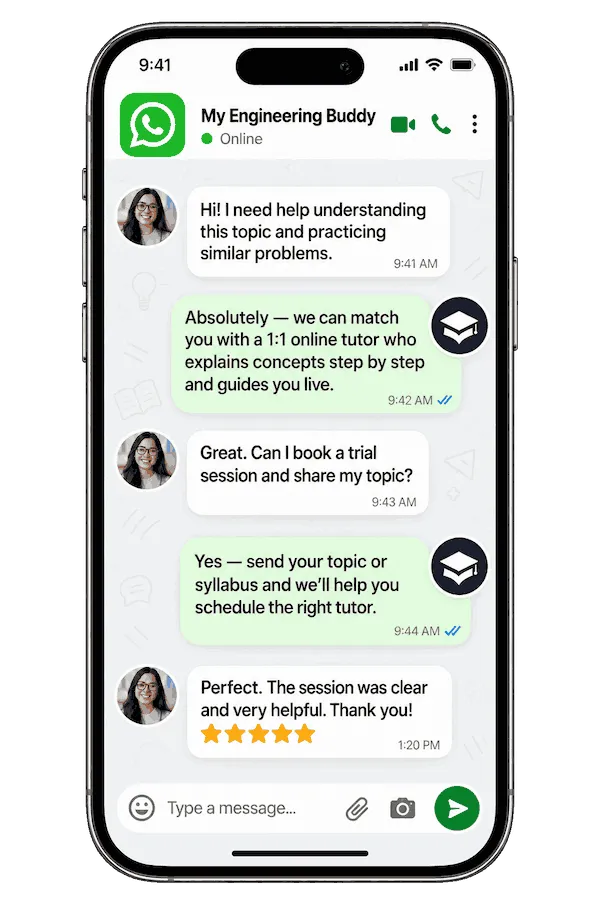
Unlike platforms where you fill out a form and wait, MEB responds in under a minute, 24/7. Tutor match takes under an hour. The $1 trial means you test before you commit. Everything runs over WhatsApp — no logins, no intake forms.
Pricing Guide
Design Patterns tutoring at MEB runs from $20 to $40 per hour for most undergraduate and graduate-level modules. Specialist tutors for system design interview prep or advanced architectural work are available at higher rates — up to $100/hr depending on tutor experience and session depth.
Rate factors: your course level, pattern complexity (introductory GoF versus enterprise architectural patterns), timeline pressure, and tutor availability. Availability tightens during finals and project submission weeks at US, UK, and Canadian universities.
For students targeting senior engineering roles or graduate programmes at top-tier universities, tutors with professional software architecture or industry research backgrounds are available at higher rates — share your specific goal and MEB will match the tier to your ambition.
Start with the $1 trial — 30 minutes, no registration, no commitment. WhatsApp MEB for a quick quote.
FAQ
Is Design Patterns hard?
It’s one of the more conceptually demanding CS topics because it requires knowing not just what a pattern is but when not to use it. Students often find the definitions easy and the application genuinely difficult. That gap is exactly what 1:1 tutoring closes.
How many sessions are needed?
Most students working through a university Design Patterns module see measurable improvement within 6–10 sessions. Students preparing for system design interviews typically need 12–20 sessions to work through the full pattern catalogue with applied examples and trade-off reasoning.
Can you help with homework and assignments?
MEB tutoring is guided learning — you understand the work, then submit it yourself. The tutor walks you through the reasoning, not the answer. See our Academic Integrity policy and Why MEB page for full details on what we help with and what we don’t.
Will the tutor match my exact syllabus or exam board?
Yes. Share your course outline or assignment brief when you book. MEB matches tutors to your specific module content — whether that’s a GoF-based undergraduate course, a graduate software architecture unit, or a company-specific system design framework.
What happens in the first session?
The tutor runs a short diagnostic — asks you to explain a pattern, gives you a scenario to solve, and identifies where your reasoning breaks down. From there they map the session plan. No time is spent on patterns you already understand.
Is online tutoring as effective as in-person?
For Design Patterns specifically, online is often better. The tutor can annotate your code and UML in real time, pull up reference implementations side-by-side, and share screen during the session. There’s no whiteboard in a library that gives you that.
Can you help me get ready for a system design interview using Design Patterns?
Yes. MEB tutors cover the patterns that appear most in FAANG-style system design interviews — Observer, Strategy, Factory, Decorator, Proxy — with applied examples in scalable system contexts. Sessions are structured around the trade-off reasoning interviewers actually test, not just pattern definitions.
What’s the difference between Gang of Four patterns and modern architectural patterns?
Gang of Four patterns (Gamma et al., 1994) address class- and object-level design. Modern architectural patterns — Event Sourcing, CQRS, Saga, Strangler Fig — operate at service and system level. MEB tutors cover both, and can help you understand where one ends and the other begins.
Can I get Design Patterns help at midnight?
Yes. MEB operates 24/7 via WhatsApp. Message at any hour and you’ll get a response in under a minute on average. Session scheduling depends on tutor availability in your time zone, but late-night slots are frequently available for US and Gulf students.
What if I don’t like my assigned tutor?
Tell MEB via WhatsApp. You won’t be locked in. MEB will rematch you with a different tutor — usually within the same day. The $1 trial exists precisely so you can test the fit before committing to a full block of sessions.
How do I get started?
Message MEB on WhatsApp. You’ll be matched with a verified Design Patterns tutor — usually within an hour. The first session starts at $1 for 30 minutes of live tutoring or one homework question explained in full. Three steps: WhatsApp → matched → start trial.
Trust & Quality at My Engineering Buddy
Every MEB tutor goes through subject-specific screening before they take a session. That means a live demo evaluation, review of their academic and professional background, and ongoing session feedback scoring. Rated 4.8/5 across 40,000+ verified reviews on Google. Tutors covering Design Patterns hold degrees in computer science or software engineering and have taught the subject at undergraduate or graduate level — not just used it professionally. Subject-specific vetting means a tutor matched to your Design Patterns module has been assessed on the exact pattern families your course covers.
MEB tutoring is guided learning — you understand the work, then submit it yourself. For full details on what we help with and what we don’t, read our Academic Integrity policy and Why MEB.
MEB has been running since 2008, serving 52,000+ students across the US, UK, Canada, Australia, the Gulf, and Europe in 2,800+ subjects. Within Computer Science, that includes algorithms tutoring, help with object-oriented programming, and distributed systems tutoring — as well as Design Patterns. See our tutoring methodology for how sessions are structured from diagnostic through to exam or submission readiness.
Students consistently tell us that the pattern catalogue feels manageable once a tutor forces them to choose wrong and explain why. That single correction — done live, with your own code on screen — does more than re-reading the chapter three times.
Explore Related Subjects
Students studying Design Patterns often also need support in:
- Automata Theory
- Concurrent Programming
- Compiler Design
- Systems Programming
- Operating Systems
- Memory Management
- Design and Analysis of Algorithms
Next Steps
When you message MEB, share your exam board or course name, the specific patterns or topics you’re struggling with, and your deadline or exam date. Include your time zone and availability. MEB will match you with a verified Design Patterns tutor — usually within 24 hours.
Before your first session, have ready:
- Your course syllabus or assignment brief
- Any code, UML diagrams, or homework you’ve already attempted
- Your exam or submission deadline date
The tutor handles the rest — starting with a diagnostic so every minute of the session is used on the gaps that actually matter.
Visit www.myengineeringbuddy.com for more on how MEB works.
WhatsApp to get started or email [email protected].
Reviewed by Subject Expert
This page has been carefully reviewed and validated by our subject expert to ensure accuracy and relevance.




