




~1 min
Average Reply Time
~1 hour
To Be Matched With A Tutor
30 Min Trial
75% Find Their Tutor On The 1st Trial
$20-35+/hr
Premium Yet Affordable Learning
Most students who struggle with procedural languages hit the same wall: they can write code that runs, but they can’t explain why it works — and that’s where exams and assignments punish them.
Procedural Languages Tutor Online
Procedural languages are programming paradigms — including C, Pascal, Fortran, and COBOL — where code executes as a sequence of instructions, using loops, conditionals, and procedures to control program flow and manage state.
MEB offers 1:1 online tutoring and homework help in Procedural Languages and across the broader Computer Science tutoring curriculum. Whether you’re searching for a Procedural Languages tutor near me or need help at midnight before a submission deadline, MEB tutors are available 24/7. You won’t get a generic explanation — you’ll get a tutor who knows your syllabus, your course level, and exactly where your code is breaking.
- 1:1 online sessions tailored to your course and syllabus
- Expert-verified tutors with hands-on procedural programming experience
- Flexible time zones — US, UK, Canada, Australia, Gulf
- Structured learning plan built after a diagnostic session
- Ethical homework and assignment guidance — you understand the code, then submit it yourself
52,000+ students across the US, UK, Canada, Australia, and the Gulf have used MEB since 2008 — including students in Computer Science subjects like Procedural Languages, Object-Oriented Programming, and Data Structures and Algorithms.
Source: My Engineering Buddy, 2008–2025.
How Much Does a Procedural Languages Tutor Cost?
Most Procedural Languages tutoring sessions run $20–$40/hr. Advanced topics — systems-level C, real-time programming, or graduate-level procedural design — may reach up to $100/hr. Not sure whether it’s worth it? Start with the $1 trial: 30 minutes of live tutoring or one full homework question explained.
| Level / Need | Typical Rate | What’s Included |
|---|---|---|
| Standard (most levels) | $20–$35/hr | 1:1 sessions, homework guidance |
| Advanced / Specialist | $35–$100/hr | Expert tutor, systems-level depth |
| $1 Trial | $1 flat | 30 min live session or 1 homework question |
Tutor availability tightens sharply in the weeks before finals and submission deadlines. Book early if your exam or coursework due date is within four weeks.
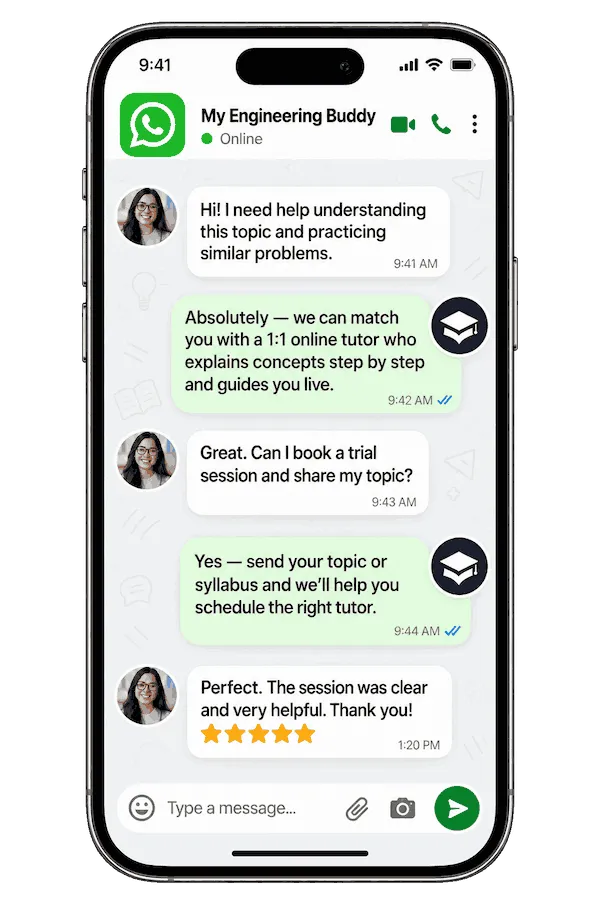
WhatsApp MEB for a quick quote — average response time under 1 minute.
Who This Procedural Languages Tutoring Is For
Procedural Languages sits at the foundation of most Computer Science degrees — but foundational doesn’t mean easy. Students who sail through high-level Python often hit serious trouble when they move to C or are asked to reason about memory, scope, and execution order from scratch.
- Undergraduates in CS, electrical engineering, or software engineering taking their first systems programming course
- Students retaking after a failed first attempt at a procedural programming module
- Students with a university conditional offer depending on their CS grade this semester
- Graduate students revisiting C or Fortran for high-performance computing or legacy system work
- Students 4–6 weeks from an exam with significant gaps in pointer arithmetic, recursion, or memory management
- Parents watching a child’s confidence collapse alongside their first serious programming course
- Students who need homework and assignment guidance — explained clearly, not just handed to them
MEB tutors have worked with students at institutions including MIT, Carnegie Mellon, Imperial College London, the University of Toronto, ETH Zurich, the University of Melbourne, and Georgia Tech. The tutor is matched to your institution’s course structure, not a generic syllabus.
1:1 Tutoring vs Self-Study vs AI vs YouTube vs Online Courses
Self-study works if you’re disciplined — but procedural languages demand line-by-line feedback, which a textbook can’t give you. AI tools explain syntax fast but can’t watch you misread a pointer and correct it in real time. YouTube is solid for concept overviews; it stops being useful the moment your specific segfault needs diagnosing. Online courses move at a fixed pace that won’t slow down for your weakest topic. With MEB, a tutor who knows C or Pascal watches your code on screen, catches the exact error pattern causing your marks to drop, and corrects it before it becomes a habit.
Outcomes: What You’ll Be Able To Do in Procedural Languages
After structured sessions with an MEB Procedural Languages tutor, students consistently report being able to write correct, readable C or Pascal programs from scratch — not just patch code they found online. You’ll be able to analyze a program’s control flow, trace execution through nested loops and recursive calls, and explain your reasoning to an examiner or interviewer. Students learn to apply memory management rules — stack vs heap, pointer arithmetic, dynamic allocation — without triggering undefined behaviour. You’ll be able to solve exam questions that ask you to model a procedural solution to a given problem, and present that solution with correct syntax and clear structure.
Based on feedback from 40,000+ sessions collected by MEB from 2022 to 2025, 58% of students improved by one full grade after approximately 20 hours of 1:1 tutoring in subjects like Procedural Languages. A further 23% achieved at least a half-grade improvement.
Source: MEB session feedback data, 2022–2025.
Supporting a student through Procedural Languages? MEB works directly with parents to set up sessions, track progress, and keep coursework on schedule. WhatsApp MEB — average response time is under a minute, 24/7.
Try your first session for $1 — 30 minutes of live 1:1 tutoring or one homework question explained in full. No registration. No commitment. WhatsApp MEB now and get matched within the hour.
What We Cover in Procedural Languages (Syllabus / Topics)

Core Procedural Programming Concepts
- Variables, data types, and type casting in C, Pascal, and Fortran
- Control flow: if/else, switch, while, for, do-while loops
- Functions and procedures: definition, parameters, return values, scope
- Recursion: base cases, recursive calls, stack frame behaviour
- Arrays and strings: declaration, iteration, manipulation
- Structured programming principles and modular design
- Debugging logic errors and tracing execution step by step
Key texts: The C Programming Language (Kernighan & Ritchie), Programming in Pascal (Wirth), C Programming: A Modern Approach (King).
Memory Management and Pointers
- Pointer declaration, dereferencing, and pointer arithmetic
- Stack vs heap memory: when and why each is used
- Dynamic memory allocation: malloc, calloc, realloc, free in C
- Common memory errors: dangling pointers, buffer overflows, memory leaks
- Structs and passing structs to functions by value and by reference
- File I/O: reading and writing files in procedural style
Key texts: Expert C Programming (van der Linden), Understanding and Using C Pointers (Reese), C Programming: A Modern Approach (King).
Applied and Systems-Level Procedural Programming
- Procedural design patterns: top-down decomposition, stepwise refinement
- Interfacing with operating systems via system calls in C
- Introduction to concurrent programming from a procedural base
- Fortran for scientific computing: arrays, loops, numerical procedures
- COBOL structure: divisions, sections, paragraphs for business data processing
- Compiling and linking: understanding the build process from source to executable
- Code readability, commenting standards, and maintainability in procedural code
Key texts: Scientific Programming and Computer Architecture (Viswanath), Programmers Guide to COBOL (Stern & Stern), MIT OpenCourseWare resources on systems programming.
Students who struggle with procedural languages often know what they want the program to do — they just can’t translate that intent into syntactically correct, logically sound procedural code. That gap is exactly where a tutor earns their hour.
Source: MEB tutor observation across 18 years of sessions.
Platforms, Tools & Textbooks We Support
Procedural Languages tutoring at MEB covers the tools and environments students actually use in their courses. Tutors are comfortable working across GCC and Clang compilers, GDB for debugging, Code::Blocks, VS Code with C/C++ extensions, Turbo Pascal, Free Pascal, and online compilers including Replit and OnlineGDB. For Fortran, tutors support gfortran and Intel Fortran. Sessions run on Google Meet with a digital pen-pad for annotating code line by line.
- GCC / Clang (C compilation)
- GDB (GNU Debugger)
- VS Code with C/C++ extension
- Code::Blocks
- Free Pascal / Turbo Pascal
- Replit and OnlineGDB
- gfortran / Intel Fortran
- Google Meet + digital pen-pad
What a Typical Procedural Languages Session Looks Like
The tutor opens by checking the previous topic — usually whatever went wrong in the last assignment or the concept that confused you most, whether that’s pointer arithmetic or recursive function design. Then you work through new problems together on screen: the tutor writes annotated code with a digital pen-pad while you follow along and replicate the logic in your own environment. You might trace the execution of a function with nested loops, or step through a memory allocation and deallocation sequence to see what happens when free() is called in the wrong order. The tutor watches how you reason, not just what you type. By the end of the session, you have a specific practice task — such as rewriting a given function without global variables — and the next topic is already agreed.
How MEB Tutors Help You with Procedural Languages (The Learning Loop)
Diagnose: In the first session, the tutor asks you to walk through a short piece of code out loud. This immediately reveals whether your gap is conceptual (you don’t understand scope), syntactic (you know the idea but mis-write the syntax), or strategic (you understand individual constructs but can’t plan a full solution).
Explain: The tutor works through live examples using a digital pen-pad on Google Meet — annotating each line, showing why a particular pointer operation causes undefined behaviour, or demonstrating the difference between passing a struct by value versus by reference in C.
Practice: You attempt a similar problem while the tutor watches. Not after the session. During it. This is where most self-study falls apart — there’s no one to catch the error the moment it forms.
Feedback: The tutor goes through your attempt step by step: what was correct, what was wrong, and exactly why marks would be lost in an exam or points deducted in an assignment. No vague encouragement. Specific corrections.
Plan: At the end of every session, the tutor names the next topic, sets a concrete task, and notes where you are in the syllabus. Progress is tracked across sessions — not reset each time.
Sessions run on Google Meet. The tutor uses a digital pen-pad or iPad with Apple Pencil to annotate code in real time. Before your first session, share your course outline or assignment brief and any code you’ve already attempted. The first session includes a diagnostic exercise — usually a short coding task — so the tutor knows exactly where to start.
Start with the $1 trial — 30 minutes of live tutoring that also serves as your first diagnostic.
At MEB, we’ve found that students who struggle most with procedural languages aren’t struggling with logic — they’re struggling with the gap between understanding a concept in a lecture and applying it correctly under exam conditions. That’s a very specific problem, and it has a very specific fix.
Tutor Match Criteria (How We Pick Your Tutor)
Every tutor match is deliberate, not algorithmic.
Subject depth: The tutor must have demonstrated competence in the specific language you’re studying — C, Pascal, Fortran, or COBOL — at or above your course level. A tutor who knows Python well is not automatically matched to a C course.
Tools: Every tutor uses Google Meet and a digital pen-pad or iPad with Apple Pencil. No plain video calls where you can’t see the code being written in real time.
Time zone: Matched to your region — US, UK, Gulf, Canada, or Australia — so sessions don’t require you to be online at 3am.
Goals: Your goal shapes the match. Exam preparation, homework help for a specific assignment, conceptual depth for research, or closing a gap before a resit — each pulls a different tutor profile.
Unlike platforms where you fill out a form and wait, MEB responds in under a minute, 24/7. Tutor match takes under an hour. The $1 trial means you test the fit before you commit. Everything runs over WhatsApp — no logins, no intake forms.
Study Plans (Pick One That Matches Your Goal)
If your exam or assignment deadline is within three weeks, the tutor runs a focused catch-up: diagnose the biggest gap first, close it, then move to the next. For four to eight weeks of structured revision, the tutor works through the full syllabus topic by topic with practice problems and past-paper-style questions at each stage. Ongoing weekly support aligns sessions to your semester schedule and coursework deadlines, so nothing builds up into a last-minute crisis. The tutor builds the specific sequence after the first diagnostic — no generic plan applied to every student.
Pricing Guide
Rates run $20–$40/hr for most undergraduate Procedural Languages courses. Systems-level topics, graduate modules, or specialist languages like Fortran for HPC or COBOL for legacy systems can reach up to $100/hr depending on tutor expertise and timeline. Rate factors include: your course level, the complexity of the topic, how close your deadline is, and tutor availability in your time zone.
Availability drops fast in the four weeks before finals. If your exam is coming up, don’t wait.
For students targeting competitive CS programmes at universities like MIT, ETH Zurich, or Imperial College London, tutors with professional software engineering or research backgrounds are available at higher rates — share your specific goal and MEB will match the tier to your target.
Start with the $1 trial — 30 minutes, no registration, no commitment. WhatsApp MEB for a quick quote.
Students consistently tell us that the biggest surprise about 1:1 Procedural Languages tutoring is how fast the gaps close once someone watches you code live and tells you exactly what you’re doing wrong. An hour of that is worth more than a week of re-reading lecture notes alone.
FAQ
Is Procedural Languages hard?
It’s harder than most students expect. The logic is often straightforward, but the syntax is unforgiving — especially in C — and concepts like pointer arithmetic and memory management have no equivalents in Python or Java. Most students find it manageable with guided practice.
How many sessions are needed?
It depends on your starting point and deadline. Students closing a specific gap before an exam often need 4–8 sessions. Those building from scratch through a full module typically benefit from weekly sessions across the semester. The tutor advises after the first diagnostic.
Can you help with homework and assignments?
Yes — MEB tutoring is guided learning. The tutor explains the concept, works through a similar example with you, then you write and submit the code yourself. See our Academic Integrity policy and Why MEB page for full details on what we help with and what we don’t.
Will the tutor match my exact syllabus or exam board?
Yes. Share your course outline, university, and the specific language (C, Pascal, Fortran, COBOL) when you contact MEB. The tutor is matched to your institution’s structure — not a generic procedural programming course that may cover different topics or compilers.
What happens in the first session?
The tutor runs a short diagnostic — usually a coding task or a walkthrough of something you’ve already attempted. This identifies whether your gap is conceptual, syntactic, or strategic. The rest of the session is live tutoring, not a lecture.
Is online tutoring as effective as in-person?
For Procedural Languages, yes — often more so. The tutor annotates your code in real time on a shared screen with a digital pen-pad. You see exactly where the error is and why. That level of granularity is harder to achieve over a physical whiteboard.
Can you help me understand the difference between procedural and object-oriented programming?
Absolutely. Many students transition between paradigms mid-degree without a clear conceptual bridge. MEB tutors cover both and can show you exactly where procedural thinking and OOP tutoring diverge — and when procedural style is still the right choice.
Do you help with C specifically, or other procedural languages too?
MEB covers C, Pascal, Fortran, COBOL, and other procedural languages. C is the most common request, but if your course uses Free Pascal or Fortran for scientific computing, the tutor match accounts for that. Specify the language when you contact MEB.
What if I’m stuck on a specific compile error or runtime crash?
Bring it to the session. Debugging a real segfault or logical error from your own code is often the fastest way to learn. The tutor will trace the error live, explain what caused it, and show you how to catch similar errors yourself in future.
Can I get Procedural Languages help at midnight?
Yes. MEB tutors are available across time zones 24/7. If your assignment is due at 8am and you’re stuck at midnight, WhatsApp MEB — average response time is under a minute. A tutor can be available within the hour in most cases.
How do I get started?
Three steps: WhatsApp MEB with your language, course level, and deadline. MEB matches you with a verified tutor — usually within an hour. Your first session starts with a $1 trial: 30 minutes of live tutoring or one full assignment question explained from start to finish.
How does procedural programming relate to systems programming and compiler design?
Procedural Languages form the foundation of both. Systems programming is almost entirely procedural in style, and compiler design courses rely on fluency in C. Tutors can bridge these topics if your course spans more than one area.
Trust & Quality at My Engineering Buddy
Every MEB tutor goes through subject-specific vetting — not just a CV check. Tutors are assessed on their knowledge of the exact languages and tools your course uses, evaluated through a live demo session, and reviewed against ongoing student feedback after every session. Rated 4.8/5 across 40,000+ verified reviews on Google. MEB has been matching students with expert tutors since 2008, across 2,800+ subjects.
MEB tutoring is guided learning — you understand the work, then submit it yourself. For full details on what we help with and what we don’t, read our Academic Integrity policy and Why MEB.
MEB serves students in Computer Science and related fields across the US, UK, Canada, Australia, the Gulf, and Europe — from first-year undergraduates writing their first C program to PhD students working on high-performance computing with Fortran. Whether you need help with algorithms tutoring or memory management, the tutor is chosen for subject fit, not just availability.
A common pattern our tutors observe is that students arrive having memorised procedural syntax from a textbook but having never written a complete program from a blank file. That’s the gap we close first — and it changes everything that follows.
Explore Related Subjects
Students studying Procedural Languages often also need support in:
- Recursion
- Parsing
- Formal Languages
- Automata Theory
- Theory of Computation
- Digital Logic Design
- Design Patterns
Understanding procedural languages well enough to write correct, documented, compilable code under exam conditions takes more than reading. It takes writing, failing, correcting, and writing again — with someone watching who can stop you the moment you go wrong.
Source: MEB tutor observation across 18 years of sessions.
Next Steps
To get matched with the right tutor, share the following when you contact MEB:
- Your programming language (C, Pascal, Fortran, COBOL, or other), course level, and university
- Your exam date, assignment deadline, or specific topic you’re stuck on
- Your time zone and available session slots
Before your first session, have ready: your course outline or syllabus, any code you’ve already attempted or an assignment you struggled with, and your exam or deadline date. The tutor handles the rest.
MEB matches you with a verified Procedural Languages tutor — usually within 24 hours. The first session starts with a diagnostic so every minute is used well. Visit www.myengineeringbuddy.com for more on how MEB works.
WhatsApp to get started or email [email protected].
Reviewed by Subject Expert
This page has been carefully reviewed and validated by our subject expert to ensure accuracy and relevance.




