




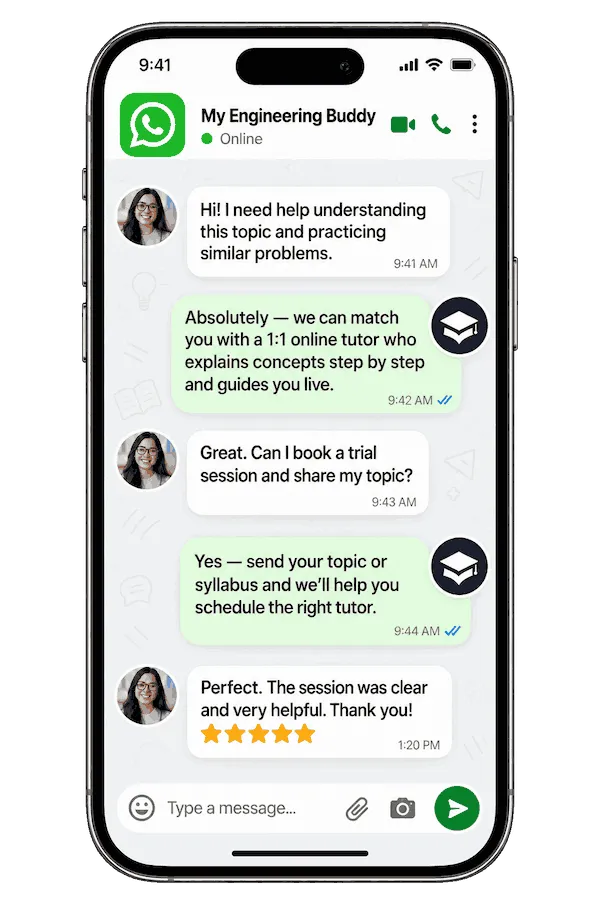
~1 min
Average Reply Time
~1 hour
To Be Matched With A Tutor
30 Min Trial
75% Find Their Tutor On The 1st Trial
$20-35+/hr
Premium Yet Affordable Learning
Hire The Best Systems Programming Tutor

Your C program segfaults at 2 a.m. Stack traces mean nothing. Your tutor is one WhatsApp message away.
Systems Programming Tutor Online
Systems programming is the discipline of writing software that directly manages hardware resources — including memory, processes, file systems, and I/O — typically in C, C++, or Rust, equipping students to build operating system components, compilers, and low-level utilities.
Finding a Systems Programming tutor near me who actually understands process scheduling, virtual memory, and socket-level networking is harder than the coursework itself. MEB’s Computer Science tutoring network includes specialists in systems-level work — tutors who have built kernels, debugged race conditions under Valgrind, and written device drivers. One diagnostic session identifies exactly where your understanding breaks down, and every session after that is built around closing that gap.
- 1:1 online sessions aligned to your exact course, university, and assignment stack
- Expert-verified tutors with postgraduate or industry-level systems programming experience
- Flexible time zones — US, UK, Canada, Australia, Gulf covered
- Structured learning plan built after a diagnostic session
- Ethical homework and assignment guidance — you understand the work, then submit it yourself
52,000+ students across the US, UK, Canada, Australia, and the Gulf have used MEB since 2008 — including students in Computer Science subjects like Systems Programming, Operating Systems, and Concurrent Programming.
Source: My Engineering Buddy, 2008–2025.
How Much Does a Systems Programming Tutor Cost?
Most Systems Programming tutoring sessions cost between $20 and $40 per hour. Graduate-level or highly specialised work — kernel development, embedded systems, real-time OS — can run up to $100/hr depending on tutor expertise and timeline. The $1 trial gets you 30 minutes of live 1:1 tutoring or one full homework question explained — no registration required.
| Level / Need | Typical Rate | What’s Included |
|---|---|---|
| Standard (undergrad core) | $20–$35/hr | 1:1 sessions, homework guidance |
| Advanced / Graduate-level | $35–$100/hr | Expert tutor, kernel/embedded depth |
| $1 Trial | $1 flat | 30 min live session or 1 homework question |
Tutor availability tightens significantly during finals and end-of-semester project deadlines. Booking earlier — even two weeks out — makes a real difference.
WhatsApp MEB for a quick quote — average response time under 1 minute.
Who This Systems Programming Tutoring Is For
Systems programming sits at the intersection of computer architecture, operating system theory, and hands-on low-level coding. Most students hit a wall somewhere between manual memory management and concurrent process design — and that wall rarely fixes itself.
- Undergraduates in CS, CE, or EE taking their first systems-level course in C or C++
- Students retaking after a failed first attempt — memory leaks, undefined behaviour, and pointer arithmetic all left unexplained
- Students with a university conditional offer depending on passing this module
- Graduate students writing OS components, schedulers, or file system implementations as coursework
- Students 4–6 weeks from their final exam with major gaps in virtual memory or process synchronisation still to close
- Students needing guided homework and assignment support at MIT, Carnegie Mellon, Georgia Tech, University of Toronto, Imperial College London, ETH Zurich, UNSW Sydney, or any university where systems courses are notoriously demanding
At MEB, we’ve found that the students who struggle most with systems programming aren’t weak programmers — they’re strong programmers who’ve never had to think about what happens below the function call. One session on the call stack and heap layout changes everything.
1:1 Tutoring vs Self-Study vs AI vs YouTube vs Online Courses
Self-study works if you already understand the memory model — otherwise you’re debugging symptoms, not causes. AI tools like ChatGPT explain concepts quickly but can’t watch you misuse a pointer and correct it in real time. YouTube is genuinely useful for conceptual overviews of process scheduling or virtual address spaces, but it stops the moment your specific assignment diverges from the example. Online courses give you structure at a fixed pace with no adaptation to your actual gaps. 1:1 tutoring with MEB is live, calibrated to your exact course and assignment stack, and corrects errors the moment they appear — which in systems programming means before a buffer overflow becomes a three-hour debugging session.
Outcomes: What You’ll Be Able To Do in Systems Programming
Students who work through systems programming with a dedicated tutor come out able to write, compile, and debug C programs that manage memory explicitly without leaks or undefined behaviour. They can analyze process lifecycle, explain how the kernel switches between threads during a context switch, and apply synchronisation primitives — mutexes, semaphores, condition variables — correctly in concurrent programs. They can solve virtual memory problems involving page tables, TLBs, and address translation. They can present a working shell implementation or file system design with genuine understanding of every component, not just the parts that compiled first time.
Based on feedback from 40,000+ sessions collected by MEB from 2022 to 2025, 58% of students improved by one full grade after approximately 20 hours of 1:1 tutoring in subjects like Systems Programming. A further 23% achieved at least a half-grade improvement.
Source: MEB session feedback data, 2022–2025.
Try your first session for $1 — 30 minutes of live 1:1 tutoring or one homework question explained in full. No registration. No commitment. WhatsApp MEB now and get matched within the hour.
What We Cover in Systems Programming (Syllabus / Topics)

Track 1: Memory, Processes, and the OS Interface
- Stack vs heap: allocation, deallocation, and what goes wrong with each
- Pointers, pointer arithmetic, and avoiding undefined behaviour in C
- Dynamic memory management: malloc, free, valgrind leak detection
- Process creation and control: fork(), exec(), wait(), and process trees
- File descriptors, pipes, and inter-process communication (IPC)
- Signals: SIGINT, SIGCHLD, signal handlers, and async-signal safety
- System calls and the user/kernel boundary
Key references: Computer Systems: A Programmer’s Perspective (Bryant & O’Hallaron), The Linux Programming Interface (Kerrisk). Tutors align sessions to whichever your course uses.
Track 2: Concurrency and Synchronisation
- Threads vs processes: POSIX pthreads, thread creation, and lifecycle
- Race conditions: identifying, reproducing, and eliminating them
- Mutexes, semaphores, and condition variables — correct usage patterns
- Deadlock: necessary conditions, prevention, and detection strategies
- Lock-free programming and atomic operations in C11/C++11
- Producer-consumer, readers-writers, and dining philosophers problems
Key references: Operating Systems: Three Easy Pieces (Arpaci-Dusseau), Programming with POSIX Threads (Butenhof). Also useful for students needing parallel computing help.
Track 3: Virtual Memory, File Systems, and Networking at the Socket Level
- Virtual address spaces: pages, frames, page tables, and the TLB
- Page replacement algorithms: LRU, FIFO, clock algorithm
- File system structures: inodes, directory entries, block allocation
- Buffered vs unbuffered I/O: fread/fwrite vs read/write
- Sockets programming: TCP/UDP socket creation, bind, listen, accept, connect
- Non-blocking I/O and multiplexing with select() and poll()
- Introduction to the network stack from application to IP layer
Key references: Unix Network Programming (Stevens), Computer Systems: A Programmer’s Perspective (Bryant & O’Hallaron, Chapters 9–11). Connects directly to work students do in computer networking tutoring.
Platforms, Tools & Textbooks We Support
Systems programming is inseparable from its toolchain. MEB tutors work with you directly inside the environments your course requires — not in a vacuum.
- GCC / Clang — compilation flags, warnings, and optimisation levels
- GDB — breakpoints, stack inspection, watching memory addresses live
- Valgrind / AddressSanitizer — memory error detection and leak analysis
- Make and CMake — build systems for multi-file C/C++ projects
- Linux terminal — shell scripting, process control, file system navigation
- Git — version control for assignment submissions
- MIT OpenCourseWare — freely available systems programming lecture notes and problem sets at MIT OpenCourseWare
What a Typical Systems Programming Session Looks Like
The tutor opens by reviewing the previous topic — usually wherever the student’s last assignment or lab exercise broke down, often something like an unresolved segfault or a deadlock that appeared under specific thread orderings. From there, the student shares their screen and the tutor walks through the problematic code live, using a digital pen-pad to annotate memory diagrams — showing exactly what the heap looks like at each malloc and free call, or how thread execution interleaves at a race condition. The student then rewrites or explains the corrected logic aloud, which is where most of the real understanding happens. By the end of the session, a specific practice task is set — often reimplementing one system call wrapper or one synchronisation pattern from scratch — and the next topic, frequently virtual memory addressing or a file system component, is mapped out in advance.
How MEB Tutors Help You with Systems Programming (The Learning Loop)
Diagnose: In the first session the tutor asks you to walk through a recent piece of code or assignment. Within 15 minutes they’ve identified whether the gap is conceptual (you don’t know what the OS is actually doing) or mechanical (you know but can’t translate it into correct C). That distinction changes everything about what comes next.
Explain: The tutor works problems live on screen — drawing memory layouts, process trees, and thread timelines with a digital pen-pad. Nothing is presented as a finished answer. Each step is shown, then questioned.
Practice: You write the code or solve the problem with the tutor present. Errors surface immediately, not three hours later when you’re alone at midnight.
Feedback: The tutor explains exactly why a given approach causes a segfault, a data race, or a memory leak — and what the marker or autograder is testing for. You leave knowing the reasoning, not just the fix.
Plan: Each session ends with a clear next topic, a specific task, and a realistic timeline to your deadline or exam. No vague “keep practising.”
Sessions run over Google Meet. The tutor uses a digital pen-pad or iPad with Apple Pencil for memory diagrams and code annotations. Before your first session, share your course syllabus or assignment spec and one piece of code or past paper question you’ve already attempted. Start with the $1 trial — 30 minutes of live tutoring that also serves as your first diagnostic. Whether you need a quick catch-up before a final, structured revision over 4–8 weeks, or ongoing weekly support through the semester, the tutor maps the session plan after that first diagnostic.
Students consistently tell us that the moment they stop treating segfaults as random events and start reading them as structured information about memory state, the subject clicks. That shift rarely happens from a textbook alone — it needs someone watching you read the error in real time.
Tutor Match Criteria (How We Pick Your Tutor)
Not every strong programmer can teach systems concepts. MEB’s matching process looks at four things specifically.
Subject depth: tutors must demonstrate hands-on experience in low-level C or C++, including memory management, process control, and concurrency — not just general programming knowledge.
Tools: every tutor works on Google Meet with a digital pen-pad or iPad and Apple Pencil. Memory diagrams and pointer annotations are non-negotiable for this subject.
Time zone: matched to the student’s region — US, UK, Gulf, Canada, or Australia — so sessions don’t start at 3 a.m.
Goals: whether you need to pass a final exam, complete a specific assignment involving a shell or file system, or build genuine conceptual depth for graduate-level work, the tutor is matched to that goal, not to a generic systems programming syllabus.
Unlike platforms where you fill out a form and wait, MEB responds in under a minute, 24/7. Tutor match takes under an hour. The $1 trial means you test before you commit. Everything runs over WhatsApp — no logins, no intake forms.
MEB tutors are matched on subject depth, time zone, and your specific course goals — not assigned from a general pool. The first session includes a live diagnostic so no time is wasted covering material you already know.
Source: My Engineering Buddy, 2008–2025.
Pricing Guide
Systems Programming tutoring runs $20–$40/hr for most undergraduate modules. Graduate-level work — custom schedulers, kernel modules, real-time embedded systems — typically falls in the $50–$100/hr range depending on the tutor’s background and how quickly the student needs to move.
Rate factors include: course level, specific topic complexity (concurrency and virtual memory command higher rates than introductory C), urgency of timeline, and tutor availability. Tutor slots fill fast in the two weeks before final exams and project submission deadlines.
For students targeting roles at systems-focused companies or graduate programmes at universities like Carnegie Mellon, MIT, or ETH Zurich, tutors with professional operating systems or embedded development backgrounds are available at higher rates — share your specific goal and MEB will match the tier to your ambition.
Start with the $1 trial — 30 minutes, no registration, no commitment. WhatsApp MEB for a quick quote.
FAQ
Is Systems Programming hard?
It is one of the most demanding undergraduate CS modules. The combination of manual memory management, concurrent execution, and low-level OS interaction gives students no safety net. Most find it hard not because the concepts are abstract but because errors are silent and cumulative.
How many sessions are needed?
Students with specific assignment gaps often need 3–5 focused sessions. Those building from a weak foundation ahead of finals typically benefit from 10–15 hours spread over 4–6 weeks. The tutor maps this out after the first diagnostic.
Can you help with homework and assignments?
MEB tutoring is guided learning — you understand the work, then submit it yourself. The tutor explains the concept, walks through an analogous example, and supports you as you work. See our Academic Integrity policy and Why MEB page for full details on what we help with and what we don’t.
Will the tutor match my exact syllabus or exam board?
Yes. Before your first session, share your course outline, university, and any assignment specs. The tutor reviews these and builds the session around your specific syllabus — not a generic systems programming curriculum.
What happens in the first session?
The tutor reviews a piece of your code or a past paper question live. Within the first 15–20 minutes they identify your specific gaps — conceptual or mechanical — and begin targeted work. You leave the first session with a clear plan and a concrete task.
Is online tutoring as effective as in-person?
For systems programming, yes — and sometimes better. Screen sharing lets the tutor see your exact development environment, error messages, and compiler output in real time. The digital pen-pad adds the diagram work that would otherwise require a whiteboard.
Can I get Systems Programming help at midnight?
MEB operates 24/7 across time zones. WhatsApp MEB at any hour — average response time is under one minute. Tutor matching and session scheduling happen the same day in most cases, including late evenings during assignment crunches.
What if I don’t like my assigned tutor?
Request a switch over WhatsApp. MEB re-matches immediately — no forms, no explanations required. The $1 trial is specifically designed so you assess fit before committing to a full session block.
Do you help with the C vs C++ decision for systems projects?
Yes. Many courses specify one; some give a choice. Tutors help you understand when C’s explicitness matters — device drivers, embedded work — versus when C++ abstractions like RAII and smart pointers make memory management safer without sacrificing control. This is a common early decision point MEB tutors address directly.
How do I find a Systems Programming tutor in my city?
All MEB sessions are online, so city location is irrelevant. Students in New York, London, Toronto, Dubai, Sydney, and Frankfurt use the same tutor pool — matched by subject depth and time zone, not geography. Online Systems Programming tutoring consistently matches or outperforms local options for this subject.
Can you help with both the coding and the theory — things like OS scheduling algorithms and memory models?
Yes. Most systems programming courses are examined on both written theory — scheduling algorithms, page replacement, synchronisation proofs — and practical coding assignments. MEB tutors cover both sides, often in the same session, because real understanding requires connecting the two.
How do I get started?
WhatsApp MEB, share your course, university, and what you’re stuck on. MEB matches you with a verified tutor — usually within the hour. Your first session is the $1 trial: 30 minutes of live tutoring or one full question explained. No registration. No commitment.
Trust & Quality at My Engineering Buddy
Every MEB tutor goes through a subject-specific vetting process — not a general interview. For systems programming, that means live evaluation of their ability to debug C code under observation, explain virtual memory models clearly, and handle questions about concurrency errors on the spot. Tutors hold postgraduate degrees or carry verifiable industry experience in systems-level development. Ongoing session feedback is reviewed and tutors with declining ratings are removed. Rated 4.8/5 across 40,000+ verified reviews on Google.
MEB tutoring is guided learning — you understand the work, then submit it yourself. For full details on what we help with and what we don’t, read our Academic Integrity policy and Why MEB.
MEB has served 52,000+ students in 2,800+ subjects since 2008 — across the US, UK, Canada, Australia, Gulf, and Europe. Within Computer Science, the platform covers everything from introductory courses through to graduate-level systems work. Students needing compiler design help, support with memory management and allocation, or guidance on distributed systems all work with tutors drawn from the same verified pool, matched to the specific subject and level. Learn more about how sessions are structured on our tutoring methodology page.
Explore Related Subjects
Students studying Systems Programming often also need support in:
- Algorithms
- Data Structures and Algorithms (DSA)
- Digital Logic Design
- Computer Organisation and Architecture
- High Performance Computing (HPC)
- Theory of Computation
- Design and Analysis of Algorithms
A common pattern our tutors observe is students who’ve been writing C for a semester but still haven’t built a mental model of what the linker does or how the loader sets up a process. Two sessions on that alone usually unlocks the rest of the course.
Next Steps
Before your first session, have ready:
- Your course syllabus or assignment specification (or both)
- A recent piece of code, error output, or past paper question you’ve already attempted
- Your exam or submission deadline date
The tutor handles the rest. Share your time zone and availability over WhatsApp — MEB matches you with a verified systems programming tutor, usually within the hour. The first session begins with a diagnostic so every minute is used on what actually needs work.
Visit www.myengineeringbuddy.com for more on how MEB works.
WhatsApp to get started or email [email protected].
Reviewed by Subject Expert
This page has been carefully reviewed and validated by our subject expert to ensure accuracy and relevance.




