~1 min
Average Reply Time
~1 hour
To Be Matched With A Tutor
30 Min Trial
75% Find Their Tutor On The 1st Trial
$20-35+/hr
Premium Yet Affordable Learning
Oral surgery finals hit differently. Most dental students pass anatomy and physiology without breaking a sweat — then stall hard on surgical flap design, impacted third molar classification, or post-operative complication management.
Oral Surgery Tutor Online
Oral surgery is the branch of dentistry concerned with the diagnosis and surgical management of diseases, injuries, and defects of the oral and maxillofacial region, including tooth extractions, impactions, cysts, and minor soft-tissue procedures.
MEB connects dental students with verified oral surgery tutor online specialists — tutors who have worked through the exact clinical reasoning, instrument identification, and case-based exam formats that trip students up. If you’ve searched for an oral surgery tutor near me and found nothing useful locally, online 1:1 sessions remove that barrier entirely. Part of our broader dentistry tutoring offer, MEB has served 52,000+ students across the US, UK, Canada, Australia, and the Gulf since 2008. One structured session can close more ground than a week of re-reading lecture slides.
- 1:1 online sessions tailored to your dental school syllabus and exam board
- Expert-verified tutors with subject-specific clinical and academic knowledge
- Flexible time zones — US, UK, Canada, Australia, Gulf
- Structured learning plan built after a diagnostic session
- Ethical homework and assignment guidance — you understand before you submit
52,000+ students across the US, UK, Canada, Australia, and the Gulf have used MEB since 2008 — including students in Dentistry subjects like Oral Surgery, Oral Pathology, and Periodontology.
Source: My Engineering Buddy, 2008–2025.
How Much Does an Oral Surgery Tutor Cost?
Most oral surgery tutoring sessions run $20–$40/hr. Advanced clinical case work or graduate-level surgical anatomy can reach $70–$100/hr depending on tutor specialisation. The $1 trial gets you 30 minutes of live 1:1 tutoring or one full homework question explained — no registration required.
| Level / Need | Typical Rate | What’s Included |
|---|---|---|
| Standard (BDS / DMD years 3–5) | $20–$35/hr | 1:1 sessions, homework guidance |
| Advanced / Specialist (postgrad, MFDS, FRCS) | $35–$100/hr | Expert tutor, niche surgical depth |
| $1 Trial | $1 flat | 30 min live session or 1 homework question |
Tutor availability tightens significantly in the weeks before finals and OSCE dates. WhatsApp MEB for a quick quote — average response time under 1 minute.
Who This Oral Surgery Tutoring Is For
This is for dental students who are past the preclinical theory stage and now facing the part where marks actually depend on clinical reasoning under pressure. If you can recall facts but freeze on application questions, that gap is exactly what 1:1 tutoring fixes.
- BDS and DMD students in years 3–5 preparing for written papers and OSCEs
- Students retaking after a failed oral surgery or clinical dentistry module
- Students 4–6 weeks from finals with significant gaps in surgical anatomy or post-operative management still to close
- Postgraduate dental students sitting MFDS, MJDF, or FRCS(OMFS) components
- Students needing help with case-based assignment write-ups and oral pathology links in surgical planning
- Parents supporting a dental student through a high-stakes clinical year
MEB tutors have worked with students at dental schools across the UK, US, Canada, Australia, and the Gulf — including students progressing toward specialist training at institutions affiliated with programs like King’s College London, University of Toronto, University of Sydney, and NYU College of Dentistry.
The $1 trial is the lowest-risk way to check whether the tutor matches your exact syllabus before committing to ongoing sessions.
1:1 Tutoring vs Self-Study vs AI vs YouTube vs Online Courses
Self-study works if your notes are solid, but oral surgery has too many interconnected clinical decisions for passive re-reading to fix a real gap. AI tools can define a dry socket but cannot watch you reason through a flap design and correct the step you missed. YouTube covers instrument identification well and stops there. Online courses follow a fixed pace — they don’t know you failed your last mock on third molar impaction classification specifically. 1:1 tutoring with MEB is live, calibrated to your dental school’s exact syllabus, and corrects the precise reasoning error in real time. For oral surgery, where a wrong assumption in a VIVA costs marks fast, that feedback loop is what matters.
At MEB, we’ve found that oral surgery students who struggle aren’t short on knowledge — they’re short on a structured way to apply it under exam conditions. The tutor’s job is to recreate that pressure safely, then walk back through every step that went wrong.
Outcomes: What You’ll Be Able To Do in Oral Surgery
After a structured set of sessions, you’ll be able to analyze a surgical case and select the correct flap design with justification. You’ll apply the Pell and Gregory and Winter’s classifications confidently on impacted third molar questions. You’ll explain the indications and contraindications for each extraction technique — forceps, elevators, surgical — without second-guessing yourself. You’ll present a post-operative complication management sequence clearly in an OSCE station. Solve haemorrhage control, dry socket, and nerve injury questions with the clinical precision examiners expect.
Based on feedback from 40,000+ sessions collected by MEB from 2022 to 2025, 58% of students improved by one full grade after approximately 20 hours of 1:1 tutoring in subjects like Oral Surgery. A further 23% achieved at least a half-grade improvement.
Source: MEB session feedback data, 2022–2025.
Supporting a student through Oral Surgery? MEB works directly with parents to set up sessions, track progress, and keep coursework on schedule. WhatsApp MEB — average response time is under a minute, 24/7.
What We Cover in Oral Surgery (Syllabus / Topics)

Track 1: Surgical Foundations and Extraction Techniques
- Indications and contraindications for exodontia
- Forceps and elevator design, mechanics, and selection
- Principles of flap design: envelope, triangular, and trapezoidal flaps
- Wound closure: suture materials, techniques, and removal
- Haemostasis — local measures, pressure packs, haemostatic agents
- Pre-operative patient assessment and consent for surgical procedures
- Management of failed or incomplete extractions
Core texts include Oral and Maxillofacial Surgery by Andersson et al. and Minor Oral Surgery in Dental Practice by Pedlar and Frame.
Track 2: Impacted Teeth and Surgical Pathology
- Classification of impacted third molars: Pell and Gregory, Winter’s lines
- Radiographic assessment: periapical, OPG, CBCT interpretation for surgical planning
- Surgical removal of impacted mandibular and maxillary third molars
- Unerupted and impacted canines: clinical and radiographic assessment
- Enucleation and marsupialisation of odontogenic cysts
- Biopsy techniques: incisional vs excisional, surgical approach
- Linking oral medicine and radiology findings to surgical decision-making
Key references: Peterson’s Principles of Oral and Maxillofacial Surgery (Miloro et al.) and Oral Surgery by Fragiskos D. Fragiskos.
Track 3: Complications and Post-Operative Management
- Dry socket (alveolar osteitis): diagnosis, aetiology, and treatment
- Nerve injuries: inferior alveolar, lingual, long buccal nerve — classification and prognosis
- Post-extraction haemorrhage: primary, reactionary, secondary
- Oro-antral communication: recognition and management
- Infection management: localised abscess, cellulitis, Ludwig’s angina
- Drug considerations: antibiotics, analgesics, anticoagulant patients, bisphosphonate considerations (MRONJ)
- Integration with endodontics when surgical retreatment is indicated
Useful references include Local Anaesthesia in Dentistry by Malamed and the Stanford Medicine surgical principles resources for complication grading frameworks.
Students consistently tell us that complication management questions — haemorrhage, nerve damage, oro-antral communications — are where marks are lost, not on extraction mechanics. Our tutors specifically drill these in the final four weeks before OSCEs.
What a Typical Oral Surgery Session Looks Like
The tutor opens by checking the previous session’s topic — usually third molar classification or flap design rationale — and asks you to walk through a case from memory. From there, you and the tutor work through a clinical scenario on screen: the tutor draws the flap using a digital pen-pad, marks the anatomical danger zones, and asks you to justify each step. You attempt it. The tutor flags errors immediately — not at the end. The session closes with a specific practice task: classify three impaction cases from OPG images, or write out the management steps for a post-extraction haemorrhage without notes. The next topic is agreed before you disconnect.
How MEB Tutors Help You with Oral Surgery (The Learning Loop)
Diagnose: In the first session, the tutor identifies exactly where your reasoning breaks down — whether that’s surgical anatomy, clinical decision criteria, or how you structure OSCE answers. This is not a general review. It’s targeted.
Explain: The tutor works through live problems on the digital pen-pad — flap designs drawn in real time, nerve pathways annotated over radiograph images, complication timelines laid out step by step. You see the reasoning, not just the answer.
Practice: You attempt the next case with the tutor present. No looking things up. The tutor watches how you approach it before saying anything.
Feedback: Every error gets corrected at the step it happened, not at the end. The tutor explains why that step costs marks in an OSCE or written paper — not just that it’s wrong.
Plan: At the close of each session, the tutor sets the next topic and a specific task. Progress is tracked across sessions, and the plan adjusts if an exam date shifts or a new weak area appears.
Sessions run on Google Meet. Tutors use a digital pen-pad or iPad with Apple Pencil for annotating surgical diagrams and radiographic images. Before your first session, have ready your dental school syllabus or module guide, a recent past paper or mock OSCE case you found difficult, and your exam or OSCE date. The first session is diagnostic — every minute is used to build the session plan that follows. Start with the $1 trial — 30 minutes of live tutoring that also serves as your first diagnostic.
Whether you need a quick catch-up before an OSCE, structured revision over 4–8 weeks, or ongoing support through a clinical year, the tutor maps the session plan after the first diagnostic. If you need parallel support in operative dentistry, that can be worked into the same session schedule.
MEB has delivered 1:1 online tutoring in 2,800+ subjects since 2008 — rated 4.8/5 across 40,000+ verified reviews, with tutors matched by subject depth, exam board, and student time zone.
Source: My Engineering Buddy, 2008–2025.
Tutor Match Criteria (How We Pick Your Tutor)
Not every dentist can tutor oral surgery at exam level. MEB matches on four things.
Subject depth: Tutors hold dental degrees (BDS, BChD, DMD) with demonstrated strength in oral surgery — clinical experience, postgraduate training, or academic teaching in the subject specifically.
Tools: Every tutor works on Google Meet with a digital pen-pad or iPad and Apple Pencil. Surgical diagrams, radiographic overlays, and anatomy annotations are drawn live — not described verbally.
Time zone: Matched to your region — US, UK, Gulf, Canada, Australia. Evening and weekend slots available across all zones.
Goals: The match accounts for whether you’re targeting a written paper pass, OSCE station improvement, assignment help with oral histology integration, or surgical anatomy depth for postgraduate entry.
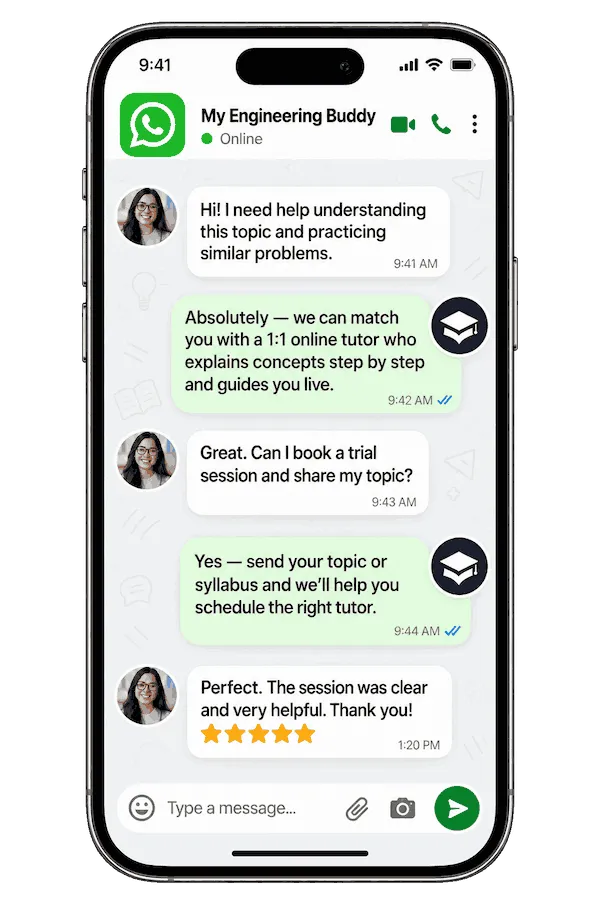
Unlike platforms where you fill out a form and wait, MEB responds in under a minute, 24/7. Tutor match takes under an hour. The $1 trial means you test before you commit. Everything runs over WhatsApp — no logins, no intake forms.
Study Plans (Pick One That Matches Your Goal)
Three plans cover most oral surgery students. Catch-up (1–3 weeks): for students with a specific gap — impaction classification, flap design, or complication management — to close before an imminent exam or OSCE date. Exam prep (4–8 weeks): structured revision across all surgical tracks, with past paper and mock OSCE practice built in. Weekly support: ongoing, semester-aligned sessions that track clinical year coursework and assignment deadlines alongside exam preparation. The tutor builds the specific session sequence after the diagnostic.
Pricing Guide
Oral surgery tutoring starts at $20/hr for standard BDS and DMD year levels. Advanced topics — MFDS/MJDF exam preparation, CBCT-based surgical planning, MRONJ protocols — run $50–$100/hr depending on tutor background and session complexity. Rate factors include the level of the qualification, how niche the topic is, your timeline, and tutor availability in your time zone.
Tutor slots fill fast in the six weeks before finals and OSCE assessment windows. Book early if your exam date is within eight weeks.
For students targeting specialist OMFS training programs or postgraduate surgical qualifications, tutors with clinical OMFS backgrounds are available at higher rates — share your specific goal and MEB will match the tier to your ambition.
Start with the $1 trial — 30 minutes, no registration, no commitment. WhatsApp MEB for a quick quote.
FAQ
Is oral surgery hard?
Yes — most dental students find it one of the steeper clinical subjects. The difficulty isn’t in memorising steps; it’s in applying surgical anatomy and decision criteria accurately under exam pressure. That gap between knowing and applying is what tutoring directly targets.
How many sessions are needed?
Students closing a single gap — one classification system, one complication type — often need 3–5 sessions. Full exam prep covering surgical technique, impaction, and complications typically runs 10–15 sessions over 4–8 weeks. The tutor gives a realistic estimate after the first diagnostic.
Can you help with homework and assignments?
Yes. MEB tutoring is guided learning — you understand the work, then submit it yourself. Tutors help you reason through case-based assignments, surgical planning write-ups, and literature-backed discussion sections. See our Academic Integrity policy and Why MEB page for full details on what we help with and what we don’t.
Will the tutor match my exact syllabus or exam board?
Yes. MEB tutors are matched to your dental school’s specific syllabus — BDS UK, DMD US/Canada, Australian BDS programs, Gulf dental curricula. For postgraduate qualifications like MFDS or MJDF, the tutor is matched to that specific exam format and syllabus content.
What happens in the first session?
The tutor runs a short diagnostic — usually a clinical case or classification exercise — to identify exactly where your reasoning breaks down. From there, the session plan is built around your specific gaps, exam date, and available time. No generic reviewing from the start of the textbook.
Is online tutoring as effective as in-person?
For oral surgery theory, clinical reasoning, and exam preparation — yes. The digital pen-pad replicates whiteboard work for surgical diagrams and anatomy. The only limitation is hands-on instrument practice, which requires a clinical setting regardless of tutoring format.
Can I get oral surgery help at midnight?
Yes. MEB operates across time zones 24/7. WhatsApp is the fastest way to reach the team. Tutors in your region are matched to evening and overnight slots — most students in the Gulf, Australia, and US West Coast use late-night sessions routinely.
What if I don’t connect with my assigned tutor?
Request a switch via WhatsApp. MEB replaces the tutor without charge or friction. The $1 trial is specifically designed to let you test the match before committing to a full session block — most mismatches are caught there.
What’s the difference between oral surgery and oral and maxillofacial surgery (OMFS)?
Oral surgery within a BDS/DMD programme covers dentoalveolar procedures — extractions, impactions, minor soft-tissue surgery. OMFS is a postgraduate surgical specialty involving complex jaw, facial, and head/neck procedures requiring a dual medical and dental qualification in most countries.
How do I prepare for an oral surgery OSCE station?
OSCE stations in oral surgery typically test instrument identification, consent for extraction, complication management, and post-operative instruction. MEB tutors run mock OSCE stations in live sessions — same time pressure, same question format — with step-by-step feedback on what examiners mark you on and where points are lost.
Do MEB tutors cover MRONJ and anticoagulant patient management?
Yes. Medication-related osteonecrosis of the jaw and anticoagulant/antiplatelet patient protocols are covered as part of the complications and special patient management track — areas that frequently appear in written papers and OSCE stations at final-year and postgraduate levels.
How do I get started?
Start with the $1 trial — 30 minutes of live 1:1 tutoring or one question explained in full. Three steps: WhatsApp MEB, get matched with a verified oral surgery tutor (usually within the hour), and start your trial session. No registration. No commitment.
Trust & Quality at My Engineering Buddy
Every MEB tutor goes through subject-specific vetting: degree verification, a live demo session assessed by the MEB academic team, and ongoing review based on student feedback after each session. Tutors covering oral surgery hold dental degrees and, in most cases, postgraduate clinical experience or academic teaching backgrounds in the subject. Rated 4.8/5 across 40,000+ verified reviews on Google.
MEB tutoring is guided learning — you understand the work, then submit it yourself. For full details on what we help with and what we don’t, read our Academic Integrity policy and Why MEB.
MEB has served 52,000+ students in 2,800+ subjects since 2008 — across the US, UK, Canada, Australia, Europe, and the Gulf. In Dentistry, that includes students needing periodontology tutoring, orthodontics tutoring, and prosthodontics help alongside oral surgery — often within the same clinical year. See how we structure sessions at our tutoring methodology page.
Try your first session for $1 — 30 minutes of live 1:1 tutoring or one homework question explained in full. No registration. No commitment. WhatsApp MEB now and get matched within the hour.
Explore Related Subjects
Students studying Oral Surgery often also need support in:
Next Steps
Before your first session, have ready: your exam board and syllabus or course outline, a recent past paper attempt or OSCE case you struggled with, and your exam or OSCE date. The tutor handles the rest.
- Share your dental school, exam board, hardest surgical topic, and current timeline
- Share your availability and time zone
- MEB matches you with a verified oral surgery tutor — usually within an hour
The first session starts with a diagnostic so every minute is used well. Visit www.myengineeringbuddy.com for more on how MEB works.
WhatsApp to get started or email [email protected].
Reviewed by Subject Expert
This page has been carefully reviewed and validated by our subject expert to ensure accuracy and relevance.