~1 min
Average Reply Time
~1 hour
To Be Matched With A Tutor
30 Min Trial
75% Find Their Tutor On The 1st Trial
$20-35+/hr
Premium Yet Affordable Learning
Most dental students who struggle with prosthodontics aren’t failing because they lack ability — they’re failing because they’re trying to memorise tooth preparation protocols without anyone showing them the mechanical logic behind each step.
Prosthodontics Tutor Online
Prosthodontics is the dental speciality concerned with the design, fabrication, and placement of fixed and removable prostheses — including crowns, bridges, dentures, and implant-supported restorations — to restore oral function and aesthetics.
If you’ve searched for a Prosthodontics tutor near me, MEB’s 1:1 online tutoring gives you a direct line to a qualified tutor who knows the BDS curriculum, the clinical reasoning behind each restoration type, and the exam questions that trip students up every year. Our Dentistry tutoring platform has served students across the US, UK, Canada, Australia, and the Gulf since 2008. With a verified online Prosthodontics tutor, you get sessions built around your exact syllabus — not a generic dental overview.
- 1:1 online sessions tailored to your university syllabus and clinical year
- Expert-verified tutors with subject-specific knowledge in fixed and removable prosthodontics
- Flexible time zones — US, UK, Canada, Australia, Gulf covered
- Structured learning plan built after an initial diagnostic session
- Ethical homework and assignment guidance — you understand the work before you submit
52,000+ students across the US, UK, Canada, Australia, and the Gulf have used MEB since 2008 — including students in Dentistry subjects like Prosthodontics, Dental Occlusion, and Endodontics.
Source: My Engineering Buddy, 2008–2025.
How Much Does a Prosthodontics Tutor Cost?
Most Prosthodontics tutoring sessions run $20–$40/hr depending on the level and topic complexity. Graduate-level or specialist implantology content can reach $60–$100/hr. Not sure if it’s worth it? Start with the $1 trial — 30 minutes of live 1:1 tutoring or one full question explained.
| Level / Need | Typical Rate | What’s Included |
|---|---|---|
| Undergraduate BDS / BDent | $20–$35/hr | 1:1 sessions, syllabus-aligned, hw guidance |
| Advanced / Specialist Level | $35–$70/hr | Expert tutor, implantology, occlusion depth |
| $1 Trial | $1 flat | 30 min live session or 1 homework question |
Tutor availability tightens significantly around semester clinical exams and OSCE preparation periods. Book early if you have a deadline within six weeks.
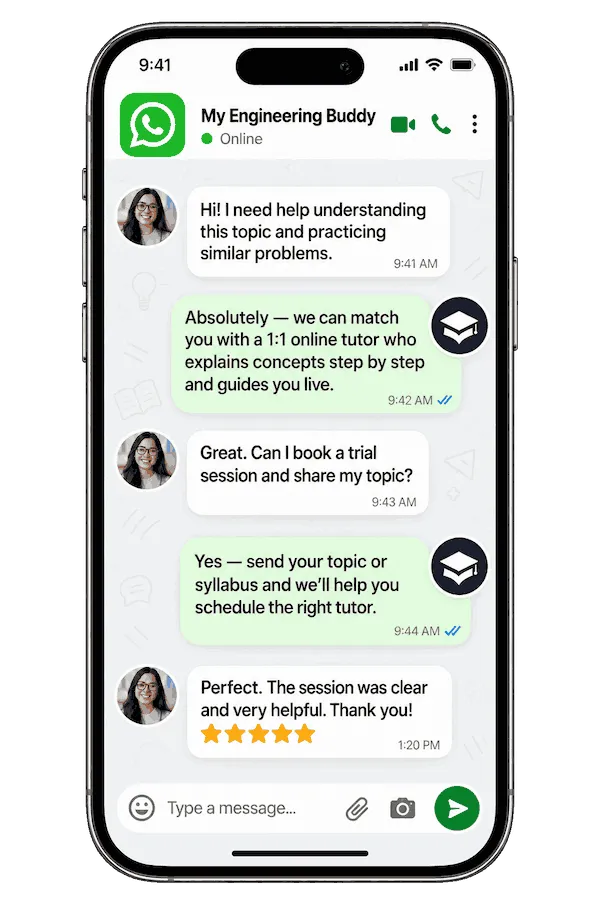
WhatsApp MEB for a quick quote — average response time under 1 minute.
Who This Prosthodontics Tutoring Is For
Prosthodontics sits at the intersection of biomechanics, materials science, and clinical judgement. Students who struggle here often need someone to work through clinical case reasoning with them — not more lecture slides.
- BDS and BDent students in years 3–5 covering fixed or removable prosthodontics
- Students preparing for OSCE stations involving crown preparation, impression techniques, or occlusal registration
- Students retaking after a failed first attempt at a clinical or written prosthodontics assessment
- Postgraduate students enrolled in MDS (Prosthodontics) or specialist diploma programmes
- Students with a conditional clinical placement offer dependent on passing prosthodontics
- Students at universities including King’s College London, University of Toronto, University of Sydney, NYU College of Dentistry, University of Michigan School of Dentistry, and Cardiff University
The $1 trial is the lowest-risk way to find out whether 1:1 sessions will move the needle before you commit to a block of hours.
At MEB, we’ve found that prosthodontics students who arrive with “I just don’t get crown prep” almost always mean “no one has connected the biomechanical reason to the clinical step.” That connection, made once in a live session, tends to unlock a lot of related topics at once.
1:1 Tutoring vs Self-Study vs AI vs YouTube vs Online Courses
Self-study works if you’re disciplined, but prosthodontics requires feedback on reasoning — not just memorisation. AI tools explain concepts fast but can’t assess whether your clinical decision logic is sound. YouTube is useful for watching a wax-up technique once; it stops short when you’re stuck on your own case. Online courses are structured but fixed-pace with no adaptation to your exam board. 1:1 tutoring with MEB is live, calibrated to your exact BDS year and syllabus, and corrects errors in the moment — particularly on the clinical case and OSCE components where marks are actually lost.
Outcomes: What You’ll Be Able To Do in Prosthodontics
After working with an online Prosthodontics tutor through MEB, you’ll be able to apply the principles of tooth preparation design to justify margin placement for full-coverage crowns. You’ll analyse occlusal schemes — balanced, canine-guided, group function — and explain the rationale for each in a clinical case context. You’ll solve impression selection problems, explaining why different tray and material combinations suit different restoration types. You’ll present a complete treatment plan for a partially edentulous patient, sequencing prosthodontic and periodontal phases correctly. You’ll write clinical notes that demonstrate understanding of denture base design, retention, and support factors — the kind of reasoning that scores marks in written and OSCE assessments alike.
Based on feedback from 40,000+ sessions collected by MEB from 2022 to 2025, 58% of students improved by one full grade after approximately 20 hours of 1:1 tutoring in subjects like Prosthodontics. A further 23% achieved at least a half-grade improvement.
Source: MEB session feedback data, 2022–2025.
Try your first session for $1 — 30 minutes of live 1:1 tutoring or one homework question explained in full. No registration. No commitment. WhatsApp MEB now and get matched within the hour.
What We Cover in Prosthodontics (Syllabus / Topics)

Fixed Prosthodontics
- Tooth preparation principles: taper, occlusal reduction, axial wall height, margin design
- Provisional restorations: fabrication techniques, cementation, and temporisation rationale
- Impression materials and techniques: polyvinyl siloxane, polyether, double-mix method
- Crown and bridge design: connector size, pontic design, abutment selection
- Cementation: luting agents (zinc phosphate, resin-modified glass ionomer, resin cement) and indications
- All-ceramic vs metal-ceramic systems: indications, fracture risk, shade matching
Core texts: McCracken’s Removable Partial Dentures (Carr & Brown), Shillingburg’s Fundamentals of Fixed Prosthodontics (4th ed.).
Removable Prosthodontics
- Complete denture: anatomical landmarks, impression techniques, jaw registration, try-in stages
- Removable partial denture (RPD) design: Kennedy classification, support, retention, stability
- Major and minor connectors: design principles and tissue compatibility
- Occlusal rests and retentive clasps: selection criteria and mechanical requirements
- Denture base materials: PMMA, flexible acrylics, processing methods
- Denture modifications and relining: clinical and laboratory procedures
Core texts: Prosthodontic Treatment for Edentulous Patients (Zarb & Hobkirk), Boucher’s Prosthodontic Treatment for Edentulous Patients.
Implant Prosthodontics and Occlusion
- Osseointegration: biological basis, loading protocols, healing timelines
- Implant components: fixture, abutment, crown — types and selection criteria
- Prosthetic design over implants: single unit, implant-supported bridge, overdenture
- Occlusal concepts in prosthodontics: centric relation, maximum intercuspation, lateral guidance
- Temporomandibular considerations in prosthesis planning
- Digital prosthodontics: CAD/CAM workflow, intraoral scanning, milled vs printed restorations
Core texts: Dental Implant Prosthetics (Misch), Clinical Occlusion and Temporomandibular Disorders (Türp & Greene).
What a Typical Prosthodontics Session Looks Like
The tutor opens by checking the previous session’s topic — say, RPD design using the Kennedy classification — asking the student to walk through a case before new content starts. From there, the session moves into the current topic: perhaps the step-by-step logic of complete denture jaw registration, with the tutor drawing the occlusal plane and anatomical landmarks on a digital pen-pad as the student follows. The student then attempts to sequence the clinical stages independently. The tutor watches, pauses on each error, and asks “why did you choose that?” rather than correcting outright. The session closes with a specific practice task — design an RPD for a given Kennedy Class II arch — and notes the next topic for the following week.
How MEB Tutors Help You with Prosthodontics (The Learning Loop)
Diagnose: In the first session, the tutor asks you to talk through a recent exam question or clinical scenario. Within 20 minutes, the pattern is clear — whether it’s tooth preparation geometry, occlusal reasoning, or denture design logic that’s breaking down.
Explain: The tutor works through a live example on a digital pen-pad, annotating crown preparation margins or drawing RPD frameworks step by step. No slides. Real-time explanation tied to your exact question.
Practice: You attempt the next problem while the tutor watches. This is where most tutoring platforms fall short — they explain, then leave. MEB tutors stay present through your attempt.
Feedback: Each error gets a specific correction — not “that’s wrong” but “that margin placement would compromise retention because the taper exceeds 6 degrees.” That precision is what changes exam performance.
Plan: The session closes with a clear next topic and a defined task. The tutor tracks what’s been covered and adjusts the sequence if your exam date moves.
Sessions run over Google Meet with a digital pen-pad or iPad and Apple Pencil. Before your first session, have your university course outline, a clinical case you found difficult, and your assessment date ready. The first session is part diagnostic, part teaching — nothing is wasted. Start with the $1 trial — 30 minutes of live tutoring that also serves as your first diagnostic.
Students consistently tell us that the shift from passive reading to active problem-solving in a live session — where someone immediately challenges a wrong assumption — compresses months of individual study into a few weeks of focused work.
Tutor Match Criteria (How We Pick Your Tutor)
MEB matches you based on four factors, not just availability.
Subject depth: The tutor must have clinical or academic experience specifically in prosthodontics — not general dentistry. BDS year, postgraduate speciality, and exam board are all checked.
Tools: Every MEB tutor uses Google Meet plus a digital pen-pad or iPad with Apple Pencil. Clinical diagrams and case annotations are drawn live — not screenshared from a slide deck.
Time zone: Matched to your region — US, UK, Gulf, Canada, or Australia. No scheduling across inconvenient time differences.
Goals: Whether you need to pass a written exam, prepare for OSCEs, get Dental Materials help alongside prosthodontics, or build clinical reasoning for a postgraduate application, the match accounts for your actual target.
Unlike platforms where you fill out a form and wait, MEB responds in under a minute, 24/7. Tutor match takes under an hour. The $1 trial means you test before you commit. Everything runs over WhatsApp — no logins, no intake forms.
Study Plans (Pick One That Matches Your Goal)
After the diagnostic session, your tutor builds the specific sequence. Most students fall into one of three plans: a catch-up sprint over 1–3 weeks for students behind on a single topic like complete denture stages or crown prep design; a structured exam prep block over 4–8 weeks covering all assessed components before a written or OSCE exam; or ongoing weekly support running alongside clinical placements, aligned to the cases and coursework you encounter each week. The tutor adjusts the plan as your exam date or placement schedule changes.
Pricing Guide
MEB charges $20–$40/hr for most undergraduate Prosthodontics tutoring. Specialist topics — implant prosthodontics, full-mouth rehabilitation, digital CAD/CAM workflows — are available at $60–$100/hr with tutors who hold postgraduate clinical experience in those areas.
Rate factors: clinical year level, topic complexity, your exam timeline, and tutor availability. Availability is limited in the 4–6 weeks before OSCE and end-of-year written exams — book early if you have a fixed deadline.
For students targeting specialist MDS programmes or clinical fellowships, tutors with postgraduate prosthodontics backgrounds are available at higher rates — share your specific goal and MEB will match the tier to your ambition.
Start with the $1 trial — 30 minutes, no registration, no commitment. WhatsApp MEB for a quick quote.
MEB has operated in over 2,800 subjects since 2008 — rated 4.8/5 across 40,000+ verified reviews — making it one of the most reviewed specialised tutoring platforms for dental and health sciences students.
Source: My Engineering Buddy platform data, 2008–2025.
FAQ
Is Prosthodontics hard?
Yes — it combines materials science, biomechanics, and clinical decision-making simultaneously. Students who find it hardest usually lack a clear mental model connecting the “why” of each preparation step to the mechanical outcome. That’s exactly what 1:1 sessions address first.
How many sessions are needed?
Most students see a clear improvement in exam confidence after 6–8 sessions focused on their specific weak areas. Students with broader gaps across fixed and removable prosthodontics typically need 15–20 hours for sustained improvement across assessments.
Can you help with homework and assignments?
MEB tutoring is guided learning — you understand the work, then submit it yourself. If you have a case study, treatment planning exercise, or written assignment, the tutor explains the underlying concepts and reasoning. See our Academic Integrity policy and Why MEB page for full details on what we help with and what we don’t.
Will the tutor match my exact syllabus or exam board?
Yes. Tutors are matched to your specific BDS year, university curriculum, and assessment format — whether that’s a written theory paper, OSCE stations, or viva examination. The diagnostic session establishes exactly which components need the most attention.
What happens in the first session?
The tutor asks you to walk through a recent question or clinical case. Within 20 minutes, they’ve identified the pattern behind your errors — whether it’s tooth geometry, occlusal reasoning, or denture design. Teaching starts immediately after that diagnosis, not in session two.
Is online tutoring as effective as in-person?
For prosthodontics theory, clinical reasoning, and exam preparation — yes. The digital pen-pad replicates whiteboard teaching, and Google Meet keeps latency low. Clinical manual skills still require in-person practice, but every conceptual and written component is well-served online.
Can I get Prosthodontics help at midnight or on weekends?
Yes. MEB operates across time zones — US, UK, Gulf, Canada, Australia — and WhatsApp response time averages under a minute, 24/7. If you have an exam in 48 hours, message now and a tutor can usually be matched the same day.
What if I don’t like my assigned tutor?
Tell MEB via WhatsApp. A replacement is arranged without argument or delay. The $1 trial exists partly for this reason — you test the match before committing to a block of sessions. No tutor reassignment fees, no forms.
What is the difference between fixed and removable prosthodontics, and do you cover both?
Fixed prosthodontics covers crowns, bridges, and implant-supported restorations that are cemented or screwed in place. Removable prosthodontics covers complete and partial dentures the patient can remove. MEB tutors cover both, including the occlusal principles that run across both disciplines.
How do OSCE stations for Prosthodontics typically work, and can a tutor help me prepare?
OSCE stations in prosthodontics commonly test clinical reasoning on case scenarios, identification of preparation errors, shade selection, and treatment sequencing — assessed in timed station rotations. Yes, MEB tutors simulate station-style questioning and mark your reasoning against the expected criteria.
Do you offer group Prosthodontics sessions?
MEB specialises in 1:1 tutoring. Group sessions are not offered — the diagnostic and personalised feedback model that produces grade improvements only works at the individual level. If cost is a concern, the $1 trial is the starting point.
How do I get started?
Start with the $1 trial: 30 minutes of live tutoring or one question explained in full. Three steps — WhatsApp MEB, get matched within the hour, begin your trial session. No registration, no intake form, no commitment beyond $1.
Trust & Quality at My Engineering Buddy
Every MEB tutor goes through subject-specific screening before their first session. That includes a live demo evaluation, degree and credential verification, and review of ongoing session feedback. Tutors covering prosthodontics hold relevant dental or biomedical science degrees, and specialist-level tutors bring postgraduate clinical experience in areas like implant prosthodontics or occlusal rehabilitation. Rated 4.8/5 across 40,000+ verified reviews on Google. The reviews are the track record — not a marketing claim.
MEB tutoring is guided learning — you understand the work, then submit it yourself. For full details on what we help with and what we don’t, read our Academic Integrity policy and Why MEB.
MEB has served 52,000+ students across the US, UK, Canada, Australia, the Gulf, and Europe since 2008 — across 2,800+ subjects. Dentistry is one of our most active subject areas, with tutors covering everything from Operative Dentistry tutoring and Periodontology help to specialist prosthodontics. If you’re studying any dental discipline at undergraduate or postgraduate level, there is a matched tutor available. See our tutoring methodology for how sessions are structured.
A common pattern our tutors observe is that prosthodontics students who are “behind” are rarely behind on facts — they’ve read the chapter. What’s missing is the clinical reasoning layer that connects material properties, preparation geometry, and patient factors into a coherent treatment decision.
Explore Related Subjects
Students studying Prosthodontics often also need support in:
Next Steps
When you contact MEB, have the following ready:
- Your exam board or university course outline and current clinical year
- Your availability and time zone
- Your exam or OSCE date and the component you find hardest
Before your first session, have ready: your university syllabus or course outline, a recent past paper attempt or clinical case you struggled with, and your assessment date. The tutor handles the rest.
MEB matches you with a verified Prosthodontics tutor — usually within 24 hours, often the same day. The first session starts with a diagnostic so every minute is used on your actual gaps, not a generic overview.
Visit www.myengineeringbuddy.com for more on how MEB works.
WhatsApp to get started or email [email protected].
Reviewed by Subject Expert
This page has been carefully reviewed and validated by our subject expert to ensure accuracy and relevance.