~1 min
Average Reply Time
~1 hour
To Be Matched With A Tutor
30 Min Trial
75% Find Their Tutor On The 1st Trial
$20-35+/hr
Premium Yet Affordable Learning
Dental materials is one of those subjects where a shaky foundation in bonding agents or alloy composition shows up later — in clinic, in exams, and in real restorations.
Dental Materials Tutor Online
Dental materials is the study of the physical, chemical, and biological properties of substances used in dentistry — including composites, ceramics, alloys, cements, and polymers — equipping students to select and apply materials safely in clinical practice.
If you’re searching for a dental materials tutor near me, MEB connects you with a verified 1:1 online dental materials tutor who knows your exact course — whether that’s a BDS module, a US dental school curriculum, or a graduate-level prosthodontics unit. Our dentistry tutoring covers the full spectrum of preclinical and clinical dental science. One tutor. Your syllabus. No guesswork.
- 1:1 online sessions tailored to your BDS module or dental school syllabus
- Expert verified tutors with subject-specific knowledge in dental materials science
- Flexible time zones — US, UK, Canada, Australia, Gulf
- Structured learning plan built after a diagnostic session
- Ethical homework and assignment guidance — you understand before you submit
52,000+ students across the US, UK, Canada, Australia, and the Gulf have used MEB since 2008 — including students in Dentistry subjects like Dental Materials, Operative Dentistry, and Prosthodontics.
Source: My Engineering Buddy, 2008–2025.
How Much Does a Dental Materials Tutor Cost?
Most dental materials tutoring sessions run $20–$40/hr. Graduate-level or specialist topics — ceramic microstructure, corrosion in alloys, biocompatibility testing — can reach up to $100/hr depending on tutor depth. New students can start with the $1 trial before committing to a package.
| Level / Need | Typical Rate | What’s Included |
|---|---|---|
| Standard (BDS, undergrad) | $20–$35/hr | 1:1 sessions, homework guidance |
| Advanced / Specialist | $35–$100/hr | Expert tutor, niche depth (ceramics, alloys) |
| $1 Trial | $1 flat | 30 min live session or 1 homework question explained |
Tutor availability tightens around dental school exam blocks — particularly in spring and autumn. Book early if your OSCE or written papers are within eight weeks.
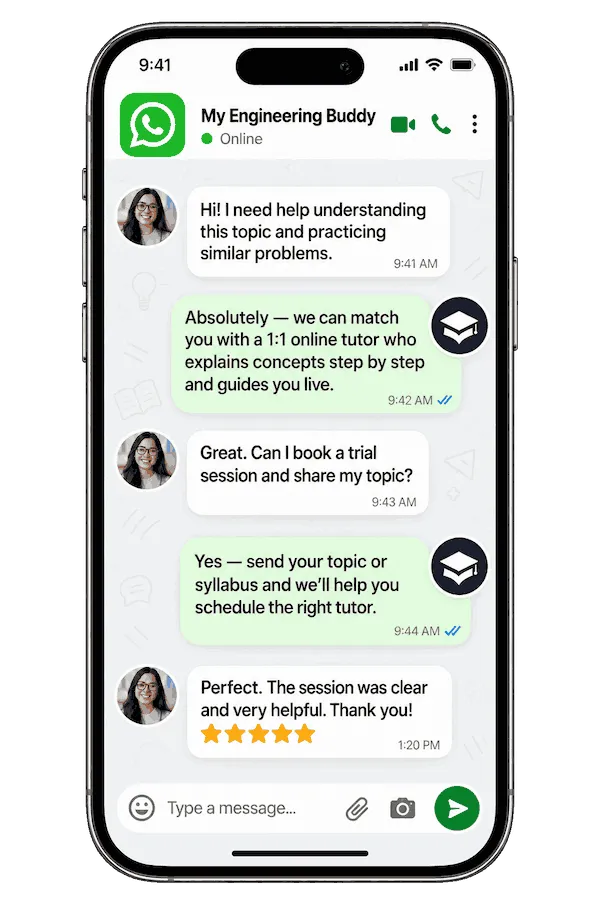
WhatsApp MEB for a quick quote — average response time under 1 minute.
Who This Dental Materials Tutoring Is For
Dental materials sits at the intersection of chemistry, physics, and clinical judgement. It trips up students who assumed it would be rote memorisation — it isn’t. The subject demands that you understand why a composite bonds or why an alloy corrodes, not just that it does.
- BDS students in years 1–3 covering materials science for the first time
- Students retaking after a failed first attempt in a dental materials exam
- Graduate students in prosthodontics or restorative dentistry needing depth in ceramics or polymers
- Students with a university conditional offer depending on this grade
- Parents watching a child’s confidence drop alongside their grades in preclinical science
- Students at dental schools including NYU College of Dentistry, King’s College London Dental Institute, University of Toronto, University of Melbourne, and Ajman University
At MEB, we’ve found that dental materials students often arrive knowing the material name but not its behaviour under stress or moisture. That gap — between memorising and actually understanding — is exactly what 1:1 tutoring is built to close.
1:1 Tutoring vs Self-Study vs AI vs YouTube vs Online Courses
Self-study works if you’re disciplined, but dental materials needs feedback — you can’t self-correct a flawed mental model of polymerisation shrinkage. AI tools explain fast but can’t walk you through a past paper question on glass ionomer cement and tell you where your logic broke down. YouTube covers composite layering in general; it stops when you need to apply it to your specific exam question. Online courses are structured but move at one pace for everyone. With a 1:1 dental anatomy or dental materials tutor at MEB, the session adapts to your exact course, your exact gaps, and the exam question styles your school uses.
Outcomes: What You’ll Be Able To Do in Dental Materials
After focused 1:1 dental materials tutoring, you’ll be able to explain the setting reactions of zinc phosphate and glass ionomer cements without prompting. You’ll apply your knowledge of stress distribution to select between amalgam and composite in a given cavity preparation. You’ll analyse the properties of dental ceramics — flexural strength, translucency, thermal expansion — and match them to clinical scenarios. You’ll present the rationale for alloy composition in fixed prosthetics, and solve MCQ and SAQ questions on polymer chemistry with the kind of precision that moves your score from a borderline pass to a clear one.
Based on feedback from 40,000+ sessions collected by MEB from 2022 to 2025, 58% of students improved by one full grade after approximately 20 hours of 1:1 tutoring in subjects like Dental Materials. A further 23% achieved at least a half-grade improvement.
Source: MEB session feedback data, 2022–2025.
Supporting a student through Dental Materials? MEB works directly with parents to set up sessions, track progress, and keep coursework on schedule. WhatsApp MEB — average response time is under a minute, 24/7.
What We Cover in Dental Materials (Syllabus / Topics)

Track 1: Fundamental Properties of Dental Materials
- Mechanical properties: stress, strain, hardness, elasticity, and fracture toughness
- Thermal properties: conductivity, expansion, and clinical relevance to pulp protection
- Optical properties: translucency, shade matching, and aesthetic performance
- Biological properties: biocompatibility, cytotoxicity, and ISO testing standards
- Adhesion and wettability: surface energy, contact angle, and bonding principles
- Corrosion in metallic restorations: galvanic corrosion, tarnish, and clinical consequences
Core texts include Anusavice’s Phillips’ Science of Dental Materials (Elsevier) and Craig’s Restorative Dental Materials (Mosby). Both are standard across US and UK dental school curricula.
Track 2: Direct Restorative Materials
- Dental amalgam: composition, setting reaction (gamma-2 phase), manipulation, and toxicity debate
- Composite resins: matrix and filler classification, polymerisation shrinkage, and light-curing protocols
- Glass ionomer cements: acid-base setting, fluoride release, and adhesion to tooth structure
- Resin-modified glass ionomers and compomers: hybrid properties and clinical indications
- Bonding systems: generations 4–8, etch-and-rinse vs self-etch, mechanism of hybridisation
- Cavity liners, bases, and varnishes: protection strategies and material selection criteria
Recommended: Sturdevant’s Art and Science of Operative Dentistry (Elsevier) and McCabe & Walls’ Applied Dental Materials (Wiley-Blackwell) for bonding system depth.
Track 3: Indirect and Prosthodontic Materials
- Dental ceramics: feldspathic, leucite-reinforced, lithium disilicate, and zirconia — properties and indications
- Dental alloys: noble vs base metal, compositional requirements, and ISO classification
- Impression materials: elastomers (addition and condensation silicones, polyether), alginates, and dimensional accuracy
- Gypsum products: dental plaster, stone, and die stone — setting expansion and clinical use
- Dental cements for luting: resin cements, RMGI, zinc phosphate — selection by restoration type
- Polymers in prosthetics: PMMA, flexible denture base materials, and polymerisation techniques
- CAD/CAM materials: milled ceramics, resin-nano composites, and digital workflow integration
Use Rosenstiel, Land & Fujimoto’s Contemporary Fixed Prosthodontics (Elsevier) for ceramic and alloy selection alongside the McCabe & Walls text for impression material chemistry.
Students consistently tell us that the jump from Track 2 to Track 3 — from direct to indirect materials — is where dental materials gets genuinely hard. The ceramic classification alone takes most students two or three sessions before it stops feeling like a list and starts feeling like a system.
What a Typical Dental Materials Session Looks Like
The tutor opens by checking where last session ended — usually the setting chemistry of glass ionomer or the polymerisation shrinkage problem in composites. From there, student and tutor work through two or three exam-style questions on screen: a comparison of luting cements, a scenario-based MCQ on alloy corrosion, or a structured question on impression material selection. The tutor uses a digital pen-pad to draw out the chemical structure of PMMA or sketch a stress-strain curve in real time. The student explains their reasoning out loud — the tutor corrects it step by step where it drifts. By the end of the hour, one concrete task is set: a past paper section on bonding systems, to be attempted before the next session. The next topic — ceramic classification — is noted and prepared for. You can get operative dentistry tutoring alongside dental materials if your exam combines both areas.
How MEB Tutors Help You with Dental Materials (The Learning Loop)
Diagnose: In the first session, the tutor identifies your exact gaps — not a general weakness in materials science, but specifically whether you’re struggling with the setting chemistry of zinc phosphate, the classification of elastomeric impressions, or the clinical selection logic for ceramics. That’s where the plan starts.
Explain: The tutor works through live problems using a digital pen-pad on Google Meet — drawing structures, annotating diagrams, stepping through reaction mechanisms for composite polymerisation or gypsum expansion. You see the reasoning, not just the answer.
Practice: You attempt the next problem with the tutor present. No skipping ahead to the mark scheme. The tutor watches where your logic breaks — at the mechanism, the clinical application, or the material selection step.
Feedback: Step-by-step error correction follows. The tutor explains not just what was wrong but why it costs marks — because in dental materials MCQs and SAQs, the wrong mental model is more dangerous than a gap in memorisation.
Plan: Each session ends with a specific task and a topic for next time. Ceramic classifications this week. Alloy corrosion next. Progress is tracked, not assumed. Get dedicated prosthodontics tutoring if your curriculum separates that unit.
Sessions run on Google Meet with a digital pen-pad or iPad and Apple Pencil. Before your first session, share your syllabus or module guide, a past paper or recent assignment you found difficult, and your exam date. Start with the $1 trial — 30 minutes of live tutoring that also serves as your first diagnostic. Whether you need a quick catch-up before an exam, structured revision over 4–8 weeks, or ongoing weekly support through the semester, the tutor maps the session plan after that first diagnostic.
Try your first session for $1 — 30 minutes of live 1:1 tutoring or one homework question explained in full. No registration. No commitment. WhatsApp MEB now and get matched within the hour.
Tutor Match Criteria (How We Pick Your Tutor)
Not every tutor who knows dentistry knows dental materials at exam depth. Here’s what MEB checks.
Subject depth: The tutor must have covered dental materials at BDS level or above — not just general chemistry or biology. Exam board and curriculum fit matters: a UK dental school syllabus differs from a US NBDE-aligned course.
Tools: Every tutor uses Google Meet with a digital pen-pad or iPad and Apple Pencil. Drawing out ceramic microstructures or composite filler classification in real time is non-negotiable for this subject.
Time zone: Matched to your region — US Eastern, UK GMT, Gulf GST, Australia AEST. No early-morning-only options for Gulf students.
Goals: Whether you need exam scores, conceptual depth for OSCEs, homework completion, or research support for a postgraduate thesis on material biocompatibility, the match reflects that.
Unlike platforms where you fill out a form and wait, MEB responds in under a minute, 24/7. Tutor match takes under an hour. The $1 trial means you test before you commit. Everything runs over WhatsApp — no logins, no intake forms.
Study Plans (Pick One That Matches Your Goal)
Catch-up (1–3 weeks): for students behind on a specific unit — bonding systems, ceramic classification, or impression materials — with an exam approaching. Tutor targets the gap directly. Exam prep (4–8 weeks): structured revision across all three tracks, past paper practice, and MCQ strategy. Weekly support: aligned to your semester timetable, covering each topic as your course delivers it. The tutor sets the exact sequence after the diagnostic. Students preparing for oral pathology exams often run dental materials support in parallel during the same semester block.
Pricing Guide
Dental materials tutoring runs $20–$40/hr for most BDS and undergraduate levels. Graduate-level work — postgraduate prosthodontics, ceramic materials research, biocompatibility testing — can reach $100/hr. Rate factors include topic complexity, tutor specialisation, timeline urgency, and availability.
For students targeting competitive dental specialty programmes or postgraduate research positions, tutors with professional clinical or materials research backgrounds are available at higher rates — share your specific goal and MEB will match the tier to your ambition.
Tutor slots during spring and autumn exam blocks fill fast. Start with the $1 trial — 30 minutes, no registration, no commitment. WhatsApp MEB for a quick quote.
MEB has been running 1:1 dental science sessions since 2008. In subjects like Dental Materials, Endodontics, and Oral Histology, the tutors know which exam components are weighted most — and build the session plan around that.
Source: My Engineering Buddy, 2008–2025.
FAQ
Is dental materials hard?
Most dental students find it harder than expected. The subject combines chemistry, physics, and clinical reasoning. Topics like polymerisation shrinkage and ceramic classification require understanding mechanisms — not just memorising names. 1:1 tutoring addresses that gap directly.
How many sessions are needed?
Students with specific exam gaps typically see clear improvement in 6–10 focused sessions. Those starting from scratch or covering the full syllabus for a resit usually need 15–20 hours spread over 4–8 weeks. The diagnostic session sets the exact plan.
Can you help with homework and assignments?
MEB tutoring is guided learning — you understand the work, then submit it yourself. If you’re stuck on a dental materials assignment about bonding systems or gypsum products, the tutor explains the concept until you can answer it independently. See our Academic Integrity policy and Why MEB page for full details on what we help with and what we don’t.
Will the tutor match my exact syllabus or exam board?
Yes. US dental school curricula, UK BDS programmes, Australian dental schools, and Gulf university syllabuses differ in emphasis. The tutor is matched to your specific course structure — not a generic dental materials overview. Share your module guide before the first session.
What happens in the first session?
The tutor runs a short diagnostic — asking you to work through a question or explain a topic. This identifies exactly where the gap is: setting chemistry, material classification, or clinical selection logic. The rest of the session and the full plan follow from that.
Is online tutoring as effective as in-person?
For dental materials specifically, yes. The subject is theory-heavy: chemical reactions, material properties, classification systems. All of that translates perfectly to a screen-based session with a digital pen-pad. Students at endodontics tutoring level consistently report the same result.
Can I get dental materials help at midnight?
MEB operates 24/7 via WhatsApp. Matching doesn’t require office hours. If your exam is tomorrow and you’re stuck on glass ionomer cement chemistry at 11 pm, send a message — average response time is under one minute.
What if I don’t like my assigned tutor?
Tell MEB via WhatsApp. A replacement is arranged, typically within the same day. The $1 trial exists precisely so you experience the tutor’s style before committing to a package. No pressure, no penalty for switching.
What’s the difference between the NBDE and BDS dental materials content?
The NBDE Part I (now integrated into the INBDE) tests dental materials within a biomedical sciences framework with heavy MCQ emphasis on composite chemistry and alloy properties. BDS exams vary by university but typically include SAQs and OSCEs. MEB tutors are matched to your specific format and oral medicine and radiology overlap areas included.
Does dental materials knowledge carry into clinical years?
Directly. The material you select for a Class II composite restoration, the luting cement for a ceramic crown, the impression material for a full-arch case — these are dental materials decisions made daily in clinic. Students who understood the theory in preclinical years make faster, more confident clinical decisions. Get oral histology tutoring alongside if your preclinical block combines both units.
How do I get started?
Start with the $1 trial — 30 minutes of live tutoring or one dental materials question explained in full. Step one: WhatsApp MEB. Step two: get matched to a tutor, usually within an hour. Step three: start your trial session.
Trust & Quality at My Engineering Buddy
Every MEB tutor goes through subject-specific screening: a live demo evaluation, review of academic and professional credentials, and an ongoing feedback review after sessions. Tutors covering dental materials hold dental science or materials science degrees and in many cases have clinical or research backgrounds in restorative dentistry or biomaterials. Rated 4.8/5 across 40,000+ verified reviews on Google.
MEB tutoring is guided learning — you understand the work, then submit it yourself. For full details on what we help with and what we don’t, read our Academic Integrity policy and Why MEB.
MEB has served 52,000+ students across the US, UK, Canada, Australia, Gulf, and Europe in 2,800+ subjects since 2008. Within Dentistry, that includes dedicated support for dental occlusion tutoring, periodontology help, and orthodontics tutoring — not just dental materials. The tutoring methodology is described fully at MEB’s tutoring methodology page.
MEB tutors covering dental materials have supported students from NYU College of Dentistry, King’s College London, University of Toronto, and the University of Melbourne — across BDS programmes, INBDE preparation, and graduate restorative dentistry units.
Source: My Engineering Buddy, 2008–2025.
Explore Related Subjects
Students studying Dental Materials often also need support in:
Next Steps
Before your first session, have ready: your exam board and syllabus or module outline, a recent past paper attempt or homework question you found difficult, and your exam or deadline date. The tutor handles the rest.
- Share your dental school, exam board, and hardest topic area
- Share your availability and time zone
- MEB matches you with a verified tutor — usually within 24 hours
The first session starts with a diagnostic so every minute is used well. Visit www.myengineeringbuddy.com for more on how MEB works.
WhatsApp to get started or email [email protected].
Reviewed by Subject Expert
This page has been carefully reviewed and validated by our subject expert to ensure accuracy and relevance.