~1 min
Average Reply Time
~1 hour
To Be Matched With A Tutor
30 Min Trial
75% Find Their Tutor On The 1st Trial
$20-35+/hr
Premium Yet Affordable Learning
Most students dropping grades in GCSE Design and Technology aren’t struggling with creativity — they’re losing marks on technical drawing, material properties, and NEA write-ups they never got proper feedback on.
GCSE Design and Technology Tutor Online
GCSE Design and Technology is a UK qualification assessed by boards including AQA, Edexcel, and OCR, covering product design, materials science, engineering principles, and the iterative design process, equipping students to design and evaluate functional products.
Finding a reliable GCSE Design and Technology tutor near me is harder than it sounds — most generalist tutors lack the technical depth the NEA and written papers actually demand. MEB’s 1:1 online GCSE tutoring connects you with subject-specialist tutors who know the AQA, Edexcel, and OCR syllabuses in detail. Whether you’re behind on materials knowledge, stuck on your Non-Examined Assessment, or need structured exam prep, a dedicated GCSE Design and Technology tutor online can close gaps that classroom teaching leaves open.
- 1:1 online sessions tailored to your exact exam board and syllabus
- Expert verified tutors with subject-specific D&T knowledge
- Flexible time zones — US, UK, Canada, Australia, Gulf
- Structured learning plan built after a diagnostic session
- Ethical homework and assignment guidance — you understand before you submit
52,000+ students across the US, UK, Canada, Australia, and the Gulf have used MEB since 2008 — including students in GCSE subjects like Design and Technology, GCSE Electronics, and GCSE Computer Science.
Source: My Engineering Buddy, 2008–2025.
How Much Does a GCSE Design and Technology Tutor Cost?
Most GCSE Design and Technology tutoring sessions with MEB run between $20 and $40 per hour, depending on the topic area and tutor specialism. Not sure if it’s worth it? Start with the $1 trial — 30 minutes of live tutoring or one full homework question explained.
| Level / Need | Typical Rate | What’s Included |
|---|---|---|
| Standard (most levels) | $20–$35/hr | 1:1 sessions, homework guidance, NEA support |
| Advanced / Specialist | $35–$70/hr | Expert tutor, technical drawing, niche materials |
| $1 Trial | $1 flat | 30 min live session or 1 homework question explained |
Tutor availability tightens considerably in the run-up to May and June exam windows — book early if you’re working to a fixed deadline.
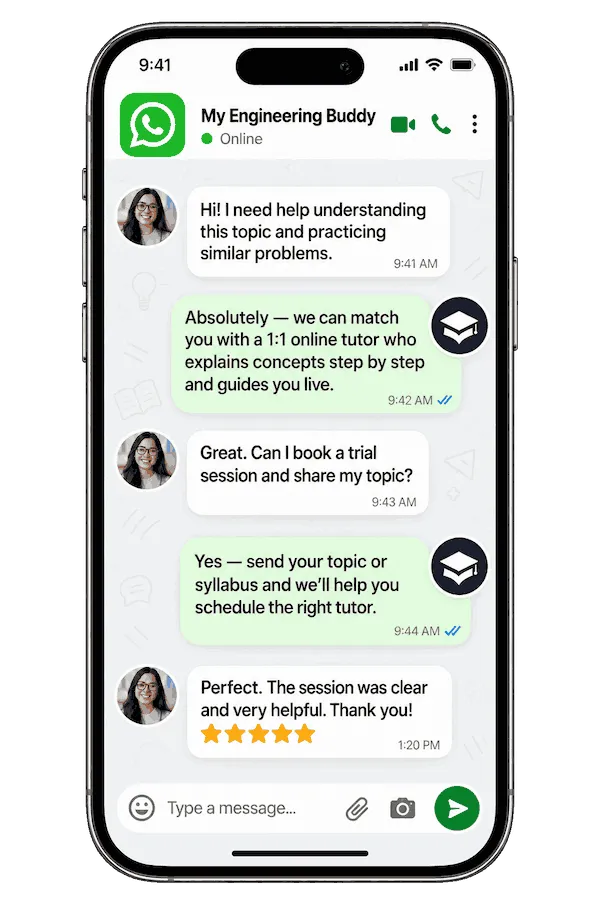
WhatsApp MEB for a quick quote — average response time under 1 minute.
Who This GCSE Design and Technology Tutoring Is For
This is for students who know they need to do better — and are ready to do something about it. It’s also for parents who’ve watched a child work hard and still not move up a grade band.
- Students losing marks on written exam questions despite understanding the practical side
- Students with a university conditional offer depending on this grade
- Students 4–6 weeks from an exam with significant gaps in materials science or design theory still to close
- Students with an NEA submission deadline approaching and no clear structure for their write-up
- Parents watching a child’s confidence drop alongside their grades in D&T
- International students taking GCSE D&T through an independent school or home-education programme
Students preparing for A Level Product Design, Engineering, or Architecture benefit from getting GCSE D&T right first. MEB tutors have worked with students heading to programmes at schools across the UK, US, Canada, and Australia. The $1 trial is the lowest-risk way to see whether the fit is right.
At MEB, we’ve found that students who bring a recent past-paper attempt to the first session — even a rough one — make noticeably faster progress than those who start from scratch. The tutor can pinpoint exactly where marks are going within the first 20 minutes.
1:1 Tutoring vs Self-Study vs AI vs YouTube vs Online Courses
Self-study works if you’re disciplined, but D&T covers a wide range — from thermosetting polymers to systems thinking — and there’s no one to tell you which gaps actually cost marks. AI tools can explain concepts quickly but can’t review your design sketches or NEA structure. YouTube is useful for overviews of manufacturing processes, but stops short when you’re stuck on a specific mark-scheme question. Online courses follow a fixed pace with no adjustment for your exam board’s specific weighting. 1:1 tutoring with MEB is live, calibrated to your AQA, Edexcel, or OCR syllabus, and corrects errors before they become exam habits.
Outcomes: What You’ll Be Able To Do in GCSE Design and Technology
After working with a GCSE Design and Technology tutor online through MEB, students can apply iterative design thinking to real briefs with confidence. You’ll be able to explain the functional and aesthetic properties of materials — from hardwoods to smart materials — in the precise language the mark scheme rewards. Students learn to analyse exam questions on manufacturing processes and systems, write structured NEA design justifications, present annotated prototypes clearly, and solve “evaluate and suggest improvements” questions with a method rather than guesswork.
Based on feedback from 40,000+ sessions collected by MEB from 2022 to 2025, 58% of students improved by one full grade after approximately 20 hours of 1:1 tutoring in subjects like GCSE Design and Technology. A further 23% achieved at least a half-grade improvement.
Source: MEB session feedback data, 2022–2025.
Supporting a student through GCSE Design and Technology? MEB works directly with parents to set up sessions, track progress, and keep NEA coursework on schedule. WhatsApp MEB — average response time is under a minute, 24/7.
Try your first session for $1 — 30 minutes of live 1:1 tutoring or one homework question explained in full. No registration. No commitment. WhatsApp MEB now and get matched within the hour.
What We Cover in GCSE Design and Technology (Syllabus / Topics)
GCSE D&T is examined by AQA, Edexcel, OCR, and WJEC/Eduqas. The core content below is common across boards; your tutor will align sessions to your specific specification and NEA brief from the first session. MEB also supports GCSE Electronics students who sit a combined or separate electronics option.
Core Technical Principles
- Properties and classification of materials: metals, polymers, timber, textiles, composites, and smart/modern materials
- Forces and stresses: tension, compression, torsion, shear — how they affect material selection
- Electronic systems: input, process, and output components; circuit diagrams and sensors
- Mechanical devices: levers, linkages, cams, gears, and their mechanical advantage calculations
- Energy generation, storage, and transfer — including renewable sources and sustainability
- Digital design tools: CAD/CAM principles, 2D and 3D modelling concepts
- Structural principles: triangulation, reinforcement, and shell structures
Recommended texts: GCSE Design and Technology for AQA (Hodder Education); Edexcel GCSE Design and Technology Student Book (Pearson). The Higher Education Statistics Agency publishes data on design and engineering progression routes that contextualise why this qualification matters at sixth-form entry.
Designing and Making Principles
- Iterative design process: explore, create, evaluate — applied to real briefs
- Design strategies: user-centred design, systems thinking, circular economy approaches
- Annotated sketching and 2D/3D design communication — perspective, orthographic, and isometric drawing
- Prototype development: scale models, mock-ups, testing against a design specification
- Manufacturing processes: cutting, joining, shaping, and finishing for wood, metal, and plastics
- Quality control and tolerance in manufacturing
- NEA (Non-Examined Assessment) structure: brief analysis, research, ideation, development, and evaluation sections
Recommended texts: Design and Technology GCSE: Design & Make it! (Stanley Thornes); OCR GCSE Design and Technology (Hodder Education). Tutors walk students through NEA documentation structure and mark-scheme language section by section.
Social, Moral, and Environmental Contexts
- Sustainability: planned obsolescence, lifecycle analysis, the 6Rs (Reduce, Reuse, Recycle, Refuse, Rethink, Repair)
- Global and ethical sourcing: Fairtrade, carbon footprint, supply chains
- Cultural and historical influences on design movements
- Impact of new technologies: automation, AI in design, nanotechnology
- Consumer rights, product safety standards, and legal responsibilities of designers
Recommended texts: Design and Technology for the IB MYP (Hodder); broader context reading from board-specific revision guides. Exam questions on this section are often underestimated — the tutor builds a structured answer framework for the 6- and 12-mark questions.

What a Typical GCSE Design and Technology Session Looks Like
The tutor opens by checking how the student got on with the previous topic — usually material properties or a specific design context question. From there, the session moves to the day’s focus. If it’s an exam technique session, tutor and student work through a past-paper question together on screen: the tutor annotates the question on a digital pen-pad, models what a full-mark answer includes, then asks the student to attempt a parallel question. If it’s NEA support, the tutor reviews the student’s current section, identifies where the examiner would lose confidence, and rebuilds that section’s structure live. Every session closes with a specific task — one past-paper question or one NEA section to draft — and the next session topic is confirmed.
How MEB Tutors Help You with GCSE Design and Technology (The Learning Loop)
Diagnose: In the first session, the tutor reviews a recent exam attempt or NEA draft to identify the exact gaps. For D&T, this usually means spotting where students are writing vaguely about materials instead of using precise technical terminology, or where design justifications lack specific reference to the brief.
Explain: The tutor works through concepts live using a digital pen-pad — annotating diagrams, sketching material cross-sections, or walking through the 6Rs framework with real product examples. Abstract ideas become concrete fast.
Practice: The student attempts a question or task while the tutor is present. No waiting until next week to find out it was wrong.
Feedback: The tutor goes through the attempt step by step — marking against the actual mark scheme, naming exactly which command words triggered which answers, and showing where marks were dropped and why.
Plan: The session ends with a clear next step. Topics are sequenced so exam pressure doesn’t create a revision scramble at the end.
Sessions run on Google Meet. Tutors use a digital pen-pad or iPad with Apple Pencil for live annotation. Before the first session, send your exam board, a recent past-paper attempt or a section of your NEA, and your exam or submission date. The tutor uses all three to build the session plan. Start with the $1 trial — 30 minutes of live tutoring that also serves as your first diagnostic.
Students tell us the moment things clicked was when the tutor showed them exactly what the GCSE D&T mark scheme is actually looking for — not a general answer about sustainability, but a precise point about lifecycle analysis or planned obsolescence, written in examiner language.
Source: My Engineering Buddy, compiled from session feedback 2022–2025.
Tutor Match Criteria (How We Pick Your Tutor)
Not every D&T tutor suits every student. Here’s what MEB matches on:
Subject depth: Tutor must have direct experience with your exam board — AQA, Edexcel, OCR, or WJEC — and your specific specialism if you’re taking a focused route (Product Design, Fashion and Textiles, or Food Preparation is handled separately by GCSE Food Preparation and Nutrition tutors).
Tools: Google Meet plus a digital pen-pad or iPad with Apple Pencil — so technical drawing and annotation work properly online.
Time zone: Matched to the student’s region — UK, US, Gulf, Canada, or Australia — so sessions happen at workable hours.
Goals: Whether the priority is exam score improvement, NEA completion, or filling a specific conceptual gap, the tutor is briefed before the first session starts.
Unlike platforms where you fill out a form and wait, MEB responds in under a minute, 24/7. Tutor match takes under an hour. The $1 trial means you test before you commit. Everything runs over WhatsApp — no logins, no intake forms.
Study Plans (Pick One That Matches Your Goal)
Catch-up (1–3 weeks): Focused on the highest-yield topics and past-paper technique before the exam. Exam prep (4–8 weeks): Systematic coverage of written paper topics, NEA completion, and timed practice. Weekly support: Ongoing sessions aligned to school deadlines and coursework submission windows. After the diagnostic, the tutor maps out the specific sequence — you don’t need to arrive with a plan, just with your syllabus and current position.
Pricing Guide
GCSE Design and Technology tutoring starts at $20/hr for standard exam-board coverage. Rates reach $40/hr for specialist NEA support or advanced technical content. Niche or urgent requests may go up to $100/hr depending on tutor availability and timeline pressure.
Rate depends on: exam board, topic complexity (materials science commands higher specialist knowledge than design process), timeline urgency, and tutor experience level. Availability tightens in April and May — if your exam is in June, book now.
For students targeting top sixth-form programmes or A Level Product Design with a strong D&T foundation requirement, tutors with professional design or engineering backgrounds are available at higher rates — share your specific goal and MEB will match the tier to your ambition.
Start with the $1 trial — 30 minutes, no registration, no commitment. WhatsApp MEB for a quick quote.
Students consistently tell us that one of the biggest surprises in their first session is discovering exactly which questions they were losing marks on — and that those questions had a learnable structure. A common pattern our tutors observe is students writing long answers on D&T context questions but never using the specific terminology the examiner needs to see.
FAQ
Is GCSE Design and Technology hard?
It has two demanding components: a written exam covering technical principles, contexts, and design theory, and the NEA, which requires sustained independent work over months. Students who struggle usually underestimate the written paper or leave NEA documentation too late.
How many sessions are needed to improve in GCSE D&T?
Most students see measurable improvement in exam technique within 6–8 sessions. NEA support often requires 10–15 sessions spread across the coursework window. The $1 trial diagnostic gives a clearer picture of what your specific timeline needs.
Can you help with homework and assignments?
MEB tutoring is guided learning — you understand the work, then submit it yourself. The tutor explains concepts, walks through examples, and checks your reasoning. See our Academic Integrity policy and Why MEB page for full details on what we help with and what we don’t.
Will the tutor match my exact syllabus or exam board?
Yes. When you contact MEB, share your exam board (AQA, Edexcel, OCR, or WJEC) and your specific specialism if applicable. The tutor is matched to your exact specification — not a generic D&T overview.
What happens in the first session?
The tutor reviews your current position: a past-paper attempt, an NEA draft section, or a topic list you’re unsure about. From that, the tutor sets a clear session-by-session plan. Nothing is assumed — the diagnostic drives everything.
Is online tutoring as effective as in-person for D&T?
For the written exam and NEA documentation — which together make up 100% of the assessed content — online is just as effective. Technical drawing and annotation work well with a digital pen-pad on screen. Hands-on making is the one area that needs physical access to tools.
What’s the difference between the AQA and Edexcel GCSE D&T specifications?
AQA’s written paper includes a ‘contexts’ section where students apply knowledge to a given scenario. Edexcel places greater emphasis on product analysis. OCR integrates more systems and control content. Your tutor will know which paper demands which specific response style.
How do NEA marks actually get awarded — and where do most students lose points?
NEA is marked across design communication, development quality, and evaluation depth. Most marks are lost in the evaluation section, where students describe what they made rather than critically assessing it against the original specification. The tutor shows you exactly how to frame each section for maximum credit.
Can I get help at short notice before my exam?
Yes. MEB has tutors available across time zones, including evenings and weekends. WhatsApp MEB with your exam date and the topics you need to cover — a match is usually made within an hour, even for urgent requests.
Do you offer group GCSE Design and Technology sessions?
MEB specialises in 1:1 sessions only. The NEA and written paper both require personalised feedback tied to your specific brief and exam board — group sessions don’t allow that level of specificity.
How do I get started with a GCSE D&T tutor?
Start with the $1 trial: 30 minutes of live tutoring or one homework question explained in full. Step 1 — WhatsApp MEB. Step 2 — get matched to a verified tutor within the hour. Step 3 — run the trial session, which also serves as your diagnostic.
Trust & Quality at My Engineering Buddy
Every MEB tutor goes through subject-specific vetting: a screening interview, a live demo session evaluation, and ongoing review based on student feedback after every session. Tutors covering GCSE D&T hold relevant degrees and, in many cases, professional design or engineering experience. Rated 4.8/5 across 40,000+ verified reviews on Google. MEB has served 52,000+ students since 2008.
MEB tutoring is guided learning — you understand the work, then submit it yourself. For full details on what we help with and what we don’t, read our Academic Integrity policy and Why MEB.
MEB operates across 2,800+ subjects — from GCSE Design and Technology and GCSE Art and Design tutoring to GCSE Physics help — serving students in the US, UK, Canada, Australia, the Gulf, and Europe. The platform has been running since 2008, and the subject roster and tutor pool are continuously updated to match current syllabuses. See how MEB’s tutoring methodology works for a breakdown of how sessions are structured and reviewed.
MEB has been matching students to specialist tutors since 2008 — 18 years of refining what works in live 1:1 online sessions across GCSE, A Level, and university subjects worldwide.
Source: My Engineering Buddy, 2008–2025.
Explore Related Subjects
Students studying GCSE Design and Technology often also need support in:
- GCSE Mathematics
- GCSE Combined Science
- GCSE Biology
- GCSE Chemistry
- GCSE Business Studies
- GCSE Geography
- GCSE Statistics
Next Steps
Here’s what to do right now:
- Share your exam board (AQA, Edexcel, OCR, or WJEC), the component you’re struggling with most, and your exam or NEA deadline
- Share your availability and time zone — UK, US, Gulf, Canada, or Australia
- MEB matches you with a verified GCSE D&T tutor — usually within the hour
- Your first session starts with a diagnostic, so every minute is used on what actually matters for your grade
Before your first session, have ready: your exam board and syllabus (or a past paper), a recent exam attempt or NEA section you struggled with, and your exam or submission date. The tutor handles the rest.
Visit www.myengineeringbuddy.com for more on how MEB works.
WhatsApp to get started or email [email protected].
Our experience across thousands of sessions shows that students who start with a diagnostic — even just one session reviewing a past-paper attempt — make better use of every hour that follows. Don’t start from topic one. Start from where you’re actually losing marks.
Reviewed by Subject Expert
This page has been carefully reviewed and validated by our subject expert to ensure accuracy and relevance.