

Contact MEB Today To Get The Best
GCSE Food Preparation and Nutrition Tutoring Online
Email: [email protected]



~1 min
Average Reply Time
~1 hour
To Be Matched With A Tutor
30 Min Trial
75% Find Their Tutor On The 1st Trial
$20-35+/hr
Premium Yet Affordable Learning
Most students don’t fail GCSE Food Preparation and Nutrition because they can’t cook — they fail because the written exam and NEA portfolio catch them off guard.
GCSE Food Preparation and Nutrition Tutor Online
GCSE Food Preparation and Nutrition is a UK secondary qualification, assessed by boards including AQA, OCR, and Eduqas, that equips students with knowledge of food science, nutrition, and practical cooking skills through written exams and a non-examined assessment.
Finding a reliable GCSE Food Preparation and Nutrition tutor near me has always meant trawling agency directories with no idea who you’ll actually get. MEB works differently. Our 1:1 online GCSE tutoring matches you with a subject-specific tutor — one who knows the AQA, OCR, or Eduqas syllabus, understands the NEA requirements, and can work through the science behind food with you in real time. You won’t come away with vague advice. You’ll come away knowing why starch gelatinises, how to plan a nutritionally balanced meal for a specific dietary need, and exactly what the examiners are looking for in your written answers.
- 1:1 online sessions tailored to your exact exam board and syllabus
- Expert-verified tutors with subject-specific Food Preparation and Nutrition knowledge
- Flexible time zones — US, UK, Canada, Australia, Gulf
- Structured learning plan built after a diagnostic session
- Ethical homework and assignment guidance — you understand the work, then submit it yourself
52,000+ students across the US, UK, Canada, Australia, and the Gulf have used MEB since 2008 — including students taking GCSE subjects like Food Preparation and Nutrition, GCSE Biology, and GCSE Home Economics.
Source: My Engineering Buddy, 2008–2025.
How Much Does a GCSE Food Preparation and Nutrition Tutor Cost?
Most GCSE Food Preparation and Nutrition tutoring sessions run at $20–$35/hr. More specialist support — for example, a tutor with a food science degree or professional chef background — sits closer to $40–$70/hr. You can test everything before committing with the $1 trial: 30 minutes of live tutoring or one full question worked through and explained.
| Level / Need | Typical Rate | What’s Included |
|---|---|---|
| Standard GCSE support | $20–$35/hr | 1:1 sessions, assignment guidance, exam prep |
| Advanced / Specialist | $35–$70/hr | Food science depth, NEA strategy, niche topics |
| $1 Trial | $1 flat | 30 min live session or one full homework question |
Tutor availability tightens in the weeks before the May/June written exam window. Book early if you’re working toward that deadline.
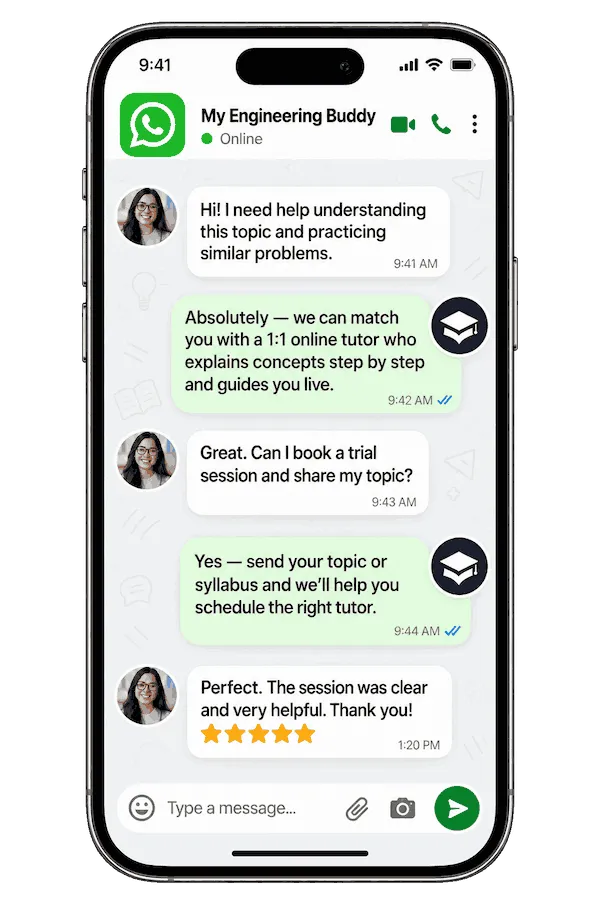
WhatsApp MEB for a quick quote — average response time under 1 minute.
Who This GCSE Food Preparation and Nutrition Tutoring Is For
This isn’t a general revision service. It’s for students who are stuck on specific things — the food science theory, the NEA planning stages, or the written exam technique — and need someone who can actually fix those gaps.
- Students who understand the practical side but can’t translate it into exam marks
- Students with a NEA (Non-Examined Assessment) submission deadline approaching fast
- Students retaking after a failed first attempt who need a clearer approach to the written paper
- Students with a conditional sixth form or college offer that depends on hitting a grade 5 or above
- Parents watching a child’s confidence drop alongside their grades in the lead-up to exams
- Students who need help structuring food science answers — the kind that require explaining the Maillard reaction or the function of gluten development, not just stating a fact
Students who go on to study Nutrition, Dietetics, Food Technology, or Hospitality at universities including Durham, Leeds, Cardiff, and Nottingham often point to GCSE Food Preparation and Nutrition as the subject where their interest solidified — but only when someone explained the underlying science properly.
1:1 Tutoring vs Self-Study vs AI vs YouTube vs Online Courses
Self-study works if you’re disciplined, but there’s no one to tell you why your NEA trial run missed marks. AI tools give fast answers on food science terms but can’t review your actual written response and pinpoint where you lost points. YouTube covers nutrient functions and cooking methods well at the overview level — it stops when you need to apply those ideas to a specific exam question. Online courses are structured but move at a fixed pace with no room to slow down on the sections you’re actually weak on. With 1:1 online Food Preparation and Nutrition tutoring through MEB, the tutor works through your exact exam board’s mark scheme with you, live — so the feedback is immediate and calibrated to what your paper actually requires.
Outcomes: What You’ll Be Able To Do in GCSE Food Preparation and Nutrition
After working with an MEB tutor, you’ll be able to explain the functional and chemical properties of ingredients — why fat shortens pastry, how emulsification works in a sauce, what happens to protein during coagulation. You’ll be able to analyse a dietary scenario and apply knowledge of macronutrients, micronutrients, and life-stage requirements to justify food choices under exam conditions. You’ll be able to write structured answers to “explain” and “evaluate” questions without padding. You’ll be able to present your NEA food investigation with clear scientific reasoning, not just observations. And you’ll be able to work through a past paper confidently, knowing which marks come from precision and which come from applied knowledge.
Supporting a student through GCSE Food Preparation and Nutrition? MEB works directly with parents to set up sessions, track progress, and keep NEA coursework on schedule. WhatsApp MEB — average response time is under a minute, 24/7.
Based on feedback from 40,000+ sessions collected by MEB from 2022 to 2025, 58% of students improved by one full grade after approximately 20 hours of 1:1 tutoring in subjects like GCSE Food Preparation and Nutrition. A further 23% achieved at least a half-grade improvement.
Source: MEB session feedback data, 2022–2025.
What We Cover in GCSE Food Preparation and Nutrition (Syllabus / Topics)

Track 1: Food Science and Nutrition
- Macronutrients: proteins, carbohydrates, fats — structure, function, dietary sources
- Micronutrients: vitamins and minerals — deficiency diseases, RDAs, food sources
- Functional properties of ingredients: coagulation, gelatinisation, emulsification, shortening, aeration, caramelisation, Maillard reaction
- Energy balance, BMR, and diet-related disease (obesity, type 2 diabetes, cardiovascular disease)
- Dietary needs across life stages: infancy, childhood, adolescence, pregnancy, older adults
- Special dietary requirements: vegetarian, vegan, coeliac, lactose intolerance, religious dietary laws
- Food labelling: traffic light system, nutritional information panels, allergen declarations
Recommended texts: AQA GCSE Food Preparation and Nutrition by Bender & Elliot; GCSE Food Preparation and Nutrition for OCR by Stevenson & Morgan (15–25 words, matched to your exam board).
Track 2: Food Preparation, Safety, and Provenance
- Food safety: bacterial contamination, temperature danger zones, storage, HACCP principles
- Hygiene practices: personal hygiene, cross-contamination prevention, safe food handling
- Food provenance: farm to fork, seasonality, food miles, ethical sourcing, Fairtrade
- Environmental impact of food production: sustainability, food waste, packaging
- Primary and secondary processing of food
- Preservation methods: freezing, canning, drying, pickling, modified atmosphere packaging
Recommended texts: Eduqas GCSE Food Preparation and Nutrition by Bender; Food Preparation and Nutrition GCSE by Loveday (cross-board revision friendly).
Track 3: NEA and Exam Technique
- NEA Task 1 (Food Investigation): hypothesis, trial runs, data collection, written analysis
- NEA Task 2 (Food Preparation Assessment): menu planning, time plan, skills demonstration, evaluation
- Written exam structure: Section A (multiple choice), Section B (short and extended answers)
- Answering “explain” and “evaluate” questions using subject-specific vocabulary
- Mark scheme analysis: what distinguishes a grade 4 from a grade 7 answer
- Past paper practice strategy: timed conditions, self-marking, gap identification
Recommended texts: AQA GCSE Food Preparation and Nutrition Revision Guide by Collins; past papers and mark schemes from your exam board’s official website.
At MEB, we’ve found that students who struggle with GCSE Food Preparation and Nutrition written papers almost always know more than their answers show. The issue is structure — knowing how to open an explanation, use the right terminology, and close with the point the mark scheme is actually looking for. That’s a teachable skill, and it usually clicks within two or three sessions.
What a Typical GCSE Food Preparation and Nutrition Session Looks Like
The tutor starts by checking the previous topic — say, the functional properties of eggs, which you covered last time. You talk through what you remember, and the tutor immediately identifies whether the gaps are in the science (coagulation temperatures, foam formation) or in how you’re expressing it in writing. From there, you work through two or three exam-style questions on screen together — the tutor writes out a model answer using a digital pen-pad, annotating where each mark is earned and why. You then attempt the next question yourself, talk through your reasoning out loud, and the tutor interrupts when the logic drifts. The session closes with a specific task: a past paper question on a topic you haven’t covered yet, which you’ll attempt before the next session. The tutor notes what’s next: emulsification, or the NEA food investigation write-up structure.
How MEB Tutors Help You with GCSE Food Preparation and Nutrition (The Learning Loop)
Diagnose: In the first session, the tutor identifies where your knowledge breaks down — whether that’s the food science theory, the written exam technique, the NEA structure, or all three. A short diagnostic exercise usually makes this clear within 20 minutes.
Explain: The tutor works through the concept live — on Google Meet with a digital pen-pad or iPad and Apple Pencil. For Food Preparation and Nutrition, this often means drawing nutrient pathway diagrams, annotating mark schemes, or walking through the stages of an NEA food investigation report.
Practice: You attempt a question while the tutor watches. Not after the session. During it. This is where most self-study methods fail — there’s no one to catch the mistake the moment it forms.
Feedback: The tutor shows you exactly where marks were lost and why. Not a vague “expand your answer” — a specific correction: “you named the reaction but didn’t state the conditions required, which is where the second mark sits.”
Plan: Before the session ends, the tutor maps the next topic and sets a practice task. Each session builds on the last. Progress is tracked, not hoped for.
Sessions run on Google Meet. The tutor uses a digital pen-pad or iPad with Apple Pencil to annotate answers and diagrams in real time. Before your first session, send across your exam board, your most recent past paper attempt or assignment, and your exam date. The first session covers the diagnostic and starts working on your highest-priority gap immediately. Start with the $1 trial — 30 minutes of live tutoring that also serves as your first diagnostic.
Students consistently tell us that the moment things change in Food Preparation and Nutrition is when they stop memorising facts about nutrients and start applying them — explaining why a pregnant woman needs more folate rather than just listing it. The tutor’s job is to make that shift happen quickly, not at the end of a twelve-week revision schedule.
Tutor Match Criteria (How We Pick Your Tutor)
Not every Food Preparation and Nutrition tutor is right for every student. Here’s what MEB checks before the match.
Subject depth: The tutor must know the specific exam board — AQA, OCR, or Eduqas — and the current syllabus, including NEA requirements and written paper structure. A tutor who knows food science in general but hasn’t worked with the mark scheme is not the right match.
Tools: Every MEB tutor uses Google Meet plus a digital pen-pad or iPad with Apple Pencil. This is non-negotiable for a subject that requires annotating diagrams and working through written answers together.
Time zone: Tutors are matched to your region — UK, US, Gulf, Canada, or Australia — so sessions happen at reasonable hours without compromise on tutor quality.
Goals: Whether you need to close a gap before the May exam, rebuild understanding from scratch, or get your NEA food investigation write-up to grade 7 standard, the match is made against your actual goal.
Unlike platforms where you fill out a form and wait, MEB responds in under a minute, 24/7. Tutor match takes under an hour. The $1 trial means you test before you commit. Everything runs over WhatsApp — no logins, no intake forms.
Study Plans (Pick One That Matches Your Goal)
The tutor builds your specific session sequence after the diagnostic — but here’s the general shape. Catch-up (1–3 weeks): intensive focus on the most examinable topics and written technique for students who are behind with the exam close. Exam prep (4–8 weeks): systematic coverage of the full written paper, past paper practice, and NEA support for students with a fixed exam date in sight. Weekly support: ongoing sessions aligned to your school’s teaching schedule, keeping coursework, assignments, and theory in sync throughout the year.
Pricing Guide
GCSE Food Preparation and Nutrition tutoring runs at $20–$40/hr for most students. The rate depends on the level of specialism required, how close the exam is, and tutor availability. Graduate-level food science knowledge or intensive NEA support from a specialist tutor can bring the rate up to $70/hr.
For students targeting nutrition or food science programmes at competitive universities, tutors with food technology or dietetics backgrounds are available at higher rates — share your goal and MEB will match the tier to your ambition.
Availability shrinks fast in April and May. Book ahead if your exam is in the summer window. Start with the $1 trial — 30 minutes, no registration, no commitment. WhatsApp MEB for a quick quote.
MEB has supported GCSE students across the UK, US, Canada, and the Gulf since 2008 — 52,000+ students, 4.8/5 on Google, 40,000+ reviews. Food Preparation and Nutrition is one of the most under-tutored GCSE subjects relative to how much it rewards structured preparation.
Source: My Engineering Buddy, 2008–2025.
FAQ
Is GCSE Food Preparation and Nutrition hard?
The practical element is manageable for most students, but the written exam and the food science theory — particularly explaining functional properties and nutritional chemistry — trip up students who haven’t studied them systematically. It’s a subject that rewards preparation more than natural ability.
How many sessions are needed?
Most students see a meaningful improvement in exam technique within 6–10 sessions. Students with large theory gaps or NEA support needs typically benefit from 15–20 sessions spread over 6–8 weeks. The tutor sets a realistic expectation after the first diagnostic.
Can you help with homework and assignments?
Yes — MEB tutoring is guided learning. The tutor explains the concept, works through the reasoning with you, and you submit the work yourself. This covers written exam practice, NEA planning documents, and food investigation write-ups. MEB tutoring is guided learning — you understand the work, then submit it yourself. See our Academic Integrity policy and Why MEB page for full details on what we help with and what we don’t.
Will the tutor match my exact syllabus or exam board?
Yes. GCSE Food Preparation and Nutrition is offered by AQA, OCR, and Eduqas, and the content, NEA requirements, and mark scheme language differ between them. Your tutor is matched to your specific board — not just the general subject area.
What happens in the first session?
The tutor runs a short diagnostic — usually a past paper question or a quick topic check — to identify your actual gaps. From there, the session moves straight into the most urgent priority. You leave with a clear sense of what to work on and a task set for next time.
Is online tutoring as effective as in-person?
For GCSE Food Preparation and Nutrition, yes — particularly for the written exam and food science theory, which don’t require a physical kitchen. The tutor annotates diagrams and mark schemes live using a digital pen-pad, which replicates the whiteboard experience closely. Most students adapt within the first session.
What’s the difference between the AQA, OCR, and Eduqas GCSE Food Preparation and Nutrition specifications?
All three cover similar core content, but the NEA task formats, written exam structures, and assessment weightings differ. AQA and Eduqas are the most widely sat. Your tutor will work from your specific board’s mark scheme and past papers from the first session.
How do tutors help with the NEA food investigation task?
The tutor helps you plan your hypothesis, structure your trial runs, interpret your results, and write up your analysis using the scientific language the mark scheme rewards. This is the component most students underestimate — it’s worth 15% of your overall grade and is submitted before the exam.
Can I get GCSE Food Preparation and Nutrition help at midnight or on weekends?
Yes. MEB operates across time zones and tutors are available evenings and weekends. WhatsApp a request at any hour — average response time is under a minute — and you can often be matched and in a session the same day.
What if I don’t like my assigned tutor?
Request a different match. No explanations needed. MEB’s matching process is fast, and finding the right tutor fit matters more than sticking with the first assignment. WhatsApp MEB and a new match is arranged within the hour.
How do I get started?
Start with the $1 trial — 30 minutes of live 1:1 tutoring or one full question explained. Three steps: WhatsApp MEB, get matched within the hour, start your trial session. No registration. No commitment required beyond that.
Do you offer GCSE Food Preparation and Nutrition help for international students or those following UK curriculum abroad?
Yes. MEB regularly supports students in the Gulf, Canada, Australia, and Europe who are following the UK GCSE curriculum at international schools. Tutor matching accounts for your time zone and your school’s specific exam board registration.
Trust & Quality at My Engineering Buddy
Every MEB tutor goes through subject-specific screening before taking on students. That means a live demo session evaluated against subject knowledge and teaching clarity — not just a CV review. Tutors are matched by exam board, syllabus, and student goal. Ongoing session feedback is reviewed to catch quality issues early. Rated 4.8/5 across 40,000+ verified reviews on Google.
MEB tutoring is guided learning — you understand the work, then submit it yourself. For full details on what we help with and what we don’t, read our Academic Integrity policy and Why MEB.
MEB has been running since 2008, serving 52,000+ students across the US, UK, Canada, Australia, the Gulf, and Europe in 2,800+ subjects. Within the GCSE category, tutors cover the full subject range — including GCSE Chemistry tutoring, GCSE Biology help, and GCSE Design and Technology tutoring — alongside Food Preparation and Nutrition. The tutoring methodology is documented at MEB’s tutoring methodology page for those who want to see the structure before booking.
Our experience across thousands of sessions shows that the students who improve most in GCSE Food Preparation and Nutrition are not necessarily the most knowledgeable — they’re the ones who get honest, specific feedback on where their written answers fall short of the mark scheme, and then practise fixing that with someone watching. That’s exactly what a good 1:1 session delivers.
Explore Related Subjects
Students studying GCSE Food Preparation and Nutrition often also need support in:
- GCSE Combined Science
- GCSE Physics
- GCSE Mathematics
- GCSE Psychology
- GCSE Geography
- GCSE Physical Education
- GCSE Statistics
Next Steps
Here’s what to do now:
- Share your exam board (AQA, OCR, or Eduqas), your hardest component, and how much time you have before your exam or NEA deadline
- Share your availability and time zone — MEB matches across all major regions
- MEB matches you with a verified Food Preparation and Nutrition tutor, usually within 24 hours
- Your first session starts with a diagnostic so every minute is used on what actually matters
Before your first session, have ready: your exam board and current syllabus (or your school’s course outline), a recent past paper attempt or an assignment you struggled with, and your exam or NEA submission date. The tutor handles the rest.
Visit www.myengineeringbuddy.com for more on how MEB works.
WhatsApp to get started or email [email protected].
Reviewed by Subject Expert
This page has been carefully reviewed and validated by our subject expert to ensure accuracy and relevance.




