




~1 min
Average Reply Time
~1 hour
To Be Matched With A Tutor
30 Min Trial
75% Find Their Tutor On The 1st Trial
$20-35+/hr
Premium Yet Affordable Learning
Most students who struggle with GCSE Economics don’t lack ability — they lack a tutor who can tell the difference between a 4 and a 6 answer on a 9-mark question.
GCSE Economics Tutor Online
GCSE Economics is a UK secondary qualification, typically assessed by AQA, Edexcel, or OCR, covering microeconomics, macroeconomics, and applied economic reasoning. It equips students to analyse markets, evaluate government policy, and interpret economic data.
If you’ve searched for a GCSE Economics tutor near me, MEB offers something better: a verified 1:1 online tutor matched to your exact syllabus — AQA, Edexcel, or OCR — available across the US, UK, Canada, Australia, and the Gulf. Our GCSE tutoring covers the full subject range, and Economics is one of our most requested. One session can be the difference between a 5 and a 7. We can’t promise the grade — but we can promise the tutor knows exactly where your marks are going missing.
- 1:1 online sessions tailored to your specific board and paper
- Expert-verified tutors with GCSE Economics subject knowledge
- Flexible time zones — US, UK, Canada, Australia, Gulf
- Structured learning plan built after a diagnostic session
- Ethical homework and assignment guidance — you understand before you submit
52,000+ students across the US, UK, Canada, Australia, and the Gulf have used MEB since 2008 — including students in GCSE subjects like GCSE Economics, GCSE Business Studies tutoring, and GCSE Mathematics.
Source: My Engineering Buddy, 2008–2025.
How Much Does a GCSE Economics Tutor Cost?
Most GCSE Economics sessions run at $20–$40/hr, depending on the tutor’s experience and your specific syllabus. The $1 trial gets you 30 minutes of live 1:1 tutoring or one full question explained — no registration required.
Availability tightens sharply in the four weeks before May/June exam series. Book early if you’re targeting a specific grade.
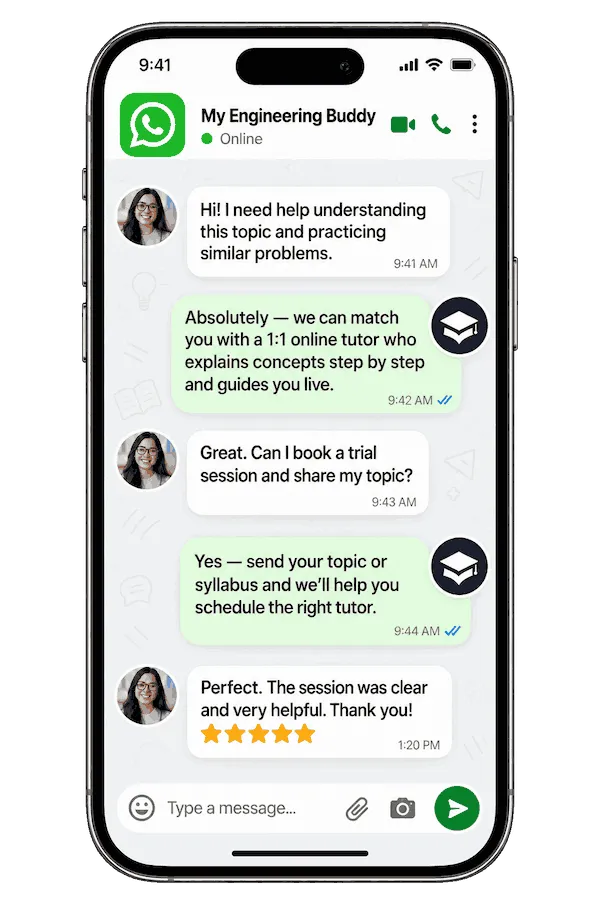
WhatsApp MEB for a quick quote — average response time under 1 minute.
Who This GCSE Economics Tutoring Is For
This isn’t a course for students who just need a bit of polish. It’s for students who are losing marks they don’t understand how to recover — and parents who have watched a grade slip despite extra revision.
- Students retaking after a failed first attempt at GCSE Economics
- Students with a sixth form or college conditional offer depending on this grade
- Students 4–6 weeks from the exam with significant gaps still to close
- Students who can recall definitions but can’t build a full evaluation answer
- Parents watching a child’s confidence drop alongside their Economics grade
- Students confused by the difference between AQA, Edexcel, and OCR question styles
Students who go on to study Economics, Politics, Business, or PPE at universities such as LSE, Warwick, UCL, Durham, Bristol, Manchester, or Edinburgh often cite GCSE Economics as the point where their analytical thinking either took root or fell apart. MEB tutors know which habits to build early. A student looking for GCSE Mathematics tutoring alongside Economics will find both covered on the platform.
1:1 Tutoring vs Self-Study vs AI vs YouTube vs Online Courses
Self-study works if you’re disciplined — but GCSE Economics mark schemes reward very specific answer structures that self-study rarely teaches. AI tools give fast definitions but can’t watch you write a 9-mark answer and tell you why it would score a 5. YouTube covers concepts clearly but stops when you hit a real exam question. Online courses run at a fixed pace with no adjustment for what you already know. 1:1 tutoring with MEB is live, calibrated to your exact board, and corrects the specific errors that are costing you marks in GCSE Economics right now.
Outcomes: What You’ll Be Able To Do in GCSE Economics
After working with an MEB tutor, students can analyse supply and demand shifts using correct diagrammatic technique, apply price elasticity of demand to real market scenarios, evaluate government intervention such as taxation or minimum wage with a structured chain of reasoning, explain macroeconomic trade-offs between inflation and unemployment using the Phillips Curve framework, and write 9-mark evaluation answers that hit the top mark band consistently. These aren’t generic study skills — they’re the specific capabilities that separate a grade 6 from a grade 8 in GCSE Economics.
Supporting a student through GCSE Economics? MEB works directly with parents to set up sessions, track progress, and keep exam preparation on schedule. WhatsApp MEB — average response time is under a minute, 24/7.
Based on feedback from 40,000+ sessions collected by MEB from 2022 to 2025, 58% of students improved by one full grade after approximately 20 hours of 1:1 tutoring in subjects like GCSE Economics. A further 23% achieved at least a half-grade improvement.
Source: MEB session feedback data, 2022–2025.
At MEB, we’ve found that GCSE Economics students lose the most marks not on knowledge — but on answer structure. A student who understands inflation can still score 3 out of 9 if they don’t know how to build an evaluation chain. That’s fixable in one session.
What We Cover in GCSE Economics (Syllabus / Topics)
MEB tutors cover the full GCSE Economics syllabus across AQA, Edexcel, and OCR. The three main content areas below reflect how the course is structured across all three boards, with board-specific terminology addressed in sessions.
| Paper | Title | Typical Weighting | Key Question Types |
|---|---|---|---|
| Paper 1 | Introduction to Economics / Microeconomics | 50% | MCQ, short answer, 9-mark evaluation |
| Paper 2 | The UK and Global Economies / Macroeconomics | 50% | MCQ, short answer, 9-mark evaluation |
Microeconomics
- Supply and demand: shifts, equilibrium, and market diagrams
- Price elasticity of demand and supply (PED, PES) — calculation and interpretation
- Market failure: externalities, public goods, information gaps
- Government intervention: taxes, subsidies, price controls, regulation
- Business behaviour and objectives
- Labour markets and wage determination
Core texts: GCSE Economics for AQA (Anderton), Edexcel GCSE Economics (Redfern), Complete Economics for Cambridge IGCSE & O Level (Hurd & Anderton).
Macroeconomics
- GDP, economic growth, and the business cycle
- Inflation: causes, measurement, and the Consumer Price Index
- Unemployment: types, causes, and consequences
- Monetary policy and fiscal policy tools
- The Phillips Curve and the inflation-unemployment trade-off
- Balance of payments and exchange rates
Core texts: GCSE Economics (Moynihan & Titley), Economics: A Student’s Guide (Sloman), OpenStax Principles of Macroeconomics (available via OpenStax).
Exam Technique and Extended Answers
- How to read and annotate unseen data in the exam
- Structure for 4-mark, 6-mark, and 9-mark answers
- Building a two-sided evaluation with a justified conclusion
- Common errors that collapse a mark scheme score
- Timed practice under exam conditions with tutor feedback
Core texts: CGP GCSE Economics Complete Revision & Practice, Oxford Revise AQA GCSE Economics.

What a Typical GCSE Economics Session Looks Like
The tutor opens by checking the previous topic — usually a specific diagram such as a supply shift or a PED calculation from the prior session. From there, the student and tutor work through a live exam question on screen: the tutor writes the model structure on a digital pen-pad while the student attempts their own version. When the student’s answer diverges from the mark scheme logic, the tutor pauses and traces the exact line of reasoning back to where the marks were lost. The session closes with one timed practice task — typically a 9-mark question — and a note of the next topic to cover before the following session.
Students consistently tell us that GCSE Economics clicks when they stop trying to memorise definitions and start building arguments. The diagram is the starting point. The evaluation is where the grade is decided. Most students never practise evaluation out loud until they sit with a tutor.
How MEB Tutors Help You with GCSE Economics (The Learning Loop)
Diagnose: In the first session, the tutor identifies which of the two papers is weaker, which question types are losing the most marks, and whether the gap is conceptual (not understanding the model) or structural (not knowing how to write the answer).
Explain: The tutor works through live examples using a digital pen-pad — drawing supply-demand diagrams, annotating exam questions, and building model answers step by step, not just describing them.
Practice: The student attempts a version of the same question type while the tutor watches. This is not homework review — it’s real-time practice with a live observer who can intervene immediately.
Feedback: The tutor goes through the student’s answer line by line against the mark scheme, naming exactly which marks were awarded, which were missed, and why.
Plan: Every session ends with a clear next step: one topic, one question type, one diagram to consolidate before the next session. Progress is tracked session to session.
Sessions run over Google Meet with a digital pen-pad or iPad and Apple Pencil. Before the first session, share your exam board (AQA, Edexcel, or OCR), any recent past paper attempts, and your exam date. The tutor uses that information to build the session plan before you connect. Start with the $1 trial — 30 minutes of live tutoring that also serves as your first diagnostic.
A common pattern our tutors observe is that students preparing for GCSE Economics Paper 2 underestimate how much macroeconomic analysis depends on diagram accuracy. A correctly drawn AD-AS diagram with correct labels can alone recover 2–3 marks per question.
Source: MEB tutor observation, 2022–2025.
Tutor Match Criteria (How We Pick Your Tutor)
Not every Economics graduate is a GCSE Economics tutor. MEB’s matching process is specific.
Subject depth: Tutors must demonstrate working knowledge of the specific board — AQA Paper 1 question types differ from Edexcel’s in structure and mark scheme logic.
Tools: All tutors use Google Meet with a digital pen-pad or iPad and Apple Pencil — diagram work is central to GCSE Economics.
Time zone: Matched to your region — UK, US, Gulf, Canada, or Australia — so sessions don’t require unsociable hours on either side.
Goals: Whether you need exam grade recovery, ongoing weekly support, or help with a specific paper, the tutor is matched to that goal — not to a generic Economics profile.
Unlike platforms where you fill out a form and wait, MEB responds in under a minute, 24/7. Tutor match takes under an hour. The $1 trial means you test before you commit. Everything runs over WhatsApp — no logins, no intake forms.
Study Plans (Pick One That Matches Your Goal)
Three plans cover most GCSE Economics situations. Catch-up (1–3 weeks): intensive sessions targeting the highest-yield gaps before the exam — usually diagram technique and 9-mark answer structure. Exam prep (4–8 weeks): structured revision covering both papers in sequence, with timed practice built in from week three. Weekly support: ongoing sessions aligned to your school’s teaching sequence, with homework guidance integrated throughout. The tutor maps the exact session sequence after the diagnostic — these timelines are starting points, not fixed templates.
Pricing Guide
GCSE Economics tutoring runs at $20–$40/hr for most students. The rate depends on the tutor’s experience level, which exam board you’re on, and how quickly you need to progress. Availability drops significantly in the six weeks before the May/June exam series — sessions fill fast during this window.
For students targeting highly competitive sixth forms or colleges where a grade 7, 8, or 9 in Economics is a realistic expectation, tutors with A Level and undergraduate Economics backgrounds are available at higher rates. Share your specific target and MEB will match the tutor tier to your ambition.
Start with the $1 trial — 30 minutes, no registration, no commitment. WhatsApp MEB for a quick quote.
Try your first session for $1 — 30 minutes of live 1:1 tutoring or one homework question explained in full. No registration. No commitment. WhatsApp MEB now and get matched within the hour.
FAQ
Is GCSE Economics hard?
It depends on the student. The content is accessible — the difficulty is in the exam technique. Most students who score below a 6 understand the concepts but don’t know how to structure a 9-mark evaluation answer. That’s a teachable skill, not a talent gap.
How many sessions are needed?
Students with 4–8 weeks before the exam typically need 8–12 sessions to see a meaningful grade shift. Students with more time can work at a slower pace. The tutor sets a realistic session plan after the first diagnostic based on your current level and target grade.
Can you help with homework and assignments?
MEB tutoring is guided learning — you understand the work, then submit it yourself. The tutor explains the Economics concept, works through the structure, and helps you build the answer. See our Academic Integrity policy and Why MEB page for full details on what we help with and what we don’t.
Will the tutor match my exact syllabus or exam board?
Yes. AQA, Edexcel, and OCR each have distinct paper structures and mark scheme conventions. When you contact MEB, share your board and year group. The tutor matched to you will have worked with that specific board’s question formats and marking criteria.
What happens in the first session?
The tutor reviews your recent work or a past paper attempt, identifies your strongest and weakest areas across both papers, and builds a session plan from that point. No time is wasted on topics you already know. The $1 trial session functions as your first diagnostic.
Is online tutoring as effective as in-person?
For GCSE Economics — yes, and sometimes more so. Diagram work done on a digital pen-pad is clearer than a whiteboard, and sessions are recorded for review. Students in the UK, US, Gulf, and Canada consistently report the same quality of interaction as face-to-face tutoring.
What is the difference between AQA, Edexcel, and OCR GCSE Economics?
All three cover microeconomics and macroeconomics, but differ in question structure, data response formats, and the weighting of evaluation marks. AQA and Edexcel are the most widely sat. OCR uses a slightly different case-study approach. Your MEB tutor will be board-specific — not generic.
My child got a grade 4 in the mock. Is a grade 7 realistic?
A three-grade jump is achievable in 8–10 weeks with consistent 1:1 support, provided the underlying issue is technique rather than absence from class. Tutors assess this in the first session and give you an honest assessment — not a sales pitch. Most grade 4 mock results reflect answer structure problems, not content knowledge gaps.
Can I get GCSE Economics help at midnight or on weekends?
Yes. MEB tutors operate across multiple time zones, and session slots are available evenings and weekends across the UK, US, Gulf, and Australia. Contact via WhatsApp at any hour — the average response time is under one minute even late at night.
Do you offer group GCSE Economics sessions?
MEB’s model is 1:1 only. Group sessions dilute the diagnostic precision that makes the difference between a 5 and a 7. If you’re sharing costs with a sibling or friend in the same year group, contact MEB to discuss options — but the sessions themselves are individual.
How do I get started?
Three steps: WhatsApp MEB with your exam board, target grade, and available time slots. MEB matches you with a verified GCSE Economics tutor — usually within 24 hours. Your first session is the $1 trial: 30 minutes live or one full question explained from start to finish.
Trust & Quality at My Engineering Buddy
Every MEB tutor goes through a subject-specific screening process — not a generic application form. Tutors submit academic credentials, complete a live demo session evaluated by a senior subject reviewer, and are assessed on board-specific question technique, not just Economics knowledge. Rated 4.8/5 across 40,000+ verified reviews on Google. Ongoing session feedback is reviewed and used to keep tutor quality consistent. Students working with a tutor on GCSE Geography help or GCSE History tutoring go through the same matching process.
MEB tutoring is guided learning — you understand the work, then submit it yourself. For full details on what we help with and what we don’t, read our Academic Integrity policy and Why MEB.
MEB has served 52,000+ students across the US, UK, Canada, Australia, the Gulf, and Europe since 2008 — across 2,800+ subjects. Within the GCSE range, Economics, GCSE Sociology tutoring, and GCSE Psychology help are among the most requested social science subjects. Tutors are matched by subject, board, and student goal — not pulled from a general pool. Read more about how we work at our tutoring methodology.
Explore Related Subjects
Students studying GCSE Economics often also need support in:
Next Steps
Here’s what to do now:
- Share your exam board (AQA, Edexcel, or OCR), your hardest paper or topic, and your exam date
- Share your availability and time zone
- MEB matches you with a verified GCSE Economics tutor — usually within 24 hours
- Your first session starts with a diagnostic so every minute of your prep time is used well
Before your first session, have ready:
- Your exam board and syllabus (or school scheme of work)
- A recent past paper attempt or homework question you struggled with
- Your exam date or deadline
The tutor handles the rest. Visit www.myengineeringbuddy.com for more on how MEB works.
WhatsApp to get started or email [email protected].
Our experience across thousands of sessions shows that students who bring a specific past paper question to their first GCSE Economics session make faster progress than those who start with a topic list. Come with your hardest question. The tutor will tell you exactly what the mark scheme wanted — and why your answer didn’t quite get there.
Reviewed by Subject Expert
This page has been carefully reviewed and validated by our subject expert to ensure accuracy and relevance.




