




~1 min
Average Reply Time
~1 hour
To Be Matched With A Tutor
30 Min Trial
75% Find Their Tutor On The 1st Trial
$20-35+/hr
Premium Yet Affordable Learning
Most students who struggle with GCSE Psychology aren’t weak at the subject — they’ve never had someone explain social influence or biopsychology in a way that actually sticks.
GCSE Psychology Tutor Online
GCSE Psychology is a qualification examined at grades 9–1 by boards including AQA, Edexcel, and OCR. It covers core areas such as memory, social influence, psychopathology, and research methods, equipping students to think critically about human behaviour.
My Engineering Buddy offers 1:1 online tutoring and homework help in 2,800+ advanced subjects — including a full range of GCSE tutoring subjects. If you’ve searched for a GCSE Psychology tutor near me, MEB matches you with a verified subject specialist — usually within the hour — who knows your exact exam board, your paper structure, and where the marks actually go. No generic revision. No wasted sessions.
- 1:1 online sessions tailored to your AQA, Edexcel, or OCR Psychology syllabus
- Expert-verified tutors with subject-specific knowledge of GCSE Psychology content
- Flexible time zones — US, UK, Canada, Australia, Gulf
- Structured learning plan built after a diagnostic session
- Ethical homework and assignment guidance — you understand the work, then submit it yourself
52,000+ students across the US, UK, Canada, Australia, and the Gulf have used MEB since 2008 — including students in GCSE subjects like GCSE Psychology, GCSE Sociology, and GCSE Biology.
Source: My Engineering Buddy, 2008–2025.
How Much Does a GCSE Psychology Tutor Cost?
Most GCSE Psychology tutoring at MEB runs $20–$40 per hour. Specialist tutors for higher-tier content or exam board-specific coaching may reach $60/hr. The $1 trial gives you 30 minutes of live 1:1 tutoring — or one full homework question explained — before you commit to anything.
| Level / Need | Typical Rate | What’s Included |
|---|---|---|
| Standard GCSE Psychology | $20–$35/hr | 1:1 sessions, homework guidance, exam prep |
| Higher Tier / Exam-Specific | $35–$60/hr | Expert tutor, board-specific depth, past paper coaching |
| $1 Trial | $1 flat | 30 min live session or 1 full homework question explained |
Tutor availability tightens significantly in the six weeks before the May/June GCSE exam window. Book early if you’re targeting that sitting.
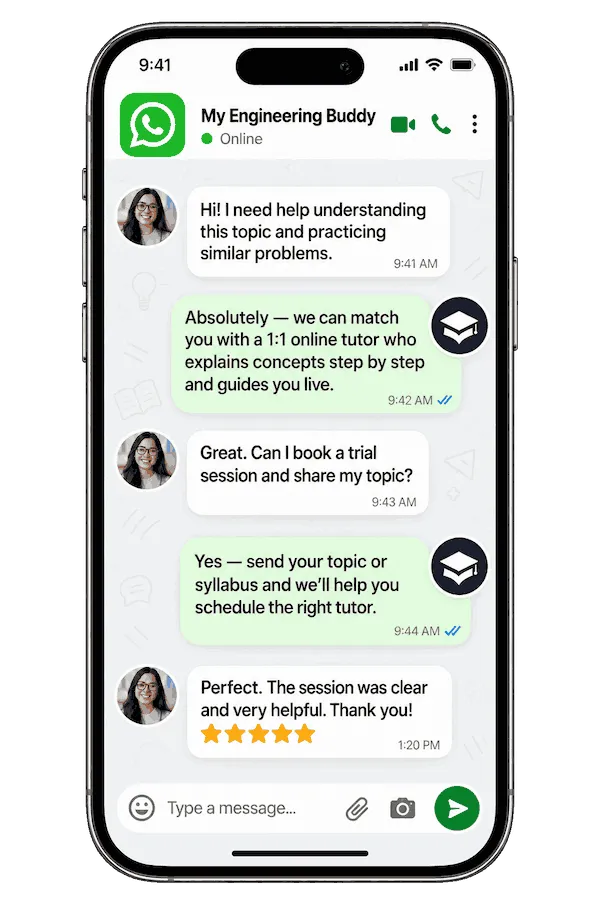
WhatsApp MEB for a quick quote — average response time under 1 minute.
Who This GCSE Psychology Tutoring Is For
GCSE Psychology covers a wide range of learners. Whether you’ve just started the course or you’re three weeks from the exam, there’s a session format that fits where you are right now.
- Students who find research methods — sampling, variables, ethics — harder than the content topics
- Students retaking after a failed first attempt at the GCSE Psychology papers
- Students with a university conditional offer depending on this grade
- Students 4–6 weeks from the exam with gaps in psychopathology or biopsychology still to close
- Parents watching a child’s confidence drop alongside their Psychology grades
- Students who need structured homework and assignment guidance without someone doing the work for them
Students progress to A Level Psychology, A Level Sociology, or university programmes in Psychology, Criminology, and Health Sciences at institutions including the University of Edinburgh, University of Manchester, University of Bristol, King’s College London, Durham University, and the University of Queensland.
1:1 Tutoring vs Self-Study vs AI vs YouTube vs Online Courses
Self-study works if you’re disciplined — but GCSE Psychology has specific mark-scheme language that self-study rarely teaches. AI tools give fast explanations but can’t diagnose why you keep dropping marks on 4-mark “explain” questions. YouTube is good for overviews of Milgram or Loftus, but stops the moment you need a worked answer for your specific paper. Online courses move at a fixed pace — yours might not. 1:1 tutoring with MEB is calibrated to your exact exam board, your current gaps, and your paper date. For a subject where two extra marks in research methods can shift a grade boundary, that specificity matters.
Outcomes: What You’ll Be Able To Do in GCSE Psychology
After working with a GCSE Psychology tutor at MEB, students write coherent extended answers on social influence studies like Milgram and Asch without losing marks to vague description. They apply the multi-store model and working memory model accurately in 6-mark evaluation questions. They explain psychopathology definitions — statistical infrequency, deviation from ideal mental health — with enough precision to score full marks. They analyse research methods questions involving sampling techniques, experimental design, and ethical considerations. They present arguments about the nature–nurture debate in a way the examiner is looking for — not just a list of points.
Supporting a student through GCSE Psychology? MEB works directly with parents to set up sessions, track progress, and keep coursework on schedule. WhatsApp MEB — average response time is under a minute, 24/7.
Based on feedback from 40,000+ sessions collected by MEB from 2022 to 2025, 58% of students improved by one full grade after approximately 20 hours of 1:1 tutoring in subjects like GCSE Psychology. A further 23% achieved at least a half-grade improvement.
Source: MEB session feedback data, 2022–2025.
At MEB, we’ve found that GCSE Psychology students drop the most marks not on content they don’t know — but on content they half-know. A tutor who can identify the difference in the first session saves weeks of unfocused revision.
What We Cover in GCSE Psychology (Syllabus / Topics)
Coverage is built around the AQA, Edexcel, and OCR specifications. Your tutor works from your exact syllabus — not a generic psychology curriculum.
Memory and Perception
- Multi-store model of memory (Atkinson and Shiffrin)
- Working memory model (Baddeley and Hitch)
- Types of long-term memory: episodic, semantic, procedural
- Eyewitness testimony and factors affecting accuracy
- Loftus and Palmer — leading questions and post-event information
- Strategies for memory improvement: mnemonics, mind maps, context-dependent memory
Key texts: Memory: A Very Short Introduction (Foster), AQA Psychology for GCSE (Birch & Purnell).
Social Influence and Development
- Conformity: Asch’s line studies, types (compliance, identification, internalisation)
- Obedience: Milgram’s electric shock experiment, factors affecting obedience
- Zimbardo’s Stanford Prison Experiment and situational vs dispositional explanations
- Piaget’s stages of cognitive development
- Bowlby’s attachment theory and Ainsworth’s Strange Situation
- Social learning theory — Bandura, Bobo doll study
Key texts: GCSE Psychology (Cardwell & Flanagan), Edexcel GCSE Psychology Student Book (Curtis et al.).
Psychopathology, Biopsychology, and Research Methods
- Definitions of abnormality: statistical infrequency, deviation from social norms, failure to function adequately, deviation from ideal mental health
- OCD, depression, and phobias — characteristics and explanations
- Brain structure and function: cerebral cortex, hemispheres, localisation of function
- The nervous system and the endocrine system
- Research methods: experiments, observations, questionnaires, interviews, case studies
- Variables, hypotheses, sampling methods, ethical guidelines (BPS)
- Data analysis: mean, median, mode, range, graphs
Key texts: OCR GCSE Psychology (Stokes et al.), Psychology for GCSE Level (Pennington).
For AQA students, assessment is split across two written papers — Paper 1 covers memory, perception, development, and research methods; Paper 2 covers social influence, language, thought and communication, brain and neuropsychology, and psychological problems. Each paper is 1 hour 45 minutes and worth 50% of the final grade.

The British Psychological Society sets the ethical framework that GCSE Psychology students must understand and apply in research methods questions — a topic that loses students marks far more often than the content topics do.
Source: Oxford University Press — Very Short Introductions
What a Typical GCSE Psychology Session Looks Like
The tutor opens by reviewing what was covered last time — say, the multi-store model — and checking with a quick question whether it’s settled or still shaky. From there, the session moves into whatever is most pressing: working through a 6-mark evaluation question on Milgram’s obedience research, or untangling the difference between a lab experiment and a field experiment in a research methods question. The tutor uses a digital pen-pad to annotate answers live on screen, showing exactly where marks were earned or dropped. The student then attempts a similar question with the tutor present, gets immediate correction, and is set a specific practice task — one past paper section on psychopathology — before the next session. The next topic is agreed before logging off.
How MEB Tutors Help You with GCSE Psychology (The Learning Loop)
Diagnose: In the first session, the tutor identifies which topic areas are genuinely understood and which are surface-level. For GCSE Psychology, this usually means a quick check on research methods terminology and one content topic — the gaps are almost always more specific than students expect.
Explain: The tutor works through live examples using a digital pen-pad — annotating mark schemes, showing how to structure a 4-mark “describe” answer versus a 6-mark “evaluate” answer, and making the examiner’s logic visible.
Practice: The student attempts a question or past paper section with the tutor present. No googling, no looking at notes — the point is to replicate exam conditions closely enough that the feedback is useful.
Feedback: Step-by-step error correction. The tutor explains why a mark was lost — not just that it was lost. For GCSE Psychology, this often comes down to precision: saying “Milgram found 65% of participants delivered the maximum shock” rather than “most people obeyed.”
Plan: Next steps are set before the session ends — a specific topic, a specific past paper section, a specific number of questions. Accountability is built in.
Sessions run over Google Meet. The tutor uses a digital pen-pad or iPad with Apple Pencil. Before your first session, have your exam board, a recent past paper attempt, and your exam date ready. The first session is a diagnostic that doubles as a working session — you leave with a clear picture of where to focus and what to do before the next one. Start with the $1 trial — 30 minutes of live tutoring that also serves as your first diagnostic.
Students consistently tell us that the moment GCSE Psychology clicks is when they stop trying to memorise studies and start understanding what the examiner is actually asking for. That shift usually happens in one focused session.
Tutor Match Criteria (How We Pick Your Tutor)
Match quality determines session quality. MEB doesn’t assign whoever is available.
Subject depth: Tutors are verified on the specific GCSE Psychology specification — AQA, Edexcel, or OCR — not just general psychology knowledge. They know the mark schemes, the weighting of assessment objectives, and the common errors examiners flag.
Tools: Every tutor uses Google Meet plus a digital pen-pad or iPad with Apple Pencil. Live annotation is standard — not optional.
Time zone: Matched to your region — UK, US East/West, Gulf, Canada, Australia. Sessions are available across all major time zones.
Goals: Whether the goal is passing a resit, hitting a grade 7 for a conditional offer, or closing a specific gap in research methods, the tutor match reflects that.
Unlike platforms where you fill out a form and wait, MEB responds in under a minute, 24/7. Tutor match takes under an hour. The $1 trial means you test before you commit. Everything runs over WhatsApp — no logins, no intake forms.
Study Plans (Pick One That Matches Your Goal)
After the first diagnostic session, the tutor builds a specific sequence. Three common starting points: Catch-up (1–3 weeks) — for students with significant gaps and a close exam date, focusing on the highest-yield topics and mark-scheme technique. Exam prep (4–8 weeks) — structured revision across all topic areas, timed past paper practice, and weekly progress reviews. Weekly support — ongoing sessions aligned to the school term, covering new content as it’s taught and reinforcing it before it fades. The tutor adjusts the plan between sessions based on what’s actually working.
Pricing Guide
GCSE Psychology tutoring runs $20–$40/hr for most students. Complex exam-board-specific preparation or intensive resit programmes may reach $60/hr. Rate factors include your current level, how close your exam date is, and tutor availability.
Availability tightens in March–May as the GCSE exam window approaches. If you’re targeting the summer sitting, earlier is better.
For students targeting top grades at selective sixth forms or universities with competitive entry requirements, tutors with psychology research or academic backgrounds are available at higher rates — share your specific goal on WhatsApp and MEB will match the right tier.
Start with the $1 trial — 30 minutes, no registration, no commitment. WhatsApp MEB for a quick quote.
GCSE Psychology is one of the most consistently popular optional subjects in England and Wales — and one where grade boundaries can be tight. One mark can be the difference between a grade 4 and a grade 5, or between a 6 and a 7.
Source: My Engineering Buddy, internal review, 2024.
Try your first session for $1 — 30 minutes of live 1:1 tutoring or one homework question explained in full. No registration. No commitment. WhatsApp MEB now and get matched within the hour.
FAQ
Is GCSE Psychology hard?
It’s manageable but precise. The content topics — memory, social influence, psychopathology — are accessible. Research methods is where most students lose marks, because it requires applying methodology concepts accurately under exam conditions, not just knowing the definitions.
How many sessions are needed?
Students with 4–6 weeks before their exam and moderate gaps typically need 8–12 sessions. Students with longer timelines or just one weak topic area often need fewer. The diagnostic session gives a clearer picture than any estimate made before it.
Can you help with homework and assignments?
Yes. MEB tutoring is guided learning — you understand the work, then submit it yourself. See our Academic Integrity policy and Why MEB page for full details on what we help with and what we don’t.
Will the tutor match my exact syllabus or exam board?
Yes. AQA, Edexcel, and OCR are all covered. When you contact MEB, share your exam board upfront — the tutor assigned will know your specific paper structure, topic list, and mark scheme conventions.
What happens in the first session?
The tutor runs a short diagnostic — checking which topics are solid, which are shaky, and where the mark-scheme language is off. From there, the first real working topic is covered in the same session. You leave with a clear plan and a specific task before the next session.
Is online tutoring as effective as in-person?
For GCSE Psychology, yes — and sometimes more so. The digital pen-pad allows the tutor to annotate answers and mark schemes live, which is harder to replicate on a physical whiteboard. Students in the UK, US, and Australia consistently report strong progress through MEB’s online format.
Can I get GCSE Psychology help at short notice — even late at night?
Yes. MEB operates across time zones and responds to WhatsApp messages in under a minute, 24/7. If you have a paper tomorrow morning, message tonight — tutors are often available for same-day or early-morning sessions.
What if I don’t like my assigned tutor?
Tell MEB on WhatsApp. A replacement is arranged quickly — usually within the same day. The $1 trial is specifically designed so you can test the match before committing to paid sessions.
What is the difference between AQA and Edexcel GCSE Psychology?
AQA covers memory, social influence, psychopathology, and biopsychology across two papers. Edexcel has a different topic spread — including criminal psychology — and a different paper structure. MEB tutors know both specifications and work from your exact course content, not a generic curriculum.
Do I need to study research methods separately from the content topics?
Research methods appears throughout both GCSE Psychology papers — embedded in questions about content studies, not only as a standalone section. Tutors at MEB treat it as a running thread across all sessions, not a topic to tackle once and move on from.
How do I get started?
Message MEB on WhatsApp — share your exam board, current grade, and exam date. MEB matches you with a verified GCSE Psychology tutor, usually within the hour. Your first session is the $1 trial: 30 minutes live or one full question explained.
Trust & Quality at My Engineering Buddy
Every MEB tutor goes through subject-specific screening — not a generic skills test. For GCSE Psychology, that means verifying familiarity with the exact specification, mark scheme language, and assessment objectives for AQA, Edexcel, or OCR. Tutors complete a live demo evaluation before being matched with students, and session feedback is reviewed on an ongoing basis. Rated 4.8/5 across 40,000+ verified reviews on Google.
MEB tutoring is guided learning — you understand the work, then submit it yourself. For full details on what we help with and what we don’t, read our Academic Integrity policy and Why MEB.
MEB has served 52,000+ students across the US, UK, Canada, Australia, Gulf, and Europe since 2008 — across 2,800+ subjects. GCSE subjects are one of the most active areas on the platform, with tutoring available across GCSE Psychology, GCSE Biology tutoring, and GCSE History help. Find out more about how MEB structures sessions at our tutoring methodology page.
Explore Related Subjects
Students studying GCSE Psychology often also need support in:
- GCSE Religious Studies
- GCSE Citizenship Studies
- GCSE Statistics
- GCSE English
- GCSE Media Studies
- GCSE Physical Education
Next Steps
Getting started takes one WhatsApp message. Share your exam board (AQA, Edexcel, or OCR), the topic or paper component you’re finding hardest, and how much time you have before your exam. Include your time zone and availability — MEB covers all major regions.
MEB matches you with a verified GCSE Psychology tutor — usually within 24 hours, often much faster. The first session starts with a diagnostic so every minute is used on what actually matters.
Before your first session, have ready:
- Your exam board and syllabus (or a recent scheme of work from your teacher)
- A past paper attempt or a piece of homework you struggled with
- Your exam date or submission deadline
The tutor handles the rest. Visit www.myengineeringbuddy.com for more on how MEB works.
WhatsApp to get started or email [email protected].
Reviewed by Subject Expert
This page has been carefully reviewed and validated by our subject expert to ensure accuracy and relevance.




