




~1 min
Average Reply Time
~1 hour
To Be Matched With A Tutor
30 Min Trial
75% Find Their Tutor On The 1st Trial
$20-35+/hr
Premium Yet Affordable Learning
Most students who struggle with GCSE Citizenship Studies aren’t failing the content — they’re losing marks on the written argument components, and nobody has shown them exactly how to structure one.
GCSE Citizenship Studies Tutor Online
GCSE Citizenship Studies is a UK secondary qualification examining democracy, rights, law, the economy, and political participation. Assessed by AQA, OCR, and Edexcel, it equips students to analyse civic issues and engage critically with political life.
Finding a GCSE Citizenship Studies tutor near me who genuinely knows the mark schemes — not just the topic content — is harder than it should be. MEB connects you with 1:1 online GCSE Citizenship Studies tutors who have worked directly with AQA, OCR, and Edexcel syllabuses. Sessions are live, structured, and built around your current gaps. No generic revision packs. As part of MEB’s wider GCSE tutoring programme covering 30+ GCSE subjects, every Citizenship Studies session is mapped to your exact paper and exam board.
- 1:1 online sessions tailored to your exam board and component weighting
- Expert-verified tutors with subject-specific knowledge of Citizenship Studies mark schemes
- Flexible time zones — US, UK, Canada, Australia, Gulf
- Structured learning plan built after a diagnostic session
- Ethical homework and assignment guidance — you understand the work before you submit it
52,000+ students across the US, UK, Canada, Australia, and the Gulf have used MEB since 2008 — including students in GCSE subjects like Citizenship Studies, Sociology, and Religious Studies.
Source: My Engineering Buddy, 2008–2025.
How Much Does a GCSE Citizenship Studies Tutor Cost?
Most GCSE Citizenship Studies tutoring sessions at MEB run $20–$35/hr. Specialist tutors with extensive exam board experience are available at higher rates. New students can start with the $1 trial — 30 minutes of live 1:1 tutoring or one full homework question explained.
| Level / Need | Typical Rate | What’s Included |
|---|---|---|
| Standard (most levels) | $20–$35/hr | 1:1 sessions, homework guidance |
| Advanced / Specialist | $35–$70/hr | Expert tutor, exam board depth |
| $1 Trial | $1 flat | 30 min live session or 1 HW question |
Tutor availability tightens significantly in April and May. If your exams are approaching, book early.
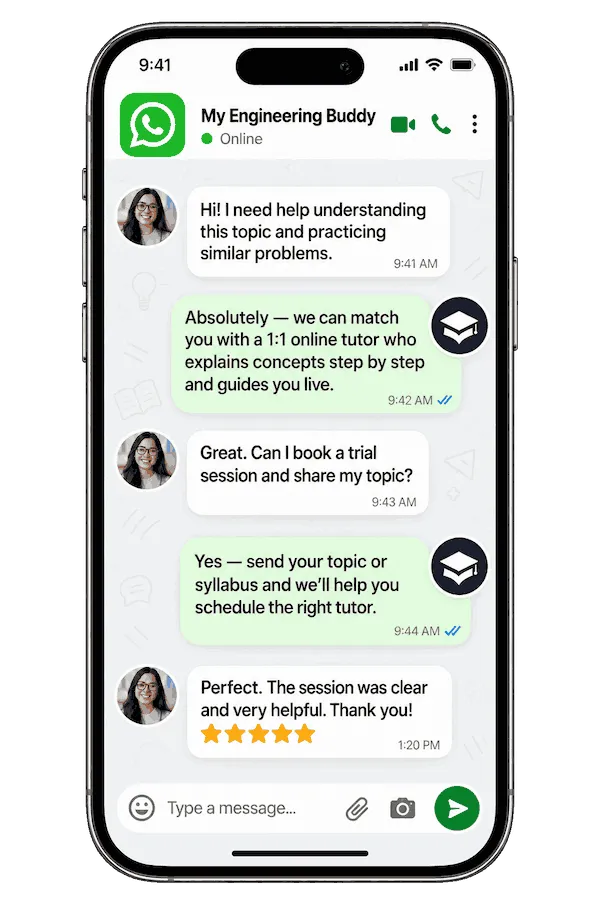
WhatsApp MEB for a quick quote — average response time under 1 minute.
Who This GCSE Citizenship Studies Tutoring Is For
This is for students who can recite the theory but freeze when asked to construct an argument under exam conditions — or who simply haven’t covered enough of the syllabus with enough time left to close the gap alone. If you’re behind, stuck, or aiming higher, this is where you start.
- Students retaking after a failed first attempt at GCSE Citizenship Studies
- Students with a sixth-form or college conditional offer depending on this grade — one of the more stressful positions to be in
- Students 4–6 weeks from the exam with written argument skills still to build
- Students who struggle specifically with the “evaluate” and “justify” question types
- Parents watching a child’s confidence drop alongside their Citizenship Studies marks
- Students needing structured homework guidance through contested political topics
Students progressing from GCSE Citizenship Studies often go on to A Level Politics, A Level Sociology, or Law at universities including Durham, Exeter, Bristol, Leeds, Manchester, Edinburgh, and Cardiff.
1:1 Tutoring vs Self-Study vs AI vs YouTube vs Online Courses
Self-study works if you’re disciplined, but Citizenship Studies mark schemes reward specific argument structures that self-study rarely teaches. AI tools explain concepts quickly but can’t tell you why your specific paragraph lost three marks. YouTube covers the basics — it stops when your question gets specific. Online courses are structured but fixed-pace with no feedback on your written answers. 1:1 tutoring with MEB is live, mapped to your exact exam board, and corrects argument errors the moment they appear — which is exactly what the written components of GCSE Citizenship Studies require.
Outcomes: What You’ll Be Able To Do in GCSE Citizenship Studies
After working with an online GCSE Citizenship Studies tutor through MEB, students typically move from vague political observations to structured, mark-scheme-aware arguments. You’ll be able to analyse how Parliament holds the government to account using specific constitutional examples. You’ll apply your knowledge of the UK legal system to evaluate the role of juries, magistrates, and judicial review. You’ll write “justify your decision” answers that hit every bullet on the levels-based mark scheme. You’ll explain the responsibilities of citizens and governments in a way that earns the top descriptor — not just a pass.
Supporting a student through GCSE Citizenship Studies? MEB works directly with parents to set up sessions, track progress, and keep coursework on schedule. WhatsApp MEB — average response time is under a minute, 24/7.
Based on feedback from 40,000+ sessions collected by MEB from 2022 to 2025, 58% of students improved by one full grade after approximately 20 hours of 1:1 tutoring in subjects like GCSE Citizenship Studies. A further 23% achieved at least a half-grade improvement.
Source: MEB session feedback data, 2022–2025.
Students consistently tell us that the written argument components — particularly the 8-mark and 12-mark questions — feel impossible until someone walks them through the levels descriptor line by line. That’s where most of the marks are, and that’s where most of the prep time should go.
What We Cover in GCSE Citizenship Studies (Syllabus / Topics)

Track 1: Democracy, Government, and Parliament
- The UK constitution — conventions, statutes, and how power is distributed
- The role of Parliament: House of Commons, House of Lords, legislative process
- How government is held to account — PMQs, select committees, the Opposition
- Voting systems: FPTP vs proportional representation — arguments for and against
- Political parties, manifestos, and the role of the media in elections
- Devolution — Scotland, Wales, Northern Ireland, and the implications for England
- The role of the UK in international organisations and global governance
Core texts: Edexcel GCSE (9–1) Citizenship Studies (Gray & Malone), AQA GCSE Citizenship Studies (Ellis & Turner), OCR board-specific revision guides.
Track 2: Rights, Law, and Justice
- Human rights — the Human Rights Act 1998, ECHR, and how they apply in the UK
- The legal system: civil vs criminal law, courts hierarchy, role of juries
- Judicial review — what it is and landmark cases students need to know
- Young people and the law — age of criminal responsibility, youth courts
- Equality legislation — the Equality Act 2010 and protected characteristics
- Resolving conflict: mediation, tribunals, and access to justice
Core texts: GCSE Citizenship Studies Revision Guide (CGP), OCR GCSE Citizenship Studies student workbooks.
Track 3: Active Citizenship and the Economy
- Citizenship in action — campaigning, pressure groups, trade unions, petitions
- The role of the media and social media in shaping political opinion
- The UK economy — taxation, public spending, the role of the Bank of England
- Global citizenship — development, inequality, and the role of NGOs and the UN
- The non-examined assessment (NEA) — selecting an issue, taking action, reporting
- Evaluating impact: how to assess whether a citizenship action was effective
Core texts: AQA GCSE Citizenship Studies (Hodder Education), Pearson Edexcel GCSE Citizenship Studies specification guide, Competition and Markets Authority resources on consumer rights and market regulation.
At MEB, we’ve found that students who understand the NEA component early — what “taking action” actually means and how to document it — score significantly better overall. It’s not an afterthought. It’s a third of some students’ final outcomes depending on their board’s structure.
What a Typical GCSE Citizenship Studies Session Looks Like
The tutor opens by checking the previous session’s topic — say, judicial review or the role of pressure groups — and asking you to explain it back in your own words. Then you move to the live work: the tutor pulls up a past paper question, typically an 8-mark or 12-mark “evaluate” or “justify” question, and you attempt it on screen. The tutor uses a digital pen-pad to annotate your answer directly, marking where you’ve hit the levels descriptor and where the argument collapsed. You rewrite the weak paragraph with the tutor present. The session closes with a specific practice task — usually a timed paragraph response on the next topic — and your next session focus is set.
How MEB Tutors Help You with GCSE Citizenship Studies (The Learning Loop)
Diagnose: In the first session, the tutor identifies which components are losing you marks — whether that’s factual recall on constitutional law, argument structure in extended writing, or NEA planning. Most students have a specific gap, not a general one.
Explain: The tutor works through the concept live using a digital pen-pad. For Citizenship Studies, that often means annotating an actual mark scheme alongside your answer so you see exactly what the examiner expects at each grade boundary.
Practice: You attempt a question or argument structure while the tutor watches. No passive reading. The tutor intervenes at the point of error — not after you’ve written three more wrong paragraphs.
Feedback: Step-by-step error correction with explicit reference to the levels descriptors. You learn not just what the right answer is, but why the examiner would award it Level 3 versus Level 2.
Plan: Each session ends with a clear next topic, a specific practice task, and a check-in point. Progress is tracked across sessions so you’re never covering ground you’ve already mastered.
Sessions run over Google Meet with a digital pen-pad or iPad and Apple Pencil for live annotation. Before your first session, share your exam board (AQA, Edexcel, or OCR), a recent past paper attempt or homework question you struggled with, and your exam date. The first session covers a diagnostic and your most urgent gap. Start with the $1 trial — 30 minutes of live tutoring that also serves as your first diagnostic.
MEB’s GCSE History tutoring and GCSE Geography tutoring follow the same structured Learning Loop — diagnostic first, targeted explanation, then deliberate practice with real-time feedback.
Source: My Engineering Buddy, 2008–2025.
Try your first session for $1 — 30 minutes of live 1:1 tutoring or one homework question explained in full. No registration. No commitment. WhatsApp MEB now and get matched within the hour.
Tutor Match Criteria (How We Pick Your Tutor)
Not every tutor who knows politics can teach GCSE Citizenship Studies mark schemes. MEB’s matching process looks at four things specifically.
Subject depth: The tutor must know your exact exam board — AQA, Edexcel, or OCR — and the specific weighting between written components and NEA. A tutor who taught one board for years may need reassignment if you’re on a different one.
Tools: All tutors use Google Meet with a digital pen-pad or iPad and Apple Pencil. Live annotation of your written answers is non-negotiable for a subject this writing-heavy.
Time zone: Matched to your region — UK, US, Gulf, Canada, or Australia — so you get evening sessions that actually fit a school schedule.
Goals: Whether you need exam score improvement, NEA support, homework guidance, or a full structured revision programme, the tutor is selected for that specific remit.
Unlike platforms where you fill out a form and wait, MEB responds in under a minute, 24/7. Tutor match takes under an hour. The $1 trial means you test before you commit. Everything runs over WhatsApp — no logins, no intake forms.
Study Plans (Pick One That Matches Your Goal)
After the first diagnostic, your tutor builds the exact sequence — but most students fall into one of three patterns. Catch-up (1–3 weeks): intensive focus on the 2–3 components causing the most mark loss, usually the extended writing questions. Exam prep (4–8 weeks): structured topic-by-topic revision with timed practice and mark scheme review each session, aligned to your specific exam date. Weekly support: ongoing sessions through the school year, tracking coursework deadlines and NEA milestones. Your tutor decides the sequence after seeing your current work.
Pricing Guide
GCSE Citizenship Studies tutoring at MEB runs $20–$40/hr for most students. Tutors with extensive senior examiner experience or specialist NEA coaching backgrounds are available at higher rates — share your specific goal and MEB matches the tier to what you actually need.
Rate factors include: exam board, component focus, how close you are to the exam, and tutor availability. Peak exam season (April–May) sees reduced availability. Book before the squeeze hits.
For students targeting top sixth forms or selective universities where Citizenship Studies grades form part of a conditional offer, tutors with A Level Politics and Law teaching backgrounds are available and bring additional contextual depth.
Start with the $1 trial — 30 minutes, no registration, no commitment. WhatsApp MEB for a quick quote.
FAQ
Is GCSE Citizenship Studies hard?
It’s not the hardest GCSE, but students consistently underestimate the writing demands. The extended-answer questions require structured argument with specific evidence — and that’s a skill, not just knowledge. Most students who struggle are losing marks on technique, not content recall.
How many sessions do students typically need?
Students with 4–8 weeks before their exam and specific gaps usually need 8–12 sessions. Students doing ongoing weekly support through the year need far fewer intensive sessions. The tutor maps this after the first diagnostic — there’s no fixed package.
Can you help with homework and assignments?
Yes. MEB tutoring is guided learning — you understand the work, then submit it yourself. See our Academic Integrity policy and Why MEB page for full details on what we help with and what we don’t. The tutor explains, you write.
Will the tutor match my exact exam board?
Yes. AQA, Edexcel, and OCR each have different component structures and mark schemes. MEB matches you to a tutor who knows your specific board — not a generic Citizenship Studies tutor who works from general notes.
What happens in the first session?
The tutor runs a short diagnostic — usually a past paper question or a topic check — to identify your exact gaps. By the end of the first session, you’ll have a clear picture of where you’re losing marks and a plan for the next two to three sessions.
Is online tutoring as effective as in-person for GCSE Citizenship Studies?
For a writing-heavy subject like Citizenship Studies, online tutoring with live annotation tools is arguably more effective — the tutor can mark up your actual answer in real time, which is harder to replicate on paper in a kitchen table session.
Can I get GCSE Citizenship Studies help at midnight or on weekends?
Yes. MEB operates 24/7 across time zones. WhatsApp the team at any hour and you’ll get a response within minutes. Session availability varies by tutor, but weekend and late-evening slots are routinely available for UK and Gulf students.
What if I don’t connect with my assigned tutor?
Tell MEB. A replacement tutor is matched within the hour. The $1 trial is specifically designed so you test the fit before committing to a longer plan. No awkward conversations, no lost money.
Do you help with the GCSE Citizenship Studies NEA (Non-Examined Assessment)?
Yes. The NEA requires students to identify a citizenship issue, take action, and produce a written report evaluating its impact. Tutors help with issue selection, structuring the action plan, and writing up the evaluation — all within the guidelines of your exam board’s NEA requirements.
What’s the difference between AQA, Edexcel, and OCR GCSE Citizenship Studies?
All three cover similar content but differ in assessment structure, NEA weighting, and question style. AQA and Edexcel use tiered papers; OCR has distinct paper structures. The mark scheme language differs enough that board-specific preparation genuinely matters — generic revision isn’t enough.
How do I get started?
Three steps: WhatsApp MEB, get matched to a verified GCSE Citizenship Studies tutor within the hour, then start your $1 trial — 30 minutes of live 1:1 tutoring or one homework question explained in full. No registration. No commitment.
Trust & Quality at My Engineering Buddy
Every MEB tutor goes through subject-specific vetting — not a general interview. For GCSE Citizenship Studies, that means verifying knowledge of the AQA, Edexcel, and OCR specifications, familiarity with the levels-based mark scheme for extended writing, and demonstrated ability to explain political and legal concepts to 14–16 year olds under exam pressure. Tutors complete a live demo session before joining the platform, and session feedback is reviewed continuously. Rated 4.8/5 across 40,000+ verified reviews on Google.
MEB tutoring is guided learning — you understand the work, then submit it yourself. For full details on what we help with and what we don’t, read our Academic Integrity policy and Why MEB.
MEB has been running since 2008, serving 52,000+ students across the US, UK, Canada, Australia, Gulf, and Europe in 2,800+ subjects. Within the GCSE family, the platform covers everything from GCSE Economics tutoring and GCSE Psychology tutoring to GCSE Politics — with the same matching rigour applied across every subject. See MEB’s tutoring methodology for how the diagnostic and session structure works across the platform.
Explore Related Subjects
Students studying GCSE Citizenship Studies often also need support in:
- GCSE Sociology
- GCSE Religious Studies
- GCSE Business Studies
- GCSE Media Studies
- GCSE English
- GCSE English Literature
Next Steps
Here’s what to do right now:
- Share your exam board (AQA, Edexcel, or OCR), the components giving you most trouble, and your exam date
- Share your time zone and available session slots
- MEB matches you with a verified GCSE Citizenship Studies tutor — usually within the hour
- Your first session opens with a diagnostic so every minute is used on what actually matters
Before your first session, have ready:
- Your exam board and the relevant specification or course outline
- A recent past paper attempt or a homework question you couldn’t finish
- Your exam or coursework deadline date — the tutor handles the rest
Visit www.myengineeringbuddy.com for more on how MEB works.
WhatsApp to get started or email [email protected].
Reviewed by Subject Expert
This page has been carefully reviewed and validated by our subject expert to ensure accuracy and relevance.




