




~1 min
Average Reply Time
~1 hour
To Be Matched With A Tutor
30 Min Trial
75% Find Their Tutor On The 1st Trial
$20-35+/hr
Premium Yet Affordable Learning
Most students who fail GCSE History don’t lack ability — they lose 12+ marks on source analysis questions they were never taught to structure.
GCSE History Tutor Online
GCSE History is a formally examined qualification for students aged 14–16 in England, Wales, and Northern Ireland, assessed across multiple exam boards. It covers thematic, period, and depth studies, equipping students to analyse historical evidence and construct arguments.
If you’ve searched for a GCSE History tutor near me, MEB offers something better: a verified specialist who knows your exact exam board — AQA, Edexcel, OCR, or WJEC — available online, any time zone, from $20/hr. Our GCSE tutoring covers every subject in the qualification, but History sits in a category of its own: it rewards students who’ve been taught how to write for marks, not just what happened. One tutor. One syllabus. One plan built after a diagnostic session.
- 1:1 online sessions matched to your exam board and paper structure
- Expert-verified tutors with subject-specific GCSE History knowledge
- Flexible time zones — US, UK, Canada, Australia, Gulf
- Structured learning plan built after an initial diagnostic session
- Ethical homework and assignment guidance — you understand the work before you submit
52,000+ students across the US, UK, Canada, Australia, and the Gulf have used MEB since 2008 — including students in GCSE subjects like GCSE History, GCSE Geography tutoring, and GCSE English Literature.
Source: My Engineering Buddy, 2008–2025.
How Much Does a GCSE History Tutor Cost?
Most GCSE History sessions run $20–$40/hr depending on exam board complexity and tutor experience. The $1 trial gives you 30 minutes of live 1:1 tutoring — or a full explanation of one past-paper question — before you commit to anything.
Availability tightens significantly in the six weeks before GCSE exam season. Book early if you’re targeting a May/June window.
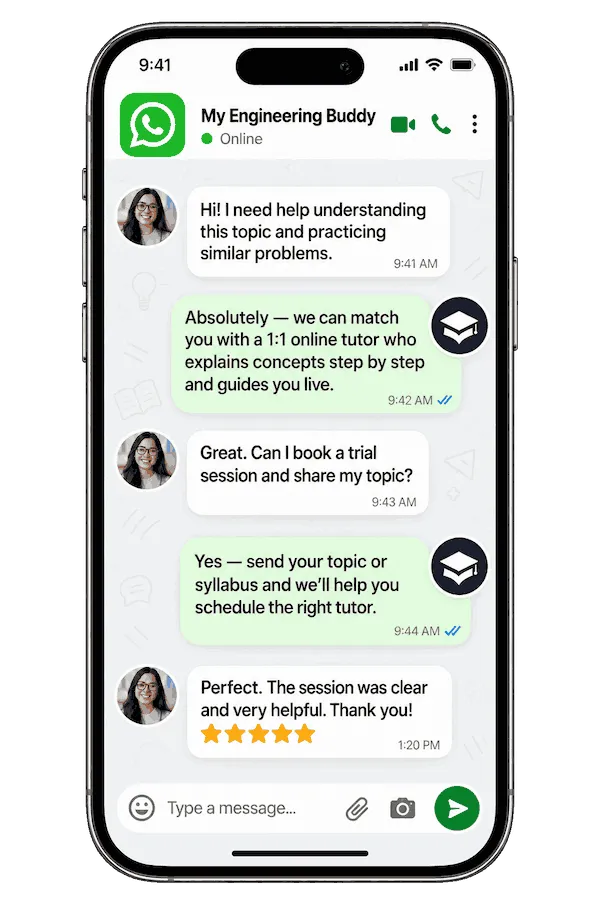
WhatsApp MEB for a quick quote — average response time under 1 minute.
Who This GCSE History Tutoring Is For
GCSE History tutoring at MEB is for students who know the facts but can’t translate them into marks — and for those who haven’t reached the facts yet. Both situations are fixable with the right tutor.
- Students retaking after a failed first attempt who need a different approach, not just more revision
- Students with a university conditional offer depending on this grade — one grade matters more than the whole retake
- Students 4–6 weeks from an exam with named gaps (e.g. Cold War depth study, Weimar Germany, source evaluation technique)
- Students losing marks on 12-mark and 16-mark extended writing questions despite knowing the content
- Parents watching a child’s confidence drop alongside their grades — sessions start where the student actually is, not where the syllabus assumes
- International students sitting GCSE History from the US, Gulf, or Australia through British curriculum schools or home education
Students who go on to A Level History at schools like Eton, Winchester, or Westminster, or who need GCSE History as a prerequisite for sixth-form humanities programmes, often begin tutoring in Year 10 to build essay technique early.
1:1 Tutoring vs Self-Study vs AI vs YouTube vs Online Courses
Self-study works if you’re disciplined — but GCSE History is marked on technique, and no textbook will tell you why your 16-mark answer scored 9. AI tools give fast definitions and can’t diagnose why your argument structure keeps losing marks. YouTube covers the content well and stops the moment you need feedback on your own writing. Online courses move at a fixed pace regardless of which paper you’re sitting. 1:1 tutoring with MEB is calibrated to your specific exam board, your weakest question type, and what you wrote in your last attempt — corrected live, on screen.
Outcomes: What You’ll Be Able To Do in GCSE History
After working with an MEB GCSE History tutor, students can write structured extended-response answers that meet the mark-scheme criteria for AQA, Edexcel, or OCR. They can analyse primary sources using the content, origin, and purpose framework without prompting. They can explain causation and consequence across their specific period studies — whether that’s Weimar and Nazi Germany, Cold War tensions, or Medicine Through Time. They can apply contextual knowledge precisely rather than listing facts. And they can manage time across multi-part papers so no question is abandoned.
Supporting a student through GCSE History? MEB works directly with parents to set up sessions, track progress, and keep coursework on schedule. WhatsApp MEB — average response time is under a minute, 24/7.
Based on feedback from 40,000+ sessions collected by MEB from 2022 to 2025, 58% of students improved by one full grade after approximately 20 hours of 1:1 tutoring in subjects like GCSE History. A further 23% achieved at least a half-grade improvement.
Source: MEB session feedback data, 2022–2025.
Try your first session for $1 — 30 minutes of live 1:1 tutoring or one homework question explained in full. No registration. No commitment. WhatsApp MEB now and get matched within the hour.
What We Cover in GCSE History (Syllabus / Topics)
GCSE History is structured around three study types: thematic studies spanning centuries, period depth studies focused on specific eras, and historical environment studies tied to a particular site or event. The exam board determines which combination you sit — your tutor is matched to yours specifically.
| Paper / Component | Content Focus | Typical Weighting |
|---|---|---|
| Paper 1 — Thematic Study & Historic Environment | E.g. Medicine Through Time; site-specific source analysis | 30% |
| Paper 2 — Period Study & British Depth Study | E.g. Superpower Relations; Elizabethan England | 40% |
| Paper 3 — Modern Depth Study | E.g. Weimar and Nazi Germany; The USA 1954–75 | 30% |
Weightings reflect AQA structure; vary by board. Your tutor confirms exact structure at first session.
Track 1: Thematic Studies & Historic Environment
- Medicine Through Time: prehistoric to present-day causes and treatments
- Crime and Punishment in Britain: key turning points and case studies
- War and British Society: impact of conflict from 1250 to present
- Whitechapel historic environment: source analysis tied to specific site
- Evaluating utility and reliability of sources using origin, purpose, and context
- Writing 16-mark extended responses with developed argument and counter-argument
Core textbooks: Edexcel GCSE History: Crime and Punishment in Britain (Brian Dowse); AQA GCSE History: Medicine Through Time (Hodder Education).
Track 2: Period & Depth Studies — Germany, Cold War, USA
- Weimar Germany: political instability, hyperinflation, rise of extremism
- Nazi Germany: consolidation of power, racial policy, life under dictatorship
- Superpower Relations and the Cold War 1941–91: key crises, turning points
- The USA 1954–75: civil rights, Vietnam, political upheaval
- Causation and consequence essay technique for 12-mark questions
- Source analysis: utility questions for Paper 1 historic environment component
- Comparing interpretations: how historians differ and why
Core textbooks: AQA GCSE History: Weimar and Nazi Germany (Hodder); Edexcel GCSE History: Superpower Relations and the Cold War (Pearson).
Track 3: British Depth Studies — Elizabethan England & Norman Conquest
- Elizabethan England 1558–88: government, religion, exploration, the Armada
- Norman England 1066–c.1100: conquest, control, castle-building, the Church
- Writing narrative accounts for 8-mark questions using specific factual evidence
- Explaining significance — differentiating importance from description
- Using contextual knowledge to support and challenge interpretations
Core textbooks: AQA GCSE History: Elizabethan England (Hodder); OCR GCSE History B: Norman England (Hodder Education).

What a Typical GCSE History Session Looks Like
The tutor opens by checking what happened in the last session — often a 12-mark causation question on the rise of the Nazi Party or a source utility question on Whitechapel that the student attempted as homework. The student shares their written answer on screen. The tutor goes through it line by line using a digital pen-pad, marking where the argument broke down and why marks were likely lost. Then they model a stronger version live — the student watches, then rewrites a paragraph themselves while the tutor stays on screen to catch the moment the same error reappears. The session closes with one specific practice task: a timed 16-mark question on the Cold War, to be attempted before the next session.
How MEB Tutors Help You with GCSE History (The Learning Loop)
Diagnose: In the first session, the tutor identifies exactly where marks are being lost — whether that’s weak source analysis, thin contextual knowledge, poor essay structure, or a specific topic gap like Weimar economic policy or the Cuban Missile Crisis.
Explain: The tutor works through a model answer live on screen using a digital pen-pad, annotating the mark scheme as they go. You see exactly what examiners reward and why a “good” answer still drops to a 9 without a specific counter-argument.
Practice: The student attempts the same question type with the tutor present — not after the session, not from a worksheet, but live where errors can be caught before they become habits.
Feedback: Step-by-step correction covers what went wrong, what mark band it would hit, and the single most effective fix for the next attempt. Feedback is specific to GCSE mark scheme language.
Plan: The tutor maps the next 2–3 sessions around the student’s exam date, weakest paper, and remaining topics. Accountability is built into every session close.
Sessions run on Google Meet. The tutor uses a digital pen-pad or iPad with Apple Pencil to annotate documents and model answers in real time. Before your first session, have your exam board confirmed, one past-paper question you attempted, and your exam date. The first session is a diagnostic — the tutor does the assessment, not you.
Start with the $1 trial — 30 minutes of live tutoring that also serves as your first diagnostic.
At MEB, we’ve found that GCSE History students lose the most marks not on content they don’t know, but on answers where they know the facts and still can’t turn them into the argument the mark scheme is looking for. That gap closes fast with the right feedback.
Tutor Match Criteria (How We Pick Your Tutor)
Every GCSE History tutor at MEB is matched on four criteria — not proximity, not availability alone.
Subject depth: The tutor has direct experience with your specific exam board — AQA, Edexcel, OCR, or WJEC — and your specific combination of period and depth studies. A tutor who knows the Edexcel Cold War paper inside out is not the same as one who knows the OCR Living Under Nazi Rule unit.
Tools: All tutors use Google Meet and a digital pen-pad or iPad with Apple Pencil. Live annotation of student writing is standard, not optional.
Time zone: Matched to your region — UK evening, US afternoon, Gulf morning. Scheduling takes under 24 hours.
Goals: Whether you need a grade 7 for a sixth-form conditional, a passing grade after a resit, or structured weekly support through Year 10 and 11, the match reflects your actual target — not a generic outcome.
Unlike platforms where you fill out a form and wait, MEB responds in under a minute, 24/7. Tutor match takes under an hour. The $1 trial means you test before you commit. Everything runs over WhatsApp — no logins, no intake forms.
Study Plans (Pick One That Matches Your Goal)
After the diagnostic session, your tutor builds the plan — but here are the three patterns most GCSE History students follow. Catch-up (1–3 weeks before exams): intensive focus on the two or three question types losing the most marks, with daily or near-daily sessions. Exam prep (4–8 weeks): structured revision covering all three papers in sequence, timed practice built in from week two. Weekly support (ongoing through Year 10/11): one or two sessions per week aligned to what’s being taught in school, with essay technique built in parallel so it’s automatic by exam season.
Pricing Guide
GCSE History tutoring runs $20–$40/hr for most students and most exam boards. Rate factors include exam board complexity, the specific depth studies you’re covering, how close the exam is, and tutor availability in your time zone.
For students targeting top sixth forms, A Level History preparation, or international schools with demanding GCSE programmes, tutors with academic research or teaching backgrounds in modern European or British history are available at higher rates — share your specific goal and MEB will match the tier to your need.
Peak exam season (April–June) brings reduced availability. Booking 6–8 weeks out gives you the most choice of tutor and schedule.
Start with the $1 trial — 30 minutes, no registration, no commitment. WhatsApp MEB for a quick quote.
Students consistently tell us that the first session feels different — not because it’s a lesson, but because it’s the first time anyone has looked at their actual written answer and told them specifically what the examiner would and wouldn’t credit. That’s what the $1 trial is for.
FAQ
Is GCSE History hard?
GCSE History is challenging because it tests skills, not just recall. Students who know the facts still lose marks on extended writing if their argument structure doesn’t meet mark-scheme criteria. With the right technique coaching, it becomes one of the more predictable GCSEs to improve in.
How many sessions are needed?
Most students see measurable improvement in essay technique within 4–6 sessions. Full exam preparation typically takes 12–20 hours spread over 4–8 weeks. The diagnostic session gives a clearer picture of what your specific timeline looks like.
Can you help with homework and assignments?
MEB tutoring is guided learning — you understand the work, then submit it yourself. If you have a timed essay or a past-paper question you’re stuck on, the tutor walks through the structure and mark scheme with you. See our Academic Integrity policy and Why MEB page for full details on what we help with and what we don’t.
Will the tutor match my exact syllabus or exam board?
Yes. GCSE History varies significantly between AQA, Edexcel, OCR, and WJEC — both in topic choice and question structure. MEB matches you to a tutor who knows your specific board and paper combination, not just the subject in general.
What happens in the first session?
The first session is a diagnostic. The tutor reviews a recent past-paper attempt or homework question, identifies where marks are being lost, and maps the next 3–5 sessions. By the end of the first hour you’ll know exactly what to work on and why.
Is online tutoring as effective as in-person?
For GCSE History, yes — often more so. The tutor annotates your actual written answers in real time on screen, which is harder to do with a printed sheet. Students in the UK, Gulf, and Australia regularly sit exams after exclusively online preparation with MEB.
Can I get GCSE History help at midnight or over weekends?
Yes. MEB operates across time zones 24/7. If you’re in the Gulf, Canada, or Australia and need evening or weekend sessions, WhatsApp MEB with your availability and a tutor will be matched within 24 hours.
What if I’m doing a different exam board from what most tutors know?
WJEC and OCR are less common than AQA and Edexcel, but MEB holds tutors for all four. When you message, name your exact board and your topic combination — the match process filters on that specifically.
Which GCSE History topics are hardest to score on?
Extended writing questions — specifically the 12-mark and 16-mark answers — produce the widest mark spread. Source utility questions are also commonly underperformed. MEB tutors focus there first because that’s where the most marks are recoverable in the shortest time.
Do you offer group GCSE History sessions?
MEB’s model is 1:1 only. Group sessions divide the tutor’s attention and can’t target an individual student’s specific mark-scheme gaps. Every MEB session is exclusively yours for the full duration.
How do I get started?
WhatsApp MEB with your exam board, your hardest topic, and your exam date. You’ll be matched with a tutor and start the $1 trial — 30 minutes of live tutoring or one full question explained. Three steps: WhatsApp → matched → start trial.
How do AQA and Edexcel GCSE History compare in difficulty?
Neither is objectively harder, but their question formats differ. Edexcel uses more source-based questions across papers; AQA has a heavier extended-writing weighting. Students who struggle with one format often do better when sessions are structured around that specific style. Your tutor will confirm what yours demands in the first session.
Trust & Quality at My Engineering Buddy
Every MEB tutor is screened before they teach a single session — subject knowledge is tested, a live demo lesson is evaluated by MEB staff, and ongoing session feedback is reviewed. GCSE History tutors are vetted on specific exam board knowledge, not just general history credentials. Tutors hold degrees in History, Politics, or related fields and many have prior teaching or examining experience. Rated 4.8/5 across 40,000+ verified reviews on Google.
MEB tutoring is guided learning — you understand the work, then submit it yourself. For full details on what we help with and what we don’t, read our Academic Integrity policy and Why MEB.
MEB has served 52,000+ students across the US, UK, Canada, Australia, the Gulf, and Europe in 2,800+ subjects since 2008. In GCSE subjects, that includes GCSE English Literature tutoring, GCSE Religious Studies help, and GCSE Sociology tutoring — all matched to the same level of exam-board specificity as History. Our tutoring methodology is built on a diagnose–explain–practice–feedback loop that applies across every subject.
MEB has operated since 2008. In that time, the one pattern that holds across every GCSE subject is this: students improve fastest when someone shows them exactly what the mark scheme rewards — not what sounds smart, but what earns marks. That’s what every MEB session is built around.
Source: My Engineering Buddy, internal programme review, 2008–2025.
A common pattern our tutors observe is that students arrive thinking they need to revise more content. In almost every case, the real gap is in how they’re writing about the content they already know. That distinction saves weeks of wasted revision time.
Explore Related Subjects
Students studying GCSE History often also need support in:
- GCSE Citizenship Studies
- GCSE Economics
- GCSE English
- GCSE Media Studies
- GCSE Psychology
- GCSE Classical Greek
- GCSE Latin
Next Steps
Before your first session, have ready: your exam board and syllabus (AQA, Edexcel, OCR, or WJEC), a recent past-paper attempt or essay you struggled with, and your exam or coursework deadline date. The tutor handles the rest.
- Share your exam board, hardest component (source analysis, extended writing, specific topic), and current timeline
- Share your availability and time zone — UK, US, Gulf, Australia all covered
- MEB matches you with a verified GCSE History tutor — usually within 24 hours
The first session starts with a diagnostic so every minute is used well. Visit www.myengineeringbuddy.com for more on how MEB works.
WhatsApp to get started or email [email protected].
Reviewed by Subject Expert
This page has been carefully reviewed and validated by our subject expert to ensure accuracy and relevance.




